Affect and effect look similar, sound almost identical, and often appear in sentences about change. However, they are separate words with different grammatical roles.
In most everyday sentences:
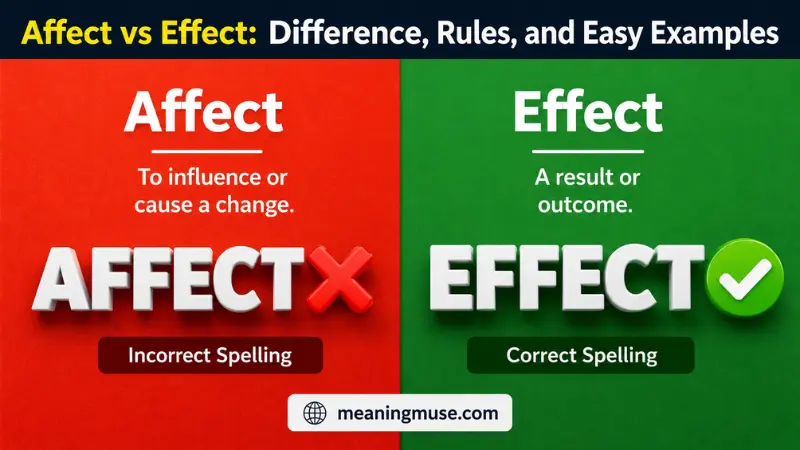
Affect is a verb meaning to influence or change something.
Effect is a noun meaning a result, outcome, or consequence.
Compare:
- The cold weather affected the game.
- The cold weather had an effect on the game.
The first sentence describes an action. The second names the result of that action.
Quick Answer
Use affect when you mean to influence or change something.
Use effect when you mean a result, outcome, or consequence.
- The loud noise affected my sleep.
- The loud noise had a negative effect on my sleep.
Remember this simple rule:
Affect = Action
Effect = End result
This rule works in most everyday writing.
Affect vs Effect at a Glance
| Situation | Correct Word | Meaning | Example |
|---|---|---|---|
| Something influences another thing | Affect | To influence or change | Rain may affect the game. |
| You are naming a result | Effect | A result or consequence | Rain had an effect on attendance. |
| Someone brings about a change | Effect | To create or accomplish | The campaign hopes to effect change. |
| You are describing visible emotion | Affect | Observable emotional expression | The patient displayed a calm affect. |
The first two uses are the ones most writers need. The other two are correct but much less common.
What Does Affect Mean?
Affect is usually a verb. It means to influence, change, or make a difference to someone or something.
Examples of Affect
- Hot weather can affect your energy.
- The delay will affect our plans.
- Music can affect your mood.
- Screen time may affect a child’s sleep.
- The new rule affects every student.
- Her kind words deeply affected me.
In each sentence, one thing influences another.
A useful test is to replace affect with influence or change.
- The storm affected traffic.
- The storm influenced traffic.
- The storm changed traffic conditions.
Because the replacement makes sense, affect is correct.
What Does Effect Mean?
Effect is usually a noun. It means a result, outcome, consequence, or impression produced by an action or event.
Examples of Effect
- The medicine had a calming effect.
- The storm had little effect on the town.
- Lack of sleep can have a negative effect on memory.
- The new policy had an immediate effect.
- Exercise has many positive effects.
- The lighting created a warm effect.
In these sentences, effect names what happened because of something else.
Try replacing it with result, outcome, or consequence.
- The new schedule had a positive effect.
- The new schedule had a positive result.
Because result fits naturally, effect is correct.
Why Are Affect and Effect Confusing?
Affect and effect are commonly confused for three reasons.
First, their spellings are almost identical. Only the first letter changes.
Second, they sound very similar in normal conversation. When spoken quickly, the difference may be difficult to hear.
Third, both words have less common meanings that reverse the usual verb-and-noun pattern. Effect can sometimes be a verb, while affect can sometimes be a noun.
For most schoolwork, emails, articles, and everyday communication, remember:
- Affect is usually an action.
- Effect is usually a result.
How to Pronounce Affect and Effect
When affect is used as a verb, it is commonly pronounced uh-FEKT.
Effect is commonly pronounced ih-FEKT.
The stress falls on the second syllable in both words, which is why they can sound nearly identical.
The pronunciation changes when affect is used as a psychology-related noun. In that specialized use, it is generally pronounced AF-ekt, with the stress on the first syllable.
Because pronunciation alone may not reveal the correct spelling, focus on the word’s function in the sentence.
Ask:
- Is something influencing something else?
- Am I naming a result?
The Easiest Way to Remember Affect vs Effect
Use the A–E rule:
- Affect is usually an action.
- Effect is usually the end result.
You can also remember this sentence:
The action affects something and creates an effect.
For example:
Heavy rain affected the roads. The main effect was slow traffic.
The rain performed the action, so affected is the verb. Slow traffic was the result, so effect is the noun.
When to Use Affect
Choose affect when something influences, changes, or has an emotional impact on someone or something.
Affecting a Person
- The sad story affected him deeply.
- Her teacher’s advice affected her decision.
- The loss affected the entire family.
- The news may affect how voters respond.
Affecting an Object or System
- Heat can affect battery life.
- A broken pipe may affect water pressure.
- The update should not affect your saved files.
- Dust can affect the machine’s performance.
Affecting a Situation
- Traffic could affect our arrival time.
- The price increase will affect many customers.
- Weather may affect tomorrow’s event.
- Staffing shortages could affect the schedule.
In each sentence, something acts on or influences something else.
When to Use Effect
Choose effect when you are naming a result, consequence, impression, or change caused by something.
Naming a Result
- The treatment had a positive effect.
- The speech had a strong effect on the audience.
- The mistake had no effect on the final score.
- The new routine had an immediate effect.
Naming a Consequence
- One effect of the storm was a power outage.
- Stress can have harmful effects on the body.
- The rule produced several unexpected effects.
- Rising prices can have a serious effect on families.
Naming an Impression
- The candles created a peaceful effect.
- The designer used mirrors to create a spacious effect.
- The movie used sound effects to build suspense.
- The soft lighting produced a welcoming effect.
In these examples, effect names a thing, result, or impression, so it functions as a noun.
Affect or Effect Before “On”?
The correct phrase is usually effect on.
- The weather had an effect on attendance.
- Noise can have an effect on concentration.
- The policy may have an effect on small businesses.
Here, effect is a noun naming a result or influence.
The verb affect takes its object directly. It does not normally require on after it.
- The weather affected attendance.
- Noise affects concentration.
- The policy may affect small businesses.
Incorrect:
- The weather affected on attendance.
- Noise affects on concentration.
Use one of these two correct structures:
Something affects someone or something.
Something has an effect on someone or something.
Common Phrases With Affect and Effect
| Phrase | Correct Word | Example |
|---|---|---|
| have an effect on | Effect | Diet can have an effect on your health. |
| take effect | Effect | The new rule takes effect Monday. |
| side effect | Effect | Drowsiness is a possible side effect. |
| cause and effect | Effect | The class studied cause and effect. |
| special effects | Effect | The movie included impressive special effects. |
| personal effects | Effect | She collected her personal effects. |
| affected by | Affect | The town was affected by flooding. |
| negatively affect | Affect | Stress can negatively affect sleep. |
| directly affect | Affect | The change will directly affect workers. |
| deeply affected | Affect | He was deeply affected by the news. |
Learning these common expressions can make the correct choice feel automatic.
Is It “Take Affect” or “Take Effect”?
The correct phrase is take effect.
It means to begin working, operating, or producing a result.
- The medicine should take effect soon.
- The new policy takes effect on August 1.
- The changes will take effect next month.
- The law has already taken effect.
Incorrect:
- The medicine should take affect.
- The new policy takes affect tomorrow.
Because the phrase refers to something beginning to produce a result, it requires effect.
Is It “Affect Change” or “Effect Change”?
Both expressions can be grammatically correct, but they do not mean the same thing.
Effect Change
Effect change means to create, accomplish, or bring about change.
- The organization hopes to effect change in the community.
- New leadership may effect meaningful change.
- The reforms were designed to effect change throughout the system.
In these examples, effect is a verb meaning to make something happen.
Affect Change
Affect change means to influence a change, its development, or its outcome.
- Public comments may affect the proposed change.
- Funding problems could affect the planned changes.
- The election may affect how the policy changes.
Use effect change when you mean create change.
Use affect a change when you mean influence that change.
Affect as a Noun
Although affect is normally a verb, it can also function as a noun in psychology, psychiatry, and clinical writing.
As a noun, affect refers to a person’s observable emotional expression, including facial expressions, tone of voice, gestures, and behavior.
- The patient displayed a flat affect.
- Her cheerful affect helped the children feel comfortable.
- His speech was calm, but his affect appeared anxious.
A flat affect means that a person shows little visible emotional expression.
This use is specialized and rarely appears in ordinary conversation. Most writers will use affect as a verb.
Effect as a Verb
Although effect is usually a noun, it can also function as a verb.
As a verb, effect means to cause, create, accomplish, or bring something about.
- The new manager effected several important changes.
- The negotiations effected a peaceful settlement.
- The reforms effected major improvements.
- The organization wants to effect lasting change.
This use is correct but relatively formal. In everyday writing, words such as create, cause, produce, or bring about may sound more natural.
Affected vs Effected
The difference between affected and effected follows the same general rule.
Affected
Affected usually means influenced, changed, or emotionally moved.
- The storm affected several homes.
- Her decision affected the entire team.
- Rising costs affected our budget.
- He was deeply affected by the loss.
Effected
Effected means created, accomplished, or brought about.
- The new director effected major reforms.
- The negotiations effected a peaceful agreement.
- The program effected meaningful change.
- The new process effected a complete transformation.
Use this replacement test:
- If influenced fits, use affected.
- If created or brought about fits, use effected.
Common Affect vs Effect Mistakes
Using Affect for a Result
Incorrect:
The new schedule had a positive affect.
Correct:
The new schedule had a positive effect.
The sentence names a result, so effect is correct.
Using Effect for Influence
Incorrect:
The weather may effect our plans.
Correct:
The weather may affect our plans.
The weather is influencing the plans, not creating them.
Writing Affect After Have
A form of have often appears before the noun effect.
Correct combinations include:
- has an effect
- had an effect
- will have an effect
- may have an effect
Example:
The decision will have an effect on everyone.
Writing “Affect On”
Incorrect:
The delay will affect on our trip.
Correct:
The delay will affect our trip.
Also correct:
The delay will have an effect on our trip.
Treating Them as Spelling Variants
Affect and effect are not American and British spellings of the same word. They are separate words with different meanings and grammatical functions.
The same basic distinction applies in both American and British English.
Affect vs Effect in Everyday Sentences
Weather
- Snow may affect the morning commute.
- One effect of the snow was a two-hour delay.
School
- Missing class can affect your grade.
- Extra study time had a positive effect on her score.
Health
- Lack of sleep affects your ability to focus.
- One effect of poor sleep is low energy.
Work
- The new schedule will affect all employees.
- The schedule change had little effect on productivity.
Technology
- The update should not affect your saved photos.
- The update had a positive effect on battery life.
Emotions
- The movie affected me deeply.
- The movie had a powerful effect on the audience.
Business
- Higher costs may affect customer demand.
- The price increase had an immediate effect on sales.
How to Choose the Correct Word in Three Steps
Step 1: Identify the Word’s Job
Ask whether the word describes an action or names a result.
- Action or influence: usually affect
- Result or outcome: usually effect
Step 2: Try a Replacement Word
Replace the word with influence.
Will the delay influence our plans?
The sentence makes sense, so use affect:
Will the delay affect our plans?
Now try result:
The result of the delay was confusion.
Because result fits, use effect:
The effect of the delay was confusion.
Step 3: Check for an Exception
Ask whether the sentence uses one of the less common meanings:
- To bring something about: use the verb effect
- Observable emotional expression: use the noun affect
These exceptions are valid, but they appear much less often than the standard uses.
Practice Questions
Choose affect or effect for each sentence.
- The new rule will _____ every student.
- The medicine had no _____ on my headache.
- Noise can _____ your ability to focus.
- The mayor hopes to _____ change.
- The storm’s strongest _____ was flooding.
- The delay could _____ our travel plans.
- The policy had an unexpected _____ on small businesses.
- The new director _____ several major reforms.
Answers
- affect
- effect
- affect
- effect
- effect
- affect
- effect
- effected
FAQs
What Is the Main Difference Between Affect and Effect?
Affect is usually a verb meaning to influence or change something. Effect is usually a noun meaning the result, outcome, or consequence of an action.
For example, a storm may affect travel, while flight cancellations may be an effect of the storm.
Is Affect Always a Verb?
No. Affect is usually a verb, but it can also be a noun in psychology and clinical writing. As a noun, it refers to a person’s observable emotional expression.
For most everyday sentences, however, affect functions as a verb.
Is Effect Always a Noun?
No. Effect is usually a noun, but it can also be a verb meaning to create, accomplish, or bring something about.
For example:
The organization hopes to effect change.
This means the organization hopes to make change happen.
Is It “Affect Me” or “Effect Me”?
Use affect me when you mean influence me.
The decision will affect me.
The phrase effect me is extremely unusual in ordinary writing because the verb effect means to create or bring something about.
Is It “Negative Affect” or “Negative Effect”?
In everyday writing, negative effect means a harmful or unwanted result.
Stress can have a negative effect on sleep.
Negative affect is a specialized psychology term connected with unpleasant emotions, moods, or emotional expression
Which Is Correct: “Side Affect” or “Side Effect”?
Side effect is correct.
A side effect is an additional result caused by a medicine, treatment, decision, or action.
Drowsiness is a common side effect of the medication.
Is It “Cause and Affect” or “Cause and Effect”?
The correct phrase is cause and effect.
A cause is the reason something happens, while an effect is the result.
The lesson explained the relationship between cause and effect.
Can Affect and Effect Be Used in the Same Sentence?
Yes. Using both words in one sentence can make the difference especially clear.
The new law affected local businesses, but its long-term effects are still unknown.
Here, affected describes the action, while effects names the results.
Final Answer
Use affect when you mean to influence or change something.
The weather may affect our plans.
Use effect when you mean a result, outcome, or consequence.
The weather had an effect on our plans.
Remember:
Affect is usually an action.
Effect is usually the end result.
The two main exceptions are effect as a verb meaning to bring something about and affect as a noun referring to observable emotional expression. Once you understand the action-versus-result rule, choosing between affect and effect becomes much easier.