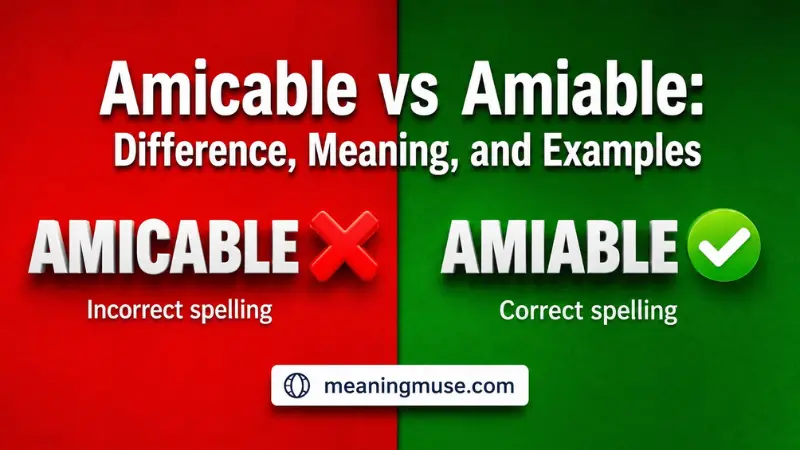
Amicable and amiable are both correct English words, but they are not interchangeable.
Use amiable to describe a person who is friendly, pleasant, and easy to like. Use amicable to describe a relationship, agreement, discussion, or situation that is peaceful and free from hostility.
Consider this example:
The amiable manager helped the employees reach an amicable agreement.
Here, amiable describes the manager’s pleasant personality, while amicable describes the peaceful agreement.
Quick Answer
Amiable usually describes a friendly or pleasant person.
- She is an amiable neighbor.
- We spoke with an amiable host.
Amicable usually describes a peaceful relationship, agreement, discussion, separation, or settlement.
- They reached an amicable settlement.
- The couple had an amicable divorce.
A simple way to remember the difference is:
Amiable person. Amicable relationship.
Amicable vs Amiable at a Glance
| Word | Main Meaning | Commonly Describes | Example |
|---|---|---|---|
| Amiable | Friendly, pleasant, and easy to like | A person, personality, manner, or smile | Our new teacher is amiable. |
| Amicable | Peaceful, civil, and free from hostility | A relationship, agreement, discussion, or settlement | They reached an amicable agreement. |
Both words are adjectives, and both are connected with friendliness. However, they express friendliness in different ways.
Amiable focuses on someone’s personality.
Amicable focuses on how people interact or resolve a situation.
Why Are Amicable and Amiable Confusing?
People often confuse amicable and amiable because the words look similar, sound somewhat similar, and share a general connection with friendliness.
However, their usual applications are different.
An amiable person is naturally friendly, warm, or pleasant.
An amicable situation is peaceful because the people involved are cooperating or avoiding conflict.
Compare these examples:
- Our new supervisor is amiable.
- Our supervisor maintains an amicable relationship with the staff.
The first sentence describes the supervisor’s personality. The second describes the peaceful relationship between the supervisor and the employees.
Neither word is a misspelling. They are separate words with different common uses.
What Does Amiable Mean?
Amiable means friendly, pleasant, good-natured, or easy to like.
It most often describes a person or a personal quality.
An amiable person generally behaves in a warm, polite, and approachable way. Other people usually feel comfortable talking to or spending time with that person.
Common combinations include:
- amiable person
- amiable teacher
- amiable host
- amiable neighbor
- amiable coworker
- amiable personality
- amiable manner
- amiable smile
Examples of Amiable
- Our new receptionist is amiable and helpful.
- Marcus has an amiable personality.
- The amiable nurse helped the patient feel comfortable.
- She welcomed the guests with an amiable smile.
- Everyone enjoyed talking with the amiable shop owner.
- His amiable manner made the interview feel relaxed.
In each example, amiable describes a person or a quality that reflects someone’s friendly nature.
What Does Amicable Mean?
Amicable means peaceful, civil, cooperative, or marked by goodwill.
It commonly describes a situation involving two or more people, groups, businesses, or organizations.
The people involved do not have to be close friends. They may even disagree. The situation is amicable when they remain respectful, avoid hostility, and handle the matter peacefully.
Common combinations include:
- amicable agreement
- amicable settlement
- amicable divorce
- amicable separation
- amicable relationship
- amicable discussion
- amicable solution
- amicable negotiations
- amicable terms
- amicable relations
Examples of Amicable
- The companies reached an amicable agreement.
- Their marriage ended in an amicable divorce.
- The neighbors found an amicable solution to the parking problem.
- The meeting remained amicable despite several disagreements.
- The former business partners separated on amicable terms.
- Both sides hoped for an amicable settlement.
In these examples, amicable describes peaceful interactions, relationships, or outcomes.
Amiable Pronunciation
Amiable is commonly pronounced:
AY-mee-uh-buhl
The first syllable sounds like the name of the letter A.
Say it in parts:
AY + mee + uh + buhl
Amicable Pronunciation
Amicable is commonly pronounced:
AM-ih-kuh-buhl
The first syllable sounds like the beginning of am.
Say it in parts:
AM + ih + kuh + buhl
The different opening sounds can help you distinguish the two words while speaking:
- Amiable: AY-mee-uh-buhl
- Amicable: AM-ih-kuh-buhl
Are Amicable and Amiable Interchangeable?
Amicable and amiable are usually not interchangeable.
They both suggest friendliness, but they focus on different things.
Use amiable for someone’s personality:
- Mrs. Garcia is an amiable teacher.
Use amicable for the way people relate to one another:
- Mrs. Garcia has an amicable relationship with the parents.
The first sentence explains what Mrs. Garcia is like as a person. The second explains how she and the parents interact.
Some overlap is possible when describing a mood, tone, or conversation. However, the emphasis may change.
Compare:
- The conversation had an amiable tone.
- The discussion remained amicable.
An amiable tone sounds warm and pleasant. An amicable discussion is peaceful and nonhostile, especially when disagreement is possible.
Which Word Should You Use?
Ask yourself one question:
Am I describing a person’s personality or a peaceful interaction?
Use Amiable for a Friendly Person
Choose amiable when describing someone who is pleasant, sociable, approachable, or easy to like.
- Daniel is an amiable employee who welcomes new team members.
- The amiable doctor helped the nervous child relax.
- Our new neighbor seems friendly and amiable.
In these sentences, the word describes someone’s character or behavior.
Use Amicable for a Peaceful Interaction
Choose amicable when people deal with one another calmly and respectfully.
- The two companies reached an amicable agreement.
- The discussion ended on amicable terms.
- Both families wanted an amicable solution.
The word describes the interaction or outcome, not one person’s personality.
Use Amicable When Conflict Was Possible
Amicable is especially useful when a dispute, breakup, disagreement, or negotiation could have become hostile.
- Their divorce was difficult but remained amicable.
- The landlord and tenant reached an amicable settlement.
- The partners ended the business relationship on amicable terms.
An amicable outcome does not mean everyone was happy. It means the people handled the situation without unnecessary hostility.
Use Amiable for Personal Warmth
Amiable often suggests natural friendliness or warmth.
- The amiable waiter patiently answered our questions.
- Her amiable personality made new students feel welcome.
- The interviewer was professional but amiable.
The focus is on the individual’s pleasant nature.
Common Incorrect Uses
Choosing the wrong word may not completely hide your meaning, but it can make the sentence sound unnatural or imprecise.
Amicable Person
Less natural:
The amicable cashier helped me find the correct aisle.
Better:
The amiable cashier helped me find the correct aisle.
The sentence describes the cashier’s friendly personality or manner, so amiable is the more natural choice.
Amiable Agreement
Less natural:
The two sides signed an amiable agreement.
Better:
The two sides signed an amicable agreement.
An agreement reached peacefully is normally described as amicable.
Amiable Divorce
Less natural:
They had an amiable divorce.
Better:
They had an amicable divorce.
A divorce is a situation involving two people, so amicable is the standard choice.
Amicable Personality
Less natural:
Her amicable personality made everyone feel welcome.
Better:
Her amiable personality made everyone feel welcome.
The sentence describes her personal nature, so amiable fits better.
Common Mistakes and How to Fix Them
Treating Them as Alternate Spellings
Amicable and amiable are not two spellings of the same word.
They are separate adjectives with different common uses.
Quick fix: Decide whether you are describing a person or an interaction.
Using Amiable for Every Friendly Situation
Amiable does not fit every sentence that contains a friendly or peaceful idea.
Incorrect:
The lawsuit ended with an amiable settlement.
Correct:
The lawsuit ended with an amicable settlement.
A settlement involves two or more sides reaching a peaceful result.
Using Amicable for Someone’s Personality
Incorrect:
Our new coach is calm and amicable.
Better:
Our new coach is calm and amiable.
Use amiable when describing a person’s friendly character.
Assuming Amicable Means Close Friendship
An amicable relationship does not have to be close, affectionate, or loving.
Two people may strongly disagree but still remain amicable. They simply continue to treat each other respectfully and avoid open hostility.
For example:
The former partners are not friends, but their relationship remains amicable.
Forgetting the Pronunciation Difference
The words begin with different sounds:
- Amiable begins with an AY sound.
- Amicable begins with an AM sound.
Remembering the pronunciation may make the words easier to recognize and use correctly.
Examples of Amiable in Sentences
- The amiable waiter answered all our questions.
- Jordan has an amiable nature and makes friends easily.
- Our new principal seems calm and amiable.
- The amiable nurse reassured the frightened patient.
- Everyone enjoyed speaking with the amiable host.
- She greeted the visitors with an amiable smile.
- His amiable manner helped the children relax.
- The shop owner remained amiable throughout the conversation.
- We appreciated the guide’s patient and amiable personality.
- The interviewer was formal but surprisingly amiable.
These sentences describe friendly people or qualities that reflect personal warmth.
Examples of Amicable in Sentences
- The neighbors found an amicable solution to the noise problem.
- Their marriage ended in an amicable divorce.
- Both companies agreed to an amicable settlement.
- The meeting remained amicable even when opinions differed.
- The former partners still have an amicable relationship.
- The manager hoped for an amicable end to the dispute.
- The two teams separated on amicable terms.
- Negotiations were difficult but remained amicable.
- The landlord and tenant reached an amicable agreement.
- The countries continued to maintain amicable relations.
These examples describe peaceful interactions, decisions, relationships, and outcomes.
Examples Using Both Words
Using both words in one sentence makes the difference especially clear.
- The amiable lawyer helped the clients reach an amicable settlement.
- Our amiable manager kept the discussion calm and amicable.
- The amiable neighbors found an amicable way to share the driveway.
- An amiable mediator can make difficult negotiations more amicable.
- The amiable counselor helped the couple plan an amicable separation.
- An amiable representative encouraged both companies to reach an amicable agreement.
In each sentence, amiable describes a person, while amicable describes the interaction or result.
Easy Memory Tricks
Use these memory clues to keep the words separate.
Amiable Means Easy to Like
Both amiable and like contain the letter i.
This can remind you that an amiable person is easy to like.
Amicable Means Calm During Conflict
The c in amicable can remind you of calm and conflict.
An amicable outcome stays calm even when conflict is possible.
You can also memorize this sentence:
An amiable person looks for an amicable solution.
Grammar and Word Forms
Both amiable and amicable are adjectives.
They describe nouns:
- an amiable teacher
- an amicable discussion
- an amiable personality
- an amicable settlement
They can also appear after linking verbs:
- The teacher seems amiable.
- The negotiations remained amicable.
Adverb Forms
The adverb form of amiable is amiably.
- She smiled amiably at the visitors.
The adverb form of amicable is amicably.
- The two companies settled the dispute amicably.
Noun Forms
The common noun related to amiable is amiability.
- His amiability made him popular with the staff.
The noun amicability may be used for the quality of being amicable, although it is less common in everyday writing.
- The amicability of the negotiations surprised both sides.
In most situations, a more natural sentence would use amicable or amicably instead.
Synonyms and Antonyms
Synonyms for Amiable
Depending on the sentence, synonyms for amiable include:
- friendly
- pleasant
- good-natured
- sociable
- likable
- agreeable
- warm
- genial
- approachable
Antonyms for Amiable
- unfriendly
- rude
- unpleasant
- cold
- disagreeable
- ill-tempered
- unapproachable
Synonyms for Amicable
Depending on the context, synonyms for amicable include:
- peaceful
- civil
- cooperative
- harmonious
- friendly
- agreeable
- nonhostile
- respectful
Antonyms for Amicable
- hostile
- bitter
- combative
- confrontational
- unfriendly
- angry
- antagonistic
- contentious
The best synonym depends on what the sentence describes. Pleasant often works for amiable, while peaceful or civil often works for amicable.
Common Phrases With Amiable
- amiable person
- amiable host
- amiable neighbor
- amiable teacher
- amiable personality
- amiable manner
- amiable smile
- amiable companion
- amiable employee
- amiable expression
Common Phrases With Amicable
- amicable agreement
- amicable settlement
- amicable divorce
- amicable separation
- amicable relationship
- amicable discussion
- amicable solution
- amicable negotiations
- amicable terms
- amicable relations
US and UK Usage
There is no major American-versus-British spelling difference between amicable and amiable.
Both words are used in American English and British English. The same general distinction applies in both varieties:
- Amiable usually describes a friendly person or pleasant personal quality.
- Amicable usually describes peaceful relations, agreements, discussions, and outcomes.
Choose the word according to its meaning, not according to the country in which you are writing.
Word Origin
Amiable and amicable have related origins connected with friendship, affection, and goodwill. This shared background explains why both words carry a positive or friendly sense.
Over time, their common uses developed differently.
Amiable became closely associated with a person who is pleasant and easy to like.
Amicable became closely associated with peaceful relationships, negotiations, agreements, and resolutions.
Their related history explains why they seem similar, but it does not make them interchangeable.
FAQs
What is the main difference between amicable and amiable?
Amiable usually describes a friendly, pleasant, or good-natured person. Amicable usually describes a peaceful relationship, agreement, discussion, separation, or settlement. For example, an amiable employee may help coworkers reach an amicable solution.
Are amicable and amiable the same word?
No. They are two separate adjectives. They have related meanings, but they are not alternate spellings. Amiable focuses mainly on someone’s pleasant personality, while amicable focuses on peaceful interactions or outcomes
Can you call a person amicable?
The meaning may be understood, but amiable is normally the clearer and more natural word for a friendly person. Use amicable for that person’s relationships, discussions, agreements, or dealings with others
Is a friendly divorce amiable or amicable?
Use amicable divorce. The phrase describes a separation handled peacefully and without unnecessary hostility. It does not mean the divorce was happy or enjoyable.
Is it an amiable relationship or an amicable relationship?
Amicable relationship is usually the better choice. It means the people involved treat each other peacefully and with goodwill. Amiable more commonly describes an individual’s friendly nature.
Can a conversation be amiable?
Yes. An amiable conversation may be warm, friendly, and pleasant. An amicable discussion places greater emphasis on civility and the absence of conflict, particularly when the participants might disagree.
What is the adverb form of amicable?
The adverb form is amicably.
Example:
The two parties resolved the dispute amicably.
What is the adverb form of amiable?
The adverb form is amiably.
Example:
She smiled amiably and welcomed us inside.
Do American and British writers use different forms?
No major regional difference applies. Both American and British writers use amicable and amiable. The correct choice depends on the intended meaning rather than the location of the writer.
Conclusion
Amicable and amiable are both correct adjectives, but they describe different kinds of friendliness.
Use amiable for a person who is friendly, pleasant, approachable, or easy to like.
Use amicable for a relationship, agreement, discussion, separation, or settlement that is peaceful and free from hostility.
Remember this example:
An amiable person can help create an amicable outcome.
That sentence provides a simple and reliable way to understand the difference between amicable vs amiable and choose the correct word.