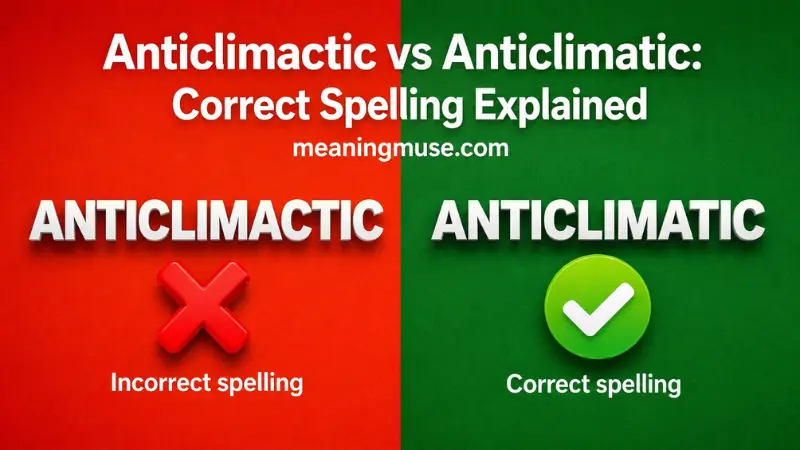
Anticlimactic is the correct spelling. Anticlimatic is a common misspelling that should be avoided in standard English.
The word anticlimactic describes an ending, result, or experience that feels less exciting, dramatic, or important than expected. It is especially useful when a strong buildup leads to a weak or ordinary conclusion.
For example, a movie may build toward a huge final battle, only for the conflict to end with a brief conversation. That ending may feel anticlimactic because it does not match the excitement created earlier.
The spelling can be confusing because anticlimactic contains two nearby c letters. Some writers accidentally remove the second one and write anticlimatic. However, there is no American-versus-British spelling difference. Standard US and UK English both use anticlimactic.
This guide explains the correct spelling, meaning, pronunciation, word forms, common mistakes, and practical examples.
Quick Answer
Anticlimactic is the correct spelling.
Anticlimatic is a misspelling and should be corrected in standard writing.
Correct: The final episode felt anticlimactic.
Incorrect: The final episode felt anticlimatic.
The word comes from anticlimax, which is an ending or result that feels less exciting or important than the events leading up to it.
A helpful spelling pattern is:
anti + climactic = anticlimactic
Why People Confuse Anticlimactic and Anticlimatic
The correct spelling is longer than many people expect. It contains the full adjective climactic after the prefix anti-:
anti + climactic
Writers sometimes confuse climactic with climatic, a real word related to climate and weather. This confusion can lead to the incorrect spelling anticlimatic.
However, an anticlimactic event has nothing to do with weather or climate. It relates to a climax, which is the most exciting, dramatic, or important point in a story, event, or experience.
Pronunciation can also cause confusion. In normal conversation, the middle of the word may be spoken quickly, making it difficult to hear every consonant clearly.
The word is pronounced approximately:
an-tee-kly-MAK-tik
Because the middle sounds are close together, writers may accidentally leave out one of the c letters.
Key Differences at a Glance
| Context | Correct Choice | Explanation |
|---|---|---|
| Standard American English | Anticlimactic | The accepted spelling |
| Standard British English | Anticlimactic | The spelling is the same |
| Academic writing | Anticlimactic | Follows standard dictionary spelling |
| Business writing | Anticlimactic | The correct professional form |
| Reviews and commentary | Anticlimactic | Describes a disappointing result or ending |
| Anticlimatic | Correct it | Not the standard spelling for this meaning |
Compact Comparison
- Anticlimactic: Correct adjective
- Anticlimatic: Common spelling error
- Meaning: Less exciting, dramatic, or important than expected
- US spelling: Anticlimactic
- UK spelling: Anticlimactic
- Related noun: Anticlimax
Are Anticlimactic and Anticlimatic the Same Word?
They are not two accepted spellings of the same word.
Anticlimactic is the standard English word. Anticlimatic is usually an incorrect attempt to spell it without the second c.
The adjective anticlimactic describes something connected with an anticlimax.
An anticlimax occurs when excitement, tension, or expectation builds, but the final result feels weak, ordinary, or disappointing.
Consider this example:
A school announces that it will reveal a major surprise at the end of the month. Students expect a concert, a special trip, or a famous guest. On the final day, the surprise turns out to be a new hallway sign.
The announcement may feel anticlimactic because the buildup was much more exciting than the result.
The word does not necessarily mean that something was terrible. It mainly shows that the outcome felt smaller or less dramatic than people expected.
What Does Anticlimactic Mean?
Anticlimactic means less exciting, dramatic, satisfying, or important than expected, especially after a strong buildup.
It often describes a situation in which expectations rise but the final result fails to match them.
Example:
After months of advertising, the product launch felt anticlimactic.
The launch may not have been completely unsuccessful. However, it did not deliver the excitement people expected.
The word commonly describes:
- Endings
- Conclusions
- Finales
- Announcements
- Reveals
- Victories
- Results
- Ceremonies
- Events
- Experiences
Anticlimactic vs Anticlimatic in US and UK English
There is no meaningful regional difference between these spellings.
American English uses anticlimactic.
British English also uses anticlimactic.
Therefore, anticlimatic is not a British alternative to an American spelling. It is also not an accepted house-style variation.
This pair differs from regional spelling pairs such as color and colour. Those are both correct in different varieties of English.
With anticlimactic and anticlimatic, the choice is based on correctness rather than location.
American English:
The ending was anticlimactic.
British English:
The ending was anticlimactic.
The spelling remains the same in both varieties.
Which Spelling Should You Use?
Always use anticlimactic when describing something that feels disappointing or underwhelming after a strong buildup.
The word frequently appears before nouns such as:
- Anticlimactic ending
- Anticlimactic finale
- Anticlimactic result
- Anticlimactic finish
- Anticlimactic conclusion
- Anticlimactic moment
- Anticlimactic event
- Anticlimactic announcement
- Anticlimactic reveal
- Anticlimactic victory
Examples
The mystery had an anticlimactic ending.
After weeks of excitement, the announcement felt anticlimactic.
The game ended in an anticlimactic way.
The final reveal was surprisingly anticlimactic.
You can also use the word after linking verbs such as feel, seem, become, and sound.
The final result felt anticlimactic.
The big reveal seemed anticlimactic.
Ending the story that way would be anticlimactic.
The announcement sounded anticlimactic after such a dramatic introduction.
Why Anticlimatic Looks Correct
The incorrect spelling anticlimatic looks believable because climatic is a real English word.
However, climatic and climactic have different meanings.
Climatic
Climatic relates to climate, long-term weather conditions, or environmental patterns.
Examples:
The region has difficult climatic conditions.
Scientists are studying long-term climatic changes.
The plants cannot survive in these climatic conditions.
Climactic
Climactic relates to a climax, which is the most dramatic or important point of an event or story.
Examples:
The climactic battle lasted twenty minutes.
The novel ends with a climactic confrontation.
The climactic scene reveals the villain’s identity.
Anticlimactic
Anticlimactic describes an ending or result that fails to deliver the expected climax.
Examples:
The movie’s final scene was anticlimactic.
The competition ended with an anticlimactic withdrawal.
The difference becomes clearer when the words appear together:
The storm resulted from unusual climatic conditions.
The hero won during the movie’s climactic battle.
The villain’s quick surrender made the ending anticlimactic.
Climatic, Climactic, and Anticlimactic
| Word | Meaning | Example |
| Climatic | Related to climate or weather patterns | The area has harsh climatic conditions. |
| Climactic | Related to the most dramatic or important point | The climactic scene ends the conflict. |
| Anticlimactic | Disappointing after a strong buildup | The final scene felt anticlimactic. |
| Anticlimatic | Nonstandard misspelling | Correct it to anticlimactic. |
A useful memory rule is:
- Climate → climatic
- Climax → climactic
- Anticlimax → anticlimactic
Common Mistakes and Quick Fixes
Dropping the Second C
Incorrect:
The final scene was anticlimatic.
Correct:
The final scene was anticlimactic.
Quick fix: Look for the complete word climactic inside anticlimactic.
Treating the Spellings as Regional Variants
Some writers assume that anticlimatic may be the British spelling.
It is not.
Quick fix: Use anticlimactic in both American and British English.
Confusing Climatic and Climactic
Climatic relates to climate.
The desert has harsh climatic conditions.
Climactic relates to a climax.
The movie’s climactic battle resolved the conflict.
Anticlimactic describes an outcome that feels weak after a buildup.
The villain’s immediate surrender was anticlimactic.
Quick fix: Connect climactic with climax, not climate.
Using Anticlimax as an Adjective
Incorrect:
The ending was anticlimax.
Correct:
The ending was anticlimactic.
Anticlimax is a noun. Anticlimactic is an adjective.
Noun: The ending was an anticlimax.
Adjective: The ending was anticlimactic.
Using Anticlimactic for Any Bad Experience
An experience is not anticlimactic simply because it is unpleasant, frustrating, or unsuccessful.
The word normally requires a contrast between strong expectations and a weaker result.
Not necessarily anticlimactic:
The flight delay was annoying.
This sentence describes an unpleasant situation, but it does not show a buildup followed by a disappointing outcome.
Correct use:
After months of planning, the five-minute ceremony felt anticlimactic.
The sentence works because the brief ceremony did not match the excitement and effort that came before it.
Using Anticlimactic When There Was No Buildup
An ordinary disappointing result is not always anticlimactic. Readers should be able to understand what created the expectation.
Weak use:
The sandwich was anticlimactic.
This sentence lacks context.
Clearer use:
After hearing people praise the restaurant for weeks, I found the sandwich anticlimactic.
The added context explains the expectation and disappointment.
Everyday Examples of Anticlimactic
Movies and Television
The movie’s final battle was surprisingly anticlimactic.
Many viewers found the final episode anticlimactic.
The villain’s quick defeat made the ending feel anticlimactic.
After such a strong story, the final reveal was anticlimactic.
The mystery ended with an anticlimactic explanation.
The season finale felt anticlimactic after months of suspense.
Sports
The championship ended with an anticlimactic penalty.
After an exciting season, the easy victory felt anticlimactic.
The match had an anticlimactic finish because heavy rain stopped play.
Winning by default was an anticlimactic way to secure the title.
The star player’s early withdrawal created an anticlimactic final.
The tournament ended in an anticlimactic draw.
School and Work
The award announcement was anticlimactic because everyone already knew the winner.
After weeks of preparation, the short meeting felt anticlimactic.
The project ended with an anticlimactic email.
Receiving the results online made the moment feel anticlimactic.
The presentation’s conclusion was anticlimactic after such a strong opening.
The long-awaited promotion announcement felt strangely anticlimactic.
Everyday Life
Opening the large box was anticlimactic because it was almost empty.
The surprise party felt anticlimactic when the guest arrived early.
Our long trip ended with an anticlimactic visit to a closed store.
The big announcement turned out to be anticlimactic.
After waiting for hours, the brief fireworks display was anticlimactic.
Reaching the viewpoint felt anticlimactic because fog covered the entire landscape.
How to Use Anticlimactic Naturally
The word works best when the sentence shows both the expectation and the disappointing result.
With “After”
After months of promotion, the announcement felt anticlimactic.
After a dramatic chase, the villain’s quiet surrender was anticlimactic.
With “Because”
The ending was anticlimactic because the conflict was resolved too easily.
The award ceremony felt anticlimactic because the winner had already been announced.
With “Despite”
Despite the intense buildup, the final scene was anticlimactic.
Despite weeks of preparation, the event had an anticlimactic conclusion.
With Contrast
The opening was exciting, but the ending was anticlimactic.
The season created high expectations, yet the finale felt anticlimactic.
Dictionary-Style Word Details
Part of Speech
Anticlimactic is an adjective.
It modifies a noun or describes the condition of a subject.
Before a noun:
The story had an anticlimactic ending.
After a linking verb:
The ending felt anticlimactic.
Noun Form
The related noun is anticlimax.
An anticlimax is a disappointing or less important ending after a strong buildup.
Examples:
The final announcement was an anticlimax.
The competition ended in an anticlimax.
The villain’s sudden surrender created an anticlimax.
Do not use anticlimactic as a noun.
Incorrect:
The final scene was an anticlimactic.
Correct:
The final scene was an anticlimax.
Adverb Form
The adverb is anticlimactically, although it is less common in everyday writing.
Example:
The story ended anticlimactically when the main conflict disappeared without explanation.
In most situations, a more natural sentence uses the adjective:
The story had an anticlimactic ending.
Verb Form
Anticlimactic is not normally used as a verb.
Use a verb phrase instead:
The weak ending disappointed the audience.
The final scene reduced the tension.
The quick resolution weakened the conclusion.
Synonyms
Possible alternatives include:
- Disappointing
- Underwhelming
- Flat
- Dull
- Uneventful
- Unexciting
- Unsatisfying
- Weak
- Deflating
- Lackluster
These words are not always exact replacements.
For example, dull simply means boring. Anticlimactic more specifically suggests that the result failed to match earlier excitement or expectations.
Antonyms
Possible opposite ideas include:
- Climactic
- Exciting
- Dramatic
- Thrilling
- Satisfying
- Memorable
- Impressive
- Powerful
Example:
The climactic battle was exciting, but the final conversation felt anticlimactic.
More Example Sentences
The long mystery ended with an anticlimactic answer.
Winning by default felt anticlimactic.
The speech had an anticlimactic conclusion.
After all the advertising, the event was anticlimactic.
The final challenge seemed too easy and anticlimactic.
The concert ended anticlimactically when the power failed before the last song.
The reunion felt anticlimactic because several important guests did not attend.
The investigation reached an anticlimactic conclusion.
The highly promoted update contained only minor changes, making the launch feel anticlimactic.
The ceremony was pleasant but anticlimactic after months of preparation.
The treasure chest contained ordinary supplies, creating an anticlimactic ending.
The long negotiation ended with an anticlimactic compromise.
Incorrect and Correct Examples
Incorrect: The ending was anticlimatic.
Correct: The ending was anticlimactic.
Incorrect: It was an anticlimatic result.
Correct: It was an anticlimactic result.
Incorrect: The finale was an anticlimactic.
Correct: The finale was an anticlimax.
Incorrect: The weather created anticlimactic conditions.
Correct: The weather created unusual climatic conditions.
Incorrect: The climatic battle ended the movie.
Correct: The climactic battle ended the movie.
Word History
Anticlimactic is connected with the words anticlimax, climax, and climactic.
A climax is the highest, most intense, or most important point in a sequence of events. In a story, it is often the moment when the central conflict reaches its greatest intensity.
An anticlimax occurs when the expected high point is replaced by something weaker, less important, or less exciting.
The adjective follows this relationship:
climax → climactic
anticlimax → anticlimactic
The incorrect spelling anticlimatic likely appears because writers confuse climactic with climatic or overlook one of the nearby c letters.
The word does not have separate standard American and British spellings.
Common Phrases With Anticlimactic
Common phrases include:
- Anticlimactic ending
- Anticlimactic finish
- Anticlimactic conclusion
- Anticlimactic finale
- Anticlimactic result
- Anticlimactic moment
- Anticlimactic reveal
- Anticlimactic victory
- Anticlimactic announcement
- Anticlimactic experience
- Anticlimactic resolution
- Anticlimactic outcome
Examples
The story reached an anticlimactic conclusion.
It was an anticlimactic victory because the opposing team withdrew.
The highly promoted reveal felt anticlimactic.
The investigation had an anticlimactic resolution.
The long-awaited announcement produced an anticlimactic result.
How to Remember the Correct Spelling
The easiest method is to keep the complete word climactic inside anticlimactic:
anti + climactic = anticlimactic
You can also remember this word family:
- Climax
- Climactic
- Anticlimax
- Anticlimactic
Do not connect the word with climate or climatic.
Another memory sentence is:
An anticlimax creates an anticlimactic ending.
Both words keep the climact- pattern.
FAQs
Is Anticlimactic or Anticlimatic Correct?
Anticlimactic is the correct spelling. Anticlimatic is a common spelling mistake and should be avoided in standard English.
What Does Anticlimactic Mean?
Anticlimactic describes an ending, event, or result that feels less exciting, dramatic, or important than expected. It usually follows a strong buildup.
Example: The movie had an anticlimactic ending.
Is Anticlimatic a Real Word?
Anticlimatic is not the accepted standard spelling for something related to an anticlimax. It is usually created by leaving out the second c in anticlimactic.
Is Anticlimactic the Same in US and UK English?
Yes. Both American and British English use anticlimactic. There is no regional spelling difference between the two forms.
How Do You Pronounce Anticlimactic?
The word is pronounced approximately an-tee-kly-MAK-tik. The middle of the word may be spoken quickly, which is one reason the spelling can be confusing.
What Is the Difference Between Climatic and Climactic?
Climatic relates to climate or weather conditions.
The region has difficult climatic conditions.
Climactic relates to the most exciting or important point of an event or story.
The climactic battle ended the movie.
Anticlimactic describes a result that feels disappointing after an exciting buildup.
What Is the Noun Form of Anticlimactic?
The related noun is anticlimax.
Noun: The final announcement was an anticlimax.
Adjective: The final announcement was anticlimactic.
Can Anticlimactic Describe a Person?
The word normally describes an event, ending, result, announcement, or experience rather than a person’s personality.
However, a person’s action can create an anticlimactic result.
Example: His brief speech made the ceremony feel anticlimactic.
Can Something Be Anticlimactic but Still Good?
Yes. Something can be pleasant or enjoyable while still feeling anticlimactic. The word only indicates that the result did not match the excitement or expectations created beforehand.
Is Underwhelming the Same as Anticlimactic?
The words are similar, but they are not always identical. Underwhelming means less impressive than expected. Anticlimactic usually emphasizes a weak result after a noticeable buildup.
How Can I Remember the Correct Spelling?
Keep the full word climactic inside it:
anti + climactic = anticlimactic
This pattern will help you remember both c letters.
Conclusion
Anticlimactic is the correct spelling. Anticlimatic is a common misspelling and should be corrected in standard writing.
Use anticlimactic for an ending, result, announcement, or experience that feels less exciting or important than expected after a strong buildup.
Remember the simple structure:
anti + climactic = anticlimactic
Keeping the complete word climactic inside anticlimactic will help you spell it correctly every time.