Analyse and analyze are two correct spellings of the same verb. Both mean to examine something carefully so you can understand its meaning, structure, causes, parts, or results.
The difference is regional:
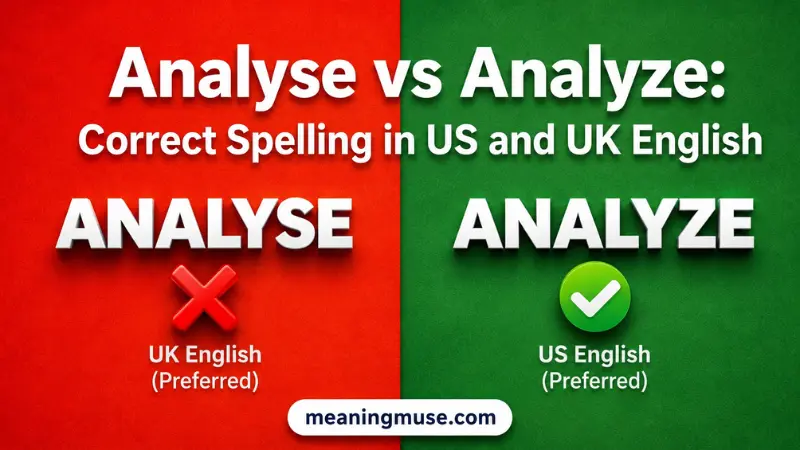
- Analyze is the standard spelling in American English.
- Analyse is the usual spelling in British English.
The spelling does not change the meaning, pronunciation, tone, or level of formality. Your choice should match the variety of English you are using.
For a United States audience, analyze is the best choice. British writers generally use analyse.
Quick Answer
Use analyze in American English.
Use analyse in British English.
Both words mean to examine something carefully and in detail.
- American English: Analyze
- British English: Analyse
- Meaning: The same
- Pronunciation: The same
- Part of speech: Verb
- US recommendation: Use analyze
The related noun is analysis in both American and British English.
Analyse vs Analyze at a Glance
| Point | Analyse | Analyze |
|---|---|---|
| Regional use | British English | American English |
| Meaning | Examine carefully | Examine carefully |
| Pronunciation | The same | The same |
| Part of speech | Verb | Verb |
| Past tense | Analysed | Analyzed |
| Present participle | Analysing | Analyzing |
| Third-person form | Analyses | Analyzes |
| Related noun | Analysis | Analysis |
| Best choice for US readers | No | Yes |
| Best choice for UK readers | Yes | Usually no |
The only meaningful difference is regional spelling.
Are Analyse and Analyze the Same Word?
Yes. Analyse and analyze are spelling variants of the same verb.
Both words describe the act of studying something closely. The purpose may be to understand how it works, what it means, why it happened, or what conclusions can be drawn from it.
People may analyse or analyze:
- Data
- Evidence
- Research findings
- Test results
- Problems
- Poems
- Stories
- Behavior
- Business performance
- Scientific samples
- Market trends
- Financial reports
The action remains the same regardless of the spelling.
A US-based company will normally analyze customer data. A British organization will usually analyse the same type of information. Neither spelling describes a deeper, more formal, or more technical process.
What Does Analyze Mean?
Analyze is the standard American English spelling.
It means to examine something carefully by considering its parts, details, causes, relationships, or results.
American writers commonly use analyze in:
- School assignments
- Academic papers
- Scientific reports
- Business documents
- Professional emails
- News articles
- Website content
- Technical instructions
- Research reports
Examples of common American usage include analyzing survey results, analyzing a literary character, analyzing market performance, and analyzing scientific evidence.
For content written primarily for readers in the United States, analyze is the safest and most natural spelling.
What Does Analyse Mean?
Analyse is the standard British English spelling of the same verb.
It has the same meaning as analyze and is commonly used in:
- British schools
- UK universities
- British publications
- Government documents
- Professional writing
- Business communication
- General British English
Analyse is not a different action. It does not imply a more detailed or more formal examination.
It simply follows British spelling conventions.
American English Forms of Analyze
In American English, the verb forms are:
- Base form: Analyze
- Third-person singular: Analyzes
- Past tense: Analyzed
- Past participle: Analyzed
- Present participle: Analyzing
Examples:
- Researchers analyze the results carefully.
- The software analyzes customer behavior.
- The team analyzed last month’s performance.
- Scientists are analyzing the sample.
- The report has analyzed several possible causes.
These forms consistently use the letter z.
British English Forms of Analyse
In British English, the verb forms are:
- Base form: Analyse
- Third-person singular: Analyses
- Past tense: Analysed
- Past participle: Analysed
- Present participle: Analysing
Examples:
- Researchers analyse the results carefully.
- The software analyses customer behaviour.
- The team analysed last month’s performance.
- Scientists are analysing the sample.
- The report has analysed several possible causes.
These forms consistently use the letter s.
Which Spelling Should You Use?
Choose the spelling that matches your audience and required writing style.
Use Analyze for an American Audience
Use analyze when writing for:
- US websites
- American schools
- US universities
- American companies
- US publications
- American clients
- General US readers
If your website targets readers in the United States, analyze is the correct choice.
Use Analyse for a British Audience
Use analyse when writing for:
- UK websites
- British schools
- UK universities
- British companies
- British publications
- General UK readers
British editors may change analyze to analyse when a document follows standard British spelling.
Follow the Required Style
Your location does not always determine the spelling.
A British writer producing content for an American company should normally use analyze. An American writer working for a British publisher may be expected to use analyse.
The audience, organization, publisher, or style guide should determine the final choice.
Why People Confuse Analyse and Analyze
The words are easy to confuse because they differ by only one letter.
Analyse contains an s, while analyze contains a z.
Online readers may encounter both forms because websites, books, social posts, and publications use different regional standards. Someone may read an American article using analyze and then see analyse in a British publication.
The related words analysis, analyses, and analyzes create additional confusion because their spellings and grammatical roles differ.
Analysis vs Analyse vs Analyze
These words are related, but they do not serve the same grammatical function.
Analysis
Analysis is a noun.
It refers to the process or result of examining something carefully.
Correct:
- The report includes a detailed analysis.
- Her analysis identified several weaknesses.
- We completed an analysis of the data.
Analysis is used in both American and British English.
Analyze
Analyze is the American verb.
It describes the action of examining something.
Correct in American English:
- We need to analyze the results.
- The researcher analyzed the evidence.
Analyse
Analyse is the British verb.
It performs the same function as analyze.
Correct in British English:
- We need to analyse the results.
- The researcher analysed the evidence.
The basic rule is:
- Analysis: Noun
- Analyze: American verb
- Analyse: British verb
Analyses vs Analyzes
Analyses and analyzes look similar, but their meanings and uses may differ.
Analyses as a Plural Noun
Analyses is the plural form of analysis in both American and British English.
- One analysis
- Two analyses
- Several analyses
The report may contain several analyses of the same issue.
Analyses as a British Verb
In British English, analyses can also be the third-person singular form of analyse.
It is used with subjects such as he, she, it, the program, or the company.
The surrounding sentence shows whether analyses is functioning as a plural noun or a verb.
Analyzes as an American Verb
In American English, analyzes is the third-person singular form of analyze.
It is always a verb.
The key distinction is:
- Analyses: Plural noun in both varieties or British verb
- Analyzes: American verb
Do Analyse and Analyze Have the Same Pronunciation?
Yes. Analyse and analyze are normally pronounced the same way.
The pronunciation sounds approximately like:
AN-uh-lyze
The final syllable rhymes with eyes.
The spelling difference does not create a different pronunciation.
Is One Spelling More Formal?
No. Analyse is not more formal than analyze, and analyze is not more modern or more technical than analyse.
Both words can appear in casual, professional, academic, literary, scientific, and technical writing.
The choice depends on regional spelling rather than formality.
What About Canadian English?
Canadian English uses a mixture of British and American spelling patterns.
Both analyse and analyze may appear in Canadian writing, depending on the publication, school, company, or style guide.
Canadian writers should follow the required house style rather than assuming that one form is always correct.
Consistency remains more important than personal preference.
What About Australian English?
Australian English generally follows British spelling conventions, so analyse is normally preferred.
Common Australian forms include:
- Analyse
- Analyses
- Analysed
- Analysing
However, organizations may follow their own editorial rules. Writers should check the required style before submitting formal work.
What About Oxford Spelling?
Oxford spelling uses z in many verbs that other British styles write with s. For example, Oxford-style writing may prefer organize instead of organise.
However, analyse is generally treated as an exception.
Oxford-style British writing normally retains:
- Analyse
- Analysed
- Analysing
Writers should not assume that every British -ise verb changes to -ize under Oxford spelling.
Can You Mix Analyse and Analyze?
You should not mix the two spellings in ordinary original writing.
A document that switches between analyse, analyze, analysed, and analyzing may look careless or poorly edited.
For American English, use the complete American set:
- Analyze
- Analyzes
- Analyzed
- Analyzing
For British English, use the complete British set:
- Analyse
- Analyses
- Analysed
- Analysing
Choose one system and apply it consistently throughout the article, report, email, or assignment.
When Mixed Spelling Is Acceptable
Mixed spelling may be acceptable when preserving original material.
Do not change spelling inside:
- Direct quotations
- Book titles
- Article titles
- Company names
- Product names
- Official document titles
- Published research titles
- Legal names
A quotation from a British source may contain analyse even when the rest of an American article uses analyze.
Preserving the original wording is more important than forcing every quoted term to match your preferred spelling.
When One Spelling Looks Wrong
A spelling can be correct English but still look inappropriate in a specific document.
Analyse may appear unusual in an American school assignment, business report, or website. A US spelling checker may flag it because the document is set to American English.
Similarly, analyze may be changed by a British editor when a document is expected to follow UK spelling.
The word is not universally wrong. It is simply inconsistent with the chosen regional style.
Common Mistakes and Corrections
Mistake 1: Believing the Meanings Are Different
Incorrect idea:
Analyse means a deeper examination than analyze.
Correction:
Both spellings have exactly the same meaning. Choose according to regional English, not the depth of the examination.
Mistake 2: Using Analyse as a Noun
Incorrect:
We completed an analyse of the problem.
Correct:
We completed an analysis of the problem.
Neither analyse nor analyze is the standard noun. The noun is always analysis.
Mistake 3: Spelling Analysis With a Z
Incorrect:
Her analyzis was detailed.
Correct:
Her analysis was detailed.
The noun analysis uses s in both American and British English.
Mistake 4: Mixing Regional Verb Forms
Inconsistent:
The team analysed the first report and is now analyzing the second.
Consistent American style:
The team analyzed the first report and is now analyzing the second.
Consistent British style:
The team analysed the first report and is now analysing the second.
Mistake 5: Confusing Analyses With Analyzes
Remember:
- Analyses may be a plural noun.
- Analyses may also be a British verb.
- Analyzes is an American verb.
The sentence structure and regional style reveal the correct meaning.
Mistake 6: Changing Spelling Inside a Quotation
Do not silently replace analyse with analyze inside a direct quotation from a British writer.
Quotations should preserve their original spelling unless an editorial note clearly explains the change.
Mistake 7: Choosing Based on Personal Location Only
A writer living in the United Kingdom may still need analyze when producing content for an American audience.
The target reader and required style are more important than the writer’s location.
Examples of Analyze in American English
- Doctors analyze test results before making a diagnosis.
- Students analyze the main character’s decisions.
- The marketing team analyzed customer feedback.
- Scientists are analyzing water samples.
- Managers should analyze the problem before proposing a solution.
- The program analyzes user activity.
- Researchers analyzed several possible causes.
- The coach analyzed the team’s performance.
- Investors analyze financial reports before making decisions.
- The article analyzes changes in consumer behavior.
Examples of Analyse in British English
- Doctors analyse test results before making a diagnosis.
- Students analyse the main character’s decisions.
- The marketing team analysed customer feedback.
- Scientists are analysing water samples.
- Managers should analyse the problem before proposing a solution.
- The program analyses user activity.
- Researchers analysed several possible causes.
- The coach analysed the team’s performance.
- Investors analyse financial reports before making decisions.
- The article analyses changes in consumer behaviour.
Synonyms for Analyse and Analyze
Both spellings share the same synonyms.
Possible alternatives include:
- Examine
- Study
- Evaluate
- Investigate
- Inspect
- Assess
- Review
- Explore
- Break down
- Interpret
- Consider
- Scrutinize
These words are related, but they are not always exact replacements.
For example, review may simply mean looking over something. Analyze usually suggests a more detailed examination of parts, causes, patterns, or relationships.
Scrutinize emphasizes especially close inspection. Evaluate focuses more strongly on judging quality, value, or performance.
Common Phrases With Analyze
American English commonly uses:
- Analyze data
- Analyze results
- Analyze evidence
- Analyze a problem
- Analyze a poem
- Analyze performance
- Analyze behavior
- Analyze a sample
- Analyze the situation
- Analyze customer feedback
- Analyze market trends
- Analyze research findings
Common Phrases With Analyse
British English commonly uses:
- Analyse data
- Analyse results
- Analyse evidence
- Analyse a problem
- Analyse a poem
- Analyse performance
- Analyse behaviour
- Analyse a sample
- Analyse the situation
- Analyse customer feedback
- Analyse market trends
- Analyse research findings
The phrases have the same meaning. Only the regional spelling changes.
Dictionary-Style Word Details
Analyse
Part of speech: Verb
Meaning: To examine something carefully to understand its parts, meaning, causes, or results.
Regional use: Mainly British English
Word forms:
- Analyse
- Analyses
- Analysed
- Analysing
Analyze
Part of speech: Verb
Meaning: To examine something carefully to understand its parts, meaning, causes, or results.
Regional use: American English
Word forms:
- Analyze
- Analyzes
- Analyzed
- Analyzing
Analysis
Part of speech: Noun
Meaning: A detailed examination or the result of examining something.
Regional use: American and British English
Plural form: Analyses
FAQs
Is Analyse or Analyze Correct?
Both spellings are correct. Use analyze in American English and analyse in British English. The meaning and pronunciation remain the same.
Which Spelling Should Americans Use?
Americans should normally use analyze. It is the standard spelling in US schoolwork, business writing, publications, websites, and professional communication.
Is Analyse Wrong in American English?
Analyse is a valid British spelling, but it may look incorrect or inconsistent in an American document. For a US audience, analyze is the preferred form.
Do Analyse and Analyze Mean the Same Thing?
Yes. Both mean to examine something carefully to understand its details, parts, causes, meaning, or results.
Are Analyse and Analyze Pronounced Differently?
No. Both spellings normally have the same pronunciation. The final syllable rhymes with eyes.
Is It Analysis or Analyze?
Use analysis as a noun and analyze as an American verb.
Analysis names the examination. Analyze describes the action of examining.
Is Analyses a Noun or Verb?
It can be either. Analyses is the plural noun form of analysis in both American and British English. It is also a third-person singular verb in British English.
Is Analyzes a Correct Word?
Yes. Analyzes is the American third-person singular form of analyze. It is used with subjects such as he, she, it, the program, or the company.
Should Canadian Writers Use Analyse or Analyze?
Both forms may appear in Canadian English. Canadian writers should follow the spelling required by their school, employer, publisher, or style guide.
Which Spelling Is Better for a US Website?
Analyze is the better choice for a US website because it matches standard American English and looks natural to American readers.
Can I Use Analyse and Analyze in the Same Article?
Avoid mixing them in your original writing. Choose one regional style and use it consistently. Different spellings may remain inside direct quotations or official names.
Is Analyse More Formal Than Analyze?
No. Neither spelling is more formal. They are regional variants with the same meaning and grammatical function.
Conclusion
Analyse and analyze are both correct spellings of the same verb.
Use analyze in American English and analyse in British English. Both mean to examine something carefully to understand its details, structure, causes, meaning, or results.
The pronunciation and meaning do not change. Only the regional spelling differs.
For a United States audience, use these forms consistently:
- Analyze
- Analyzes
- Analyzed
- Analyzing
For a British audience, use:
- Analyse
- Analyses
- Analysed
- Analysing
The easiest rule to remember is:
Use analyze for American readers and analyse for British readers.