Consists in or of is a common English usage question. The two phrases look very similar, but they are not simply interchangeable.
The basic difference is easy to remember:
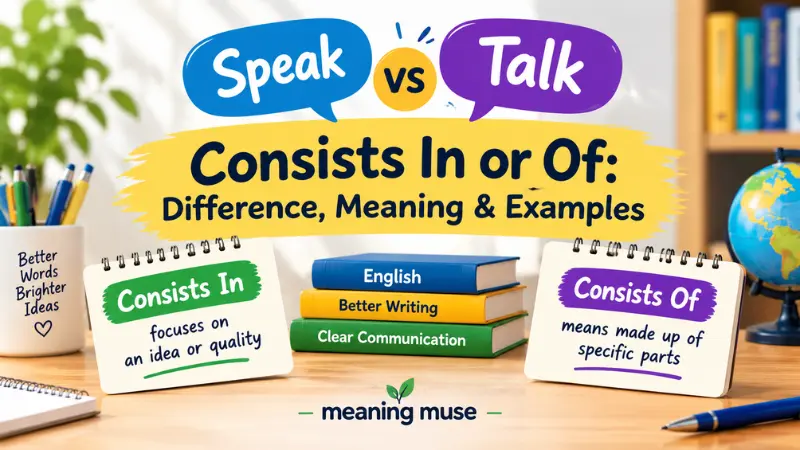
- consists of = is made up of parts, people, things, or activities
- consists in = has something as its main, essential, or defining quality
In everyday American English, consists of is much more common. Consists in is correct in certain contexts, but it is more formal and less common.
For example:
The class consists of 20 students.
But:
True leadership consists in serving others.
The first sentence names the parts that make up the class. The second describes the essential nature of leadership.
Quick Answer
If you are talking about the parts or members that make up something, use consists of.
The team consists of five players.
If you are talking about the main quality, basis, or essential nature of something, consists in can be correct.
Happiness consists in finding meaning in everyday life.
For most normal US-English writing, consists of will be the phrase you need when you are listing components.
A quick test helps:
Can you replace the phrase with “is made up of”?
If yes, use consists of.
The meal consists of rice, chicken, and vegetables.
= The meal is made up of rice, chicken, and vegetables.
If you mean “lies in,” “is found in,” or “has its essential quality in,” then consists in may fit.
The value of the lesson consists in its practical use.
Why People Confuse Them
The confusion happens because both phrases come from the same verb: consist.
The prepositions of and in create different constructions.
With consists of, the subject is the whole thing, and what follows identifies its parts.
The box consists of six books.
The box is the whole. The six books are the parts.
With consists in, what follows describes the central quality or basis of the subject.
The beauty of the design consists in its simplicity.
The sentence is not saying that the beauty is physically made from “simplicity.” It says simplicity is the key quality that gives the design its beauty.
This is why simply choosing of or in based on whether a noun is physical or abstract is not a reliable rule. The meaning of the complete sentence matters.
Key Differences At A Glance
| Context | Best Choice | Why |
|---|---|---|
| A group is made up of people | consists of | Names the members |
| A meal has several ingredients | consists of | Names the components |
| A book has several chapters | consists of | Names the parts |
| An idea has an essential quality | consists in | Describes its basis or essence |
| A quality lies in something | consists in | Points to the defining feature |
| Everyday US writing | Usually consists of | It is the more natural general choice |
A Simple Comparison
- Consists of: What is it made up of?
- Consists in: What does its essential nature lie in?
That distinction is more useful than trying to memorize a long grammar rule.
Are They the Same Word?
Yes, both expressions use the same verb, consist, but they form different constructions.
They should not be treated as two spellings of the same phrase.
Consists of means that something is formed from particular parts, people, things, or activities.
The course consists of eight lessons.
Consists in means that something has a particular quality, feature, action, or idea as its main or essential part.
The challenge consists in finding a practical solution.
Both are established English constructions. The important difference is meaning and usage, not spelling.
Pronunciation does not normally cause the confusion. The verb consist is pronounced the same in these two expressions; the difference comes from the preposition and the meaning of the sentence.
US vs UK Preference
The distinction is not a simple American-English spelling versus British-English spelling issue.
Both American and British English use consists of and consists in.
The bigger difference is frequency and style.
Consists of is common in everyday writing and speech. It works naturally in business writing, school writing, descriptions, reports, and ordinary conversation.
Consists in is much less common. It is more likely to appear in formal, philosophical, literary, or abstract writing.
For an American reader, a sentence such as:
The committee consists of seven members.
sounds completely natural.
A sentence such as:
The committee consists in seven members.
does not use the normal construction for listing members.
However, consists in is not automatically wrong. It can be correct when the intended meaning is about an essential quality or basis.
The strength of the plan consists in its simplicity.
So the safe lesson is not “never use consists in.” The better lesson is use it only when its special meaning fits the sentence.
Which Spelling Should You Use?
Technically, neither phrase is a different spelling of the other. The real choice is between two uses of consist.
For most US-English situations, use consists of when you mean “is made up of.”
Examples:
The apartment consists of two bedrooms and one bathroom.
The package consists of three separate items.
The team consists of experienced engineers.
The report consists of five sections.
Use consists in when you mean something closer to “lies in” or “has its essential quality in.”
Examples:
The value of the program consists in its flexibility.
The real difficulty consists in choosing the right option.
Her strength consists in staying calm under pressure.
If you are unsure, ask what you are trying to say. If you are listing the parts, people, or activities that form something, consists of is usually the right answer.
When One Spelling Looks Wrong
A phrase can look wrong when the preposition does not match the intended meaning.
Example 1
❌ The committee consists in six members.
This is not the normal way to say that six people make up the committee.
✅ The committee consists of six members.
Example 2
❌ The beauty of the painting consists of its simplicity.
If the intended meaning is that simplicity is the essential quality creating the beauty, consists in can be more precise.
✅ The beauty of the painting consists in its simplicity.
Example 3
❌ The meal consists in chicken, rice, and vegetables.
When you are naming ingredients, use consists of.
✅ The meal consists of chicken, rice, and vegetables.
Example 4
The difficulty consists in understanding the instructions.
Here, the difficulty is not made up of physical parts. The sentence explains where the difficulty lies.
This is a good situation for consists in.
Common Mistakes (and Quick Fixes)
Mistake 1: Using “consists in” for a list
❌ The course consists in six units.
✅ The course consists of six units.
Use of when the following words identify the components or sections.
Mistake 2: Thinking “in” is always wrong
❌ Consists in is always incorrect.
That statement is too strong.
Consists in is an established construction. It is simply less common and has a more specific use.
Mistake 3: Treating them as spelling variants
❌ Consists in and consists of are two spellings of the same phrase.
They are not spelling variants. The difference is the preposition and the meaning created by the construction.
Mistake 4: Using “consisted of” incorrectly with “is”
A common mistake is:
❌ The team is consisted of five players.
Use:
✅ The team consists of five players.
Or:
✅ The team is made up of five players.
Do not add is before consisted of in this construction.
Mistake 5: Using “consists of” when explaining an essential quality
Sometimes writers use consists of because it is much more familiar.
For example:
The value of the plan consists of its flexibility.
If the intended meaning is “the value lies in its flexibility,” consists in may express the idea more clearly.
Everyday Examples
Here are practical examples that show the difference.
Examples with “consists of”
The breakfast consists of eggs, toast, and fruit.
The team consists of twelve employees.
The course consists of four short units.
The machine consists of several moving parts.
The report consists of three main sections.
The package consists of a charger, cable, and instruction guide.
The meeting will consist of two short presentations.
These sentences identify the parts, people, or activities that make up the whole.
Examples with “consists in”
The real challenge consists in staying focused.
The value of the method consists in its simplicity.
The problem consists in finding enough time.
The strength of the argument consists in its clear evidence.
Much of the enjoyment consists in learning something new.
These sentences point to an essential feature, basis, or central idea.
Dictionary-Style Word Details
Verb
- Consists of: A verb construction meaning that something is made up of particular people, things, parts, or activities.
- Consists in: A verb construction meaning that something has a particular quality, basis, or essential feature.
Both use the verb consist.
Noun
- Consists of: Not a noun. It is the third-person singular form of the verb consist followed by of.
- Consists in: Not a noun. It is the third-person singular form of the verb consist followed by in.
The noun consist exists in specialized usage, especially in railroad terminology, but that is separate from the expressions discussed here.
Synonyms
For consists of, useful closest plain alternatives include:
- is made up of
- is composed of
- contains
- comprises
The exact substitute depends on the sentence.
For consists in, useful closest plain alternatives can include:
- lies in
- is found in
- is based on
- has its essential quality in
These are not exact replacements in every sentence, but they can help explain the intended meaning.
Example Sentences
Consists of:
The library consists of three floors.
The project consists of several small tasks.
Consists in:
The main benefit consists in saving time.
The beauty of the design consists in its simplicity.
The first group identifies components. The second group identifies an important quality or basis.
Word History
The verb consist comes from Latin consistere, meaning roughly “to stand together” or “stand firm.”
The two modern constructions developed different uses around the same verb. Modern dictionaries continue to recognize both consist of and consist in, with different meanings.
For practical US writing, the important point is not the history. It is knowing when the sentence describes components and when it describes an essential quality or basis.
Phrases Containing
Common phrases with consist of include:
- consist mainly of
- consist largely of
- consist entirely of
- consist mostly of
- consist of several parts
- consist of two sections
- consist of a group of people
Common phrases with consist in include:
- consist in its simplicity
- consist in being
- consist in finding
- consist in the fact that
- consist in the ability to
- consist in the quality of
The consist of patterns are much more common in ordinary modern writing.
FAQs
Is it “consists in” or “consists of”?
Both are correct, but they are used differently. Use consists of when something is made up of particular parts, people, or things. Use consists in when an essential quality or main feature lies in something.
What does “consists of” mean?
Consists of means “is made up of” or “is formed from.” For example, “The team consists of ten players” means ten players make up the team.
What does “consists in” mean?
Consists in means that something has its main or essential quality, value, or basis in something else. For example, “The value consists in its simplicity” means the value lies in its simplicity.
Is “consists in” correct in American English?
Yes. Consists in is a valid English construction, including in American English. However, it is less common in everyday writing than consists of and often has a more formal or abstract tone.
Is “consists of” more common than “consists in”?
Yes. Consists of is the usual choice when describing the parts or members that make up something. Consists in has a narrower use related to an essential quality, basis, or feature.
Can I use “consists in” and “consists of” interchangeably?
No. They can express different ideas. Consists of focuses on what makes up something, while consists in focuses on where an essential quality or basis lies.
Which is correct: “The team consists in five players” or “The team consists of five players”?
The correct sentence is “The team consists of five players.” The sentence identifies the people who make up the team, so consists of is the appropriate construction.
Which is correct: “The difficulty consists in finding a solution”?
Yes. “The difficulty consists in finding a solution” is grammatically correct because the sentence explains where the difficulty lies.
Is “consists of” the same as “is made up of”?
In many sentences, yes. Consists of and is made up of can often express the same basic idea when describing the parts that form a whole.
What is the easiest way to remember the difference?
Remember this simple rule:
Consists of = made up of.
Consists in = essential quality or basis lies in.
If you are listing parts, people, ingredients, or sections, consists of is usually the right choice.
Conclusion
The choice between consists in and consists of depends on what you mean.
Use consists of when you mean “is made up of.”
The team consists of ten players.
Use consists in when you mean that something’s essential quality, basis, or main feature lies in something.
The value of the lesson consists in its practical use.
For most everyday US-English writing, consists of is the natural choice when you are naming parts, members, ingredients, sections, or activities. Consists in is still correct in the right context, but it is less common and more formal.
The easiest question to remember is:
Are you naming the parts? Use “consists of.”
Are you explaining where the essential quality lies? “Consists in” may be the right choice.