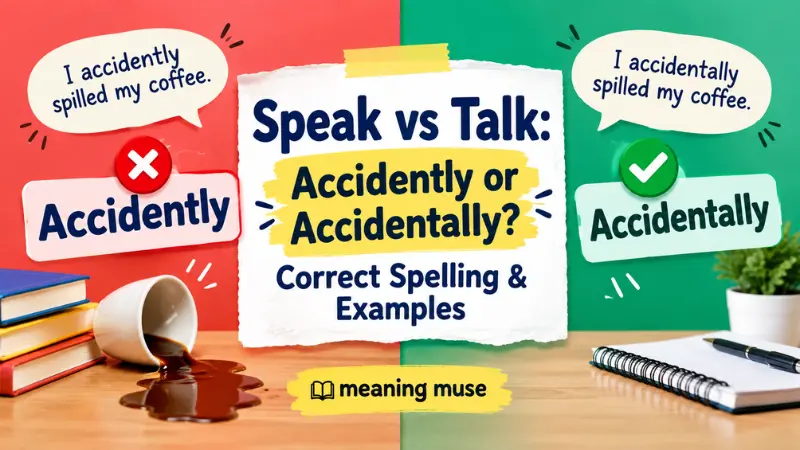
Many English learners wonder whether the correct spelling is accidently or accidentally.
The correct spelling in modern standard English is:
Accidentally ✅
The spelling accidently is generally considered a misspelling because it leaves out the second “a” in the ending -ally.
For example:
✅ She accidentally deleted the file.
❌ She accidently deleted the file.
The word accidentally means something happened by mistake, without intention, or without planning.
Quick Answer
Accidentally is the correct spelling.
It means something happened unintentionally or by chance.
Example:
- I accidentally spilled my coffee.
- He accidentally sent the message to the wrong person.
Accidently is a common spelling mistake and is not the standard form used in modern English.
Accidently vs Accidentally at a Glance
| Context | Best Choice | Why |
|---|---|---|
| Something happens by mistake | Accidentally | Standard English spelling |
| Writing formal messages | Accidentally | Accepted spelling |
| School or professional writing | Accidentally | Correct dictionary form |
| Casual typing mistakes | Accidently | Common misspelling |
| Describing an unintended action | Accidentally | Correct adverb form |
Why Do People Confuse Accidently and Accidentally?
The confusion happens because many English adverbs are created by adding -ly to adjectives.
For example:
- quick → quickly
- careful → carefully
- happy → happily
Since the adjective is accidental, some people remove part of the ending and write:
accidental + ly = accidently
However, the correct spelling keeps the full ending:
accidental + ly = accidentally
The extra a before “ly” is part of the correct spelling.
Is Accidently a Correct Spelling?
No. In standard modern English, accidently is not considered the correct spelling.
It is usually a spelling error caused by dropping the second “a.”
For example:
Incorrect:
I accidently forgot my appointment.
Correct:
I accidentally forgot my appointment.
The meaning is understandable, but the spelling should be corrected in careful writing.
Is Accidentally the Correct Word?
Yes.
Accidentally is the standard adverb form of the adjective accidental.
It describes something that happens:
- unintentionally
- unexpectedly
- by mistake
- without planning
Examples:
She accidentally broke the glass.
They accidentally arrived at the wrong location.
I accidentally clicked the wrong button.
In each sentence, the action was not planned.
Are Accidently and Accidentally the Same Word?
They are not two accepted spellings of the same word.
Accidentally is the standard spelling.
Accidently is a nonstandard spelling caused by a common spelling mistake.
Unlike some English spelling differences, such as color and colour, this pair does not represent a regional preference.
The difference is simply correct spelling versus an incorrect form.
US vs UK Preference
American English and British English both use:
Accidentally
There is no major US and UK spelling difference for this word.
Examples:
American English:
She accidentally left her keys inside the car.
British English:
She accidentally left her keys inside the car.
The spelling remains the same.
Which Spelling Should You Use?
Always choose:
Accidentally
Use it in:
- emails
- school assignments
- articles
- business writing
- professional communication
Examples:
The mistake happened accidentally.
He accidentally deleted the important document.
The package was accidentally delivered to the wrong address.
Avoid using:
accidently
because readers may recognize it as a spelling error.
When Accidently Looks Wrong
The spelling accidently often looks incorrect because the word comes from accidental.
The adjective already contains the ending:
accidental
When we turn it into an adverb, we keep that structure:
accidental + ly
accidentally
Removing the second “a” changes the accepted spelling pattern.
Common Mistakes and Quick Fixes
Mistake 1: Removing the second “a”
Wrong:
He accidently called his boss.
Right:
He accidentally called his boss.
Mistake 2: Thinking shorter spelling is easier
Some writers remove letters because the pronunciation feels shorter.
However, spelling does not always follow sound.
Mistake 3: Using accidently in formal writing
A quick spelling check can prevent this mistake in important documents.
Everyday Examples of Accidentally
Here are natural examples using the correct spelling:
I accidentally locked myself out of the house.
She accidentally deleted her photos.
He accidentally spilled water on the laptop.
We accidentally chose the wrong road.
The child accidentally dropped the toy.
I accidentally sent the email too early.
They accidentally revealed the surprise.
The door accidentally opened.
These sentences all describe actions that were not intentional.
Dictionary-Style Word Details
Verb
Accidentally is not a verb. It is an adverb.
It describes how an action happens.
Example:
She accidentally touched the hot pan.
The verb is touched.
The adverb accidentally explains that the action was not planned.
Accidently: Not a standard adverb form.
Noun
Accidentally is not a noun.
The related noun is:
Accident
Examples:
The accident happened yesterday.
The car accident caused traffic delays.
Accidently: Does not function as a noun.
Synonyms
Useful alternatives for accidentally include:
- unintentionally
- by mistake
- unknowingly
- unintentionally done
Examples:
I accidentally deleted the file.
I unintentionally deleted the file.
These alternatives have similar meanings.
Example Sentences
Correct:
She accidentally dropped her phone.
The message was accidentally sent to the wrong person.
He accidentally walked into the wrong room.
Incorrect:
She accidently dropped her phone.
The message was accidently sent.
The second examples contain the common spelling mistake.
Word History
The word comes from the adjective accidental, which relates to something happening by chance rather than by intention.
The spelling accidentally follows the normal pattern of forming an adverb from an adjective ending in -al.
The shortened form accidently is a spelling error rather than an established alternative spelling.
Phrases Containing
Common phrases with accidentally include:
- accidentally deleted
- accidentally clicked
- accidentally broken
- accidentally revealed
- accidentally discovered
- accidentally shared
- accidentally created
- accidentally sent
These phrases describe actions that happened without intention.
Accidentally vs Intentionally
The opposite meaning of accidentally is intentionally.
Compare:
She accidentally broke the vase.
She did not mean to break it.
She intentionally broke the vase.
She chose to break it.
Other opposite ideas include:
- deliberately
- purposely
- knowingly
- deliberately planned
Accidentally vs Accidentally Made Mistakes
Many people use accidentally when describing small daily mistakes.
Examples:
I accidentally forgot my password.
I accidentally pressed the wrong button.
I accidentally deleted the message.
These are normal uses because the actions were not planned.
How to Remember the Correct Spelling
Use this simple memory trick:
Remember the original word:
Accidental
Then add:
-ly
accidental + ly = accidentally
Do not remove the second “a.”
A quick check:
❌ accidently
✅ accidentally
The longer spelling is the correct one.
FAQs
Is accidently or accidentally correct?
Accidentally is the correct spelling. Accidently is a common misspelling.
Why do people spell accidentally as accidently?
People often remove the second “a” because the pronunciation may not make every letter feel obvious. However, the standard spelling keeps the full form of accidental.
Is accidently accepted in English?
No. It is not considered a standard spelling in modern English.
What does accidentally mean?
Accidentally means something happens by mistake, unintentionally, or without planning.
What is the opposite of accidentally?
The opposite is intentionally, deliberately, or purposely.
How do you spell accidentally?
The correct spelling is:
A-C-C-I-D-E-N-T-A-L-L-Y
It contains two “a” letters: one after “t” and one before “lly.”
Conclusion
The correct spelling is accidentally, not accidently.
Use accidentally when something happens by mistake or without intention.
Examples:
I accidentally deleted the file.
She accidentally missed the meeting.
The spelling accidently is a common error, but it is not the standard form.
Remember the connection:
accidental → accidentally
Keeping the full word structure will help you avoid this mistake.