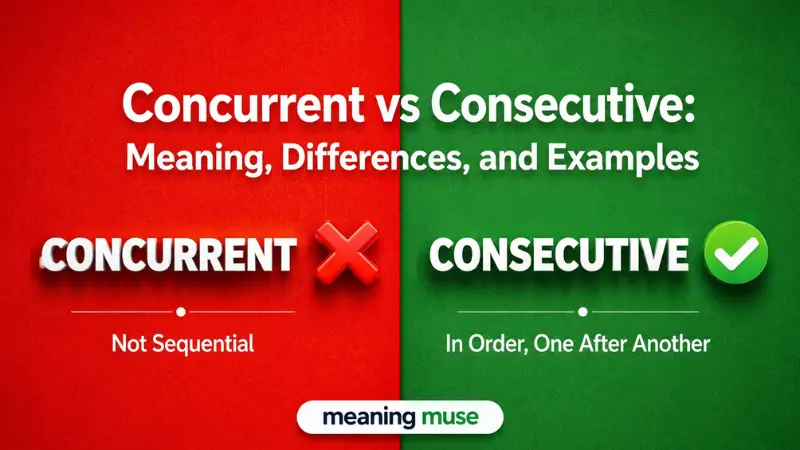
Concurrent and consecutive both describe when events happen. However, they show two very different time patterns.
Concurrent means that two or more things happen at the same time or during the same period.
Consecutive means that things happen one after another in a clear order, usually without a break.
For example, two meetings at 10:00 a.m. are concurrent. Three meetings at 10:00, 11:00, and 12:00 are consecutive.
Both words are correct in American English. The right choice depends on whether the events overlap or follow each other. Major dictionaries make this same basic distinction: concurrent events happen at the same time, while consecutive events follow one another in order.
Quick Answer
Use concurrent for things that happen at the same time.
Use consecutive for things that happen one after another without a break.
- Concurrent meetings: The meetings overlap.
- Consecutive meetings: One meeting starts after the previous one ends.
- Concurrent tasks: The tasks are active during the same period.
- Consecutive tasks: Each task is completed before the next one begins.
A simple memory rule is:
Concurrent = together in time.
Consecutive = connected in order.
Concurrent vs Consecutive at a Glance
| Feature | Concurrent | Consecutive |
|---|---|---|
| Main meaning | Happening at the same time | Happening one after another |
| Time pattern | Overlapping | Sequential |
| Common idea | Side by side in time | In a row |
| Meeting example | Two meetings at 10:00 a.m. | Meetings at 10:00, 11:00, and 12:00 |
| Work example | Two tasks active together | Three tasks completed in order |
| Legal example | Sentences served at the same time | Sentences served one after another |
| Common adverb | Concurrently | Consecutively |
| Close synonym | Simultaneous | Successive |
What Does Concurrent Mean?
Concurrent is an adjective that means happening, operating, or existing at the same time.
It can describe events that fully overlap or continue during the same period.
Examples:
- The school offers two concurrent classes.
- The interviews will take place in concurrent sessions.
- She is working on three concurrent projects.
- The two shows are being broadcast concurrently.
- The company had many concurrent users on its website.
Merriam-Webster also records other specialized meanings. For example, concurrent lines meet at one point, and concurrent authority may be shared by two government bodies over the same matter.
Concurrent Does Not Always Mean Identical
Two concurrent events do not need to be exactly the same.
They only need to happen during the same time or time period.
For example:
- A class runs from 9:00 to 10:00.
- A meeting runs from 9:30 to 10:30.
The class and meeting are concurrent from 9:30 to 10:00 because they overlap.
Concurrent in Computing
In computing, concurrent tasks make progress during the same period. A system may work on several tasks by switching between them. Therefore, concurrency does not always mean that every task runs at the exact same instant.
On a single processor, a computer can switch between threads and create concurrent execution. On systems with more processing power, some tasks may also run in parallel.
Examples:
- The program can handle many concurrent requests.
- Concurrent users may access the website at the same time.
- The system runs several tasks concurrently.
What Does Consecutive Mean?
Consecutive is an adjective that means following one after another in order.
It normally describes a series with no break or missing item.
Examples:
- She worked for seven consecutive days.
- The team won four consecutive games.
- He missed three consecutive classes.
- We met on two consecutive weekends.
- The numbers 8, 9, and 10 are consecutive.
Cambridge defines consecutive events or numbers as items that follow one another without an interruption. Merriam-Webster gives the same core meaning: following one after another in order.
Consecutive Means No Gap
The word often tells the reader that a sequence was not broken.
Suppose a team wins on Monday, Wednesday, and Friday but loses on Tuesday and Thursday. Those are not three consecutive wins.
However, if the team wins its next three games without losing between them, the wins are consecutive.
Consecutive Numbers
Consecutive numbers follow each other in counting order.
Examples:
- 1, 2, 3
- 14, 15, 16
- 98, 99, 100
The numbers do not need to start at one. They only need to follow each other with no missing number.
The Main Difference: Time vs Order
The clearest difference is this:
- Concurrent focuses on the same time.
- Consecutive focuses on a continuing order.
Imagine a movie theater with three screens.
If three movies begin at 7:00 p.m., they are concurrent.
If one movie starts at 5:00 p.m., another at 7:00 p.m., and another at 9:00 p.m., they are consecutive showings.
The same rule works with meetings:
- Two meetings scheduled for 2:00 p.m. are concurrent.
- Three back-to-back meetings are consecutive.
It also works with work tasks:
- Answering emails while downloading a file involves concurrent activity.
- Finishing Task A, then Task B, and then Task C involves consecutive work.
When Should You Use Concurrent?
Use concurrent when two or more activities overlap in time.
Concurrent Meetings
- I cannot attend both concurrent meetings.
- The company scheduled three concurrent training sessions.
- Choose one workshop because the sessions are concurrent.
Concurrent Events
- Two concerts were held concurrently.
- The festival has several concurrent events.
- The games will run concurrently on different fields.
Concurrent Courses
Students may take several courses during the same semester. Those courses are concurrent because they run during the same general period.
- Mia is taking four concurrent courses.
- The course runs concurrently with her internship.
Concurrent Jobs or Projects
A person may work on several projects during the same week or month.
- Our team manages five concurrent projects.
- He found it hard to meet all the concurrent deadlines.
The deadlines may be close together, while the projects themselves overlap in time.
Concurrent Users
Websites and apps often count the number of people using a service at one time.
- The server supports 5,000 concurrent users.
- Traffic reached 800 concurrent visitors.
When Should You Use Consecutive?
Use consecutive when events form an unbroken sequence.
Consecutive Days
- She studied for ten consecutive days.
- It rained for four consecutive days.
- He arrived late three consecutive days in a row.
The phrase “in a row” repeats the meaning, so it is often unnecessary. However, it may be used for emphasis in informal speech.
Consecutive Wins
- The team earned five consecutive wins.
- She won three consecutive races.
- The player scored in seven consecutive games.
Consecutive Terms
A person who serves two consecutive terms completes one term and then immediately serves another.
- The mayor served two consecutive terms.
- The president of the club won a third consecutive term.
Consecutive Numbers
- Please write five consecutive numbers.
- Eleven and twelve are consecutive numbers.
- The tickets have consecutive numbers.
Consecutive Meetings
- I have four consecutive meetings this afternoon.
- The interviews are scheduled in consecutive time slots.
- We held three consecutive planning sessions.
Concurrent vs Consecutive Sentences in Law
The difference is important in legal language.
Concurrent sentences are prison terms served at the same time.
Consecutive sentences are served one after another.
For example, imagine that a court gives a person two five-year sentences.
If the sentences run concurrently, both five-year terms are served during the same period.
If they run consecutively, the second five-year term begins after the first one ends. The total would normally become ten years before other legal factors are considered.
The United States Courts glossary defines concurrent sentences as prison terms served at the same time. Cornell’s Legal Information Institute explains that consecutive sentences follow one another rather than running together.
This is a general language explanation, not legal advice.
Concurrent vs Consecutive in Computing
These words also appear in technology.
Concurrent Processing
Concurrent processing allows more than one task to make progress during the same period.
Examples include:
- Handling several user requests
- Downloading a file while playing music
- Running several background jobs
- Managing multiple open connections
Consecutive or Sequential Processing
Consecutive processing completes one step before starting the next step.
For example:
- Open the file.
- Read the data.
- Check the data.
- Save the result.
The steps happen in order.
In technical writing, sequential is often more common than consecutive for computer instructions. Official Microsoft documentation commonly contrasts concurrent or parallel work with sequential execution.
Concurrent vs Simultaneous
Concurrent and simultaneous are close in meaning, but they can carry slightly different ideas.
Simultaneous strongly suggests that events happen at the exact same time.
Concurrent may describe events that happen at the same time or overlap during the same period.
Examples:
- The runners crossed the line simultaneously.
- The two classes run concurrently during the fall semester.
In everyday use, the words may overlap. Cambridge lists simultaneous as a synonym of concurrent.
Consecutive vs Continuous
Consecutive and continuous are also different.
Consecutive describes separate events that happen one after another.
Continuous describes something that keeps going without stopping.
Compare:
- She worked for five consecutive days.
- The machine ran continuously for five days.
In the first sentence, each day is a separate item in a series.
In the second sentence, the machine did not stop during that whole period.
Consecutive vs Successive
Consecutive and successive are very close.
Both can describe things that follow one after another.
However, consecutive often makes the “no break” idea stronger.
Examples:
- The team won four consecutive games.
- Four successive managers changed the policy.
In many sentences, either word is possible. Cambridge and Merriam-Webster both list successive as a close synonym of consecutive.
Common Mistakes and Quick Fixes
Mistake 1: Calling Back-to-Back Events Concurrent
- Incorrect: I have three concurrent meetings from 9:00 to 12:00.
- Correct: I have three consecutive meetings from 9:00 to 12:00.
Use consecutive when each meeting follows the one before it.
Mistake 2: Calling Overlapping Events Consecutive
- Incorrect: The two classes start at 10:00, so they are consecutive.
- Correct: The two classes start at 10:00, so they are concurrent.
Use concurrent when the classes happen at the same time.
Mistake 3: Confusing Concurrent with Current
Current means happening now or belonging to the present.
Concurrent means happening at the same time as something else.
- My current job starts at 8:00.
- I cannot attend two concurrent meetings.
Mistake 4: Confusing Consecutive with Continuous
- Consecutive: Five separate days in a row
- Continuous: One action that does not stop
Mistake 5: Assuming the Words Are Exact Opposites
Concurrent and consecutive show contrasting time patterns, but they are not strict opposites.
The direct opposite of concurrent is nonconcurrent.
The direct opposite of consecutive is nonconsecutive.
Events can also be neither concurrent nor consecutive. For example, two meetings held several weeks apart do not overlap and do not form an unbroken sequence.
Everyday Examples
Concurrent Examples
- Two alarms sounded concurrently.
- The classes have concurrent schedules.
- Several events will take place concurrently.
- She manages three concurrent projects.
- The website supports many concurrent users.
- His job runs concurrently with his evening course.
- The two court cases moved forward concurrently.
- We watched the concurrent games on different screens.
- The company faced several concurrent problems.
- Two interviews were happening concurrently.
Consecutive Examples
- He worked six consecutive nights.
- The team won three consecutive games.
- She missed two consecutive lessons.
- Write four consecutive numbers.
- The store closed early on three consecutive Fridays.
- I have five consecutive appointments.
- They won a second consecutive award.
- The dog barked for several consecutive minutes.
- She served two consecutive terms.
- We visited for four consecutive summers.
Side-by-Side Examples
- Concurrent: Both workshops begin at 1:00 p.m.
- Consecutive: One workshop begins after the other ends.
- Concurrent: The apps are running at the same time.
- Consecutive: The apps are opened one after another.
- Concurrent: The projects overlap for three months.
- Consecutive: Project B starts after Project A ends.
- Concurrent: The sentences are served together.
- Consecutive: The sentences are served one after another.
Dictionary-Style Word Details
Part of Speech
Concurrent: Mainly an adjective.
- concurrent meetings
- concurrent events
- concurrent users
Consecutive: An adjective.
- consecutive days
- consecutive wins
- consecutive numbers
Pronunciation
Concurrent: kuh-KUR-uhnt
The main stress falls on KUR.
Consecutive: kuhn-SEK-yuh-tiv
The main stress falls on SEK.
Related Word Forms
Concurrent:
- Concurrently — adverb
- Concurrency — noun
- Concurrence — noun, but it may also mean agreement
Consecutive:
- Consecutively — adverb
- Consecutiveness — noun, though it is less common
- Nonconsecutive — adjective
Synonyms
Close words for concurrent:
- simultaneous
- overlapping
- coexisting
- parallel
- coinciding
Close words for consecutive:
- successive
- sequential
- back-to-back
- in a row
- following
These words are not always exact replacements. The best choice depends on the sentence.
Word History
Concurrent comes from a Latin word linked to running together or meeting. This background fits its modern meaning of events happening together in time.
Consecutive comes from Latin roots linked to following. This fits its modern meaning of one event following another. Merriam-Webster traces concurrent through Latin concurrere and consecutive through Latin consequi.
Common Phrases
Phrases with concurrent:
- concurrent events
- concurrent meetings
- concurrent sessions
- concurrent users
- concurrent tasks
- concurrent projects
- concurrent sentences
- concurrent jurisdiction
- run concurrently
- occur concurrently
Phrases with consecutive:
- consecutive days
- consecutive wins
- consecutive games
- consecutive terms
- consecutive numbers
- consecutive meetings
- consecutive years
- consecutive sentences
- run consecutively
- three times consecutively
FAQs
What is the main difference between concurrent and consecutive?
Concurrent means happening at the same time. Consecutive means happening one after another in order. Two meetings at 10:00 a.m. are concurrent. Meetings at 10:00, 11:00, and 12:00 are consecutive.
Can meetings be concurrent and consecutive?
A group of meetings may include both patterns, but the words describe different relationships. Two meetings that overlap are concurrent. Meetings arranged back to back are consecutive.
Does concurrent mean the same as simultaneous?
The words are close. Simultaneous often suggests the exact same moment. Concurrent can also describe events that overlap during the same period. In many everyday sentences, either word may work.
Does consecutive always mean without a break?
Usually, yes. Consecutive items follow one another in an unbroken order. Five consecutive workdays means five workdays in a row without another workday breaking the series.
What are consecutive numbers?
Consecutive numbers follow one another in counting order with no missing number. For example, 21, 22, and 23 are consecutive numbers.
What do concurrent and consecutive sentences mean?
Concurrent prison sentences are served at the same time. Consecutive sentences are served one after another. The second consecutive term begins after the first term ends.
Is it concurrent with or concurrent to?
Use concurrent with when comparing two events.
- The course runs concurrent with the internship.
- The meeting is concurrent with another event.
You can also write runs concurrently with, which often sounds more natural.
What is the adverb form of concurrent?
The adverb is concurrently.
Example:
- The two programs run concurrently.
The adverb form of consecutive is consecutively.
Example:
- She won three races consecutively.
Are concurrent and consecutive spelling variants?
No. They are two correctly spelled words with different meanings. Concurrent describes overlapping time. Consecutive describes an unbroken order.
Conclusion
Concurrent and consecutive describe different ways in which events happen.
Use concurrent when events happen at the same time or overlap during the same period.
Use consecutive when events happen one after another in an unbroken order.
Remember this simple difference:
Concurrent events happen together.
Consecutive events follow each other.
Choosing the correct word helps readers understand whether activities overlap or form a sequence.