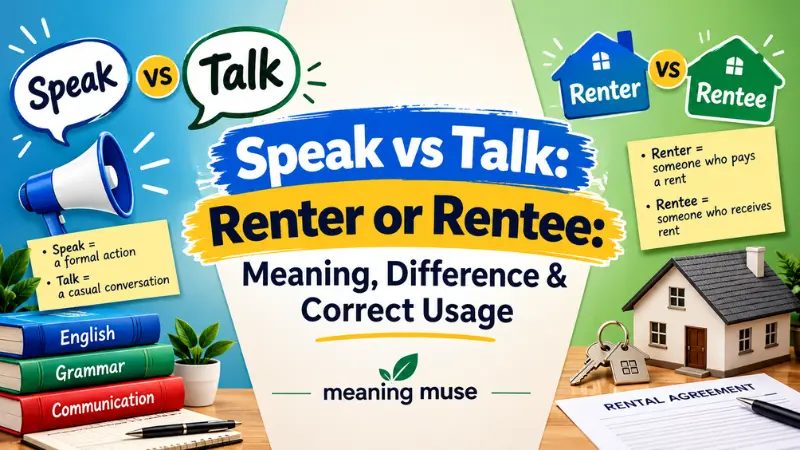
Renter or rentee can be confusing because both words are connected with renting.
The important point is that they are not two spellings of the same word. They are separate words.
In everyday American English, renter is the familiar word for a person who pays to use or live in property owned by someone else. Rentee is much less common and can be used for a person who rents something, but its use is not consistent across all sources.
That is why renter is usually the clearer choice for ordinary US writing.
For legal or contract writing, however, always check the definitions used in the specific document or law. Some legal definitions use renter for the owner or provider of rented property and rentee for the person who pays to use it.
Quick Answer
If you mean a person who pays rent to use a house, apartment, car, or other property, renter is the normal choice in everyday US English.
Rentee is a real but uncommon word. It can mean a person who rents something, and some contracts or legal definitions use it in a more specific way.
Simple rule
Renter = common everyday word
Rentee = rare and context-dependent word
For a normal American sentence, choose renter when you mean someone who rents a home, apartment, car, or other property.
Example:
Maria is a renter in Chicago.
This sounds natural in US English.
Why People Confuse Them
Both words come from the idea of renting, so they look closely related.
The ending -er often describes a person connected with an action. The ending -ee can describe someone who receives or is affected by an action.
That can make rentee look like the natural opposite of renter.
But real English usage is not always that neat.
Today, renter is widely understood to mean someone who rents property from another person. Thesaurus.com lists renter with tenant and gives modern examples of the word used for people who rent homes.
Rentee, by contrast, is rare. Wiktionary defines it as someone who rents property, while other sources use the word in contracts to identify the person receiving the rented property or service.
This difference between common usage and technical usage is the main reason the two words can be confusing.
Key Differences At A Glance
| Context | Best Choice | Why |
|---|---|---|
| Person who rents an apartment | Renter | This is the normal US term. |
| Person who rents a house | Renter | It is familiar and clear. |
| Person who rents a car | Renter | Common everyday usage. |
| General housing article | Renter | Most readers understand it immediately. |
| A contract that specifically defines “rentee” | Rentee | Use the term if the document gives it a specific definition. |
| Rare or technical wording | Rentee | It may be used when the writer needs a specific contractual label. |
The safest choice for general American readers is usually renter.
Are They the Same Word?
No.
Renter and rentee are separate words. They are not alternative spellings of the same lexical item.
There is also an important usage issue with renter.
In common modern US English, a renter is usually a person who pays to use property belonging to someone else. Rent.com, for example, defines a renter as someone who pays rent to use or occupy property owned by another person.
However, some dictionaries and legal sources preserve another sense of renter: a person who rents out property or receives payment for its use. YourDictionary shows both senses from different dictionary sources.
Some laws make the distinction explicit. For example, one Ohio municipal code defines a renter as the person who owns rented property and a rentee as the person who pays for its use.
So context matters.
US vs UK Preference
There is no simple US-versus-UK spelling rule for renter and rentee.
The bigger difference is frequency and context.
Renter is widely understood in American English. It is especially common when talking about apartments, houses, cars, and people who rent property. Modern US examples regularly use the word this way.
Rentee is much less common. Wiktionary labels it as rare and defines it as someone who rents property.
Because rentee can have different technical uses, it should not be treated as a simple American or British spelling choice.
For a general US audience, renter will normally be easier and clearer.
Which Spelling Should You Use?
If you are writing for everyday American readers, use renter in most situations.
Use “renter” for:
- apartment renters
- home renters
- car renters
- people paying rent
- rental customers
- general housing articles
- ordinary conversation
Examples:
The renter signed the lease on Monday.
The apartment is available to a new renter.
Every renter should read the lease carefully.
The car renter returned the vehicle on time.
When might “rentee” appear?
You may see rentee in a contract, business document, or specialized source where the writer has defined the term.
For example:
The rentee must return the equipment by Friday.
But if you are writing a general article, renter is usually the clearer word.
When One Spelling Looks Wrong
Because rentee is uncommon, it can look unusual even when a writer has a specific reason for using it.
For example:
The rentee must pay the monthly fee.
The sentence can be understood, but many US readers would expect renter or tenant in ordinary housing writing.
Now compare:
The renter must pay the monthly fee.
This is immediately clear to most American readers.
The reverse problem can happen in a legal document.
If a contract clearly defines renter as the person who owns or provides the rented property and rentee as the person paying to use it, changing those terms could create confusion.
The lesson is simple:
Use ordinary wording for ordinary readers. Follow defined terms in legal or contractual documents.
Common Mistakes (and Quick Fixes)
Mistake 1: Treating renter and rentee as spelling variants
They are not two spellings of one word.
They are separate terms with overlapping usage in some contexts.
Mistake 2: Assuming “rentee” is always the correct opposite of “renter”
That is too simple.
Some sources use rentee for the person receiving the rented property, but ordinary English commonly uses renter for the person paying to rent something.
Mistake 3: Using “rentee” in everyday US writing
This can make a sentence sound unusual.
Instead of:
The rentee is looking for a new apartment.
A natural US sentence is:
The renter is looking for a new apartment.
Mistake 4: Ignoring definitions in a contract
A contract may define renter and rentee in its own way.
If those terms are defined, follow the document’s definitions rather than assuming everyday usage applies.
Mistake 5: Assuming renter always has only one meaning
Most readers understand renter as someone who rents property from another person. But dictionaries and some legal sources also record another sense connected with the person who rents property to someone else.
Everyday Examples
Examples with “renter”
- The renter paid the security deposit.
- The renter moved into the apartment last week.
- The landlord contacted the renter about the repair.
- The renter returned the car on Sunday.
- Many young adults start out as renters.
- The renter signed a one-year lease.
- The building has several long-term renters.
These examples use renter in its common everyday sense.
Examples with “rentee”
- The contract refers to the customer as the rentee.
- The rentee must return the equipment before the rental period ends.
- The agreement defines the rentee as the person using the rented vehicle.
- The company sent the notice directly to the rentee.
These examples show why the word can appear in specialized writing, even though it is much less common.
Quick comparison
Everyday conversation:
The renter paid the rent.
Defined contract language:
The rentee must return the equipment.
The second sentence depends on how the contract defines the word.
Dictionary-Style Word Details
Verb
Renter: As a noun, renter commonly refers to someone who rents property. There is also an uncommon verb sense unrelated to the normal rental meaning, involving sewing or repairing fabric.
Rentee: Rentee is normally used as a noun, not as the ordinary verb form of rent.
Noun
Renter: A person who rents or pays to use property owned or controlled by another person. This is the common everyday US sense.
Rentee: A rare noun for someone who rents property or receives something under a rental arrangement. Some specialized legal or contractual sources give the term a more specific definition.
Synonyms
For renter, useful alternatives include:
- tenant
- lessee
- leaseholder
- occupant
The exact choice depends on the situation.
For rentee, renter, tenant, or lessee may be suitable when the intended meaning is the person who rents property. Thesaurus.com lists renter and rentee as related terms, but rentee is much less common.
Example Sentences
Renter:
The renter paid the first month’s rent.
The landlord gave the renter a copy of the lease.
The car renter returned the vehicle before noon.
Rentee:
The agreement identifies the customer as the rentee.
The rentee must return the rented equipment on time.
The second group is more specialized and should be used when the intended terminology is clear.
Word History
Renter is formed from rent with the suffix -er.
Rentee is formed from rent with the suffix -ee. Wiktionary gives its formation as rent + -ee and records it as a rare noun meaning one who rents property.
The two words therefore have a clear connection, but they are not simply two spellings of one word.
Phrases Containing
Common phrases with renter include:
- renter’s insurance
- renter’s rights
- renter agreement
- apartment renter
- home renter
- car renter
- long-term renter
- first-time renter
Phrases with rentee are much less common and are more likely to appear in specialized agreements or definitions.
FAQs
Is it renter or rentee?
Both words exist, but renter is the normal choice in everyday American English. Rentee is rare and is more likely to appear in specialized or contractual contexts.
Is “rentee” a real word?
Yes. Rentee is an English noun, but it is uncommon. It can refer to someone who rents property. Some specialized sources give it a more specific contractual meaning.
What is the difference between renter and rentee?
Renter is the common everyday term for someone who rents property. Rentee is a rare term that can refer to the person receiving or paying for rented property, depending on the source or contract.
Which word is more common in American English?
Renter is much more common in ordinary US English. It is widely used for people who rent houses, apartments, cars, and other property.
Is rentee the same as tenant?
Not always in every technical context, but rentee can be used for someone who rents property, while tenant is the standard term for a person who occupies rented property under a rental arrangement.
Should I use renter or rentee in an article?
For a general US audience, renter is usually the clearer choice. Use rentee only when the context specifically calls for it or when a document defines the term.
Is renter the person who pays rent?
In common American usage, yes. A renter is generally understood as someone who pays to use or occupy property owned by another person.
Can renter mean the property owner?
In some dictionary and legal contexts, yes. Some sources preserve a technical sense of renter for someone who rents property to another person or receives payment for its use.
Is rentee used in legal documents?
It can be. Some laws and contracts explicitly define rentee as the person who pays for the use of rented property.
Is renter or rentee better for a US website?
For normal US readers, renter is generally clearer because it is familiar and widely used. The appropriate term can change when a particular legal document has its own definitions.
Are renter and rentee different spellings?
No. They are different words, not two spellings of the same word.
What is the easiest way to remember renter?
Think of renter as the everyday word you will normally see in US housing, apartment, car-rental, and consumer writing.
Why does rentee sound unusual?
Because rentee is rare compared with renter. It exists, but most American readers are much more familiar with renter.
Conclusion
Renter or rentee is not a normal spelling-choice question because the two words are not spelling variants.
For most American readers, renter is the natural and familiar choice when you mean a person who rents a home, apartment, car, or other property.
Rentee is a real but uncommon term. Some sources use it for a person who rents property, while certain legal or contractual definitions use it specifically for the party paying to use rented property.
The safest rule for general US writing is:
Use “renter” for ordinary readers.
Use “rentee” only when a specific document, contract, or context defines or requires the term.
If you are writing a lease or other legal document, follow the definitions used in that document and the applicable law rather than relying on everyday me