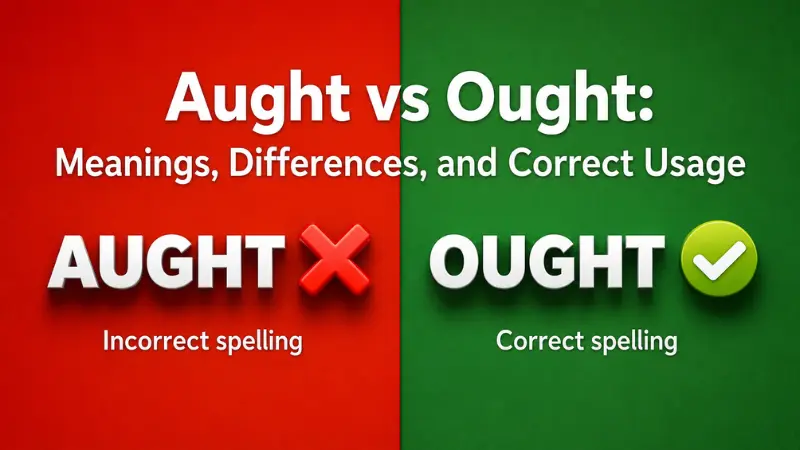
Aught and ought sound alike, but they usually have different meanings and jobs.
Aught can mean anything or zero. It also appears in the aughts, a name for the years from 2000 through 2009.
Ought is a helping verb. It expresses advice, duty, expectation, or what is likely to happen.
For aught I know, the store may be closed.
You ought to check the store hours.
The first sentence uses aught to mean anything. The second uses ought to give advice.
These words are not modern spelling variants. You cannot freely replace one with the other. This guide explains their meanings, grammar, pronunciation, common mistakes, and correct examples.
Quick Answer
Use aught when you mean anything, zero, or the first decade of a century.
Use ought when you mean should, have a duty to, or be expected to.
Correct: You ought to apologize.
Correct: For aught we know, she already left.
Incorrect: You aught to apologize.
The easiest rule is:
Ought gives advice. Aught names something, nothing, or zero.
Aught vs Ought at a Glance
| Feature | Aught | Ought |
|---|---|---|
| Main meaning | Anything or zero | Should or be expected to |
| Main grammar role | Pronoun or noun | Modal helping verb |
| Common modern use | The aughts | Ought to |
| Example | For aught I know | You ought to know |
| Can mean zero? | Yes | Not in normal modern use |
| Gives advice? | No | Yes |
| Pronunciation | Sounds like “awt” | Sounds like “awt” |
| Interchangeable? | No | No |
Both words are correct. The sentence meaning decides which one you need.
What Does Aught Mean?
Aught has several meanings. Some are old-fashioned, while others still appear in modern American English.
Aught Meaning Anything
As a pronoun, aught can mean anything.
This use sounds literary, formal, or old-fashioned. It survives most clearly in a few set expressions.
For aught I know, the meeting has been canceled.
For aught anyone could tell, the house was empty.
In these sentences, for aught I know means as far as I know or for all I know.
Aught Meaning Zero
As a noun, aught can mean zero.
The code contains two aughts.
The final number ends in an aught.
This use is less common than simply saying zero. However, it may appear when people read numbers aloud.
The Aughts
The aughts commonly refers to the years from 2000 through 2009.
That style became popular in the early aughts.
Many social media sites began during the aughts.
This expression works much like the nineties or the twenties.
What Does Ought Mean?
Ought is mainly a modal helping verb. It is usually followed by to and another verb.
The most common structure is:
ought + to + base verb
You ought to rest.
We ought to leave soon.
She ought to call her mother.
The word can express several closely related ideas.
Ought for Advice
Use ought to when suggesting a wise or helpful action.
You ought to drink more water.
Marcus ought to check his work.
We ought to book the tickets early.
In these examples, ought to is close to should.
Ought for Duty
Ought can express a moral duty or responsibility.
People ought to keep their promises.
Drivers ought to follow the speed limit.
We ought to treat others with respect.
This use may sound stronger than a casual suggestion.
Ought for Expectation
Use ought to when something is expected or likely.
The package ought to arrive tomorrow.
This key ought to open the door.
The movie ought to end by ten.
The speaker believes the result is likely, but not fully certain.
The Main Difference Between Aught and Ought
The main difference is both meaning and grammar.
Aught normally acts as a pronoun or noun. It can mean anything, zero, or the opening decade of a century.
Ought normally acts as a helping verb. It expresses what someone should do or what is expected to happen.
Compare these sentences:
For aught I know, Ben is already home.
Here, aught means anything.
Ben ought to be home by now.
Here, ought expresses an expectation.
Another pair shows the difference clearly:
The password ends with an aught.
You ought to change your password.
The first sentence talks about zero. The second gives advice.
Do Aught and Ought Sound the Same?
Yes. In normal speech, aught and ought are homophones.
A homophone is a word that sounds like another word but has a different spelling or meaning.
Both words sound roughly like:
awt
Because they sound alike, listening alone may not reveal the correct spelling. You must look at the sentence meaning.
Ask yourself:
• Does the sentence mean anything or zero? Use aught.
• Does the sentence mean should or be expected to? Use ought.
How to Use Aught Correctly
Modern uses of aught are limited. It often appears in fixed expressions or when talking about zero and decades.
For Aught I Know
For aught I know means for all I know.
For aught I know, they changed the schedule.
He may already be on his way, for aught I know.
The phrase shows that the speaker lacks full information.
For Aught Anyone Knows
This expression has the same basic meaning.
For aught anyone knows, the keys are still in the car.
For aught the neighbors knew, the family had moved.
Aught as a Number
Use aught when it clearly refers to zero.
Write an aught in the empty space.
The serial number begins with two aughts.
In everyday American English, zero is usually clearer. Use aught only when it sounds natural in the setting.
Aughts as a Decade
The band was famous in the early aughts.
Fashion from the aughts has become popular again.
Always use the plural form aughts for the decade.
How to Use Ought Correctly
Ought usually appears with to and a base verb.
We ought to start now.
She ought to finish her homework.
They ought to know the answer.
The verb after to stays in its base form.
Correct:
He ought to study.
Incorrect:
He ought to studies.
Negative Form
The normal negative structure is ought not to.
You ought not to ignore that warning.
We ought not to be late.
The shortened form oughtn’t exists, but it is less common in everyday American writing.
You oughtn’t to worry.
Most American writers will find ought not to or should not more natural.
Questions With Ought
Questions beginning with ought are correct but can sound formal.
Ought we to tell them?
Ought I to bring anything?
In casual American English, people often use should instead.
Should we tell them?
Should I bring anything?
Ought to Have
Use ought to have with a past participle when discussing a past action that was expected or advisable.
You ought to have called me.
We ought to have left earlier.
The package ought to have arrived yesterday.
The first two examples may express criticism or regret. The last expresses an expectation that was not met.
Ought vs Should
Ought to and should often express similar ideas.
You ought to get some sleep.
You should get some sleep.
Both sentences give advice.
However, ought to can sound slightly more formal or more connected to duty.
We ought to help people in need.
Still, the strength of the sentence depends on context and tone. Do not assume that ought is always much stronger than should.
One clear grammar difference is that ought normally takes to.
You ought to leave.
Should does not take to.
You should leave.
Not:
You should to leave.
Is Ought Ever a Spelling of Aught?
Historically, ought has sometimes been used as a spelling of aught.
That old overlap can appear in historical texts or dictionary notes. It does not mean the two words are interchangeable in normal modern writing.
In a modern sentence about duty or advice, use ought.
We ought to be careful.
In a phrase meaning anything, use aught.
For aught we know, the road is closed.
Readers should preserve the original spelling when quoting an older text. In their own modern writing, they should follow the standard distinction.
Common Mistakes and Quick Fixes
Mistake: Writing Aught To
Incorrect:
You aught to finish your work.
Correct:
You ought to finish your work.
Quick fix: Advice and duty require ought.
Mistake: Writing For Ought I Know
Incorrect in normal modern writing:
For ought I know, they may be waiting.
Standard modern form:
For aught I know, they may be waiting.
Here, the phrase means for all I know.
Mistake: Adding S to Ought
Incorrect:
She oughts to apologize.
Correct:
She ought to apologize.
Modal verbs do not take an -s ending for he, she, or it.
Mistake: Using Ought Without To
Incorrect:
We ought leave now.
Correct:
We ought to leave now.
In standard modern English, ought normally appears with to before another verb.
Mistake: Using Aught When Zero Is Clearer
Enter aught in the box.
The sentence may be correct, but many modern readers will find this version clearer:
Enter zero in the box.
Use aught only when it suits the style or context.
Mistake: Confusing Aughts and Oughts
Use aughts for the decade or several zeros.
The show began in the early aughts.
Use oughts only in rare discussions where ought is treated as a noun or quoted word.
Everyday Examples
Examples With Aught
For aught I know, the train is delayed.
She cared little for aught he said.
The form showed an aught in the final box.
The music takes me back to the early aughts.
For aught anyone could see, the room was empty.
The number contains three aughts.
Examples With Ought
You ought to wear a coat.
We ought to arrive before noon.
The children ought to be asleep.
You ought to tell the truth.
This plan ought to work.
They ought to have checked the address.
Side-by-Side Examples
For aught I know, Lisa may be home.
Lisa ought to be home by now.
The code ends in an aught.
You ought to write down the code.
Music from the aughts is popular again.
Artists ought to be paid for their work.
Grammar Details
Aught
Pronoun:
For aught I know, he is right.
Here, aught means anything.
Noun:
Add an aught after the five.
Here, it means zero.
Plural noun:
The movie was released in the aughts.
Here, aughts names a decade.
Ought
Modal helping verb:
You ought to listen.
It works with another verb to express advice, duty, or expectation.
Noun:
In formal discussions, ought can name a moral duty or what should be true.
The debate focused on the difference between what is and what ought to be.
This noun use is less common in simple everyday sentences.
Synonyms and Related Words
Alternatives for Aught
When aught means anything, possible plain alternatives include:
• Anything
• Something
• All
• Whatever
When it means zero, alternatives include:
• Zero
• Naught
• Nothing
• Cipher
The best option depends on the sentence.
Alternatives for Ought
Possible alternatives include:
• Should
• Need to
• Be expected to
• Be supposed to
• Have a duty to
These are not exact matches in every context.
The bus ought to arrive soon.
Here, is expected to is a close alternative.
You ought to apologize.
Here, should is the clearest alternative.
Memory Trick
Remember this simple sentence:
You ought to know that aught may mean zero.
Connect the o in ought with obligation.
Ought = obligation or advice
Connect the a in aught with anything.
Aught = anything or zero
This pattern will help you choose the correct word.
FAQs
What Is the Difference Between Aught and Ought?
Aught can mean anything, zero, or the years from 2000 through 2009. Ought is a helping verb meaning should, be required to, or be expected to.
Is It Aught to or Ought to?
Write ought to.
You ought to be more careful.
Aught to is incorrect when giving advice or expressing duty.
Does Aught Mean Nothing or Anything?
Aught traditionally means anything. It can also mean zero or nothing in its noun use.
The sentence context shows which meaning applies.
What Does “For Aught I Know” Mean?
For aught I know means for all I know. It shows that the speaker does not have complete information.
For aught I know, the office may be closed.
What Does Ought Mean in a Sentence?
Ought usually means should or be expected to.
You ought to apologize.
The mail ought to arrive today.
Are Aught and Ought Pronounced the Same?
Yes. They are normally pronounced alike and rhyme with caught in many American accents.
Their spelling and meaning are different.
Is Aught Still Used Today?
Yes, but its uses are limited. It appears in phrases such as for aught I know, as a word for zero, and in the aughts for the years 2000–2009.
Is Ought a Past-Tense Verb?
In modern use, ought does not have a separate past form. Writers use ought to have when discussing a past action.
You ought to have called earlier.
Is Ought Stronger Than Should?
Sometimes ought to can sound more connected to duty. However, the two expressions often overlap, and tone depends on context.
What Is the Negative Form of Ought?
Use ought not to.
You ought not to share your password.
The contraction oughtn’t is correct but less common in everyday American English.
Conclusion
Aught and ought sound the same, but they are different words.
Use aught for anything, zero, or the decade from 2000 through 2009. Use ought for advice, duty, or expectation.
Remember:
Aught may mean zero.
Ought usually means should.
Once you connect ought with advice and aught with anything or zero, the difference becomes easy to remember.