Calibrate and recalibrate are both correct verbs, but they do not communicate exactly the same timing.
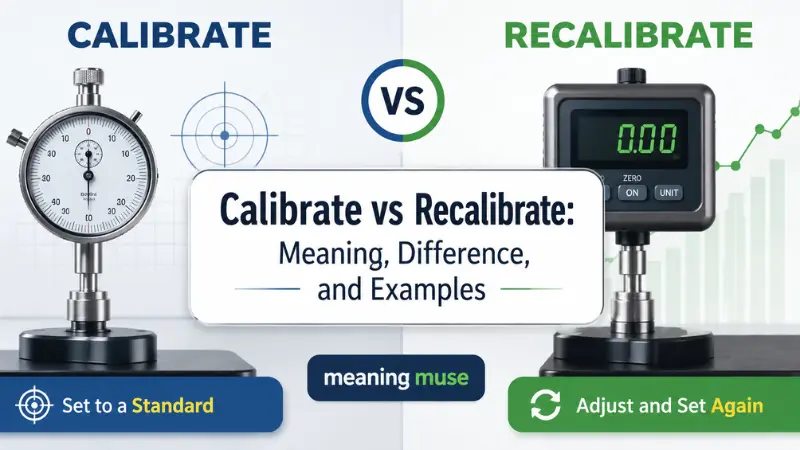
To calibrate something means to check its accuracy against a known standard or prepare it to produce dependable results. To recalibrate something means to perform that calibration process again.
The difference is mainly repetition. A new instrument may need to be calibrated before use, while an instrument that has already been checked may need to be recalibrated after a repair, environmental change, unusual reading, or period of use.
The simplest rule is:
Calibrate means check or set accurately. Recalibrate means do it again.
Quick Answer
Use calibrate when a device, instrument, system, or setting requires its first calibration or when you are referring to calibration as a general process.
Use recalibrate when the same process must be repeated because something has changed or the earlier calibration may no longer be reliable.
The prefix re- means “again,” which creates the main distinction:
- Calibrate: Check, compare, or set for accuracy
- Recalibrate: Check, compare, or set for accuracy again
- Calibration: The process or result of calibrating
- Recalibration: A repeated calibration
Both calibrate and recalibrate are verbs.
Calibrate vs Recalibrate at a Glance
| Point | Calibrate | Recalibrate |
|---|---|---|
| Core meaning | Perform a calibration | Perform another calibration |
| Timing | First, initial, or general process | A repeated process |
| Common use | New or routinely checked equipment | Previously calibrated equipment |
| Typical reason | Confirm or establish accuracy | Restore confidence after a change |
| Technical use | Compare readings with a standard | Repeat that comparison |
| Figurative use | Carefully adjust a message or response | Revise plans or expectations again |
| Past tense | Calibrated | Recalibrated |
| Noun form | Calibration | Recalibration |
The essential difference is not the type of action. It is whether the action is being performed generally or repeated.
What Does Calibrate Mean?
To calibrate means to compare, check, mark, or set a device so its readings relate correctly to a trusted standard.
The word is frequently associated with measuring and testing equipment, including:
- Scales
- Thermometers
- Pressure gauges
- Sensors
- Cameras
- Medical equipment
- Laboratory instruments
- Navigation systems
- Manufacturing machines
- Testing equipment
During calibration, a device’s result is compared with a known reference. This comparison helps determine whether the device is producing acceptable readings.
For instance, a scale may be tested with a certified weight. If the known weight is 10 pounds but the scale displays 10.4 pounds, the difference suggests that the scale is not reading as expected.
Calibration identifies and records that difference. Depending on the equipment and procedure, the device may then require adjustment, repair, or further testing.
Does Calibration Always Adjust a Device?
Calibration does not always mean physically changing or fixing the device.
In technical work, calibration may only involve:
- Applying a known reference
- Recording the device’s reading
- Comparing the result with the reference
- Measuring the difference
- Determining whether the difference is acceptable
An adjustment may follow if the calibration reveals an unacceptable error. However, calibration and adjustment remain separate ideas.
A technician may calibrate an instrument and discover that it is already accurate. In that situation, no adjustment is required.
Calibrate in Everyday Use
Outside laboratories and factories, calibrate often means preparing a device or system so it responds correctly.
Common situations include calibrating:
- A game controller
- A computer monitor
- A digital scale
- A camera
- A compass
- A touchscreen
- A vehicle sensor
- A home weather station
A photography professional may calibrate a monitor so colors appear more accurately. A gamer may calibrate a controller to improve movement response. A mechanic may calibrate sensors before testing a vehicle system.
These uses retain the same basic idea: checking or preparing something so its performance can be trusted.
Figurative Meaning of Calibrate
Calibrate can also be used figuratively when no measuring instrument is involved.
In this sense, it means to adjust something carefully according to a particular goal, audience, or situation.
A business might calibrate its marketing message for younger customers. A manager may calibrate a response to sound firm without appearing hostile. A speaker may calibrate the level of detail for a beginner audience.
The word suggests a controlled and thoughtful adjustment rather than a careless change.
Common figurative objects include:
- A response
- A message
- A strategy
- A reaction
- An approach
- A policy
- Expectations
- Communication
What Does Recalibrate Mean?
To recalibrate means to calibrate something again.
The word makes sense when a device or system was previously calibrated but another calibration is now necessary.
Recalibration may be required because:
- Readings have become unusual
- The equipment was dropped
- A component was repaired
- An important part was replaced
- The device was moved
- The environment changed
- The instrument has been used heavily
- A maintenance date has arrived
- Quality procedures require another check
- The manufacturer recommends repeated calibration
Recalibrate does not describe a completely different procedure. It clearly indicates that the calibration process is being repeated.
When Should Equipment Be Recalibrated?
The correct recalibration schedule depends on the equipment, its purpose, and the required level of accuracy. No single interval works for every device.
Several situations commonly justify recalibration.
When Readings Become Unusual
A device that once produced dependable results may begin displaying unexpected values.
If a thermometer consistently reads higher than a trusted reference, another calibration may be needed to determine whether its performance has changed.
Unexpected readings do not always prove that calibration is the only problem. The device may also require cleaning, repair, inspection, or replacement.
After Damage
Dropping, striking, or mishandling sensitive equipment can affect its accuracy.
A pressure gauge that falls from a workbench may need to be inspected and recalibrated before it returns to service.
Recalibration confirms measurement performance, but it does not repair physical damage. A damaged device should be examined before anyone relies on its readings.
After Repair or Part Replacement
Repairs can change how a device operates, especially when technicians replace sensors, circuit boards, controls, or measuring components.
Equipment that was accurate before the repair may not remain accurate afterward. Recalibration helps determine whether the repaired system still meets the required standard.
After Moving Sensitive Equipment
Some instruments are affected by movement, vibration, leveling, installation, or changes in location.
Laboratory machines, industrial scales, and precision measuring systems may require recalibration after being moved to another room or facility.
Whether recalibration is necessary depends on the equipment and the manufacturer’s instructions.
After Environmental Changes
Temperature, humidity, air pressure, vibration, and other environmental conditions can affect certain instruments.
A sensor moved from a normal room into cold storage may produce different results. Recalibration may be needed to confirm performance under the new conditions.
During Planned Maintenance
Many organizations follow scheduled calibration and maintenance programs.
The timing may depend on:
- Frequency of use
- Past performance
- Required accuracy
- Safety risk
- Manufacturer guidance
- Industry procedures
- Workplace rules
- Environmental exposure
Frequently used or safety-critical equipment may require more regular checks than equipment used occasionally for low-risk tasks.
Figurative Meaning of Recalibrate
Recalibrate also has a common figurative meaning.
It may describe changing plans, expectations, goals, or behavior after new information becomes available.
A team may recalibrate its budget after losing a major client. A traveler may recalibrate a schedule after a flight cancellation. A company may recalibrate its strategy when customer demand changes.
The idea is consistent with the technical meaning: something had already been set, but new conditions made another adjustment necessary.
Figurative uses commonly involve:
- Recalibrating expectations
- Recalibrating goals
- Recalibrating a strategy
- Recalibrating a plan
- Recalibrating priorities
- Recalibrating an approach
Calibrate or Recalibrate: Which Should You Use?
Choose calibrate when the action is initial, general, or described without emphasizing repetition.
Appropriate situations include:
- Preparing a new device
- Checking equipment before a test
- Describing a regular calibration process
- Establishing a measurement relationship
- Carefully adjusting communication or behavior
Choose recalibrate when you want readers to understand that an earlier calibration or setting already existed.
Appropriate situations include:
- Checking a device after repair
- Repeating calibration after movement
- Responding to doubtful readings
- Confirming performance after replacement
- Revising plans after circumstances change
The word calibrate can sometimes describe a recurring process. Recalibrate is more precise when the repeated nature of the action matters.
For example, saying that a laboratory calibrates its instruments every year is grammatically correct because it describes a routine procedure. Saying that the laboratory recalibrates its instruments every year places greater emphasis on the fact that each instrument was calibrated previously.
Calibrate vs Adjust
Calibrate and adjust are related, but they do not mean exactly the same thing.
Calibrate
To calibrate means to compare a device’s performance or readings with a trusted reference.
The process helps determine whether the equipment is accurate enough for its intended purpose.
Adjust
To adjust means to change a setting, component, or position.
An adjustment may occur after calibration identifies an unacceptable difference. However, a device can be calibrated without being adjusted if its readings are already acceptable.
The practical sequence may be:
- Calibrate the instrument
- Identify any error
- Adjust the instrument if necessary
- Verify or recalibrate it afterward
Calibrate vs Reset
Reset and calibrate also describe different actions.
Reset
To reset means to return a device, display, setting, or system to a starting condition.
A user might reset a scale to zero or restore a controller to its default settings.
Calibrate
To calibrate means to check performance against a known reference.
Resetting a scale to zero does not automatically prove that it will measure weight accurately. The display may show zero while the scale still gives incorrect readings when an object is placed on it.
Therefore, resetting may be part of preparing a device, but it does not replace calibration.
Calibrate vs Verify
Verification checks whether a device meets a specified requirement. Calibration establishes or records how its measurements relate to a known reference.
The two processes are closely connected, but their purposes may differ.
Calibration may reveal the amount of measurement error. Verification may determine whether that error remains within an acceptable limit.
In everyday writing, people may use these terms loosely. In technical documentation, the exact distinction depends on the organization, procedure, or industry.
Calibrate vs Calculate
Calibrate and calculate look similar, but their meanings are unrelated.
- Calibrate: Check or relate a device to a known standard
- Calculate: Find a numerical result
You calculate a total, percentage, distance, or cost. You calibrate a thermometer, scale, monitor, or sensor.
Confusing the two words can completely change the meaning of a sentence.
Is It Recalibrate or Re-Calibrate?
Recalibrate is the normal modern spelling.
It is generally written as one word without a hyphen.
Correct forms include:
- Recalibrate
- Recalibrates
- Recalibrated
- Recalibrating
- Recalibration
The hyphenated spelling re-calibrate is normally unnecessary.
Is “Recalibrate Again” Redundant?
Recalibrate already means to calibrate again. Therefore, adding again is usually repetitive.
Wordy wording:
The technician needs to recalibrate the instrument again.
Cleaner wording:
The technician needs to recalibrate the instrument.
However, recalibrate again can be logical when the device has already undergone one recalibration and must go through the process another time.
In most ordinary situations, recalibrate alone is clearer.
Grammar and Word Forms
Calibrate
Part of speech: Verb
Meaning: To check, compare, mark, or set something in relation to a standard.
Common forms:
- Base form: calibrate
- Third-person singular: calibrates
- Past tense: calibrated
- Past participle: calibrated
- Present participle: calibrating
Related noun:
- Calibration
Related person or device:
- Calibrator
Recalibrate
Part of speech: Verb
Meaning: To calibrate something again.
Common forms:
- Base form: recalibrate
- Third-person singular: recalibrates
- Past tense: recalibrated
- Past participle: recalibrated
- Present participle: recalibrating
Related noun:
- Recalibration
Both verbs normally take an object. A person calibrates or recalibrates a device, instrument, system, plan, or response.
Common Phrases With Calibrate
Common combinations include:
- Calibrate a scale
- Calibrate an instrument
- Calibrate a sensor
- Calibrate a monitor
- Calibrate a machine
- Calibrate a camera
- Calibrate a controller
- Properly calibrated
- Factory calibrated
- Calibrate for accuracy
Common Phrases With Recalibrate
Common combinations include:
- Recalibrate the device
- Recalibrate the sensor
- Recalibrate the system
- Recalibrate after repair
- Recalibrate after moving
- Recalibrate expectations
- Recalibrate a strategy
- Recalibrate a plan
- Scheduled recalibration
- Automatic recalibration
Common Mistakes and Corrections
Using Recalibrate for a Completely New Device
Recalibrate usually suggests that an earlier calibration has already occurred.
When a brand-new device is being checked for the first time, calibrate is generally the more natural choice.
Recalibrate may still be correct if the manufacturer calibrated the device before delivery and the user is deliberately repeating the process.
Assuming Calibration Means Repair
Calibration checks how a device performs against a reference. It does not automatically fix mechanical damage, replace faulty parts, or repair electronic problems.
If calibration reveals an error, further adjustment or repair may be necessary.
Treating Resetting as Proof of Accuracy
A reset may return a device to zero or restore default settings. It does not always confirm accurate performance.
A reset scale can still produce incorrect measurements.
Writing Re-Calibrate With a Hyphen
Recalibrate is normally written as one word. The same rule applies to recalibrated, recalibrating, and recalibration.
Using Calibrate and Calculate Interchangeably
Calculate involves numerical computation. Calibrate involves checking or setting accuracy.
The two words should not replace one another.
Assuming Every Repeated Check Is Recalibration
A visual inspection, functional test, reset, or routine check may not qualify as recalibration.
Use recalibrate only when the calibration process is actually repeated.
Practical Examples With Calibrate
- Technicians calibrate the production equipment before testing begins.
- The application guides users through the controller calibration process.
- Medical staff check that monitoring devices are properly calibrated.
- The photographer calibrates the display before editing important images.
- The factory uses trusted standards to calibrate measuring instruments.
- Engineers calibrate new sensors before installing them.
- The mechanic calibrated the vehicle’s safety system.
- Laboratories calibrate equipment according to documented procedures.
Practical Examples With Recalibrate
- Technicians recalibrate instruments after replacing important components.
- The scale may need recalibration if it begins producing inconsistent readings.
- Engineers recalibrated the sensor after moving the machine.
- The display should be recalibrated when its colors no longer appear accurate.
- The company recalibrated its goals after the budget changed.
- Maintenance staff recalibrate sensitive equipment at scheduled intervals.
- The team recalibrated its strategy after reviewing the latest results.
- Repaired equipment must be inspected and recalibrated before use.
Related Words and Alternatives
Alternatives for Calibrate
Depending on the context, possible alternatives include:
- Check
- Compare
- Measure
- Standardize
- Align
- Fine-tune
- Set
- Configure
These words are not exact technical substitutes in every situation.
Alternatives for Recalibrate
Possible alternatives include:
- Calibrate again
- Check again
- Readjust
- Realign
- Reconfigure
- Revise
- Rethink
- Adapt
For plans and expectations, revise, rethink, or adjust may sound more natural. For technical equipment, recalibrate is often the most precise term when the calibration process is repeated.
FAQs
What Is the Difference Between Calibrate and Recalibrate?
Calibrate means to perform a calibration by checking or relating something to a known standard. Recalibrate means to perform that process again. Use recalibrate when the device or system was calibrated previously.
Is Recalibrate a Correct Word?
Yes. Recalibrate is a standard English verb. It means to calibrate something again. It can also be used figuratively for revising plans, expectations, goals, or strategies after conditions change.
Does Calibrate Mean Reset?
Not necessarily. Reset means to return something to a starting state or default setting. Calibrate means to check its performance against a reference. A device can be reset without being accurately calibrated.
Does Calibration Mean Adjustment?
Not always. Calibration identifies how a device’s readings relate to a known standard. Adjustment changes the device. An adjustment may follow calibration, but the two processes are not automatically the same.
When Should Equipment Be Recalibrated?
Equipment may need recalibration after repair, damage, movement, unusual readings, part replacement, environmental changes, or a scheduled maintenance date. The correct timing depends on the device, its use, and the required accuracy.
Is It Recalibrate or Re-Calibrate?
Recalibrate is the standard modern spelling. It is normally written as one word without a hyphen.
What Is the Past Tense of Calibrate?
The past tense of calibrate is calibrated. The same form is also used as the past participle.
What Is the Past Tense of Recalibrate?
The past tense of recalibrate is recalibrated. It indicates that another calibration was completed.
Can You Recalibrate a Plan?
Yes. Recalibrate can be used figuratively. Recalibrating a plan means revising or adjusting it because the situation, available information, or desired outcome has changed.
Can Calibrate and Recalibrate Be Used Interchangeably?
Sometimes both words can refer to the same general process. However, recalibrate specifically emphasizes that the process is being repeated. Calibrate is broader and can describe an initial, regular, or general calibration.
Is Recalibration the Same as Repair?
No. Recalibration checks measurement performance again. Repair corrects a physical, mechanical, electrical, or software problem. Repaired equipment may require recalibration, but the two actions are different.
Can a New Device Be Recalibrated?
Yes, but only when an earlier calibration has already occurred. For instance, a manufacturer may calibrate a device before shipping, and the user may recalibrate it after installation.
Conclusion
Calibrate and recalibrate are both correct verbs, but they differ in timing.
Calibrate means to check, compare, or set something in relation to a trusted standard. It may describe an initial calibration or the calibration process in general.
Recalibrate means to repeat that process because the equipment, environment, readings, or requirements have changed.
The same distinction also applies figuratively. A person may calibrate a response carefully or recalibrate a plan after receiving new information.
Remember the basic rule:
Calibrate it when calibration is needed. Recalibrate it when the process must be performed again.