Ordnance and ordinance look almost the same, but they do not mean the same thing.
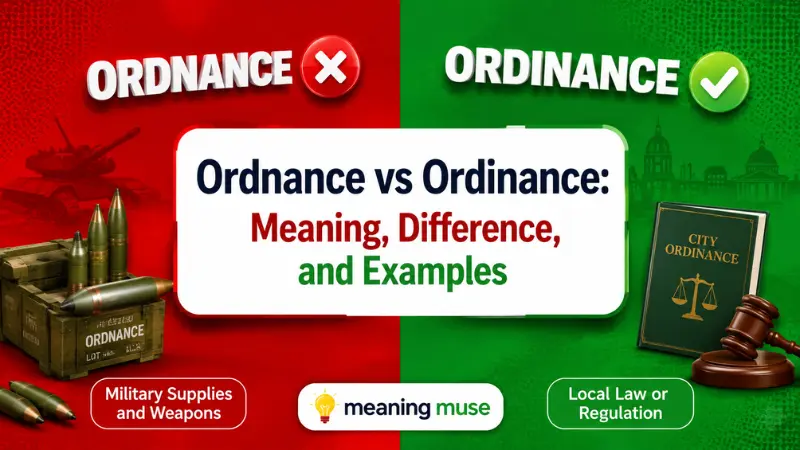
Ordnance is connected with military weapons, ammunition, and equipment. Ordinance usually means a law, rule, or official order.
For example, a military unit may handle explosive ordnance, while a city council may pass a parking ordinance.
The extra “i” changes the meaning of the word.
This guide explains the difference between ordnance vs ordinance, shows when each word is correct, and gives simple examples that make the choice easier to remember.
Quick Answer
Ordnance means military weapons, ammunition, artillery, or related military supplies. Ordinance means an official law, rule, or order, especially one passed by a city or local government.
Examples:
- The soldiers inspected the ordnance.
- The city passed a new noise ordinance.
Easy memory rule:
Ordnance = arms and ammunition.
Ordinance = official rule or law.
Ordnance vs Ordinance at a Glance
| Feature | Ordnance | Ordinance |
|---|---|---|
| Main meaning | Military weapons and supplies | Official law or rule |
| Common context | Military, defense, explosives | Government, cities, legal rules |
| Example phrase | explosive ordnance | city ordinance |
| Usually used as | Noun | Noun |
| Example | The team removed old ordnance. | The council approved an ordinance. |
| Key clue | Weapons | Law |
The quickest way to choose is to look at the topic.
If the sentence is about weapons or military equipment, use ordnance.
If it is about a law or official rule, use ordinance.
What Does Ordnance Mean?
Ordnance is a noun that refers to military weapons, ammunition, artillery, or related military equipment and supplies.
It is mainly used in military, defense, and safety contexts.
Examples include:
- artillery
- ammunition
- bombs
- military weapons
- explosive devices
- some types of military equipment
You may also see the word in phrases such as explosive ordnance and explosive ordnance disposal.
Ordnance Examples
- The military stored its ordnance in a secure area.
- Specialists were called to remove unexploded ordnance.
- The ship carried heavy ordnance.
- The unit was responsible for military ordnance.
- Old ordnance was discovered near the training area.
In these examples, the word is connected with weapons or military supplies.
Is Ordnance the Same as Ammunition?
Not exactly.
Ammunition usually refers to items such as bullets, shells, or other material used by weapons.
Ordnance can be broader. It may include military weapons, ammunition, artillery, and related equipment.
So ammunition can fall under the wider idea of ordnance in some contexts.
What Does Ordinance Mean?
Ordinance is a noun meaning an official rule, law, decree, or order made by an authority.
In American English, the word is especially common when talking about laws made by a city, town, county, or other local government.
Common phrases include:
- city ordinance
- local ordinance
- municipal ordinance
- zoning ordinance
- noise ordinance
- parking ordinance
Ordinance Examples
- The city passed a new parking ordinance.
- The noise ordinance limits loud music at night.
- Local businesses must follow the new ordinance.
- The council voted to change the zoning ordinance.
- Residents spoke against the proposed ordinance.
Each example deals with an official rule or law.
Ordinance vs Law
An ordinance is a type of law or official rule.
In U.S. usage, the word often refers specifically to rules passed by a local government.
For example, a city may have ordinances covering:
- parking
- zoning
- pets
- trash collection
- building rules
- noise
- local businesses
So every ordinance can function as a legal rule, but the word law has a much wider meaning.
What Is the Difference Between Ordnance and Ordinance?
The main difference is meaning.
Ordnance deals with military weapons.
Ordinance deals with laws or official rules.
Compare:
The army transported ordnance.
Here, ordnance refers to military weapons or supplies.
Now compare:
The city approved an ordinance.
Here, ordinance refers to an official local law.
Only one letter separates the spellings, but the meanings belong to very different subjects.
Think About the Topic
Ask yourself:
Is the sentence about the military or weapons?
Use ordnance.
Is the sentence about government rules or laws?
Use ordinance.
That simple test solves most cases.
How to Remember Ordnance vs Ordinance
A small memory trick can help.
Ordnance = Arms
Think:
Ordnance → arms
Both relate to weapons and military equipment.
You can also remember that ordnance is the shorter spelling, and military writing often uses short, specialized terms.
Ordinance = Official Rule
Think:
Ordinance → official order
Both ordinance and official contain the letter i.
That gives you a useful reminder:
The word with the extra “i” is the one about an official rule.
So:
- ordnance → military
- ordinance → official rule
Common Ordnance and Ordinance Examples
Seeing the words in natural sentences makes the difference easier to understand.
Correct Uses of Ordnance
- The military team safely removed the ordnance.
- Unexploded ordnance can remain dangerous for many years.
- The base had a secure area for storing ordnance.
- Specialists inspected the old military ordnance.
- The ship’s ordnance was checked before the mission.
Correct Uses of Ordinance
- The town adopted a new recycling ordinance.
- A local ordinance limits overnight parking.
- The council discussed the proposed zoning ordinance.
- Businesses must follow the city’s sign ordinance.
- The new ordinance takes effect next month.
Compare Them Side by Side
Incorrect: The city passed a noise ordnance.
Correct: The city passed a noise ordinance.
Why? A noise rule is a law, not military equipment.
Incorrect: The soldiers removed unexploded ordinance.
Correct: The soldiers removed unexploded ordnance.
Why? Explosive military material is ordnance.
Common Mistakes and How to Fix Them
Mistake 1: Using Ordinance for Weapons
Incorrect:
The military transported heavy ordinance.
Correct:
The military transported heavy ordnance.
Military weapons and supplies require ordnance.
Mistake 2: Using Ordnance for a Local Law
Incorrect:
The city adopted a parking ordnance.
Correct:
The city adopted a parking ordinance.
A city rule is an ordinance.
Mistake 3: Assuming They Are Two Spellings of One Word
They are not interchangeable modern spellings.
You cannot choose either spelling based on preference.
Their meanings are different.
Use the meaning of the sentence to decide which word you need.
Mistake 4: Looking Only at Pronunciation
The words can sound similar in fast speech, which is one reason people mix them up.
Do not rely only on sound.
Look at the meaning:
Military = ordnance.
Law = ordinance.
How Do You Pronounce Ordnance and Ordinance?
The pronunciations are similar, but ordinance normally has an extra syllable sound.
A simple pronunciation guide is:
ordnance: ORD-nuhns
ordinance: OR-duh-nuhns
The exact pronunciation can vary slightly by speaker.
The important point is that the words can sound close enough to cause confusion, especially in quick conversation.
In writing, however, their different spellings and meanings should stay clear.
Are Ordnance and Ordinance the Same Word?
No. In modern English, they are separate words with separate meanings.
They do share historical roots, which helps explain why they look so similar.
Over time, ordnance became the specialized form used for military weapons and supplies, while ordinance remained connected with orders, rules, and laws.
Today, writers should treat them as distinct words.
This means the difference is not:
- American vs British spelling
- formal vs informal spelling
- preferred vs alternative spelling
Instead, it is a meaning difference.
Choosing the wrong form changes what the sentence says.
Ordnance vs Ordinance in American English
Both words are standard in American English, but they appear in very different settings.
Ordnance in U.S. English
You are most likely to see ordnance in:
- military writing
- defense reports
- news about warfare
- military history
- safety warnings
- discussions of unexploded weapons
- specialized military jobs
The phrase unexploded ordnance is especially important in military and safety contexts.
Ordinance in U.S. English
You are more likely to see ordinance in everyday civic life.
Common examples include:
city ordinance
A rule passed by a city government.
noise ordinance
A local rule limiting certain levels or times of noise.
zoning ordinance
A rule controlling how land or buildings may be used.
parking ordinance
A local rule about where or when vehicles may park.
municipal ordinance
A law or regulation made by a local government.
For most American readers, these local-government uses are the most familiar examples of ordinance.
Word Forms and Grammar
Both ordnance and ordinance are nouns, but they behave a little differently.
Ordnance
Ordnance often works as a mass noun when referring generally to weapons or military supplies.
Example:
The team found unexploded ordnance.
We normally do not need to count individual items when using the word this way.
Useful related terms include:
- military ordnance
- naval ordnance
- explosive ordnance
- heavy ordnance
- unexploded ordnance
Ordinance
Ordinance is commonly a countable noun.
Singular:
The city passed an ordinance.
Plural:
The city reviewed several ordinances.
Useful combinations include:
- city ordinance
- local ordinance
- municipal ordinance
- zoning ordinance
- noise ordinance
- parking ordinance
Word History
The similar spellings are not an accident.
The two words have a shared history.
Ordnance developed as a shortened form related to ordinance. Over time, the shorter form became established for military weapons, artillery, and military supplies.
Meanwhile, ordinance continued to be used for an authoritative direction, order, decree, or law.
That history explains why the words look so close even though their modern meanings are different.
For today’s writer, however, the historical connection should not affect the choice.
Use:
ordnance for military weapons
and
ordinance for laws or official rules.
FAQs
What is the difference between ordnance and ordinance?
Ordnance refers to military weapons, ammunition, artillery, or related military supplies. Ordinance means an official law, rule, or order, especially one made by a local government.
Is it city ordnance or city ordinance?
The correct phrase is city ordinance when referring to a city law or rule.
Example:
The city ordinance limits overnight parking.
Is it explosive ordnance or explosive ordinance?
The correct military term is explosive ordnance.
Ordnance is the word connected with weapons and explosive military material.
Does ordnance mean ammunition?
Ordnance can include ammunition, but its meaning may be broader. It can refer to weapons, artillery, ammunition, and related military supplies.
Is ordinance another spelling of ordnance?
No. They are separate modern English words. Their spellings are similar because they are historically related, but their current meanings are different.
What is an ordinance in simple words?
An ordinance is an official rule or law. In the United States, the word often refers to a law passed by a city, town, or other local government.
How can I remember ordinance vs ordnance?
Remember:
Ordnance = weapons.
Ordinance = official rule.
The extra “i” in ordinance can remind you of the i in official.
Conclusion
The difference between ordnance vs ordinance comes down to one simple choice.
Use ordnance when writing about military weapons, ammunition, artillery, explosives, or related supplies.
Use ordinance when writing about a law, rule, decree, or official government order.
Compare:
The military removed unexploded ordnance.
The city passed a new ordinance.
When you are unsure, remember this rule:
Weapons = ordnance.
Rules = ordinance.
That quick check will help you choose the correct word in American English.