hould you write hone in or home in?
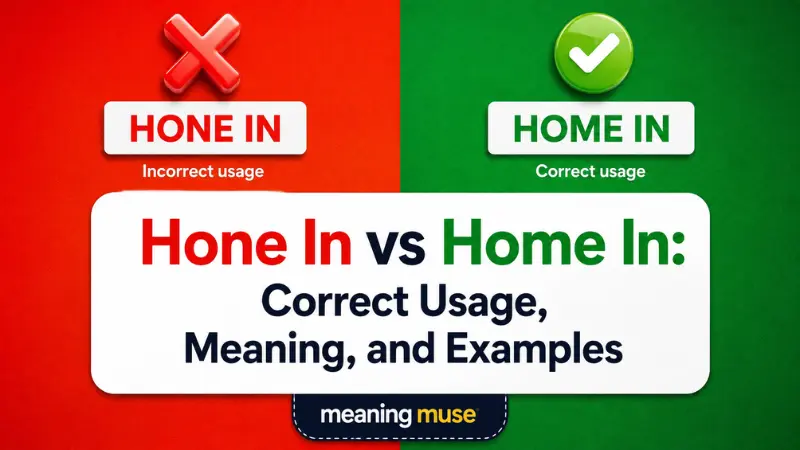
For careful American English, use home in on when you mean to move toward a target or focus closely on one subject.
Use hone without in when you mean to sharpen or improve something, such as a skill.
- The police homed in on the main suspect.
- She honed her writing skills.
- The report homes in on the biggest problem.
Hone in on is also common in modern American writing. Major dictionaries now record it. Still, many editors and readers consider it a mistaken form of home in on. For formal, academic, business, and publication writing, home in on remains the safest choice.
Quick Answer
Home in on is the original and widely recommended phrase.
It means:
- To move toward a target
- To focus closely on one issue
- To direct attention toward something
- To find the most important point
Hone in on is a common later version. It is used with the same meaning, especially in informal American English. However, some readers still see it as an error.
Remember this simple rule:
Home in on a target. Hone a skill.
Hone In vs Home In at a Glance
| Context | Best Choice | Why |
|---|---|---|
| Moving toward a target | Home in on | It comes from the verb “home” |
| Focusing on one problem | Home in on | It is the established phrase |
| Sharpening a skill | Hone | “Hone” means improve or sharpen |
| Formal business writing | Home in on | It avoids usage criticism |
| Academic writing | Home in on | It is the safer standard form |
| Informal speech | Either may appear | “Hone in on” is common but debated |
| Avoiding both phrases | Zero in on | It clearly means focus closely |
The clearest standard sentence is:
- We need to home in on the cause of the problem.
Which Is Correct: Hone In or Home In?
Home in on is the recommended choice in careful writing.
The phrase comes from the verb home, which can mean to move toward a destination or target by following a signal, direction, or landmark.
A missile may home in on a target. An animal may home in on a familiar location. A person can also home in on an idea, mistake, cause, or solution.
Cambridge defines home in on as aiming for something or giving close attention to a person or subject. Merriam-Webster also lists the verb home for moving or directing attention toward an objective.
Correct examples
- The pilot homed in on the landing signal.
- The detective homed in on one important clue.
- The discussion homed in on the cost of the plan.
- Researchers are homing in on the cause.
- The article homes in on three common mistakes.
In each example, something moves or focuses toward a clear target.
Is Hone In Wrong?
Hone in on is not rare. It appears often in modern American speech and writing.
Merriam-Webster lists it as an informal verb meaning to move toward or focus attention on an objective. However, the dictionary also notes that many people regard it as an error and recommends home in for writers who want to avoid criticism.
That creates a balanced answer:
- Hone in on is widely used.
- Home in on is still the safer standard form.
You may hear or read:
- Let’s hone in on the main issue.
- The team honed in on its target market.
- The article hones in on family life.
Most readers will understand these sentences. Still, some editors may change hone to home.
For polished writing, use:
- Let’s home in on the main issue.
- The team homed in on its target market.
- The article homes in on family life.
What Does Home In On Mean?
Home in on means to move directly toward a target or give close attention to one subject.
It can be used in a literal way or a figurative way.
Literal meaning
The literal meaning involves real movement toward a target.
- The missile homed in on the ship.
- The bird homed in on its nesting area.
- The rescue team homed in on the radio signal.
In these examples, something follows a signal, direction, or clue.
Figurative meaning
The figurative meaning involves attention rather than physical movement.
- The teacher homed in on the student’s main weakness.
- The report homes in on rising housing costs.
- The police homed in on one possible motive.
- The company is homing in on younger buyers.
Here, the subject focuses more closely on one idea, person, problem, or goal.
What Does Hone Mean?
The verb hone means to sharpen something or make it better through practice.
It was first used for sharpening objects with a fine stone. Today, it is also commonly used for improving an ability, plan, method, or performance.
Correct uses of hone
- Hone a knife
- Hone a blade
- Hone your skills
- Hone your technique
- Hone your message
- Hone your argument
- Hone your strategy
- Hone your talent
Examples
- She honed her speaking skills through daily practice.
- The chef carefully honed the knife.
- He spent years honing his craft.
- The team must hone its sales message.
- Regular training helped her hone her technique.
Notice that hone usually takes a direct object.
You hone something:
- Hone your skills.
- Hone the plan.
- Hone the message.
When you are moving toward a target, use home in on:
- Home in on the solution.
- Home in on the target.
- Home in on the main issue.
Why Do People Say Hone In?
People often use hone in because the phrase sounds logical.
The verb hone means to sharpen or improve. A person who focuses on one topic may seem to be sharpening their attention. Because of that meaning, hone in on a problem can feel natural.
The words home and hone also sound very similar. They differ only in their final sound:
- Home ends with an m sound.
- Hone ends with an n sound.
The expression home in on may also be less familiar than phrases such as come home or stay home. Some speakers do not realize that home can function as a verb meaning to move toward an objective.
These factors helped hone in on become common. American Heritage describes it as an alteration of home in on and notes that the idea of sharpening one’s focus may have encouraged the newer version.
Home In On vs Hone In On
The full expressions usually include the preposition on.
Standard form
Home in on + target or subject
- Home in on the answer
- Home in on the cause
- Home in on the suspect
- Home in on the customer’s needs
- Home in on the main point
Common but debated form
Hone in on + target or subject
- Hone in on the answer
- Hone in on the cause
- Hone in on the suspect
- Hone in on the customer’s needs
- Hone in on the main point
Both forms communicate the same general idea in modern use. The difference is acceptability.
Home in on is established and broadly accepted.
Hone in on is common but may still attract criticism.
Homing In or Honing In?
The same rule applies when the verb ends in -ing.
Use homing in when something is moving or focusing toward a target.
- The police are homing in on the suspect.
- The team is homing in on a final design.
- Scientists are homing in on the cause.
- The report is homing in on the biggest risk.
Use honing when someone is improving or sharpening something.
- She is honing her skills.
- He is honing his argument.
- The team is honing its plan.
- I am honing my writing style.
Compare the meanings
- We are homing in on the answer.
- We are honing our research skills.
The first sentence means we are getting closer to the answer.
The second sentence means we are improving our skills.
Homed In or Honed In?
Use homed in on as the standard past-tense phrase.
- The detective homed in on a key witness.
- The company homed in on a younger audience.
- The discussion homed in on safety concerns.
- Researchers homed in on two possible causes.
Use honed when someone improved or sharpened something.
- The athlete honed her technique.
- He honed his skills at college.
- The editor honed the article’s message.
- The chef honed the blade.
Honed in on is widely understood, but homed in on is safer for formal writing.
A Simple Memory Trick
Use this memory rule:
A pigeon homes. A person hones.
A homing pigeon moves toward home.
A person hones a skill by making it sharper or better.
You can also remember:
Home toward. Hone better.
- Home in on = move or focus toward something
- Hone = improve something
Target test
Ask yourself:
Am I moving or focusing toward a target?
Use home in on.
- The police homed in on the suspect.
- The report homes in on the main problem.
Skill test
Ask yourself:
Am I improving or sharpening something?
Use hone.
- She honed her skills.
- He honed his argument.
Home In, Hone In, and Zero In
Zero in on is a useful alternative to home in on.
It means to focus attention on a specific target, idea, or problem.
Merriam-Webster recommends zero in on as an option for writers who want to avoid confusion between home and hone.
Examples
- The report zeroes in on the main cause.
- Police zeroed in on one suspect.
- Let’s zero in on the customer’s concern.
- The study zeroes in on childhood reading habits.
Compare:
- We need to home in on the problem.
- We need to zero in on the problem.
Both are clear and widely accepted.
Formal vs Informal Usage
Formal writing
Use home in on in:
- Academic papers
- Business reports
- News articles
- Professional emails
- School assignments
- Legal writing
- Technical documents
- Edited publications
Example:
- The study homes in on the main cause of the decline.
Informal writing
You may see hone in on in:
- Social media posts
- Casual emails
- Interviews
- Online articles
- Everyday conversation
- Advertising copy
Example:
- Let’s hone in on what customers really want.
This sentence is understandable and common. Still, home in on avoids debate and works in both formal and informal settings.
US vs UK Usage
The same basic distinction applies in American and British English.
Home in on is the established phrase for moving or focusing toward a target.
Hone in on appears most strongly in modern American usage, though readers in other English-speaking regions may also encounter it.
Cambridge includes home in on in both its British and American dictionary sections. It defines the phrase as aiming for something or paying close attention to it.
For an international audience, home in on is the clearer choice.
Common Mistakes and Quick Fixes
Mistake 1: Hone your target
Unclear:
- The missile honed its target.
Correct:
- The missile homed in on its target.
A missile moves toward the target. It does not improve it.
Mistake 2: Home your skills
Incorrect:
- She homed her writing skills.
Correct:
- She honed her writing skills.
Skills are improved or sharpened, so hone is correct.
Mistake 3: Leaving out “on”
Awkward:
- The report homed in the problem.
Correct:
- The report homed in on the problem.
The full expression is normally home in on.
Mistake 4: Using hone in in formal writing
Debated:
- The research hones in on sleep habits.
Safer:
- The research homes in on sleep habits.
- The research focuses on sleep habits.
Mistake 5: Changing every use of hone
Not every use of hone is wrong.
Correct:
- Hone your skills.
- Hone the message.
- Hone your technique.
- Hone the blade.
Only the expression hone in on creates a usage debate.
Mistake 6: Confusing sound with meaning
Because home and hone sound similar, a spell-checker may not catch the wrong choice.
Read the sentence for meaning:
- Target or focus → home in on
- Sharpen or improve → hone
Everyday Examples
Correct examples with home in on
- The police homed in on the stolen car.
- The teacher homed in on the student’s main problem.
- The report homes in on rising food prices.
- Scientists are homing in on a possible cause.
- The team homed in on three strong candidates.
- We need to home in on the customer’s real concern.
- The camera homed in on the player’s face.
- The article homes in on common money mistakes.
- The dog homed in on the smell of food.
- Detectives homed in on one important clue.
- The company is homing in on a younger market.
- Her questions homed in on the main issue.
- The search team homed in on the radio signal.
- The meeting homed in on next year’s budget.
- The doctor homed in on the source of the pain.
Correct examples with hone
- She practiced every day to hone her skills.
- The chef honed the knife before dinner.
- He used the class to hone his writing.
- The team is honing its sales plan.
- Years of practice honed her talent.
- The speaker honed his message.
- She wants to hone her leadership skills.
- The player worked to hone his passing.
- Editors helped hone the final draft.
- The company must hone its strategy.
Common informal examples with hone in on
These sentences are common and easy to understand, but careful editors may prefer home in on:
- Let’s hone in on the main issue.
- The team honed in on one design.
- Researchers are honing in on the cause.
- The article hones in on family problems.
- Police honed in on a suspect.
For publication-ready writing, change them to:
- Let’s home in on the main issue.
- The team homed in on one design.
- Researchers are homing in on the cause.
- The article homes in on family problems.
- Police homed in on a suspect.
Verb Forms
| Base Form | Present Form | Past Form | -ing Form |
| Home in on | Homes in on | Homed in on | Homing in on |
| Hone in on | Hones in on | Honed in on | Honing in on |
| Hone | Hones | Honed | Honing |
Home in on
- I home in on the strongest clue.
- She homes in on the main point.
- They homed in on the problem.
- We are homing in on a solution.
Hone
- I hone my skills.
- She hones her technique.
- They honed their plan.
- We are honing our message.
Synonyms for Home In On
Useful alternatives include:
- Zero in on
- Focus on
- Concentrate on
- Aim at
- Target
- Direct attention to
- Narrow down
- Pinpoint
- Move toward
- Identify
- Center on
Merriam-Webster’s thesaurus connects the debated form with alternatives such as home in on, zero in on, focus, aim, direct, and concentrate.
Example replacements
- Let’s home in on the problem.
- Let’s focus on the problem.
- Let’s zero in on the problem.
- Let’s pinpoint the problem.
The best replacement depends on the sentence.
Phrases Containing Home and Hone
Common phrases with home in
- Home in on a target
- Home in on the problem
- Home in on the cause
- Home in on the answer
- Home in on a suspect
- Home in on a solution
- Home in on the main point
- Home in on the customer’s needs
- Home in on the details
- Home in on an opportunity
Common phrases with hone
- Hone your skills
- Hone your craft
- Hone your technique
- Hone your talent
- Hone your message
- Hone your argument
- Hone your strategy
- Hone your abilities
- Hone your instincts
- Hone a blade
The pattern makes the difference easy to see:
- Home in on an outside target.
- Hone an ability, object, plan, or method.
FAQs
Is it hone in or home in?
Use home in on when you mean to move toward a target or focus closely on a subject. Hone in on is common and dictionary-listed, but many editors still view it as an error.
Is hone in grammatically correct?
Major dictionaries record hone in because it is widely used. However, it remains debated. For formal writing, home in on is the safer choice.
What does home in on mean?
Home in on means to move directly toward something or focus attention closely on one person, problem, idea, or target.
What does hone in on mean?
In modern informal use, hone in on has the same meaning as home in on. It means to focus on or move toward a target. Still, some readers consider it incorrect.
Is it homing in or honing in?
Use homing in for moving or focusing toward a target. Use honing for improving a skill, plan, technique, or object.
Is it homed in or honed in?
Homed in on is the recommended past-tense expression. Honed in on is common but still criticized by some editors.
Can you hone a skill?
Yes. Hone a skill means to improve or perfect it through practice.
Example:
- She honed her speaking skills.
Can you home in on a problem?
Yes. To home in on a problem means to direct attention toward it and identify its most important part.
Does home in always need “on”?
When the phrase means to focus closely on a target, it is normally written as home in on.
Example:
- The report homes in on the main concern.
What is another phrase for home in on?
Good alternatives include zero in on, focus on, concentrate on, pinpoint, and direct attention to.
Should I use hone in on in an article?
You can, because the phrase is common and widely understood. However, home in on is less likely to be challenged or corrected, so it is better for polished articles.
How can I remember home in vs hone in?
Remember:
Home in on a target. Hone a skill.
Conclusion
Both hone in and home in appear in modern American English, but they do not have equal status.
Home in on is the original, established, and safest expression when you mean to move toward a target or focus closely on a subject.
Hone in on is common and appears in dictionaries, especially as informal American usage. Even so, many editors and careful readers still consider it a mistaken version of home in on.
Use hone by itself when you mean to sharpen or improve something:
- Hone your skills.
- Hone your message.
- Hone the blade.
Use home in on when you mean to focus or move toward something:
- Home in on the problem.
- Home in on the target.
- Home in on the best solution.
The simplest rule is:
Home in on what you seek. Hone what you improve.