Strife vs strive is easy to mix up because the words look almost the same. They also sound similar. But they have very different jobs in a sentence.
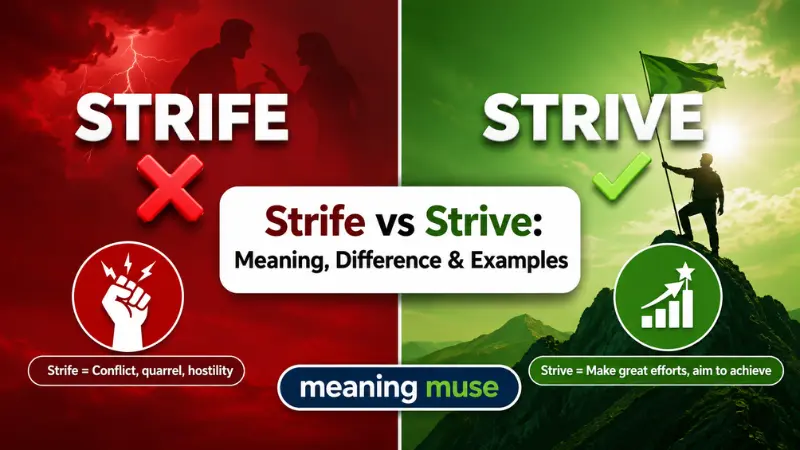
Strife is a noun. It means serious disagreement, conflict, trouble, or fighting.
Strive is a verb. It means to try very hard to reach a goal or make something happen.
For example:
The family wanted to end years of strife.
Here, strife means conflict.
She strives to become a better writer.
Here, strives means tries very hard.
The easiest memory trick is:
Strife = conflict. Strive = effort.
Once you know that difference, choosing the right word becomes much easier.
Quick Answer
The difference between strife and strive is meaning and grammar.
- Strife is a noun meaning conflict, disagreement, or struggle.
- Strive is a verb meaning to work or try very hard toward a goal.
Example:
The community faced years of strife, but its leaders continued to strive for peace.
In the same sentence, strife names the conflict, while strive describes the effort to improve the situation.
Easy Memory Trick
Think:
Strife has F = fighting.
Strive has V = verb.
It is not a perfect spelling rule, but it can help you remember which word does which job.
Strife vs Strive at a Glance
| Feature | Strife | Strive |
|---|---|---|
| Part of speech | Noun | Verb |
| Basic meaning | Conflict or serious disagreement | Try very hard |
| Simple replacement | Conflict | Try hard |
| Example | family strife | strive for success |
| Common pattern | strife between people | strive to improve |
| Pronunciation ending | Rhymes with life | Rhymes with drive |
| Describes | A problem or condition | An action or effort |
The shortest difference is:
Strife is something people experience. Strive is something people do.
What Does Strife Mean?
Strife means serious conflict, disagreement, or trouble between people or groups.
It is a noun.
You might hear about:
- family strife
- political strife
- civil strife
- labor strife
- social strife
- internal strife
Example:
Money problems caused strife in the family.
This means the money problems caused conflict or serious disagreement.
Another example:
The country suffered years of political strife.
Here, strife describes ongoing political conflict.
Is Strife the Same as an Argument?
Not exactly.
An argument can be one disagreement.
Strife usually suggests a more serious or continuing state of conflict.
Compare:
They had an argument last night.
That may describe one event.
There was years of strife between the two families.
This suggests a longer period of conflict.
So strife often feels stronger than a simple disagreement.
What Does Strive Mean?
Strive means to make a strong effort to do, reach, or achieve something.
It is a verb.
Example:
We strive to improve every day.
This means we work hard or make a serious effort to improve.
You can strive for:
- success
- peace
- excellence
- progress
- happiness
- better results
- a goal
You can also strive to:
- learn
- improve
- win
- succeed
- help
- change
- grow
Example:
She strives to get better grades.
The sentence tells us what she is trying hard to do.
Is Strive Stronger Than Try?
Often, yes.
Try is the common everyday word.
Strive usually suggests a stronger or more continued effort.
Compare:
I will try to improve.
This simply says you will make an effort.
I will strive to improve.
This sounds more serious. It suggests dedication and continued effort.
That is why strive often appears when people talk about goals, progress, values, and improvement.
What Is the Main Difference Between Strife and Strive?
The main difference is simple:
Strife names conflict. Strive describes effort.
They also belong to different parts of speech.
Strife Is a Noun
The dispute created strife.
The word names a condition.
Strive Is a Verb
They strive to solve the dispute.
The word describes an action.
You can even use both words together:
The team faced internal strife but continued to strive for better results.
Here:
- strife = conflict
- strive = make a strong effort
This example shows why the two words cannot be switched.
Why Do People Confuse Strife and Strive?
There are three main reasons.
They Look Similar
Only one letter changes at the end:
strife
strive
That small difference is easy to miss when reading or typing quickly.
They Sound Similar
The first part of both words sounds the same.
However, the endings are different:
strife rhymes with life
strive rhymes with drive
Listening for the final sound can help.
Their History Is Connected
The words have old historical links to ideas of struggle, conflict, and effort.
That helps explain why their spellings are so similar.
Modern English, however, gives them clearly different jobs.
Strife mainly names conflict.
Strive mainly describes determined effort.
How to Pronounce Strife and Strive
Pronunciation is useful here because the words differ by their final sound.
Strife
Say it like:
STRYFE
It rhymes with:
- life
- wife
- knife
Example:
family strife
Strive
Say it like:
STRYVE
It rhymes with:
- drive
- five
- alive
Example:
strive for success
The difference is at the end:
strife → f sound
strive → v sound
When Should You Use Strife?
Use strife when you mean conflict, serious disagreement, or trouble between people or groups.
Family Conflict
The disagreement caused strife between the brothers.
Political Conflict
Years of political strife hurt the country.
Workplace Conflict
Poor communication created strife among the staff.
Social Conflict
The leaders hoped to reduce social strife.
Conflict Inside a Group
Internal strife divided the organization.
In all these cases, strife names a difficult condition.
A simple test is to replace it with conflict.
If the sentence still makes sense, strife may be correct.
The disagreement caused conflict.
The disagreement caused strife.
Both work.
When Should You Use Strive?
Use strive when someone makes a serious effort toward a goal.
Personal Goals
I strive to be more patient.
School
Students should strive to do their best.
Work
Our team strives to give customers good service.
Improvement
She always strives to improve her skills.
Peace
The two sides continue to strive for peace.
Success
He strives for success in everything he does.
A simple test is to replace strive with try hard.
We strive to improve.
We try hard to improve.
The basic meaning remains the same.
Strive To or Strive For?
Both forms are correct, but they are used differently.
Strive to + Verb
Use strive to before an action.
Examples:
strive to improve
strive to win
strive to learn
strive to help
strive to succeed
Sentence:
We strive to give every customer a good experience.
Strive for + Noun
Use strive for before a thing, result, or goal.
Examples:
strive for success
strive for peace
strive for excellence
strive for improvement
Sentence:
The students strive for better results.
Remember:
strive to + action
strive for + goal
Common Phrases With Strife
Knowing common word combinations can make strife easier to use naturally.
Civil Strife
Conflict within a country or society.
The region experienced years of civil strife.
Political Strife
Strong conflict connected with politics.
Political strife divided the community.
Family Strife
Conflict within a family.
The decision caused family strife.
Labor Strife
Conflict between workers and employers or within labor relations.
The company hoped to avoid labor strife.
Internal Strife
Conflict within one organization, group, family, or system.
Internal strife weakened the team.
Notice that strife often follows a word that tells us what kind of conflict is happening.
Common Phrases With Strive
Strive often appears with goals and positive actions.
Common combinations include:
- strive for success
- strive for excellence
- strive for peace
- strive for improvement
- strive to improve
- strive to succeed
- strive to achieve
- strive to become
- strive to provide
- strive toward a goal
Examples:
We strive for excellence.
She strives to become a better teacher.
They continue to strive for peace.
He strives to achieve his goals.
These patterns are useful in school, business, speeches, and everyday writing.
Forms of Strive
Because strive is a verb, its form can change.
Present
strive
I strive to improve.
Third-Person Present
strives
She strives to improve.
-ing Form
striving
They are striving for better results.
Past
Two accepted past forms are:
strove
and
strived
Example:
He strove to finish the work.
He strived to finish the work.
Both forms can be correct.
Past Participle
You may see:
striven
or
strived
Example:
They have striven to make things better.
They have strived to make things better.
For beginners, the most important point is not to confuse these verb forms with strife.
Does Strife Have Verb Forms?
In normal modern English, strife is used as a noun.
You do not normally say:
I strife for success.
That is wrong.
Use:
I strive for success.
Likewise:
She is striving to improve.
Not:
She is strafing to improve.
The verb you need is strive.
Common Mistakes and Quick Fixes
Mistake 1: “I strife to do my best.”
Incorrect.
Correct:
I strive to do my best.
You need a verb describing effort.
Mistake 2: “There was a lot of strive in the family.”
Incorrect in normal modern usage.
Correct:
There was a lot of strife in the family.
You need the noun meaning conflict.
Mistake 3: “They strive with each other all year.”
This may be possible in an older or special sense of struggling against someone, but it is not the best choice if you simply mean ongoing conflict.
For clear modern writing:
There was strife between them all year.
Mistake 4: “She strifes for excellence.”
Incorrect.
Correct:
She strives for excellence.
The third-person form of strive is strives.
Mistake 5: Thinking Strife Means Hard Work
In modern everyday English, strife normally refers to conflict or serious disagreement.
If you mean serious effort, use strive.
Strife vs Strive in Everyday Sentences
Compare these pairs.
Example 1
Strife:
The argument caused strife in the family.
Strive:
The family will strive to solve the problem.
Example 2
Strife:
Political strife divided the city.
Strive:
Local leaders strive for unity.
Example 3
Strife:
The team suffered from internal strife.
Strive:
The players strive to work together.
Example 4
Strife:
Years of strife made life difficult.
Strive:
People continued to strive for a better future.
Example 5
Strife:
The company wanted to prevent workplace strife.
Strive:
Managers strive to build a better workplace.
Each pair shows the same pattern:
Strife = the conflict
Strive = the effort
Dictionary-Style Word Details
Verb
Strife:
Strife is not normally used as a verb in modern standard English. It is mainly a noun.
Strive:
Strive is an intransitive verb meaning to make a strong effort or work hard toward something.
Common forms:
- strive
- strives
- striving
- strove
- strived
- striven
Example:
We strive to make progress.
Noun
Strife:
A noun meaning serious conflict, disagreement, or struggle.
Example:
The dispute caused strife between the neighbors.
Strive:
Strive is normally used as a verb, not a noun.
If you need a noun for the act of trying, words such as effort or attempt may fit better.
Synonyms
Useful synonyms for strife include:
- conflict
- discord
- dissension
- contention
- fighting
- disagreement
The exact choice depends on context.
Useful alternatives for strive include:
- try
- endeavor
- work
- struggle
- attempt
- make an effort
Again, they do not all have exactly the same strength.
Strive often suggests serious or continued effort.
Example Sentences
Strife: The dispute created strife in the neighborhood.
Strive: We strive to treat everyone fairly.
Strife: The group was weakened by internal strife.
Strive: She strives to improve every day.
Strife: Years of political strife hurt the region.
Strive: Leaders continued to strive for peace.
Strife: Money can sometimes cause family strife.
Strive: He strives to reach his goals.
Word History
Strife and strive have related histories.
Both came into English long ago through forms connected with conflict, struggle, and effort.
Earlier uses of strive could have a stronger sense of fighting or contending with someone.
Over time, the words developed different main jobs in modern English.
Today:
strife mainly names conflict.
strive mainly means making a strong effort.
Their shared history helps explain why the words look so similar even though their modern meanings are different.
Phrases Containing
Common phrases with strife:
- civil strife
- political strife
- family strife
- labor strife
- internal strife
- social strife
Common phrases with strive:
- strive for success
- strive for excellence
- strive for peace
- strive to improve
- strive to succeed
- strive to achieve
- strive toward a goal
FAQs
What is the difference between strife and strive?
Strife is a noun meaning conflict or serious disagreement. Strive is a verb meaning to try very hard to reach a goal.
Is strife the same as strive?
No. They are different words. Strife names conflict, while strive describes strong effort.
Is it “strife for success” or “strive for success”?
The correct phrase is strive for success because strive is the verb meaning to make a strong effort.
What is an example of strife?
The disagreement caused strife between the two families.
Here, strife means serious conflict.
What is an example of strive?
She strives to become a better student.
Here, strives means tries very hard.
Is strife a verb?
Not in normal modern use. Strife is mainly a noun. Use strive when you need the verb.
What is the past tense of strive?
Both strove and strived are accepted past-tense forms. You may also see striven or strived as past participles.
How do you remember strife vs strive?
Remember:
Strife = fighting or conflict.
Strive = trying hard.
You can also remember that the V in strive can remind you that it is a verb.
Conclusion
The difference between strife vs strive is simple once you know their jobs.
Strife is a noun. It means serious conflict, disagreement, or trouble.
Strive is a verb. It means to work or try very hard to reach a goal.
Remember this quick rule:
Strife = conflict.
Strive = effort.
So you may experience strife, but you strive to make things better.
That one difference will help you choose the correct word in almost every sentence.