Divisive and decisive look and sound similar, but they describe very different things.
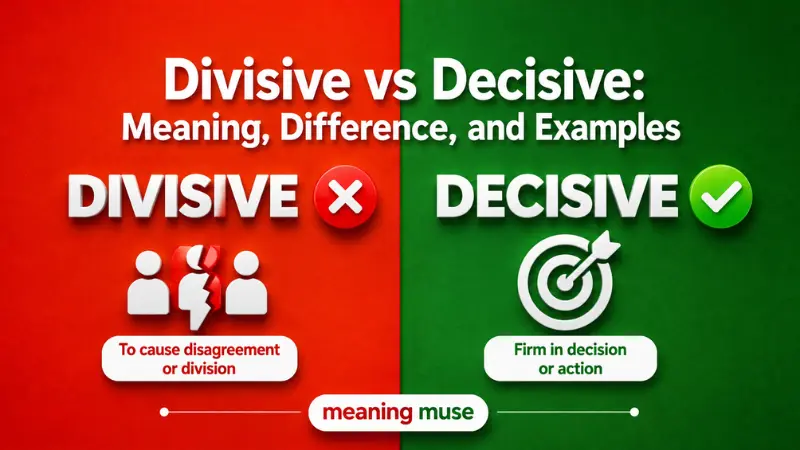
Use divisive for something that causes disagreement or separates people into opposing groups.
Use decisive for someone who makes firm choices or for something that produces a clear, final result.
Compare these sentences:
The new policy was divisive.
The policy caused people to disagree.
The manager was decisive.
The manager made a firm choice without unnecessary delay.
Both words are correct. They are not alternate spellings, and one cannot replace the other without changing the meaning.
This guide explains the difference between divisive and decisive, including their meanings, pronunciation, tone, related forms, and common uses in American English.
Quick Answer
Divisive means causing disagreement or division. Decisive means firm in making choices or powerful enough to settle a matter.
Use divisive for an issue, comment, policy, person, or idea that splits people:
The proposal became a divisive issue in the community.
Use decisive for a person who makes clear choices or for an action or result that settles something:
The coach made a decisive change before the final quarter.
Remember this simple difference:
- Divisive creates division.
- Decisive creates or settles a decision.
Why People Confuse Them
Divisive and decisive are often confused because they share the same beginning and ending:
- di-vi-sive
- de-ci-sive
Both are also adjectives. That means they describe a person, action, event, idea, or result.
Their meanings can appear in the same situation. A leader may need to make a decisive choice about a divisive issue.
The mayor took decisive action on a divisive problem.
In this sentence:
- divisive describes the problem because people strongly disagree about it
- decisive describes the action because it is firm and clear
The easiest way to separate the words is to connect them with their related nouns:
- divisive → division
- decisive → decision
If something creates division, use divisive.
If something shows a firm decision or settles the result, use decisive.
Key Differences at a Glance
| Context | Best Choice | Why |
|---|---|---|
| A topic causes strong disagreement | Divisive | It divides people into opposing groups |
| A leader makes a firm choice | Decisive | The leader acts with confidence |
| A vote settles the result | Decisive | It determines the final outcome |
| A speech turns groups against each other | Divisive | It creates conflict or division |
| A team wins by a clear margin | Decisive | The result leaves little doubt |
| A public figure causes strong opposing reactions | Divisive | People have sharply different views |
| One fact determines the answer | Decisive | The fact settles the question |
| A policy creates tension in a community | Divisive | The policy causes disagreement |
The central difference is simple:
Divisive separates people. Decisive settles choices or results.
Are They the Same Word?
No. Divisive and decisive are separate words.
They are not:
- regional spellings
- optional spelling forms
- interchangeable adjectives
- American and British versions of one word
Both words are standard in American and British English.
They also come from different word families.
Divisive Belongs to the “Divide” Family
Words in this family include:
- divide
- division
- divisive
- divisively
- divisiveness
They relate to separation or disagreement.
The argument divided the group.
It became a divisive argument.
Decisive Belongs to the “Decide” Family
Words in this family include:
- decide
- decision
- decisive
- decisively
- decisiveness
They relate to making a choice or settling an outcome.
The judge will decide the case.
One piece of evidence may be decisive.
The words can sometimes describe the same person, event, or action from different viewpoints.
The president made a decisive but divisive decision.
The decision was decisive because it was firm and had a strong effect. It was divisive because it caused disagreement.
Meaning and Usage Difference
What Does Divisive Mean?
Divisive means causing disagreement, conflict, or separation among people.
It often describes something that divides a group into opposing sides.
Common nouns used with divisive include:
- issue
- topic
- policy
- debate
- figure
- speech
- comment
- idea
- campaign
- question
- language
- decision
Examples:
School funding became a divisive issue.
His comments were deeply divisive.
The proposal led to a divisive public debate.
Divisive often has a negative tone. It suggests that disagreement has become serious, unfriendly, or harmful.
However, divisive does not simply mean unpopular.
Something unpopular is disliked by many people. Something divisive creates strong opposing groups.
For example, a rule may be unpopular because almost everyone dislikes it. That does not make it divisive if people mostly agree.
A policy is divisive when one group strongly supports it while another strongly opposes it.
What Does Decisive Mean?
Decisive has several closely related meanings.
1. Able to Make Firm Decisions
A decisive person chooses a course of action with confidence.
Our new supervisor is calm and decisive.
This does not mean the person always makes the correct choice. It means the person can make a clear choice without endless delay.
2. Settling a Question or Outcome
Something decisive may determine the final result.
Her final vote was decisive.
The vote settled the matter.
3. Clear and Strong
Decisive can describe a victory, result, advantage, or action that leaves little doubt.
The team earned a decisive victory.
The team won clearly, not by a tiny or uncertain margin.
Common nouns used with decisive include:
- action
- decision
- vote
- victory
- factor
- evidence
- moment
- step
- result
- advantage
- leader
- response
Decisive usually has a positive or neutral tone. It often suggests confidence, clarity, strength, or effectiveness.
US vs UK Preference
There is no major American and British spelling difference between these words.
Both varieties use:
- divisive
- decisive
You should not choose between them based on location or house style. Choose according to meaning.
Pronunciation can vary slightly, especially for divisive. Many American speakers pronounce it roughly as dih-VY-siv, while another accepted pronunciation uses a shorter middle vowel.
Decisive is commonly pronounced approximately as dih-SY-siv.
The most useful sound difference is:
- di-VY-sive
- de-SY-sive
Even when the words sound similar, their related words provide a stronger memory clue:
- division → divisive
- decision → decisive
Which Word Should You Use?
Choose the word by asking what is happening.
Does It Cause People to Disagree?
Use divisive.
The new rule proved divisive among parents.
The rule separated parents into opposing groups.
Does It Show a Firm Choice?
Use decisive.
The principal took decisive action after the incident.
The principal acted clearly and firmly.
Does It Determine the Outcome?
Use decisive.
The final goal was decisive.
The goal settled the result of the game.
Does It Create Conflict Between Groups?
Use divisive.
The ad used divisive language.
The language encouraged disagreement or separation.
Is the Person Confident About Making Choices?
Use decisive.
Mia is a decisive team leader.
She can make clear choices when the team needs direction.
Does the Person Produce Strong Opposing Opinions?
Use divisive.
The director remains a divisive public figure.
Some people may strongly support the director, while others strongly oppose them.
Quick Comparison
- Divisive issue: an issue that splits people
- Decisive issue: uncommon; an issue that determines the result in a special context
- Divisive leader: a leader who separates people into opposing groups
- Decisive leader: a leader who makes firm choices
- Divisive action: an action that creates disagreement
- Decisive action: an action that settles a problem or changes the outcome
When One Choice Looks Wrong
Using the wrong word can completely change the sentence.
Incorrect
The coach made a divisive choice in the final seconds.
This sentence means the choice caused disagreement. That may be possible, but it does not mean the coach acted firmly.
Correct for a Firm Choice
The coach made a decisive choice in the final seconds.
Incorrect
The debate became highly decisive.
A debate that causes disagreement is usually divisive, not decisive.
Correct
The debate became highly divisive.
Incorrect
She is a divisive manager who makes quick, confident choices.
This describes a manager who causes conflict, not merely one who decides quickly.
Correct
She is a decisive manager who makes quick, confident choices.
Incorrect
The final point gave the team a divisive victory.
A victory does not normally divide itself into opposing groups.
Correct
The final point gave the team a decisive victory.
Both Words May Be Correct
Sometimes either word can fit, but the meaning changes.
It was a divisive decision.
The decision caused disagreement.
It was a decisive decision.
The decision was firm or settled an important matter.
A decision can also be both:
It was a decisive but divisive decision.
It clearly settled the issue, but it also split public opinion.
Common Mistakes and Quick Fixes
Mistake 1: Treating Them as Spelling Variants
Divisive and decisive are not different spellings of one adjective.
Quick fix: Connect divisive with division and decisive with decision.
Mistake 2: Using Divisive for a Confident Person
Incorrect:
Our captain is bold and divisive.
This says the captain causes disagreement.
Correct:
Our captain is bold and decisive.
This says the captain makes firm choices.
Mistake 3: Using Decisive for a Controversial Topic
Incorrect:
Taxes can be a decisive political topic.
Better:
Taxes can be a divisive political topic.
Use divisive when people strongly disagree.
Mistake 4: Assuming Divisive Means Difficult
A difficult issue is hard to solve. A divisive issue splits people into opposing groups.
An issue can be:
- difficult but not divisive
- divisive but easy to understand
- both difficult and divisive
Quick fix: Look for disagreement between people, not just difficulty.
Mistake 5: Assuming Decisive Means Correct
A decisive person makes firm choices, but those choices can still be wrong.
The manager was decisive, but the plan failed.
Quick fix: Decisive describes firmness or effect, not guaranteed wisdom.
Mistake 6: Confusing Decisive With Indecisive
Decisive means firm and able to choose.
Indecisive means unable or slow to choose.
A decisive leader chose one plan.
An indecisive leader kept changing plans.
Mistake 7: Confusing Divisive With Divisible
Divisive means causing disagreement.
Divisible means able to be divided, especially in mathematics.
The speech was divisive.
Twelve is divisible by three.
These words belong to the same broad family but have different uses.
Mistake 8: Overusing Divisive for Any Disagreement
A small disagreement is not always divisive.
Divisive usually suggests a stronger split that places people into opposing sides.
Instead of writing:
We had a divisive talk about where to eat.
A more natural sentence may be:
We disagreed about where to eat.
Use divisive when the disagreement is important or creates real division.
Everyday Examples
Examples With Divisive
- The proposal became a divisive issue in the neighborhood.
- His speech used divisive language.
- The new policy divided the staff and proved highly divisive.
- The movie was popular but divisive.
- Immigration remains a divisive political topic.
- The candidate became a divisive public figure.
- Personal attacks made the discussion more divisive.
- The board avoided a divisive debate during the meeting.
- Her comment had a divisive effect on the group.
- The campaign focused on several divisive social questions.
Examples With Decisive
- The manager took decisive action.
- One vote became the decisive factor.
- The team won a decisive victory.
- She is confident and decisive under pressure.
- The final test provided decisive evidence.
- His quick response was decisive in preventing more damage.
- The judge’s ruling marked a decisive moment in the case.
- We need a decisive leader during this crisis.
- The company made a decisive move into the new market.
- A decisive answer ended the debate.
Examples Using Both Words
- The governor made a decisive choice about a divisive issue.
- The debate was divisive, but the final vote was decisive.
- A decisive leader must sometimes address divisive topics.
- Her decisive response ended a divisive argument.
- The policy was decisive in reducing costs but divisive among workers.
- The committee took decisive action after months of divisive debate.
- His decisive victory followed a long and divisive campaign.
- The ruling was both decisive and divisive.
- The mayor gave a decisive answer to a divisive question.
- A divisive proposal required a decisive vote.
Dictionary-Style Word Details
Adjective
Both divisive and decisive are adjectives.
Divisive describes something or someone that causes disagreement or separation.
The subject remains divisive.
Decisive describes someone who makes firm choices or something that determines a result.
She gave a decisive answer.
The final vote was decisive.
Verb
Neither divisive nor decisive is normally used as a verb.
Use these related verbs:
- divide for divisive
- decide for decisive
The issue divided the community.
The council will decide tomorrow.
Do not write:
The issue divisived the community.
She decisived what to do.
Noun
Neither word normally functions as a noun.
The related noun forms are:
- divisiveness: the quality of causing division or conflict
- decisiveness: the quality of making firm choices
- division: separation or disagreement
- decision: a choice or judgment
Examples:
The divisiveness of the campaign concerned many voters.
Her decisiveness helped the team move forward.
Synonyms
Closest alternatives for divisive include:
- polarizing
- conflict-causing
- inflammatory
- discordant
- separating
- controversial
Controversial is not always an exact synonym. A topic may receive public attention or criticism without dividing people into two clear groups.
Possible opposites of divisive include:
- unifying
- harmonious
- conciliatory
- peace-making
Synonyms for decisive depend on the meaning.
For a person:
- determined
- firm
- resolute
- confident
- quick to decide
For a result or piece of evidence:
- conclusive
- determining
- final
- critical
- outcome-changing
Possible opposites include:
- indecisive
- hesitant
- uncertain
- inconclusive
Example Sentences
Divisive:
The article covered a deeply divisive subject.
His words had a divisive effect on the team.
The proposal remains divisive among local residents.
Decisive:
The director made a decisive choice.
The new evidence was decisive.
The Tigers earned a decisive win on Saturday.
Both words:
Her decisive ruling ended a divisive dispute.
The divisive campaign ended with a decisive victory.
Word History
Divisive is connected with words such as divide and division. Its basic idea is separation.
Decisive is connected with decide and decision. Its meanings developed around settling a question, choosing a course, or producing a final result.
Their similar endings come from the adjective ending -ive, which often carries the sense of having a certain quality or effect.
The similar appearance does not mean the words share the same meaning.
Phrases Containing
Common phrases with divisive include:
- divisive issue
- divisive topic
- divisive figure
- divisive policy
- divisive debate
- divisive language
- divisive rhetoric
- divisive campaign
- deeply divisive
- politically divisive
- socially divisive
- increasingly divisive
Common phrases with decisive include:
- decisive action
- decisive decision
- decisive vote
- decisive victory
- decisive factor
- decisive evidence
- decisive moment
- decisive step
- decisive advantage
- decisive result
- decisive response
- strong and decisive
FAQs
What is the difference between divisive and decisive?
Divisive means causing disagreement or splitting people into opposing groups. Decisive means firm in making choices or powerful enough to settle an outcome.
Does divisive mean bad?
Divisive often has a negative tone because it suggests harmful or unfriendly disagreement. However, it describes the effect of something, not whether the idea itself is morally right or wrong.
Does decisive mean confident?
It can. A decisive person makes clear, firm choices. Decisive can also describe an event, vote, fact, or action that settles a result.
Can a decision be divisive and decisive?
Yes. A decision can be decisive because it settles an issue and divisive because it causes strong disagreement.
The court issued a decisive but divisive ruling.
Is divisive the opposite of decisive?
No. They are not direct opposites.
The opposite of divisive may be unifying. The opposite of decisive may be indecisive or inconclusive, depending on the sentence.
How do you pronounce divisive?
A common pronunciation is approximately dih-VY-siv. Some speakers use a different middle vowel, but the word remains distinct from decisive.
How do you pronounce decisive?
Decisive is pronounced approximately dih-SY-siv, with stress on the second syllable.
Is a decisive person always a good leader?
Not necessarily. Being decisive can help a leader act quickly, but good leadership also requires judgment, knowledge, honesty, and care.
What is a divisive person?
A divisive person causes or increases disagreement between people or groups. The word often describes a public figure who receives strong support from one group and strong opposition from another.
What does decisive victory mean?
A decisive victory is a clear and convincing win. It leaves little doubt about which side succeeded.
Conclusion
Divisive and decisive are both correct adjectives, but they express different ideas.
Use divisive for something that causes conflict or separates people into opposing groups:
The policy was divisive.
Use decisive for a firm person, a clear action, or something that settles an outcome:
The leader took decisive action.
The simplest memory trick is:
- Divisive comes from division.
- Decisive comes from decision.
A subject can be divisive because people disagree about it. A vote, action, or fact can be decisive because it settles the matter.
One sentence can use both words correctly:
The council made a decisive choice about a divisive issue.
The issue divided people, but the choice produced a clear result.