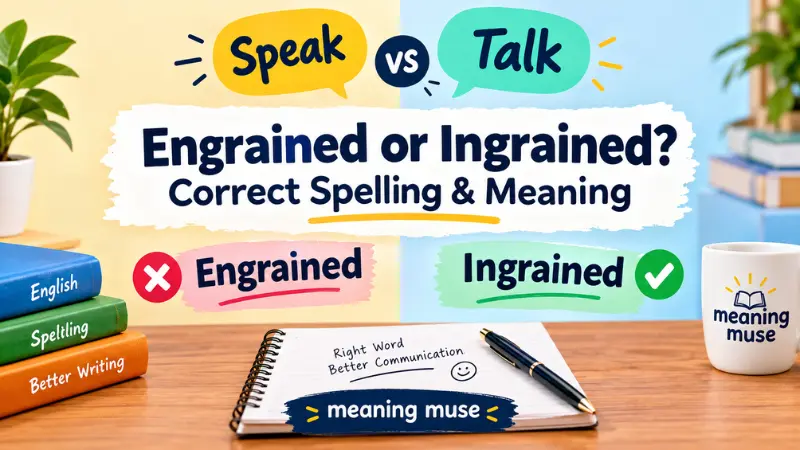
Many writers pause when choosing between engrained or ingrained because the two words look almost identical and sound the same.
The short answer is:
Ingrained is the standard and most commonly used spelling in modern English.
Engrained is also recognized as a variant spelling, but it is much less common.
Both forms describe something that is deeply fixed, firmly established, or difficult to change.
For most American English writing, ingrained is the safest choice.
Examples:
✅ Good habits become ingrained over time.
✅ Her beliefs were deeply ingrained from childhood.
Less common:
△ The habit became engrained over time.
The meaning is understood, but most readers expect ingrained.
Quick Answer
Use ingrained in most situations.
It means something is:
- deeply fixed
- firmly established
- difficult to remove or change
Examples:
- He has an ingrained habit of checking his phone.
- Respect for others was ingrained in her.
Engrained is a recognized alternative spelling, but it is rare compared with ingrained.
For American English, school writing, business writing, and professional content:
Choose ingrained.
Engrained vs Ingrained at a Glance
| Context | Best Choice | Why |
|---|---|---|
| American English writing | Ingrained | Most common modern spelling |
| Formal writing | Ingrained | More familiar to readers |
| Describing habits or beliefs | Ingrained | Standard choice |
| Describing something deeply embedded | Ingrained | Widely accepted form |
| Alternative spelling | Engrained | Recognized but less common |
Feature Comparison
| Feature | Ingrained | Engrained |
|---|---|---|
| Meaning | Deeply fixed or established | Same basic meaning |
| Correct spelling | Yes | Yes, as a variant |
| Common usage | Very common | Less common |
| US preference | Preferred | Unusual |
| Formal writing | Recommended | Usually avoided |
Why People Confuse Them
The confusion happens because both spellings are logical.
The word contains the idea of something becoming fixed deeply inside something else.
Many people connect engrained with words like:
- engrave
- engraved
- engraving
This makes the “en-” spelling feel natural.
However, the standard modern form most writers use is:
ingrained
The two words are also pronounced the same, so sound does not help writers choose the spelling.
Are They the Same Word?
Yes, in modern usage, ingrained and engrained refer to the same basic idea.
Both can describe:
- habits
- beliefs
- attitudes
- behaviors
- traditions
- dirt or stains deeply embedded in a surface
Examples:
A strong work ethic became ingrained in him.
A strong work ethic became engrained in him.
The meaning is nearly identical.
The main difference is frequency and preference, not meaning.
US vs UK Preference
Unlike words such as color/colour, this is not a major American versus British spelling difference.
Both American English and British English commonly use:
Ingrained
British dictionaries may recognize engrained as a variant, but ingrained remains the more familiar and standard choice.
For a US audience:
Use:
The tradition is deeply ingrained in the community.
Avoid choosing engrained unless you have a specific reason.
Which Spelling Should You Use?
For almost every modern writing situation:
Choose:
Ingrained
Use it in:
- school assignments
- articles
- reports
- emails
- professional documents
- websites
Examples:
Honesty was an ingrained part of her personality.
The company has an ingrained culture of teamwork.
Fear can become deeply ingrained over time.
These examples sound natural to American readers.
When Engrained Looks Wrong
Although engrained exists, many readers may think it is a spelling mistake because it appears much less often.
Compare:
Preferred:
The belief was deeply ingrained.
Less common:
The belief was deeply engrained.
The second sentence is understandable, but the first one matches normal modern usage better.
Common Mistakes (and Quick Fixes)
Mistake 1: Saying engrained is always wrong
This is too simple.
Engrained is recognized as a variant spelling.
Better explanation:
Ingrained is preferred, while engrained is uncommon.
Mistake 2: Thinking the words have different meanings
They usually do not.
Both describe something deeply established.
Mistake 3: Confusing ingrained with engraved
These words are different.
Ingrained:
A deeply ingrained belief.
Meaning: fixed deeply in the mind.
Engraved:
A name engraved on a ring.
Meaning: physically carved into a surface.
Everyday Examples
Using Ingrained
- Good manners were ingrained in the children.
- The habit became ingrained over many years.
- She has an ingrained fear of public speaking.
- Teamwork is ingrained in the company culture.
- The tradition is deeply ingrained in the community.
- Dirt became ingrained in the carpet.
Using Engrained
- The habit was engrained over time.
- The belief became engrained in his thinking.
- The dirt was engrained in the fabric.
These sentences can be understood, but modern writers usually choose ingrained.
Dictionary-Style Word Details
Verb
Ingrained
Ingrained comes from the verb ingrain.
Example:
Years of practice ingrained the skill into her memory.
It can also appear as a past participle:
The habit was ingrained from childhood.
Engrained
Engrained can also appear as a form related to the same idea.
Example:
The belief was engrained over many years.
However, it is much less common.
Noun
Neither ingrained nor engrained is normally used as a noun.
Related nouns include:
- habit
- belief
- tradition
- pattern
- behavior
Examples:
The habit became deeply ingrained.
The tradition became deeply rooted.
Synonyms
Depending on context, useful alternatives include:
For habits or beliefs:
- deep-rooted
- established
- fixed
- embedded
- rooted
Example:
She has an ingrained habit of planning ahead.
Similar:
She has a deeply rooted habit of planning ahead.
For physical material:
- embedded
- absorbed
- settled
- trapped
Example:
Dirt was ingrained in the carpet.
Similar:
Dirt was embedded in the carpet.
Example Sentences
Ingrained
- The belief was deeply ingrained in society.
- Good communication became an ingrained habit.
- The team had an ingrained culture of cooperation.
- His values were ingrained from childhood.
Engrained
- The custom was engrained in local traditions.
- The idea was engrained in their thinking.
- Dirt became engrained in the old fabric.
Word History
The word relates to the idea of something being worked deeply into a material.
Historically, “grain” referred to the structure of a material, especially fabric. Something placed deeply into the grain became difficult to remove.
Over time, this physical idea developed a figurative meaning:
Something deeply fixed in the mind, character, or behavior.
Phrases Containing
Common phrases include:
- deeply ingrained habit
- deeply ingrained belief
- culturally ingrained
- socially ingrained
- ingrained behavior
- ingrained attitude
- ingrained tradition
Examples:
The belief was deeply ingrained.
The company had an ingrained culture of safety.
Ingrained Habit or Engrained Habit?
The standard phrase is:
Deeply ingrained habit
Example:
Checking email first thing in the morning became a deeply ingrained habit.
Deeply engrained habit can be understood, but it is much less common.
Ingrained in Memory or Engrained in Memory?
The preferred phrase is:
Ingrained in memory
Example:
That childhood experience remained ingrained in her memory.
You may also hear “engraved in memory,” but that is a different expression with a more poetic meaning.
Is Engrained a Real Word?
Yes.
Engrained is not simply a random spelling mistake. It is recognized as a variant spelling.
However, it is much less common than ingrained.
For clear modern writing, choose:
Ingrained
Is Ingrained the Correct Spelling?
Yes.
Ingrained is the preferred spelling in most modern English writing.
It is the form most readers expect and the safest choice for professional communication.
FAQs
Which is correct, engrained or ingrained?
Both forms exist, but ingrained is the standard and more common spelling. Engrained is a recognized but less common variant.
Do ingrained and engrained have different meanings?
No. They generally have the same meaning: deeply fixed, established, or embedded.
Should I use ingrained in American English?
Yes. For American readers, ingrained is the preferred spelling.
Is engrained a misspelling?
Not always. It is recognized as a variant, but many writers choose ingrained because it is more familiar.
What does ingrained mean?
Ingrained means something is deeply established and difficult to change or remove.
Is it deeply ingrained or deeply engrained?
The most common phrase is:
Deeply ingrained
It is the version most readers expect.
Conclusion
The choice between engrained or ingrained is mainly about spelling preference.
Both forms can describe something deeply fixed, but:
Ingrained is the standard and most common spelling.
Engrained is a less common variant.
For American English, professional writing, and everyday communication, use:
Ingrained
Examples:
The habit was deeply ingrained.
Her values were ingrained from childhood.
Choosing ingrained keeps your writing clear, natural, and familiar to most readers.