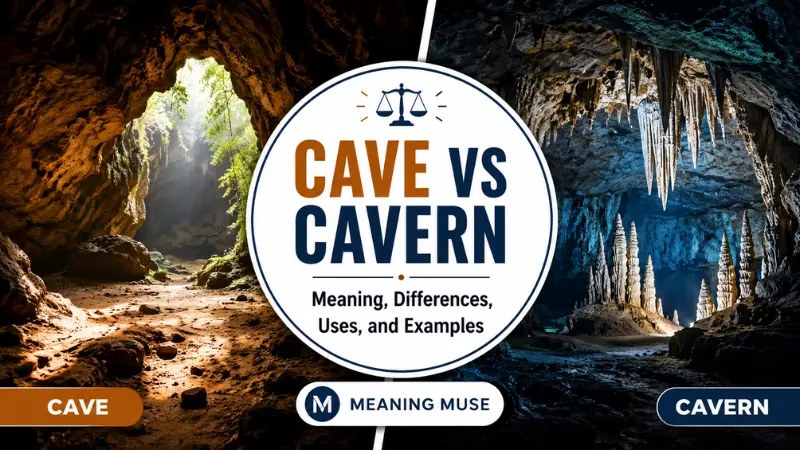
Cave and cavern both describe natural underground spaces. However, the two words do not always create the same picture.
A cave is the broad, general term. It may describe a small opening, a narrow passage, a deep chamber, or an extensive underground system.
A cavern, by contrast, is usually a particularly large, open, or spacious cave. The word often suggests high ceilings, wide chambers, strong echoes, and an impressive amount of underground space.
Compare these examples:
The fox disappeared into a small cave.
The explorers entered an enormous cavern.
Both places are caves. However, the second sentence places greater emphasis on size and openness.
The simplest rule is:
Use cave for the general underground feature. Use cavern when you want to emphasize that the space is especially large or spacious.
Quick Answer
A cave is any natural underground opening, chamber, or system of passages. It may be small, narrow, deep, wide, or extremely extensive.
A cavern is usually a large cave or a spacious underground chamber.
Therefore, every cavern can normally be described as a cave, but not every cave would naturally be called a cavern.
- Cave: The broader and more common term
- Cavern: A large or spacious cave or chamber
- Cave: Can function as a noun or verb
- Cavern: Used mainly as a noun
- Main difference: Cavern adds a stronger sense of size and openness
Cave vs Cavern at a Glance
| Point | Cave | Cavern |
|---|---|---|
| Basic meaning | A natural underground opening, chamber, or passage | A large or spacious cave or underground chamber |
| Size | May be small, medium, or enormous | Usually suggests a large space |
| Scope | Can describe one chamber or an entire system | Often describes one large chamber inside a cave |
| Emphasis | Identifies the underground feature | Highlights size, openness, or grandeur |
| Grammar | Common as a noun and verb | Mainly used as a noun |
| Best use | When size is unknown or unimportant | When great size matters |
| Common phrases | Cave entrance, cave system, cave in | Vast cavern, underground cavern |
| Figurative use | To collapse or stop resisting | A very large, hollow-feeling space |
What Is a Cave?
A cave is a natural opening, hollow, chamber, or network of passages beneath the ground or inside a rock formation, mountain, hill, or cliff.
Its size can vary greatly. For example, one cave may be a shallow opening that provides shelter for an animal. Another may contain miles of tunnels, underground rivers, deep shafts, and enormous rooms.
A cave may include:
- A single chamber
- Several connected rooms
- Narrow passages
- Deep shafts
- Underground streams
- Small entrances
- Wide tunnels
- Large open areas
Because cave does not imply a particular size, it is usually the safest word when the dimensions of the underground space are unknown or unimportant.
Examples of Cave
- The bear returned to its cave before nightfall.
- We noticed a cave entrance behind the trees.
- Water flowed from the mouth of the cave.
- The rescue team carefully entered the flooded cave.
- Ancient drawings covered part of the cave wall.
- Scientists discovered bones near the cave entrance.
- The cave contained several narrow passages.
- The explorers mapped more than ten miles of the cave.
In each sentence, the writer identifies the natural underground feature without emphasizing its size.
What Is a Cavern?
A cavern is a large cave or a broad, open underground chamber.
The word commonly creates an image of:
- High ceilings
- Wide walls
- Deep darkness
- Strong echoes
- Large rock formations
- Open underground rooms
- Enough space for many people
For example:
The narrow tunnel opened into a vast cavern.
The word cavern tells the reader that the passage leads into a much larger and more spacious area.
Examples of Cavern
- Their voices echoed throughout the cavern.
- A huge cavern stretched beneath the mountain.
- Powerful lights illuminated the cavern roof.
- An underground river crossed the dark cavern.
- Thousands of bats filled the enormous cavern.
- Stone columns rose from the cavern floor.
- The cavern was large enough to hold hundreds of visitors.
- A clear pool rested at the bottom of the cavern.
Here, cavern works well because each sentence emphasizes the impressive size of the underground space.
Are a Cave and a Cavern the Same?
Cave and cavern describe the same general type of natural feature, but they are not perfect substitutes in every sentence.
A cavern is still a type of cave. It is not an entirely separate landform. Nevertheless, cavern is more specific because it usually suggests that the underground space is especially large, wide, deep, or open.
Consider the difference:
The hikers entered a cave.
This sentence simply identifies the location.
The hikers entered a vast cavern.
Now the reader imagines a much larger and more dramatic underground chamber.
In other words, cave provides the basic meaning, while cavern adds descriptive emphasis.
Can a Cavern Be Part of a Cave?
Yes. A cavern can be one large chamber within a wider cave system.
A long cave may include:
- Narrow tunnels
- Small chambers
- Deep shafts
- Underground rivers
- Steep passages
- Several large open rooms
Those especially large rooms may be called caverns.
The narrow passage opened into a giant cavern.
In this sentence, the cavern is one spacious area inside the larger cave.
Another example makes the relationship even clearer:
We explored the cave until we reached its largest cavern.
Here, cave refers to the complete underground system. Meanwhile, cavern refers to one particularly large chamber within it.
However, people may also use cavern for an entire underground location when the place is mainly known for its large, open rooms.
Seven Main Differences Between Cave and Cavern
1. Cave Is the Broader Word
Cave can describe almost any natural underground opening, chamber, or system of passages.
It may be:
- Small
- Narrow
- Shallow
- Deep
- Wide
- Extremely large
Cavern has a narrower meaning. It usually refers to a cave or underground chamber that feels especially large or spacious.
Therefore, cave works in more situations.
2. Cavern Emphasizes Size
The word cave does not tell readers whether the underground space is small or large.
Cavern, on the other hand, strongly suggests considerable size.
Compare:
The path ended at a cave.
The path ended inside a vast cavern.
The first sentence identifies the underground feature. The second creates a stronger image of size, depth, and openness.
3. Cave Can Describe an Entire System
A cave may include miles of tunnels, chambers, shafts, and underground waterways.
A cavern often refers to one especially large chamber inside that system.
The cave contains five major caverns.
In this example, cave describes the complete network. Caverns identifies its largest open areas.
4. Cave Can Function as a Verb
Cave has several common verb meanings.
It can refer to exploring caves:
They spent the weekend caving in the mountains.
It can describe a collapse:
Part of the ceiling caved in.
Additionally, cave or cave in can mean to stop resisting:
The company finally caved under public pressure.
Cavern does not normally replace cave in these expressions.
Incorrect:
The ceiling caverned in.
Correct:
The ceiling caved in.
5. Cavern Sounds More Dramatic
Writers may choose cavern when they want an underground setting to feel vast, dark, hollow, mysterious, or impressive.
Compare:
The room looked like a cave.
The room looked like a cavern.
Both comparisons are possible. However, the second makes the room seem much larger and more open.
6. Cave Is Better When Size Is Unknown
Suppose you notice an opening in the side of a hill but have not explored it. Cave is the safer word because you do not yet know what lies inside.
We discovered a cave entrance near the river.
Calling it a cavern could create the unsupported impression that the opening leads to an enormous chamber.
Therefore, choose cave when you lack information about the space’s size.
7. Place Names Do Not Follow a Fixed Rule
Official place names may use cave or cavern regardless of the location’s actual dimensions.
History, local tradition, tourism, and naming preferences can all influence the chosen name. As a result, a place called a cave may be larger than another location called a cavern.
Always preserve the official proper name.
Correct:
We visited Mammoth Cave.
Incorrect:
We visited Mammoth Cavern.
Even when another term seems more descriptive, do not change an established place name.
Which Word Should You Use?
Choose cave when you need a simple, broad, or neutral term.
Choose cavern when the size and openness of the underground area are important to your meaning.
Use Cave for a General Underground Feature
- Bears sometimes shelter in caves.
- The map shows several caves in the region.
- Water slowly shaped the limestone cave.
- The team entered the cave through a narrow opening.
- Ancient paintings covered the cave wall.
- A stream emerged from the cave.
- The animal disappeared inside the cave.
- Researchers began mapping the cave system.
These sentences do not need to stress great size.
Use Cavern for a Large Open Chamber
- Their voices echoed across the cavern.
- A vast cavern lay beneath the mountain.
- The lights revealed the cavern’s enormous ceiling.
- An underground river flowed through the cavern.
- The cavern could hold hundreds of people.
- Massive stone columns filled the cavern.
- The guide led the group into a spacious cavern.
- A deep lake covered the cavern floor.
Each sentence suggests a broad and impressive underground area.
Use Cave When the Space Is Small
Cavern usually sounds unnatural when a place is clearly tiny.
Awkward:
The mouse disappeared into a tiny cavern.
Better:
The mouse disappeared into a tiny cave.
Because cavern normally suggests great size, combining it with tiny creates an odd contrast. Such wording may work in humor or deliberate exaggeration, but it is not the natural everyday choice.
Use Cavern for Stronger Description
Cave can still be correct when describing an enormous chamber. Nevertheless, cavern may create a clearer and more vivid picture.
Correct but less descriptive:
Hundreds of people stood inside the cave.
More descriptive:
Hundreds of people stood inside the cavern.
The second version helps readers understand how the underground space could accommodate such a large crowd.
Do Caverns Need Stalactites or Stalagmites?
No. A cavern does not need stalactites, stalagmites, columns, or other visible rock formations.
Large caverns often contain impressive formations. However, those features do not determine whether a space should be called a cave or cavern.
The main distinction still concerns size and openness:
- Cave is the general word.
- Cavern usually emphasizes a large underground chamber.
Therefore, a cavern without stalactites can still be a cavern. Likewise, a small cave containing many formations does not automatically become a cavern.
Cave and Cavern as Parts of Speech
Cave as a Noun
As a noun, cave refers to a natural underground chamber, opening, or system of passages.
The cave had two entrances.
Bats rested near the cave roof.
The plural form is caves.
Cave as a Verb
As a verb, cave can have several meanings.
To collapse inward:
The damaged wall began to cave in.
To explore caves:
They went caving during their vacation.
To stop resisting:
Her parents finally caved and allowed her to attend.
Common forms include:
- Cave
- Caves
- Caved
- Caving
Cavern as a Noun
Cavern is mainly used as a noun meaning a large cave or spacious underground chamber.
The passage led into a wide cavern.
The plural form is caverns.
Cavernous as an Adjective
The related adjective cavernous means extremely large, open, hollow, or cave-like.
The hotel had a cavernous entrance hall.
His voice echoed through the cavernous room.
Cavernous can describe both real underground spaces and large buildings or rooms.
Literal and Figurative Uses
Literal Uses of Cave
In its literal sense, cave describes a natural underground feature.
The explorers entered the cave at sunrise.
Water had shaped the cave over time.
Figurative Uses of Cave
As a verb, cave may describe collapsing or surrendering.
The roof could cave in.
She refused to cave under pressure.
The informal expression man cave describes a private room or personal area used for hobbies or relaxation.
Literal Uses of Cavern
Literally, cavern describes a large underground cave or chamber.
The river disappeared into the cavern.
The cavern contained several enormous stone formations.
Figurative Uses of Cavern
Cavern may also describe a building or room that feels very large, empty, hollow, or echoing.
The abandoned warehouse felt like a cavern.
The warehouse is not a real underground cavern. Instead, the comparison emphasizes its size and emptiness.
Cavernous is even more common in this type of description:
The empty station had a cavernous interior.
Cave vs Cavern in American and British English
The basic distinction is similar in American and British English.
Both varieties generally use:
- Cave as the broad term
- Cavern for a large cave or underground chamber
There is no major spelling difference:
- American English: cave, cavern
- British English: cave, cavern
The correct choice depends on meaning and emphasis rather than region.
However, official place names may use either term. Always keep the original wording when referring to a named cave, park, attraction, or landmark.
Pronunciation
Cave
Pronunciation: /keɪv/
Cave rhymes with:
- Brave
- Save
- Wave
- Gave
Cavern
Pronunciation: /ˈkæv.ərn/
It is commonly pronounced KAV-ern, with the stress on the first syllable.
Common Mistakes and Corrections
Mistake 1: Treating Caves and Caverns as Separate Landforms
Misleading:
Caves and caverns are two completely different landforms.
Better:
A cavern is usually a large or spacious type of cave.
The meanings overlap. Cavern is simply the narrower and more descriptive term.
Mistake 2: Assuming Every Cave Is Small
Incorrect idea:
A cave is small, while a cavern is large.
Correct explanation:
A cave can be any size, but cavern usually emphasizes large size.
Some caves extend for many miles and contain enormous chambers.
Mistake 3: Calling Every Cave a Cavern
A small opening, shallow shelter, or narrow underground passage would not normally be called a cavern.
Instead, use cave unless the context supports the idea of a large, open space.
Mistake 4: Requiring Rock Formations
Incorrect idea:
It is only a cavern if it contains stalactites.
Correct explanation:
Cavern mainly emphasizes size and spaciousness, not specific formations.
Stalactites and stalagmites can appear in both caves and caverns.
Mistake 5: Using Cavern as a Common Verb
Incorrect:
The wall caverned in.
Correct:
The wall caved in.
Cave has several common verb uses. Cavern is mainly a noun.
Mistake 6: Changing Official Names
Do not replace Cave with Cavern or Cavern with Cave in a proper name.
Use the official wording even when another term seems more accurate or descriptive.
Mistake 7: Using Cavern for Every Large Building
Cavern may describe a building figuratively, but the place should feel unusually large, empty, hollow, or echoing.
Natural:
The empty terminal felt cavernous.
Less natural:
The crowded office was a cavern.
The second example does not provide enough context to support the comparison.
Examples With Cave
- The children watched bats fly from the cave.
- Rainwater entered through a crack in the cave roof.
- The narrow cave was difficult to explore.
- Early communities may have used the cave for shelter.
- The guide warned us not to touch the cave walls.
- A stream flowed from the mouth of the cave.
- The researchers mapped several cave passages.
- The fox returned to its cave before sunset.
- We needed helmets and lights to enter the cave.
- The cave contained narrow tunnels and wide chambers.
- The trail ended near a hidden cave.
- Several birds nested above the cave entrance.
Examples With Cavern
- The tunnel opened into an enormous cavern.
- Their voices echoed through the dark cavern.
- Powerful lights illuminated the cavern roof.
- The cavern was wider than a football field.
- A clear pool lay at the bottom of the cavern.
- The explorers crossed the cavern carefully.
- Thousands of bats filled the enormous cavern.
- Stone columns rose from the cavern floor.
- The guide led the group into a cool cavern.
- The vast cavern resembled an underground cathedral.
- A waterfall disappeared into the cavern.
- The cavern’s ceiling towered above the visitors.
Examples Using Both Words
- The cave began with a narrow passage that led into a huge cavern.
- We explored the cave until we reached its largest cavern.
- The map showed three caverns inside the cave system.
- Although the cave entrance was small, a vast cavern waited beyond it.
- Water moved through the cave before collecting in a deep cavern.
- The cave contained several tunnels and one central cavern.
- Explorers entered the cave and eventually reached a spacious cavern.
- The smallest part of the cave led to its most impressive cavern.
Synonyms and Related Words
Words Related to Cave
Possible alternatives include:
- Hollow
- Grotto
- Underground chamber
- Rock shelter
- Den
- Cavity
However, these words do not always mean exactly the same thing.
A den often refers to an animal’s shelter. Meanwhile, a grotto commonly suggests a small, attractive cave or a decorative cave-like structure.
Words Related to Cavern
Possible alternatives include:
- Large cave
- Underground chamber
- Vault
- Hollow
- Grotto
- Chamber
The best alternative depends on the location, shape, size, and purpose of the space.
Common Phrases With Cave
- Cave entrance
- Cave mouth
- Cave system
- Cave passage
- Cave wall
- Cave ceiling
- Cave painting
- Sea cave
- Ice cave
- Lava cave
- Limestone cave
- Cave exploration
- Cave in
- Man cave
Common Phrases With Cavern
- Underground cavern
- Limestone cavern
- Vast cavern
- Dark cavern
- Hidden cavern
- Salt cavern
- Cavern wall
- Cavern roof
- Cavern floor
- Enormous cavern
- Spacious cavern
- Deep cavern
FAQs
Is a cavern bigger than a cave?
A cavern is usually understood as a particularly large cave or underground chamber. However, cave is the broader word and can also describe an enormous underground system. Therefore, a cave is not automatically smaller than a cavern.
Is every cavern a cave?
Yes. In ordinary English, a cavern is generally considered a type of cave, especially one that is unusually large, deep, wide, or spacious.
Is every cave a cavern?
No. Small caves, narrow passages, and shallow underground openings would not normally be called caverns. Cavern usually requires a strong sense of size and open space.
Can a cave be larger than a cavern?
Yes. Cave does not mean small. A cave system may extend for many miles and contain several large caverns. In addition, official place names do not follow a universal size rule.
Is there an official size difference?
There is no single universal measurement that automatically changes a cave into a cavern in ordinary English. The difference mainly depends on how much the speaker or writer wants to emphasize size and spaciousness.
Do caverns always contain stalactites?
No. A cavern may contain stalactites, stalagmites, columns, and other rock formations, but those features are not required. The word primarily emphasizes the size and openness of the underground chamber.
Can a cavern be one room inside a cave?
Yes. Cavern often refers to a large chamber within a wider cave system. However, it may also describe an entire underground location known for its spacious rooms.
What Is the Difference Between a Cave and a Tunnel?
A cave is a natural underground opening, chamber, or system. A tunnel is generally a long passage and may be natural or built by people. A cave can contain tunnel-like passages, but the two words are not exact synonyms.
What Is the Difference Between a Cave and a Grotto?
A grotto is usually a small cave or an attractive cave-like place. It may be natural or constructed as a decorative feature. Cave is the broader and more neutral term.
Is “Cave System” or “Cavern System” Correct?
Cave system is the more common general phrase for a connected network of underground passages and chambers. Cavern system is possible, but it places greater emphasis on large underground rooms.
Can Cavern Describe a Building?
Yes, but usually figuratively. A very large, empty, hollow, or echoing building may be compared to a cavern.
Can Cave and Cavern Be Used Interchangeably?
Sometimes, especially when describing a large underground place. However, cavern sounds unnatural for a very small space, while cave remains appropriate for underground features of almost any size.
Is every cave a cavern
The abandoned station felt like a cavern.
The adjective cavernous is often more natural:
The station had a cavernous main hall.
Conclusion
Cave and cavern both refer to natural underground spaces, but cave is the broader and more flexible word.
A cave may be small, narrow, deep, wide, or part of an extensive underground network.
The trail ended at a cave entrance.
A cavern is usually a cave or chamber that feels especially large, deep, and open.
The narrow passage opened into a vast cavern.
No fixed everyday size rule automatically changes one into the other. Instead, the correct choice depends on the picture you want to create.