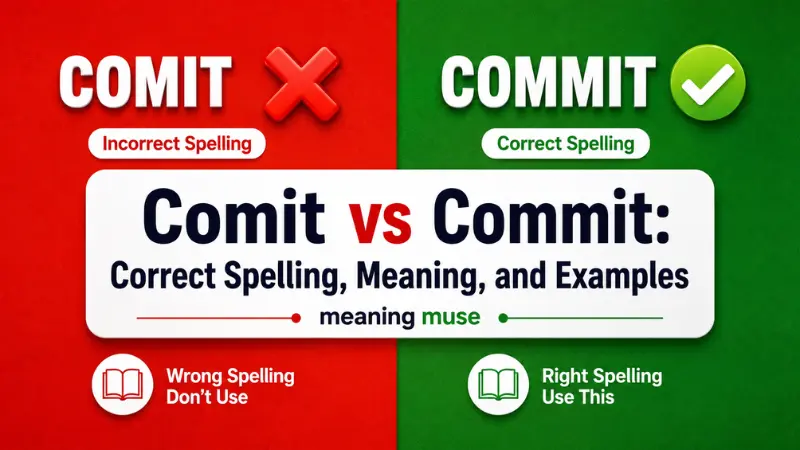
If you are wondering whether comit or commit is the correct spelling, the answer is simple: commit is correct in standard English.
Comit is usually a spelling or typing mistake caused by leaving out one m. The correct word is commit, with two m’s.
You use commit when you make a firm promise, give time or money to a goal, carry out an action, or record changes in a computer project. The word is common in everyday English, school writing, business communication, legal writing, and technology.
Both American and British English use the same spelling: commit.
Quick answer: Commit is the correct spelling. Comit is normally incorrect unless it is part of an official name, brand, project, or acronym.
Comit vs Commit: Which Spelling Is Correct?
The correct spelling is commit.
| Spelling | Correct? | Meaning |
|---|---|---|
| commit | Yes | Standard English word |
| comit | No, normally | Common misspelling of commit |
| Comit / COMIT | Sometimes | May be a proper name, brand, project, or acronym |
Correct example
- I will commit more time to studying.
Incorrect example
- I will comit more time to studying.
The important difference is the extra m. Standard English spells the word c-o-m-m-i-t.
Why Is “Comit” a Common Mistake?

People often write comit because the two m’s are pronounced as one normal m sound.
When you say commit, you hear something like kuh-MIT. You do not hear two separate “m” sounds, so it can be easy to forget the second m when writing.
Typing quickly can also cause the mistake.
Compare:
- comit ❌
- commit ✅
A simple memory aid is:
commit = comm + it
Remember the double m in the middle.
This is only a memory trick, not a general spelling rule. The safest approach is to learn the complete spelling: commit.
What Does Commit Mean?
Commit is a standard English verb with several meanings.
It can mean:
- To make a firm promise or decision
- To give time, money, or effort to something
- To carry out an action
- To entrust someone or something to another person or place
- To record changes in a computer project
Commit meaning: making a firm promise
When you commit to something, you agree to do it or support it.
- I will commit to the training plan.
- She cannot commit to that date yet.
- We committed to helping the community.
Commit meaning: giving time or resources
You can also use commit when you give time, money, effort, or other resources to a purpose.
- The school committed more money to new books.
- He commits two hours a week to practice.
- The company committed more resources to the project.
Commit meaning: carrying out an act
Commit can describe performing an action, especially something wrong, illegal, or serious.
- The suspect was accused of committing a crime.
- The player committed a serious foul.
- Anyone can commit an error.
Commit in computing
In software development, a commit is a recorded set of changes made to files in a version-control system.
- Please commit your changes before switching branches.
- I made a commit before lunch.
- The latest commit fixed the login problem.
Is “Comit” Ever Correct?

Usually, no.
In ordinary English, comit is not an accepted alternative spelling of commit.
However, you may occasionally see Comit or COMIT used as the official name of a company, product, organization, project, software system, or acronym.
In that situation, the unusual spelling may be intentional.
For example:
- Please commit the updated files.
- She works for a company called Comit.
The first sentence uses the standard English word. The second may use a proper name.
When you see Comit as a name, check the organization’s official spelling before changing it.
Commit vs Comit in American and British English

There is no standard US-versus-UK spelling difference between commit and comit.
Both American English and British English use:
- commit
- commits
- committed
- committing
- commitment
So whether you are writing for readers in the United States or the United Kingdom, use commit.
This is different from words such as:
- color / colour
- organize / organise
- center / centre
Those words can have regional spelling differences. Commit does not.
Correct for both varieties
- American English: commit
- British English: commit
Commit Word Forms
Learning the word family can help you avoid spelling mistakes.
| Word | Correct Spelling | Example |
| Base verb | commit | I will commit to the plan. |
| Third-person singular | commits | She commits to her goals. |
| Past tense | committed | They committed to the project. |
| Present participle | committing | He is committing more time to training. |
| Noun | commitment | Her commitment is impressive. |
Pay special attention to committed and committing.
The final t in commit is doubled before -ed and -ing:
- commit → committed
- commit → committing
But the noun is:
- commit → commitment
Do not write committment.
Common Spelling Mistakes With Commit
1. Comit
❌ I will comit to the plan.
✅ I will commit to the plan.
Fix: Remember the double m.
2. Commited
❌ She commited to the project.
✅ She committed to the project.
Fix: Double the final t before -ed.
3. Commiting
❌ He is commiting more time to practice.
✅ He is committing more time to practice.
Fix: Double the final t before -ing.
4. Committment
❌ We value your committment.
✅ We value your commitment.
Fix: The correct noun is commitment.
5. Comitted
❌ The team is comitted to quality.
✅ The team is committed to quality.
Fix: Remember both the double m and double t.
How to Use Commit Correctly
The word commit appears in several common sentence patterns.
Commit to + noun
Use commit to when you promise or agree to something.
- I committed to the plan.
- She committed to the new schedule.
- They committed to the goal.
Commit to + -ing verb
After commit to, you can use an -ing form.
- We committed to improving customer service.
- He committed to saving money.
- She committed to studying every night.
Commit + time or money + to
You can also use commit when giving resources to something.
- I commit two hours a day to reading.
- The company committed more money to training.
- The team committed additional resources to testing.
Commit + an act
Use commit with words such as:
- commit a crime
- commit an offense
- commit an error
- commit a mistake
- commit a foul
Examples:
- He did not commit a crime.
- The player committed a foul.
- I committed an error in the report.
Common Phrases With Commit
Here are some natural phrases you may see in everyday English:
- commit to a plan
- commit to a goal
- commit to a relationship
- commit to memory
- commit to paper
- commit time
- commit money
- commit resources
- commit an error
- commit a crime
- commit an offense
- commit a foul
- commit changes
- Git commit
- commit message
Commit to memory
Commit to memory means to learn something so that you can remember it.
- She committed the poem to memory.
- Students were asked to commit the formula to memory.
This meaning is different from commit to a plan, which means to make a firm decision or promise.
Comit vs Commit Examples
The following examples show the difference clearly.
Incorrect
- I will comit to the new schedule.
- The company comited more money to training.
- She is comiting herself to the project.
- We appreciate your committment.
Correct
- I will commit to the new schedule.
- The company committed more money to training.
- She is committing herself to the project.
- We appreciate your commitment.
Everyday Examples of Commit
At school
- I will commit more time to math.
- Our class committed to keeping the room clean.
- She committed the poem to memory.
At work
- The manager committed more money to employee training.
- We cannot commit to a launch date yet.
- The company is committed to better customer service.
Personal goals
- Ben committed to exercising every morning.
- I am ready to commit to this plan.
- She made a strong commitment to saving money.
Rules and actions
- The report says he did not commit the offense.
- The referee saw the player commit a foul.
- People sometimes commit small errors when they are tired.
Software and coding
- Please commit your changes before you leave.
- I made a commit after fixing the bug.
- The latest commit updated the homepage.
- Add a clear commit message before pushing the changes.
Commit as a Verb and Noun
Commit as a verb
In general English, commit is mainly a verb.
It can mean to promise, dedicate, carry out, entrust, or record changes.
Examples:
- We commit to the plan.
- They committed more funds.
- He committed an error.
- Please commit the changes.
Commit as a noun
In computing, commit is also commonly used as a noun.
A commit is a recorded set of changes in a version-control system.
Example:
- The latest commit fixed two bugs.
In ordinary conversation, however, commit is much more commonly understood as a verb.
Synonyms for Commit
The best synonym depends on the meaning.
When commit means promise
You can use:
- promise
- pledge
- agree
- dedicate yourself
Example:
- I commit to the plan.
- I promise to follow the plan.
When commit means give resources
Possible alternatives include:
- devote
- give
- assign
- allocate
- set aside
Example:
- The company committed more money to training.
- The company allocated more money to training.
When commit means carry out an act
Possible alternatives include:
- do
- perform
- carry out
Example:
- He committed an error.
- He made an error.
There is no single synonym that works for every meaning of commit.
Word History of Commit
The English word commit has a long history. It entered English through Middle English and ultimately comes from the Latin committere, which carried meanings related to joining, entrusting, or bringing things together.
Over time, commit developed several meanings in English. These include entrusting something to someone, carrying out an action, and binding yourself to a decision or course of action.
The modern spelling is commit, with two m’s.
Today, the word is also an important term in software development, where a commit records changes made to a project.
How to Remember the Correct Spelling
If you often confuse comit and commit, use this simple reminder:
Commit has two m’s: coMMit.
You can also remember:
I commit with two m’s.
Then remember the related forms:
- commit
- committed
- committing
- commitment
A quick spelling check can prevent the most common errors.
Comit vs Commit: Quick Comparison
| Feature | Commit | Comit |
| Standard English word | Yes | No |
| Correct ordinary spelling | Yes | No |
| Two m’s | Yes | No |
| Used in American English | Yes | No as a standard spelling |
| Used in British English | Yes | No as a standard spelling |
| Used as a verb | Yes | No |
| Used as a computing term | Yes | No |
| May appear as a proper name | Yes | Yes |
| Common spelling mistake | No | Yes |
FAQs About Comit vs Commit
Is comit or commit the correct spelling?
Commit is the correct spelling in standard English. It has two m’s. Comit is normally a spelling or typing mistake.
For example:
- Correct: I will commit to the plan.
- Incorrect: I will comit to the plan.
Is comit a real English word?
Comit is not normally a standard English word with the meaning of commit. You may see Comit or COMIT as a company name, product name, project name, or acronym. In those cases, the spelling may be intentional.
What does commit mean?
Commit can mean to make a firm promise, give time or resources to something, carry out an action, or entrust something to someone. In computing, it can also mean to record changes to a project.
Is commit spelled differently in American and British English?
No. Both American and British English use commit. There is no standard spelling variation between comit and commit.
Is it committed or commited?
Committed is correct.
The word commit becomes committed when you add -ed, so the final t is doubled.
- commit → committed ✅
- commited ❌
Is it committing or commiting?
Committing is correct.
The final t is doubled before -ing:
- commit → committing ✅
- commiting ❌
Is commitment spelled with one or two t’s?
The correct spelling is commitment.
It contains the letters tt in the middle because the base word commit already ends in t:
commit + ment = commitment
Do not write committment.
Can commit be a noun?
Yes. In software development, a commit is a recorded set of changes made to files in a version-control system.
For example:
- The latest commit fixed the error.
What is the easiest way to remember commit?
Remember that commit has two m’s:
coMMit
This simple memory aid can help you avoid writing comit.
Final Answer: Comit or Commit?
The correct spelling is commit.
Use commit when you mean to make a firm promise, dedicate time or resources, carry out an act, or record changes in a software project.
Comit is normally a misspelling and should be corrected in schoolwork, business emails, articles, reports, websites, and professional writing.
The spelling is the same in both American and British English.
Remember:
Correct: commit
Incorrect: comit
And for the related forms:
commit → committed → committing → commitment
If Comit appears as the official name of a company, product, project, or acronym, keep its official spelling. Otherwise, when you mean the standard English word, always choose commit.