A real estate agent and a REALTOR® may do many of the same jobs, but the terms do not mean exactly the same thing.
A real estate agent is a professional who holds the state license needed to help people buy, sell, or rent real estate.
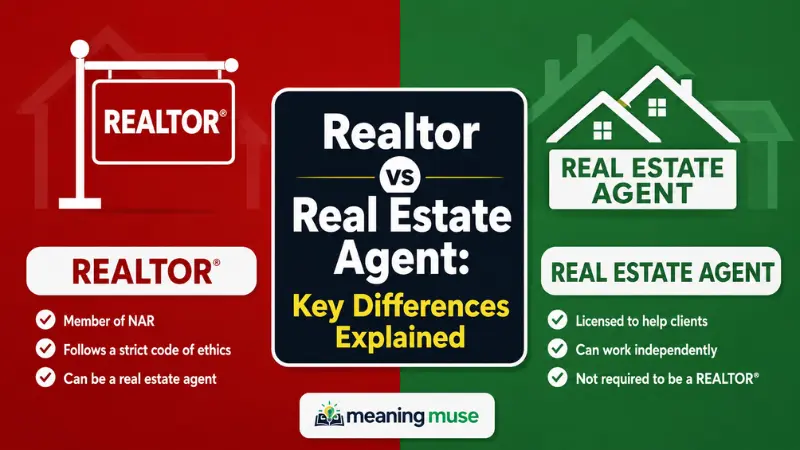
A REALTOR® is a real estate professional who is also a member of the National Association of REALTORS®, or NAR, and agrees to follow its Code of Ethics.
So, the main difference is simple:
Real estate agent = state licensing and real estate work
REALTOR® = NAR membership and its professional standards
A real estate agent does not automatically become a REALTOR® just by getting a real estate license.
Quick Answer
The difference between realtor vs real estate agent comes down mainly to membership.
A real estate agent is licensed under state rules to work in real estate.
A REALTOR® is an eligible real estate professional who belongs to the National Association of REALTORS® and follows its Code of Ethics.
Many REALTORS® work as real estate agents, but REALTOR® is not a general word for every agent.
The easiest rule is:
Every REALTOR® must qualify for NAR membership, but not every real estate agent is a REALTOR®.
Realtor vs Real Estate Agent at a Glance
| Context | Best Term | Why |
|---|---|---|
| General licensed property professional | Real estate agent | Describes the profession |
| NAR member | REALTOR® | Identifies association membership |
| Helping a buyer find a home | Either may apply | Both may provide this service |
| Helping sell a property | Either may apply | Both may represent sellers |
| Following NAR’s Code of Ethics | REALTOR® | NAR members have this added obligation |
| Holding a state real estate license | Real estate agent | Licensing comes from the state |
| Describing every property agent | Real estate agent | REALTOR® should not be used as a generic term |
A second quick comparison:
- Real estate agent: professional job or role
- REALTOR®: membership designation
- Real estate agent: licensed according to state rules
- REALTOR®: connected with NAR membership
- Real estate agent: may or may not belong to NAR
- REALTOR®: follows the NAR Code of Ethics
What Is a Real Estate Agent?
A real estate agent is a licensed professional who helps people with real estate transactions.
This can include helping clients:
- buy homes
- sell homes
- find properties
- market properties
- arrange showings
- prepare offers
- negotiate terms
- understand local market conditions
- complete parts of a real estate transaction
Real estate licensing is handled at the state level in the United States.
That means the exact education, testing, continuing education, and license rules can differ from one state to another.
A person normally needs to meet their state’s requirements before legally working as a real estate sales agent.
What Does a Real Estate Agent Do?
Imagine Maria wants to buy a house.
Her agent may help her find homes in her price range, arrange tours, prepare an offer, and communicate with the seller’s representative.
Now imagine David wants to sell his house.
His agent may suggest a listing price, market the property, arrange showings, review offers, and help with negotiations.
The agent’s exact duties depend on the client, contract, state law, and type of transaction.
What Is a REALTOR®?
A REALTOR® is not simply another name for a real estate agent.
REALTOR® is a registered membership mark owned by the National Association of REALTORS®.
It identifies a real estate professional who is a member of NAR and follows the organization’s Code of Ethics.
That membership is the key difference.
For example:
“Jenna is a licensed real estate agent.”
That tells us about her professional role.
If Jenna also belongs to NAR and is authorized to use the membership mark, she may identify herself as a REALTOR®.
Is REALTOR® a Job Title?
Not in the same way that real estate agent is.
“Real estate agent” describes the work a person does.
“REALTOR®” identifies membership in a professional trade association.
This distinction matters because NAR membership includes more than sales agents.
Its membership can include real estate brokers, salespeople, property managers, appraisers, and other real estate professionals.
So it is more accurate to think of REALTOR® as a professional membership designation, not simply another job title.
What Is the Main Difference Between a Realtor and a Real Estate Agent?
The biggest difference is NAR membership.
A real estate agent gets authority to work through state licensing.
A REALTOR® has the professional credentials needed for their work and also belongs to the National Association of REALTORS®.
Here is an easy example.
Suppose two people both have active real estate licenses and help buyers purchase homes.
One belongs to NAR.
The other does not.
Both may be real estate agents.
Only the NAR member may use the REALTOR® membership mark in the proper way.
That is why the two terms should not automatically be treated as synonyms.
Is Every Real Estate Agent a REALTOR®?
No.
A person can be a licensed real estate agent without being a member of the National Association of REALTORS®.
That person may still legally work as an agent if they meet the licensing and other requirements in their state.
However, they should not call themselves a REALTOR® simply because they sell real estate.
REALTOR® identifies NAR membership.
This is one of the most important facts to remember about realtor vs real estate agent.
Is Every REALTOR® a Real Estate Agent?
Not necessarily in the narrow job-title sense.
Many REALTORS® are real estate agents, but NAR membership also includes other real estate professionals.
For example, members may work as:
- brokers
- property managers
- appraisers
- counselors
- commercial real estate professionals
This is why the simple statement “every REALTOR® is an agent” can be misleading.
A safer rule is:
A REALTOR® is a real estate professional who is a member of NAR.
Does a REALTOR® Need a Different License?
REALTOR® membership does not replace a state real estate license.
Licensing and NAR membership are separate ideas.
A state license gives a real estate professional legal authority to perform work covered by that license.
REALTOR® status shows membership in NAR.
Think of it this way:
License = permission under state rules
REALTOR® = professional association membership
A person cannot simply join an organization instead of following state licensing laws.
REALTOR® Code of Ethics
One major difference between a REALTOR® and a nonmember real estate agent is NAR’s Code of Ethics.
NAR members agree to follow this professional code.
The 2026 Code covers duties involving:
- clients and customers
- the public
- other REALTORS®
- truthful communication
- professional conduct
- client interests
- real estate advertising
For example, the Code states that REALTORS® must protect and promote their client’s interests while also treating all parties honestly.
This does not mean that a non-REALTOR® agent has no ethical or legal duties.
Licensed real estate professionals must still follow applicable laws, regulations, licensing standards, contracts, and professional duties.
The difference is that REALTORS® take on NAR’s Code of Ethics in addition to the other rules that apply to their work.
Realtor vs Real Estate Agent: Duties
A REALTOR® who works as an agent may perform many of the same everyday duties as another licensed real estate agent.
Both may:
- show homes
- list properties
- talk with buyers
- communicate with sellers
- prepare offers
- negotiate
- study local prices
- market homes
- attend inspections
- help move a transaction toward closing
This is why buyers sometimes cannot see an obvious difference during normal day-to-day work.
The main difference is not necessarily the basic task being performed.
It is the professional’s membership status and added NAR obligations.
Realtor vs Real Estate Broker
A broker is also different from both terms.
In general, a real estate broker has completed the licensing requirements needed for broker status in their state.
Brokers may have responsibilities that sales agents do not have.
For example, a broker may be able to operate a brokerage or supervise sales agents, depending on state law.
A broker can also be a REALTOR® if the broker is a qualifying NAR member.
So one person could be:
a broker + a REALTOR®
Another person could be:
a real estate sales agent + a REALTOR®
And another could be:
a licensed real estate agent who is not a REALTOR®
The terms describe different parts of a person’s professional status.
Realtor vs Real Estate Agent: Which Is Better?
Neither title by itself tells you everything about how good a person will be at helping you buy or sell a home.
REALTOR® membership adds NAR membership and Code of Ethics obligations.
That can be useful information.
However, you should still look at the individual professional.
Before choosing someone, consider:
- active license status
- experience
- local market knowledge
- communication
- availability
- negotiation skills
- past client experience
- services offered
- fees and compensation
- knowledge of your type of property
For example, an experienced agent who knows your neighborhood well may be a stronger fit than someone whose title looks impressive but has little experience with your type of transaction.
Choose the person, not only the label.
Do REALTORS® Cost More Than Real Estate Agents?
There is no simple rule saying that a REALTOR® must cost more than another real estate agent.
Real estate compensation can vary by professional, brokerage, services, location, and client agreement.
Compensation is something buyers and sellers should discuss before agreeing to work with an agent.
Do not assume that a certain fee is required simply because someone is a REALTOR®.
Ask clearly:
“How will you be paid?”
“What services are included?”
“Is the amount negotiable?”
“Are there any other costs I should understand?”
Getting the terms in writing helps prevent confusion.
Can Any Real Estate Agent Call Themselves a Realtor?
No.
A real estate professional should not use REALTOR® as a general word meaning “real estate agent.”
The term is associated with membership in the National Association of REALTORS®.
For example:
Correct general description:
“We spoke with three real estate agents.”
If one of those professionals is an NAR member, the REALTOR® term may apply to that person.
Using REALTOR® for every person who sells homes removes the membership distinction the term is meant to show.
Why Is REALTOR® Often Written in Capital Letters?
You may see several forms online:
realtor
Realtor
REALTOR®
The National Association of REALTORS® treats REALTOR® as a registered membership mark rather than an ordinary generic profession name.
NAR’s preferred written form is:
REALTOR®
The registered symbol helps show that the word has a special trademark meaning.
In normal search queries, people often type “realtor vs real estate agent,” but careful professional writing should respect the official use of the membership mark.
Common Mistakes With Realtor and Real Estate Agent
Mistake 1: Calling Every Agent a REALTOR®
Incorrect idea: Every licensed real estate agent is automatically a REALTOR®.
Correct: A licensed agent becomes eligible to use the REALTOR® membership designation through NAR membership and proper use of the mark.
Mistake 2: Thinking REALTOR® Is a Separate State License
A REALTOR® designation is not a replacement for required state licensing.
State licensing and association membership are different things.
Mistake 3: Thinking REALTORS® Perform a Completely Different Job
An agent who is a REALTOR® may perform the same basic property services as another licensed agent.
The key extra distinction is NAR membership and the obligations connected with that membership.
Mistake 4: Using Realtor as a Generic Word
It is better to use real estate agent when talking about the profession in general.
Use REALTOR® when NAR membership is relevant.
Mistake 5: Choosing Only by Title
A professional title is useful, but it should not be your only test.
Experience, communication, local knowledge, licensing, services, and your comfort with the professional also matter.
Everyday Examples
Here are examples using real estate agent:
“My real estate agent showed us four homes on Saturday.”
“She became a licensed real estate agent last year.”
“We need an agent who knows this neighborhood.”
“The seller’s real estate agent called about our offer.”
“Ask your agent what services are included.”
Now compare examples using REALTOR®:
“Our agent is also a REALTOR® and a member of NAR.”
“He joined his local REALTOR® association.”
“She is a real estate professional and REALTOR®.”
“The REALTOR® Code of Ethics applies to NAR members.”
“The buyer asked whether the agent was a REALTOR®.”
The examples show why the terms overlap but are not identical.
How to Choose a Real Estate Professional
If you are buying or selling a home, start by checking the professional rather than focusing only on what title appears on a business card.
Ask questions such as:
“How long have you worked in this area?”
“Is your license active?”
“How often do you work with buyers like me?”
“How will you communicate with me?”
“What services will you provide?”
“How will you be paid?”
“Are you familiar with this neighborhood?”
“Are you a member of the National Association of REALTORS®?”
Clear answers can tell you much more than a title alone.
Dictionary-Style Word Details
Verb
Realtor/REALTOR®: Not normally used as a verb. It identifies qualifying NAR members.
Real estate agent: A noun phrase, not a verb.
Avoid sentences such as “She realtored the house.”
Instead, say:
“She represented the seller.”
“She worked as the seller’s real estate agent.”
Noun
REALTOR®: A membership mark used for a real estate professional who is a member of the National Association of REALTORS®.
Real estate agent: A noun phrase for a licensed professional who helps clients with real estate transactions.
The two can describe the same person, but they describe different things about that person.
Synonyms
Real estate agent has several close terms, but they are not always exact synonyms:
- real estate professional
- property agent
- real estate salesperson
- sales agent
Specific meanings can depend on local law and professional role.
REALTOR® does not have an exact synonym because it identifies membership in a particular organization.
“Real estate agent” should not be treated as an exact synonym for REALTOR®.
Example Sentences
REALTOR®:
“Her agent is also a REALTOR®.”
“He became a member of the National Association of REALTORS®.”
“The REALTOR® explained the association’s ethical standards.”
Real estate agent:
“Our real estate agent scheduled the showing.”
“She works as a real estate agent in Texas.”
“The agent helped the buyer prepare an offer.”
Word History
The term REALTOR® was created as a special term for members of the National Association of REALTORS® and became a protected membership mark.
Its purpose is to separate association membership from generic job descriptions such as real estate agent or broker.
Real estate agent is a general occupational phrase. It describes a professional role rather than membership in one particular trade organization.
For modern readers, that distinction matters more than memorizing dates.
Phrases Containing
Common phrases with real estate agent include:
- buyer’s real estate agent
- seller’s real estate agent
- licensed real estate agent
- local real estate agent
- experienced real estate agent
- commercial real estate agent
Common uses connected with REALTOR® include:
- REALTOR® member
- REALTOR® association
- REALTOR® Code of Ethics
- National Association of REALTORS®
- REALTOR® membership
These phrases make the difference easier to see.
FAQs
What is the difference between a Realtor and a real estate agent?
A real estate agent is licensed to perform real estate work under state rules. A REALTOR® is a qualifying real estate professional who is also a member of the National Association of REALTORS® and follows its Code of Ethics.
Is every Realtor a real estate agent?
Many REALTORS® work as agents, but NAR membership also includes brokers, appraisers, property managers, and other real estate professionals. REALTOR® is a membership designation rather than one narrow job title.
Is every real estate agent a Realtor?
No. A licensed real estate agent does not automatically become a REALTOR®. NAR membership is required to use the membership mark properly.
Is REALTOR® a real estate license?
No. REALTOR® is not a state license. Real estate licensing comes from state authorities. REALTOR® identifies membership in the National Association of REALTORS®.
Is a Realtor better than a real estate agent?
Not automatically. REALTOR® membership adds NAR’s Code of Ethics and membership standards, but consumers should still compare experience, local knowledge, communication, services, licensing, and professional fit.
Do Realtors charge more?
Not necessarily. There is no universal rule that REALTORS® must charge more. Real estate compensation depends on the agreement, professional, brokerage, location, and services offered.
Can a real estate agent call themselves a Realtor?
Only professionals who meet NAR membership requirements and are authorized to use the mark should identify themselves as REALTORS®.
Should Realtor be capitalized?
NAR’s preferred trademark form is REALTOR®. The term is a registered collective membership mark, not simply a generic name for a real estate agent.
Is a broker the same as a Realtor?
No. Broker is a professional licensing category. REALTOR® identifies NAR membership. A broker may also be a REALTOR® if they are an eligible NAR member.
Conclusion
The difference between realtor vs real estate agent is easier to understand once you separate a job role from a membership designation.
A real estate agent is a licensed professional who helps people buy, sell, or rent property.
A REALTOR® is a real estate professional who is also a member of the National Association of REALTORS® and agrees to follow its Code of Ethics.
Remember the simple rule:
Real estate agent = licensed real estate role.
REALTOR® = NAR membership designation.
The terms can describe the same person, but they do not mean the same thing.