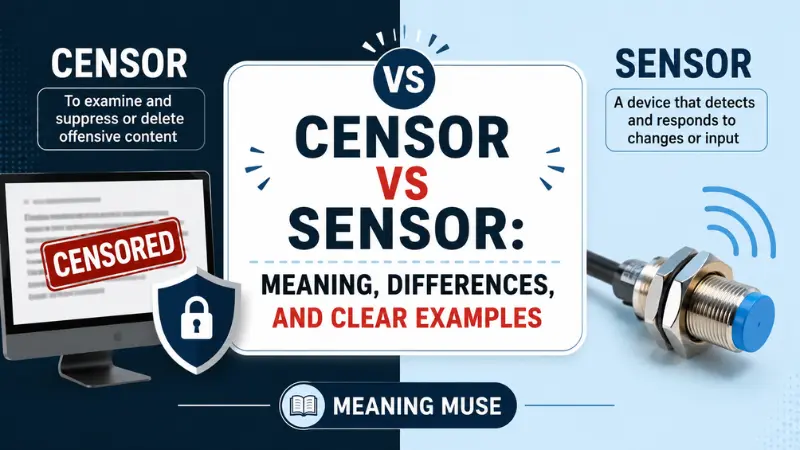
Censor and sensor sound almost identical, but they have completely different meanings.
A censor is a person who reviews books, movies, news, speeches, or other material and decides whether anything should be removed or restricted. As a verb, censor means to hide, block, edit, or remove content.
A sensor is a device that detects or measures a physical condition, such as movement, light, temperature, pressure, sound, speed, or moisture.
The easiest way to remember the difference is:
Censor relates to content control. Sensor relates to sensing or detection.
Quick Answer
Use censor when the sentence is about reviewing, restricting, hiding, editing, or removing information.
Use sensor when the sentence refers to a device that detects, measures, or responds to a physical change.
- Censor as a noun: A person who reviews and restricts content
- Censor as a verb: To block, hide, edit, or remove content
- Sensor as a noun: A device that detects or measures something
- Censored: Restricted, hidden, edited, or removed
- Sensors: Devices used for detection or measurement
Censor and sensor are separate words. They are not regional spellings or alternative forms of the same term.
Censor vs Sensor at a Glance
| Point | Censor | Sensor |
|---|---|---|
| Main meaning | A person who reviews content or an action that restricts it | A device that detects or measures something |
| Part of speech | Noun and verb | Mainly a noun |
| Main purpose | Content control | Detection or measurement |
| Common subjects | Movies, books, news, posts, speeches | Motion, light, heat, sound, pressure |
| Past form | Censored | Not normally used as a verb |
| Related verb | Censor | Sense or detect |
| Related noun | Censorship | Sensing or detection |
| Plural form | Censors | Sensors |
| Memory clue | C for content control | S for sensing |
What Does Censor Mean?
Censor can function as both a noun and a verb.
In either use, the word relates to examining content and deciding whether part of it should be restricted, changed, or removed.
Material that may be censored includes:
- Books
- Movies
- Television programs
- News reports
- Photographs
- Letters
- Speeches
- Music
- Online posts
- Social media comments
- Private information
- Sensitive documents
The reason for censorship may involve privacy, security, legal requirements, platform rules, age restrictions, or concerns about offensive material.
Censor as a Noun
As a noun, a censor is a person or official who reviews material before or after it is shared.
A censor may decide whether certain words, scenes, images, facts, or personal details should remain available to the public.
For example, a film censor may review a movie before its release. A military censor may examine letters or reports to prevent sensitive information from being disclosed. A content reviewer may perform a similar role on an online platform.
The plural form is censors.
Censor as a Verb
As a verb, censor means to examine material and block, hide, edit, or remove parts considered unacceptable, restricted, sensitive, or private.
The main verb forms are:
- Censor
- Censors
- Censored
- Censoring
Content may be censored by:
- Removing a scene
- Covering an image
- Muting a word
- Hiding a social media post
- Blocking access to a website
- Redacting private information
- Deleting sensitive details
- Restricting publication
The exact action depends on the context, but the central idea is always control over information or content.
What Does Sensor Mean?
A sensor is a device or component that detects, measures, or responds to a physical condition.
Sensors collect information from their surroundings and pass that information to another device, system, or control unit.
A sensor may respond to:
- Movement
- Light
- Heat
- Temperature
- Pressure
- Sound
- Speed
- Distance
- Moisture
- Smoke
- Touch
- Electrical changes
- Nearby objects
Sensors are commonly found in phones, cars, security systems, cameras, factories, medical equipment, home appliances, and electronic devices.
The plural form is sensors.
How Sensors Work in Everyday Life
Sensors are part of many ordinary products and systems.
A motion sensor may activate a security light when someone approaches a building. A temperature sensor can send information to a heating or cooling system. A phone’s light sensor may adjust screen brightness according to the surrounding light.
Cars also contain several types of sensors. These devices may monitor speed, tire pressure, engine conditions, parking distance, temperature, and nearby objects.
Although different sensors perform different jobs, they all share one basic purpose: detecting or measuring a condition.
Is Sensor a Verb?
Sensor is mainly used as a noun in standard everyday English.
Natural wording includes:
- The machine contains several sensors.
- The device detects movement.
- The system senses heat.
- The sensor measures pressure.
Using sensor as a general verb usually sounds unnatural.
Instead of saying that a device “sensored” movement, use a clearer verb such as:
- Sensed
- Detected
- Measured
- Recorded
- Monitored
The most natural structure is often to use sensor as the noun and detect or measure as the verb.
Why People Confuse Censor and Sensor
Censor and sensor are frequently confused because they look and sound very similar.
Only their first letters differ:
- Censor begins with c
- Sensor begins with s
For many American English speakers, both words are pronounced approximately SEN-ser. This means pronunciation may not help you choose the correct spelling.
Both words are also correctly spelled English terms. A standard spelling checker may not identify the mistake when the wrong word appears in a sentence.
The writer must check the meaning rather than relying only on spelling software.
Are Censor and Sensor Homophones?
Censor and sensor are homophones for many English speakers.
Homophones are words that sound the same but have different spellings and meanings.
Their similar pronunciation explains why writers may accidentally type censor when they mean sensor or sensor when they mean censor.
The sentence’s meaning provides the clearest clue:
- Content being controlled requires censor.
- A physical condition being detected requires sensor.
How to Choose Between Censor and Sensor
Ask one simple question:
Is the sentence about controlling information or detecting something?
Choose censor when the subject involves:
- Restricting speech
- Removing a movie scene
- Blocking a post
- Hiding an image
- Redacting private details
- Editing unacceptable material
- Preventing information from being published
- Limiting what someone says
Choose sensor when the subject involves:
- Detecting motion
- Measuring temperature
- Responding to light
- Monitoring pressure
- Recording sound
- Identifying smoke
- Measuring distance
- Detecting nearby objects
This meaning test works more reliably than pronunciation.
Use Censor for Content Control
Censor is the correct word when a person, organization, authority, editor, platform, or system controls what information can be shown or shared.
Common combinations include:
- Censor a movie
- Censor a scene
- Censor a word
- Censor a post
- Censor the news
- Censor an image
- Censor private information
- Government censor
- Film censor
- Military censor
The related adjective and past-tense form is censored.
Censored content has been blocked, removed, edited, hidden, or restricted.
Use Sensor for Detection
Sensor is the correct word when a device detects, measures, monitors, or responds to a condition.
Common sensor types include:
- Motion sensor
- Light sensor
- Heat sensor
- Temperature sensor
- Pressure sensor
- Image sensor
- Sound sensor
- Speed sensor
- Parking sensor
- Smoke sensor
- Touch sensor
- Door sensor
- Proximity sensor
Sensor is especially common in technology, engineering, electronics, vehicles, security systems, and home automation.
The Replacement Test
A simple replacement test can help you select the correct word.
Replace Censor With “Restrict Content”
When the phrase restrict content fits the meaning, censor is likely correct.
For example, a platform may restrict content that violates its rules. Therefore, the platform may censor that content.
Replace Sensor With “Detecting Device”
When the phrase detecting device fits the meaning, sensor is likely correct.
A detecting device may respond to movement, temperature, light, or another condition. Therefore, sensor is the correct word.
This test focuses on meaning and avoids confusion caused by pronunciation.
Censored vs Sensored
Censored is a common and standard word.
It means that information, speech, images, or other material has been restricted, edited, hidden, or removed.
Sensored is uncommon in ordinary English and should not replace censored.
When discussing detection, use:
- Sensed
- Detected
- Measured
- Monitored
- Recorded
When discussing restricted material, use censored.
Therefore:
- A removed movie scene was censored.
- Movement was sensed or detected.
- A sensor detected the movement.
Censoring vs Sensing
Censoring and sensing also have different meanings.
Censoring means restricting, editing, blocking, or removing content.
Sensing means detecting or becoming aware of something.
A social platform may be censoring certain posts, while an electronic device may be sensing movement.
The endings look similar, but the actions are unrelated.
Censorship vs Sensor
Censorship is the practice or system of controlling, restricting, or removing content.
A sensor is a physical or electronic detecting device.
Censorship may affect:
- Speech
- News
- Books
- Movies
- Images
- Online content
- Political communication
- Personal information
A sensor may detect:
- Motion
- Heat
- Pressure
- Sound
- Light
- Speed
- Moisture
- Distance
Censorship is an abstract practice. A sensor is usually a physical component or device.
What Is Self-Censorship?
Self-censorship occurs when people limit their own speech, writing, or behavior instead of being directly forced to do so by another person.
Someone may self-censor because of:
- Fear of criticism
- Workplace pressure
- Social expectations
- Possible punishment
- Privacy concerns
- Personal safety
- Fear of conflict
The verb is self-censor.
The noun is self-censorship.
These terms remain connected to content and expression, not electronic detection.
Censor vs Editor
A censor and an editor may both review content, but their purposes are not always the same.
An editor typically improves:
- Clarity
- Accuracy
- Grammar
- Structure
- Style
- Readability
- Organization
A censor focuses on whether certain material should be restricted, removed, or prevented from being shared.
An editor may remove weak or irrelevant wording to improve quality. A censor removes or blocks material because it violates rules, contains sensitive information, or is considered unacceptable.
The roles can overlap, but the words are not exact synonyms.
Sensor vs Detector
Sensor and detector are closely related, but they are not always interchangeable in technical contexts.
A sensor typically measures or responds to a physical condition and produces information.
A detector identifies the presence of a particular substance, event, object, or condition.
In everyday language, the distinction may be small. A smoke detector, for example, contains sensing technology that identifies smoke.
The preferred term depends on the device and its established name.
Censor and Sensor in American and British English
Censor and sensor have the same spellings and basic meanings in American and British English.
There is no regional pattern in which one country uses censor and another uses sensor.
Both varieties use:
- Censor for content control
- Sensor for a detecting or measuring device
Pronunciation may vary slightly because of accent, but the word choice does not change.
Always select the spelling according to meaning.
Pronunciation
Both censor and sensor are commonly pronounced:
SEN-ser
The first syllable sounds like sen, and the second sounds like a reduced form of sir or ser, depending on the speaker’s accent.
Because the pronunciation is so similar, listeners usually depend on context to determine which word is intended.
Common Mistakes and Corrections
Using Censor for a Device
Incorrect idea:
A censor detects motion, light, or temperature.
Correction:
A sensor detects or measures physical conditions. A censor deals with content.
Using Sensor for Restricted Content
Incorrect idea:
A television station sensors offensive language.
Correction:
The station censors offensive language because it is blocking or removing content.
Writing Motion Censor
The correct phrase is motion sensor.
A motion sensor detects movement. It does not control or restrict information.
Writing Censor Light
The correct phrase is sensor light.
A sensor light turns on when it detects darkness, movement, or another condition.
Saying a Device Censored Temperature
A device may sense, measure, monitor, or record temperature.
Censored means that content was hidden or removed, so it does not fit a measurement context.
Using Sensorship Instead of Censorship
The correct noun for restricting content is censorship.
Sensorship is not the standard word for this meaning.
Using Censorship for a Broken Device
Censorship is an activity or system of restricting information. It is not a mechanical or electronic component.
When a detecting component stops working, use sensor.
Assuming a Spelling Checker Will Catch the Error
Censor and sensor are both correctly spelled words.
Software may not recognize that the wrong one has been used. Always check whether the sentence concerns content control or physical detection.
Word Forms
Censor
Part of speech: Noun and verb
Noun meaning: A person who examines material and may remove or restrict certain parts.
Verb meaning: To block, hide, edit, restrict, or remove content.
Verb forms:
- Censor
- Censors
- Censored
- Censoring
Plural noun: Censors
Related nouns:
- Censorship
- Self-censorship
Related adjective:
- Censored
Sensor
Part of speech: Noun
Meaning: A device that detects, measures, or responds to a physical condition.
Plural: Sensors
Related words:
- Sense
- Sensing
- Sensitive
- Detection
- Detector
Sensor is not normally used as a verb in everyday standard English.
Synonyms for Censor
Possible alternatives for censor as a verb include:
- Suppress
- Block
- Remove
- Delete
- Redact
- Restrict
- Hide
- Cut
- Edit
- Withhold
These words do not have identical meanings in every situation.
For example, redact usually means covering or removing private, secret, or sensitive information from a document.
Suppress may suggest deliberately preventing information from becoming publicly known.
Edit is broader and does not always involve censorship.
Synonyms for Sensor
Possible alternatives or related terms include:
- Detector
- Probe
- Monitor
- Sensing device
- Measuring device
- Transducer
These terms are not always technically interchangeable.
Detector is often the closest everyday alternative, but the correct term depends on the device’s function and design.
Common Phrases With Censor
- Government censor
- Military censor
- Film censor
- Censor a movie
- Censor a scene
- Censor the news
- Censor a post
- Censor a word
- Censor an image
- Heavily censored
- Partly censored
- Self-censor
- Uncensored content
- Media censorship
Common Phrases With Sensor
- Motion sensor
- Light sensor
- Heat sensor
- Temperature sensor
- Pressure sensor
- Image sensor
- Parking sensor
- Door sensor
- Touch sensor
- Speed sensor
- Smoke sensor
- Proximity sensor
- Sensor data
- Sensor reading
- Sensor system
FAQs
What Is the Main Difference Between Censor and Sensor?
Censor relates to reviewing, controlling, restricting, or removing content. Sensor refers to a device that detects or measures a physical condition such as movement, light, heat, or pressure.
Do Censor and Sensor Sound the Same?
They are pronounced alike by many English speakers. Both commonly sound like SEN-ser. Their similar pronunciation is one reason they are frequently confused.
Is It Motion Censor or Motion Sensor?
The correct phrase is motion sensor. A motion sensor is a device that detects movement.
Is It Sensor Light or Censor Light?
The correct phrase is sensor light. The light uses a sensor to detect movement, darkness, or another condition.
Is It Censored or Sensored?
Use censored when content has been hidden, blocked, edited, or removed. Sensored is uncommon in everyday writing. For detection, use sensed, detected, measured, or monitored.
Is Censor a Person or an Action?
Censor can be both. As a noun, it means a person who reviews and restricts content. As a verb, it means to hide, block, edit, or remove material.
Is Sensor a Noun or a Verb?
Sensor is mainly a noun. It names a device that detects or measures something. The related verb is usually sense, detect, measure, or monitor.
What Is the Plural of Censor?
The plural of censor is censors. It refers to two or more people or officials who review and restrict content.
What Is the Plural of Sensor?
The plural of sensor is sensors. A modern phone, car, or security system may contain several sensors.
What Is Censorship?
Censorship is the practice or system of restricting, blocking, editing, or removing information, speech, images, or other material.
What Is Self-Censorship?
Self-censorship occurs when people limit their own speech or writing because they fear criticism, punishment, conflict, or another negative result.
What Can a Sensor Detect?
Depending on its type, a sensor may detect or measure motion, light, heat, sound, pressure, speed, distance, moisture, smoke, temperature, touch, or electrical changes.
Can a Person Be a Sensor?
Sensor usually refers to a device or component. A person may sense something, but they are not normally called a sensor in everyday English.
Can a Machine Be a Censor?
A system or platform may automatically censor content by hiding, blocking, or removing it. However, the word sensor should be used when the machine is detecting a physical condition.
Conclusion
Censor and sensor sound alike, but their meanings are completely different.
A censor is a person who reviews content and may decide to restrict or remove part of it. As a verb, censor means to hide, block, edit, or remove information.
A sensor is a device that detects or measures something, such as movement, light, heat, pressure, sound, or distance.
Remember the simplest rule:
Censor begins with C for content control. Sensor begins with S for sensing.