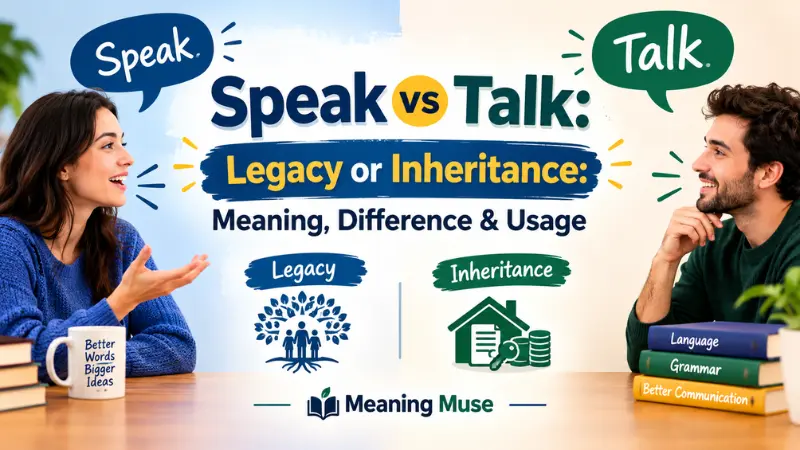
Legacy or inheritance? These words can overlap, but they do not mean exactly the same thing.
Inheritance usually refers to money, property, land, or other possessions received after someone dies. It can also refer to characteristics passed from parents through genes.
Legacy has a wider meaning. It can refer to money or property left to someone after death, but it can also mean something handed down from the past or the lasting effect of a person’s life, work, or actions.
So, the best word depends on what you want to say.
Quick Answer
Use inheritance when you mean money, property, or possessions received after someone’s death.
Use legacy when you mean something passed down from the past or the lasting impact a person, organization, or event leaves behind.
For example:
- She received a large inheritance from her grandfather.
- Her kindness was an important part of her legacy.
There is some overlap. A person can leave both an inheritance and a legacy, but the words emphasize different ideas.
Why People Confuse Them
The confusion happens because both words can describe something that is passed from one person or generation to another.
For example, a person may leave money to a family member. That money can be described as an inheritance. In some contexts, it can also be called a legacy. Cambridge defines legacy as money or property received from someone after death, while also giving broader meanings connected to the past.
The important difference is the wider use of legacy.
You can talk about someone’s:
- financial legacy
- cultural legacy
- artistic legacy
- professional legacy
- historical legacy
You would not normally use inheritance for all of these meanings.
Key Differences At A Glance
| Context | Best Choice | Why |
|---|---|---|
| Money received after a person’s death | Inheritance | Directly describes money received from someone who died. |
| Property received after death | Inheritance | Refers directly to property passed to an heir. |
| Land received from a relative | Inheritance | Describes property received through inheritance. |
| A person’s lasting impact | Legacy | Describes what remains from a person’s life or work. |
| Cultural influence passed down | Legacy | Focuses on lasting influence or history. |
| A famous person’s achievements | Legacy | Describes the lasting effect of their work. |
| Traits passed through genes | Inheritance | Used for biological characteristics. |
| Something handed down from the past | Legacy | Can describe something that remains from an earlier time. |
Are They the Same Word?
No. Legacy and inheritance are separate words.
They can be synonyms in some contexts, especially when discussing property or money left after someone’s death. Dictionary.com lists inheritance as a synonym for some meanings of legacy.
But they are not interchangeable in every sentence.
Consider these examples:
She received an inheritance from her father.
This focuses on what she received.
Her father left a lasting legacy of kindness.
This focuses on the lasting effect of her father’s life.
The first sentence is about something received. The second is about something remembered or carried forward.
US vs UK Preference
There is no simple US-versus-UK spelling difference between legacy and inheritance.
Both words are established in English, including US English. The main difference is meaning and context, not regional spelling.
In US English, inheritance is commonly used for money, land, property, or possessions received after someone dies. It is also used in biology for characteristics passed through genes.
Legacy has those inheritance-related uses but also has broader uses. It can describe something from the past that continues to affect the present, as well as a person’s lasting impact.
There is also a modern US use of legacy as an adjective, such as legacy system or legacy software, referring to older systems that remain in use.
Which Word Should You Use?
Choose inheritance when the focus is on what someone receives.
Use it for:
- money
- property
- land
- possessions
- inherited family traits
Examples:
- He received an inheritance after his mother died.
- Her inheritance included a house and several investments.
- Genetic inheritance can affect physical traits.
Choose legacy when the focus is on what remains or is passed forward.
Examples:
- Her work created a lasting legacy.
- The museum protects the city’s cultural legacy.
- His greatest legacy was the school he founded.
A simple rule
Inheritance = what you receive.
Legacy = what remains or is passed on.
This is a useful guide, but context still matters because legacy can also refer directly to money or property received after death.
When One Word Looks Wrong
The wrong choice becomes easier to spot when you identify the main idea.
Talking about money from a deceased relative
Inheritance is usually the clearer choice.
❌ She received a large legacy from her aunt.
✅ She received a large inheritance from her aunt.
The first sentence is possible in some contexts because legacy can refer to money or property left after death, but inheritance is more direct when the focus is on what the person received.
Talking about a person’s lasting impact
Legacy is the natural choice.
❌ His inheritance was his greatest contribution to the community.
✅ His legacy was his greatest contribution to the community.
Here, legacy describes the lasting effect of his work.
Talking about genetic traits
Use inheritance.
❌ Eye color is part of your genetic legacy.
✅ Eye color is part of your genetic inheritance.
Cambridge specifically uses inheritance for characteristics received from parents through genes.
Common Mistakes (and Quick Fixes)
Mistake 1: Treating the words as exact synonyms
Legacy and inheritance overlap, but they are not exact replacements in every context.
Quick fix: Ask whether you mean something received or something left behind or carried forward.
Mistake 2: Using inheritance for lasting influence
❌ The author’s inheritance changed modern literature.
✅ The author’s legacy changed modern literature.
Mistake 3: Using legacy when inheritance is more precise
❌ She used her legacy to buy a new house.
✅ She used her inheritance to buy a new house.
Mistake 4: Forgetting the biological meaning of inheritance
Inheritance can also describe characteristics passed from parents through genes.
For example:
Genetic inheritance can influence eye color.
Everyday Examples
Examples with inheritance
- She received an inheritance from her grandmother.
- His inheritance included the family home.
- They used their inheritance to pay off the mortgage.
- The lawyer explained how the inheritance would be divided.
- Genetic inheritance can affect certain traits.
Examples with legacy
- Her greatest legacy was the community center she built.
- The writer left a powerful literary legacy.
- The family wanted to protect their cultural legacy.
- His legacy continues through the students he taught.
- The company is proud of its long legacy.
Compare the two
Inheritance:
She received a large inheritance after her grandfather died.
Legacy:
Her grandfather left a lasting legacy in the community.
The first focuses on what she received. The second focuses on what he left behind in a broader sense.
Dictionary-Style Word Details
Verb
Legacy: Legacy is primarily a noun. It is not normally used as a standard verb in everyday US English.
Inheritance: Inheritance is also a noun. It is not normally used as a standard verb.
The related verb inherit is used when someone receives money, property, or characteristics.
Noun
Legacy: A noun referring to money or property received after someone’s death, something handed down from the past, or a lasting effect or influence.
Inheritance: A noun referring to money, land, property, or possessions received after someone’s death. It can also refer to characteristics passed from parents through genes.
Synonyms
Legacy: Depending on the meaning, closest plain alternatives include heritage, bequest, inheritance, or lasting impact. These are not exact replacements in every context.
Inheritance: Depending on the context, closest plain alternatives include bequest, property received, heritage, or legacy. The best alternative depends on the intended meaning.
Example Sentences
Legacy:
- The artist left a lasting legacy.
- The building is part of the city’s cultural legacy.
- She received a small legacy from her uncle.
Inheritance:
- He received an inheritance from his parents.
- The inheritance included land and savings.
- Genetic inheritance affects many physical characteristics.
Word History
The two words have different histories and are not simply two forms of the same word.
Legacy developed from a word connected with a person appointed as a representative or envoy and later came to refer to a bequest or something handed down. Modern English expanded its use to include things that remain from the past and a person’s lasting influence.
Inheritance is connected with the verb inherit and refers to the act or result of receiving something passed down. Modern usage includes property received after death and biological characteristics passed from parents.
Phrases Containing
Common phrases with legacy include:
- lasting legacy
- cultural legacy
- artistic legacy
- historical legacy
- family legacy
- legacy system
- legacy software
Common phrases with inheritance include:
- large inheritance
- family inheritance
- inheritance from a parent
- inheritance tax
- genetic inheritance
- inherited property
FAQs
What is the difference between legacy and inheritance?
Inheritance usually means money, property, or possessions received after someone’s death. Legacy can mean something passed down from the past or the lasting impact of a person’s life and work.
Is legacy the same as inheritance?
No. The words can overlap when talking about money or property left after death, but they are not exact synonyms in every context. Legacy has a broader meaning.
Can legacy mean inheritance?
Yes. Legacy can refer to money or property left to someone after a person’s death. However, it can also mean a lasting influence, tradition, or contribution.
Which word is better for money received after death?
Inheritance is usually the clearest choice when you mean money, property, or possessions received after someone’s death.
Which word should I use for a person’s lasting impact?
Use legacy. For example: “Her work left a lasting legacy.”
Can inheritance refer to family property?
Yes. Inheritance can refer to property, land, money, or other possessions received from someone who has died.
Does inheritance have a meaning in genetics?
Yes. Inheritance can describe the passing of genetic characteristics from parents to their children.
Is family legacy the same as family inheritance?
Not necessarily. A family inheritance usually refers to property or money. A family legacy can include values, traditions, stories, achievements, or influence passed to future generations.
What is an easy way to remember legacy and inheritance?
Think of inheritance as something you receive, while legacy is something a person leaves behind or passes forward.
Are legacy and inheritance spelling variants?
No. Legacy and inheritance are different English words, not alternative spellings of the same word. Their meanings overlap in some contexts, but their uses are not identical.
Conclusion
Legacy or inheritance? The answer depends on your meaning.
Use inheritance when you mean money, property, possessions, or characteristics received from someone or something.
Use legacy when you mean something that remains from the past, is passed forward, or represents a person’s lasting influence.
The words can overlap when discussing property or money left after death, but they are not interchangeable in every context.
Easy way to remember
Inheritance = what you receive.
Legacy = what is left behind or carried forward.