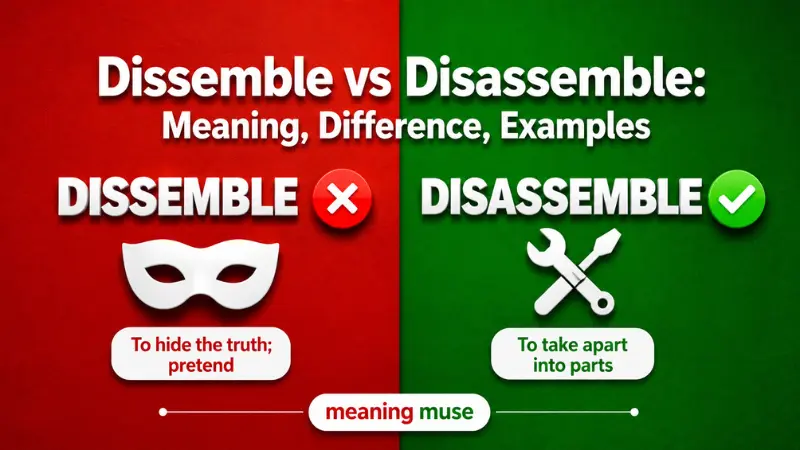
Dissemble vs disassemble are two commonly confused words because they look similar, but they have very different meanings. Dissemble means to hide your true feelings, intentions, or identity, while disassemble means to take something apart into separate pieces.
Dissemble and disassemble look almost alike, but they have very different meanings.
Use dissemble when someone hides the truth, feelings, plans, or intentions. The person may pretend, avoid a direct answer, or create a false appearance.
Use disassemble when someone takes an object, machine, or structure apart.
For example:
The witness tried to dissemble when the lawyer asked about the missing money.
The mechanic had to disassemble the engine to find the damaged part.
The first sentence is about hiding the truth. The second is about separating an object into pieces.
The words are not alternate spellings. They are separate verbs with different pronunciations, meanings, and uses. This guide explains how to choose the right one in clear American English.
Quick Answer
Dissemble means to hide your true feelings, intentions, or facts. Disassemble means to take something apart into separate pieces.
Use dissemble for dishonest or misleading behavior:
The manager dissembled when employees asked about the layoffs.
Use disassemble for machines, furniture, equipment, or structures:
We disassembled the desk before moving it upstairs.
Remember this simple rule:
- Dissemble = conceal
- Disassemble = take apart
Why People Confuse Them
People confuse these words because they share many of the same letters.
- dissemble
- disassemble
They also sound similar when spoken quickly. However, the extra as in disassemble creates a different word.
Another cause of confusion is the word assemble.
Assemble means to put parts together:
The workers assembled the new shelves.
Adding dis- creates disassemble, which means to reverse that action:
The workers disassembled the old shelves.
The same idea does not work with dissemble. Dissemble is not the opposite of assemble. It is an older, formal verb connected with hiding or disguising the truth.
The difference becomes easier when you connect each word with a familiar synonym:
- dissemble → pretend or conceal
- disassemble → dismantle or take apart
Key Differences at a Glance
| Context | Best Choice | Why |
|---|---|---|
| Hide your true feelings | Dissemble | It refers to concealment or pretense |
| Give a misleading answer | Dissemble | The speaker is hiding facts or intentions |
| Take apart an engine | Disassemble | The machine is separated into parts |
| Break down furniture for moving | Disassemble | The object is taken apart |
| Pretend not to know something | Dissemble | The person creates a false appearance |
| Separate a device into pieces | Disassemble | The device’s parts are removed |
| Describe dishonest political speech | Dissemble | The speaker may avoid or hide the truth |
| Remove the parts of a computer | Disassemble | The physical object is taken apart |
The core difference is:
You dissemble information, feelings, or intentions. You disassemble physical objects or systems.
Meaning and Usage Difference
What Does Dissemble Mean?
Dissemble means to hide what you truly think, feel, know, or plan.
A person who dissembles may:
- hide important facts
- pretend to feel differently
- avoid a direct answer
- create a false impression
- cover up a real intention
- act as though something is true when it is not
Merriam-Webster defines the word around hiding something under a false appearance. Oxford and Cambridge also describe it as concealing real feelings, intentions, or facts.
Examples:
He dissembled when reporters asked about the secret meeting.
She could not dissemble her disappointment.
The suspect dissembled about where he had been that night.
Dissemble often suggests an effort to mislead another person. However, it does not always mean telling a direct lie. Someone may dissemble by changing the subject, giving a half-answer, or pretending not to care.
What Does Disassemble Mean?
Disassemble means to take an object, machine, or structure apart so that its pieces are separate.
Common things people disassemble include:
- engines
- computers
- furniture
- toys
- appliances
- bicycles
- equipment
- shelves
- electronic devices
- temporary structures
Cambridge and Oxford define disassemble as separating something into its different parts. Merriam-Webster gives the simple meaning “to take apart.”
Examples:
The technician disassembled the laptop.
We need to disassemble the bed before moving it.
The crew disassembled the stage after the concert.
Disassemble is the opposite of assemble in this physical sense.
Assemble the chair.
Disassemble the chair.
The word can also appear in computing. In that field, it may describe translating machine code into a form a programmer can read. That is a specialized technical meaning.
Tone, Context, and Formality
Dissemble Is Formal
Dissemble is a formal word. It often appears in:
- news reports
- political writing
- court discussions
- historical writing
- serious fiction
- formal criticism
- discussions of dishonest behavior
A newspaper might write:
The official continued to dissemble about the agency’s decision.
In everyday speech, people are more likely to use:
- hide
- pretend
- mislead
- avoid the truth
- cover up
- act as if
Everyday version:
He tried to hide what he really knew.
More formal version:
He tried to dissemble his knowledge of the event.
Because dissemble is uncommon in casual conversation, some readers may need context to understand it.
Disassemble Is Neutral and Practical
Disassemble is a normal, practical word. It appears in:
- instruction manuals
- repair guides
- moving directions
- product warnings
- technical writing
- engineering
- recycling
- construction
- computer work
Examples:
Unplug the fan before you disassemble it.
The table is easy to disassemble and store.
A trained technician should disassemble the device.
It does not normally suggest dishonesty or secrecy. It simply describes taking something apart.
Which One Should You Use?
Ask what kind of action is happening.
Is Someone Hiding the Truth?
Use dissemble.
The candidate dissembled when asked about the broken promise.
The candidate is not taking anything apart. The candidate is hiding or avoiding the truth.
Is Someone Taking an Object Apart?
Use disassemble.
The repair worker disassembled the washing machine.
The worker separated the machine into parts.
Is Someone Pretending to Feel Differently?
Use dissemble.
She smiled, but she could not fully dissemble her anger.
She tried to hide her true emotion.
Is Something Being Prepared for Storage or Transport?
Use disassemble.
We disassembled the crib before placing it in storage.
The crib was taken apart.
Simple Memory Trick
Look for assemble inside disassemble:
- assemble = put together
- disassemble = take apart
For dissemble, think:
- dissemble = disguise what is true
Both dissemble and disguise begin with dis and can involve hiding something.
When One Choice Sounds Wrong
Using the wrong word can create a strange or funny sentence.
Incorrect
The mechanic dissembled the engine.
This suggests that the mechanic hid the engine’s true feelings or intentions, which makes no sense.
Correct
The mechanic disassembled the engine.
The mechanic took the engine apart.
Incorrect
The politician disassembled when asked about the missing funds.
This suggests that the politician physically came apart.
Correct
The politician dissembled when asked about the missing funds.
The politician avoided or hid the truth.
Incorrect
Please dissemble the bookshelf before moving it.
A bookshelf cannot usually hide its intentions.
Correct
Please disassemble the bookshelf before moving it.
Incorrect
She disassembled her true feelings during the meeting.
Feelings are not physical parts that can be removed.
Correct
She dissembled her true feelings during the meeting.
A more natural version would be:
She dissembled during the meeting and hid her true feelings.
Common Mistakes and Quick Fixes
Mistake 1: Treating Them as Two Spellings of One Word
Dissemble and disassemble are not regional or optional spellings.
They are separate dictionary words.
Quick fix: Check whether the sentence is about concealment or taking apart.
Mistake 2: Leaving Out “As” in Disassemble
Incorrect:
The worker dissembled the machine.
Correct:
The worker disassembled the machine.
Quick fix: Physical objects need disassemble, which contains the full word assemble.
Mistake 3: Adding “As” to Dissemble
Incorrect:
He disassembled to hide his real plans.
Correct:
He dissembled to hide his real plans.
Quick fix: Dishonest behavior needs the shorter word dissemble.
Mistake 4: Assuming Dissemble Means Disagree
Dissemble does not mean to disagree, argue, or object.
Incorrect:
The two managers dissembled about the new policy.
Better:
The two managers disagreed about the new policy.
Use dissemble only when someone hides or disguises the truth.
Mistake 5: Assuming Disassemble Means Destroy
To disassemble something is to take it apart. It does not always mean damaging or destroying it.
We carefully disassembled the table and rebuilt it in the new office.
The table remained usable.
Quick fix: Use destroy, break, or demolish when the object is ruined.
Mistake 6: Confusing Disassemble With Dismantle
Disassemble and dismantle often overlap when discussing physical objects.
We disassembled the machine.
We dismantled the machine.
However, dismantle can also describe ending a system or organization:
The company dismantled the old management structure.
Disassemble is usually more literal and focuses on separating parts.
Mistake 7: Using Dissemble in Simple Conversation
Dissemble is correct, but it may sound too formal in a casual message.
Formal:
He dissembled about his role in the mistake.
Simple:
He hid the truth about his role in the mistake.
Use the word that best fits your audience.
Everyday Examples
Examples With Dissemble
- The witness dissembled when the lawyer asked about the payment.
- She tried to dissemble her disappointment.
- The official dissembled about the reasons for the delay.
- He was too honest to dissemble.
- The manager dissembled when employees asked about job cuts.
- She dissembled her fear behind a calm smile.
- The suspect continued to dissemble during the interview.
- He could not dissemble his dislike of the plan.
- The spokesperson dissembled instead of giving a clear answer.
- They accused the company of dissembling about the risks.
Examples With Disassemble
- The mechanic disassembled the engine.
- We disassembled the desk before moving it.
- The technician carefully disassembled the phone.
- You must unplug the device before you disassemble it.
- The workers disassembled the temporary stage.
- This shelf is easy to disassemble.
- Dad disassembled the toy to replace its battery.
- The recycling center disassembles old electronics.
- The crew disassembled the equipment after the event.
- She disassembled the computer to clean the fan.
Examples Using Both Words
- The technician did not dissemble about the damage before disassembling the machine.
- The seller dissembled about the defect, so the buyer disassembled the device to inspect it.
- He dissembled when asked why he had disassembled the office computer.
- The mechanic did not dissemble; she clearly explained why the engine had to be disassembled.
- The employee dissembled about who had disassembled the equipment.
These sentences show that the words can appear together, but they describe completely different actions.
Dictionary-Style Word Details
Verb
Both words are verbs.
Dissemble: To hide facts, emotions, intentions, or knowledge under a false appearance.
She dissembled when asked how she felt.
It can be used without a direct object:
He continued to dissemble.
It can also appear with an object in formal writing:
She dissembled her true intentions.
Disassemble: To take an object or structure apart.
The worker disassembled the machine.
It is most often used with a direct object, such as a table, engine, device, or structure.
Some dictionaries also recognize an intransitive use:
The frame disassembles into four pieces.
Noun
Neither dissemble nor disassemble normally works as a noun.
Related forms of dissemble include:
- dissembling: the act of hiding the truth or creating a false appearance
- dissembler: a person who dissembles
- dissimulation: formal concealment of true feelings or intentions
Example:
Her dissembling made it hard to trust her.
Related forms of disassemble include:
- disassembly: the act or process of taking something apart
- disassembler: a person, device, or computer program that disassembles
Example:
The disassembly of the engine took two hours.
Synonyms
Synonyms and close alternatives for dissemble include:
- conceal
- pretend
- deceive
- mislead
- feign
- disguise
- hide
- cover up
- put on a false appearance
These words are not always exact matches. For example, a person can conceal an object, but dissemble usually concerns facts, intentions, or feelings.
Synonyms and close alternatives for disassemble include:
- dismantle
- take apart
- break down
- separate
- disconnect
- take to pieces
- deconstruct
The clearest opposite of disassemble is assemble.
Possible opposites of dissemble depend on the sentence:
- reveal
- admit
- disclose
- confess
- speak honestly
Example Sentences
Dissemble:
The director dissembled when asked about the private meeting.
She could not dissemble her excitement.
Rather than answer directly, he began to dissemble.
Disassemble:
Please disassemble the chair before shipping it.
The repair team disassembled the pump.
The cabinet disassembles into three main sections.
Word History
Dissemble entered English through older French and Latin forms connected with disguising or concealing something. Its spelling was influenced by words related to appearance, such as semblance. Oxford traces it to a Latin source meaning to disguise or conceal.
Disassemble was formed from dis- and assemble. The prefix gives the idea of reversing assembly or separating something that was put together.
The similar spelling is mostly accidental. The words came through different paths and developed different meanings.
Phrases Containing
Common phrases with dissemble include:
- dissemble the truth
- dissemble one’s feelings
- dissemble one’s intentions
- dissemble about the facts
- refuse to dissemble
- continue to dissemble
- attempt to dissemble
- incapable of dissembling
Common phrases with disassemble include:
- disassemble an engine
- disassemble a computer
- disassemble a device
- disassemble furniture
- disassemble a machine
- disassemble for storage
- easy to disassemble
- partially disassembled
- disassemble and reassemble
- safely disassemble
FAQs
Are Dissemble and Disassemble the Same?
No. Dissemble means to hide the truth, feelings, or intentions. Disassemble means to take an object apart. They are different verbs, not different spellings of the same word.
What Is the Simple Meaning of Dissemble?
Dissemble means to pretend or hide what you really know, feel, or plan.
He dissembled when asked about the mistake.
In simple language, he avoided or hid the truth.
What Is the Simple Meaning of Disassemble?
Disassemble means to separate an object into its parts.
The mechanic disassembled the motor.
The mechanic took the motor apart.
Is Dissemble the Opposite of Assemble?
No. Disassemble is the opposite of assemble.
- assemble = put together
- disassemble = take apart
Dissemble has a separate meaning related to hiding the truth.
Is Dissemble the Same as Lie?
The words are related but not always identical. A lie is a direct false statement. Dissembling may include lying, but it can also involve pretending, avoiding an answer, or hiding important facts.
Is Disassemble the Same as Dismantle?
They often have the same meaning when used for machines, furniture, and structures. Both can mean to take something apart.
However, dismantle can also mean ending a system or organization:
The government dismantled the program.
How Do You Pronounce Dissemble?
Dissemble is pronounced approximately:
dih-SEM-buhl
The stress falls on SEM.
How Do You Pronounce Disassemble?
Disassemble is pronounced approximately:
dis-uh-SEM-buhl
The word has an extra unstressed sound before SEM. Oxford lists clearly different pronunciations for the two verbs.
What Is the Past Tense of Dissemble?
The past tense is dissembled.
The witness dissembled during the interview.
The -ing form is dissembling.
What Is the Past Tense of Disassemble?
The past tense is disassembled.
We disassembled the table yesterday.
The -ing form is disassembling.
Conclusion
Dissemble and disassemble are both correct words, but they do not share the same meaning.
Use dissemble when someone hides facts, feelings, knowledge, or intentions:
The official dissembled about the decision.
Use disassemble when someone takes an object into separate pieces:
The technician disassembled the device.
Remember the difference this way:
- Dissemble = disguise the truth
- Disassemble = reverse assembly
Look for the full word assemble inside disassemble. When a machine, table, device, or structure is being taken apart, use disassemble.
When a person is pretending, avoiding the truth, or hiding real feelings, use dissemble.