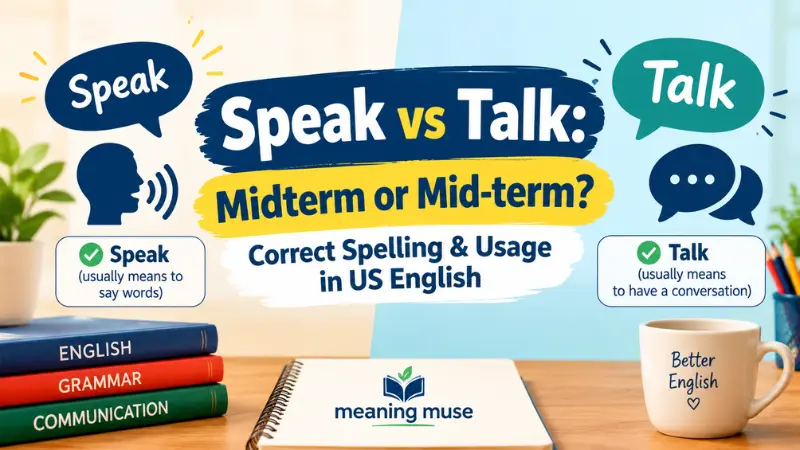
Midterm or mid-term can both appear in English, but American writers normally use midterm as one word. The hyphenated mid-term is also documented as an alternative form, and it is especially associated with British English and some house styles.
For US readers, the safest everyday choice is simple: write midterm when you mean an exam, the middle of a term, or something occurring around the middle of a term.
For example:
I have a chemistry midterm next Tuesday.
The two forms do not represent two different words with different basic meanings.
Quick Answer
Midterm is the standard choice for most US English writing.
Mid-term is a recognized alternative spelling. Collins notes that British English usually uses the hyphenated form, while its American English entry uses midterm.
The simple US rule
- US English: midterm
- British English: mid-term may be preferred
- Meaning: essentially the same
- Plural in US English: midterms
- Common US examples: midterm exam, midterm grade, midterm elections
So, if you are writing for an American audience, choose midterm unless a specific publication or organization requires a different house style.
Why People Confuse Them
The confusion comes from the way English compounds develop.
The word combines mid- with term. English uses several patterns for compounds: some become one word, some stay open, and some keep a hyphen.
That makes midterm and mid-term look like competing rules.
Dictionary sources show that both forms exist. Wiktionary lists mid-term as an alternative form of midterm, while Collins identifies mid-term as the usual British form.
There is also a separate issue with other words beginning with mid-. For example, American writing commonly uses forms such as mid-July and mid-Atlantic. That does not mean midterm should normally be written with a hyphen.
Key Differences At A Glance
| Context | Best Choice | Why |
|---|---|---|
| US school exam | midterm | Common American form |
| US college course | midterm | Standard closed spelling |
| US political usage | midterm | Common US form |
| British English | mid-term may be preferred | British usage often favors the hyphen |
| General US writing | midterm | Clear and widely accepted |
| Specific house style | Follow the style guide | Publications can set their own conventions |
The key difference is therefore mainly spelling preference and regional or house style, not meaning.
Extra comparison:
- midterm — closed form; the normal choice for US English.
- mid-term — hyphenated alternative; especially associated with British usage and some style choices.
Are They the Same Word?
Yes. Midterm and mid-term refer to the same basic word and concept.
Both can describe something that occurs around the middle of a term. They can also refer to an examination given around the middle of an academic term.
For example, these sentences express the same basic idea:
- I have a midterm tomorrow.
- I have a mid-term tomorrow.
The first is the more natural choice for a US audience.
The spelling difference does not normally create a difference in meaning. Instead, the choice reflects regional usage, editorial preference, or house style.
US vs UK Preference
In US English, midterm is the preferred everyday spelling.
Cambridge’s American Dictionary uses midterm for both the adjective and the noun. Dictionary.com also labels midterm as American and gives examples such as midterm recess and midterm elections.
British usage is more mixed across sources, but Collins specifically notes that British English usually uses mid-term.
This means you should not treat mid-term as an impossible spelling. It is a documented form. The better practical rule is to match the variety of English and the style guide you are following.
For American websites, school papers, workplace documents, and general writing, midterm is the natural default.
Which Spelling Should You Use?
If you are writing for readers in the United States, use midterm.
Use midterm in common US phrases
- midterm exam
- midterm grade
- midterm review
- midterm results
- midterm elections
- midterm break
Examples:
The professor posted our midterm grades yesterday.
I need to study for my midterm exam tonight.
The class has a midterm review on Friday.
A particular publication may have its own preference. If its style guide specifies mid-term, follow that guide consistently.
For normal American writing, however, there is usually no need to add the hyphen.
When One Spelling Looks Wrong
Mid-term may look unusual to an American reader because midterm is the familiar US form.
For example:
I studied all weekend for my mid-term.
This is understandable, but midterm is the more natural US spelling:
I studied all weekend for my midterm.
A US institutional style guide from Indiana University of Pennsylvania specifically lists midterm as the correct style for the word.
At the same time, calling mid-term simply “wrong” would be too broad. Reputable dictionaries document it as an alternative or regional form.
The important distinction is between US preference and absolute correctness.
Common Mistakes (and Quick Fixes)
Mistake 1: Using a space
Wrong for the standard compound: mid term
Better: midterm
We have a midterm next week.
Mistake 2: Assuming the hyphen is always required
The presence of mid- does not mean every word beginning with it must retain a hyphen.
Better: midterm exam
Mistake 3: Calling every hyphenated form incorrect
Mid-term is a documented alternative form. It can appear in British English or in a particular house style.
Mistake 4: Mixing styles in one document
If you choose midterm, use it consistently throughout a US-focused document unless a quoted title or required style calls for another form.
Mistake 5: Confusing related hyphenation rules
Words beginning with mid- can have different treatments depending on what follows them. For example, mid-July follows a different pattern from the established compound midterm.
Everyday Examples
Here are natural examples for US English:
- My biology midterm is on Thursday.
- She studied for three hours before her midterm.
- The professor returned our midterm exams today.
- Students received their midterm grades online.
- The department scheduled a midterm review.
- He was worried about his upcoming midterm.
- The school offers a midterm break.
- The report included a midterm assessment of the project.
- The class met after the midterm to discuss progress.
- The midterm elections receive extensive news coverage.
In each example, midterm works naturally for US readers.
Dictionary-Style Word Details
Verb
- midterm: Not commonly used as a standard English verb.
- mid-term: Not commonly used as a standard English verb.
Neither spelling should normally be treated as a verb. The word is chiefly used as a noun and adjective.
Noun
- midterm: A point around the middle of a term; in US English, it can also mean an examination given around the middle of an academic term. The plural is midterms.
- mid-term: An alternative spelling of the same word. It can function as a noun in documented usage.
Example:
I have two midterms next week.
Synonyms
Because both spellings represent the same word, their closest plain alternatives are also the same.
- midterm: closest plain alternatives include midterm exam, exam, or assessment, depending on context.
- mid-term: the same alternatives apply.
There is no meaningful synonym difference created by the hyphen.
Example Sentences
- midterm: The professor moved the midterm to Wednesday.
- mid-term: The professor moved the mid-term to Wednesday.
For American writing, the first version is normally preferable.
- midterm: We received our midterm grades today.
- mid-term: The report described a mid-term review.
The examples show that the main issue is spelling convention, not a change in meaning.
Word History
The word comes from mid- + term. Historical sources document midterm and mid-term as forms meaning “in the middle of a term.” Etymonline records the word in uses connected with the middle of a term and later academic and political contexts.
The important point for modern writers is that the closed form midterm is well established, particularly in American English.
Phrases Containing
Common phrases include:
- midterm exam
- midterm grade
- midterm review
- midterm assessment
- midterm results
- midterm elections
- midterm break
In US English, these phrases are normally written with midterm as one word.
FAQs
Is it midterm or mid-term?
Midterm is the standard spelling in most US English writing. Mid-term is also a recognized alternative, especially in British English and some house styles.
Is midterm one word in American English?
Yes. In American English, midterm is normally written as one word, especially in phrases such as midterm exam, midterm grade, and midterm elections.
Is mid-term wrong?
No. Mid-term is not simply an incorrect spelling. It is a documented alternative form. However, midterm is generally the better choice for standard US English.
Do you write midterm exam or mid-term exam?
For a US audience, write midterm exam. The closed form is the normal American spelling.
Is midterm hyphenated?
Usually not in US English. Midterm is normally written as one word. A publication’s house style may choose mid-term, so always follow a required style guide when one applies.
What is the plural of midterm?
The plural is midterms.
Example:
I have three midterms next week.
Is midterm an adjective or a noun?
Midterm can be used as both a noun and an adjective.
Noun: I have a midterm tomorrow.
Adjective: I am studying for my midterm exam.
Is midterm used in British English?
British English commonly uses mid-term, although usage can vary. For US English, midterm is the usual choice.
Does midterm have a different meaning from mid-term?
No. The two spellings generally refer to the same concept. The main difference is spelling preference and regional or house style, not meaning.
Which spelling should I use in the US?
Use midterm unless a specific publication, school, employer, or style guide requires mid-term.
Conclusion
Midterm is the standard spelling to choose in most US English writing.
Mid-term is a legitimate alternative form, and it is particularly associated with British usage and some house styles. The two forms do not normally have different meanings.
So if your audience is American, the simple choice is:
Use “midterm.”
Write midterm exam, midterm grades, and midterm elections unless a specific style guide tells you to use the hyphenated form.