Decedent and descendant look and sound similar, but they have very different meanings.
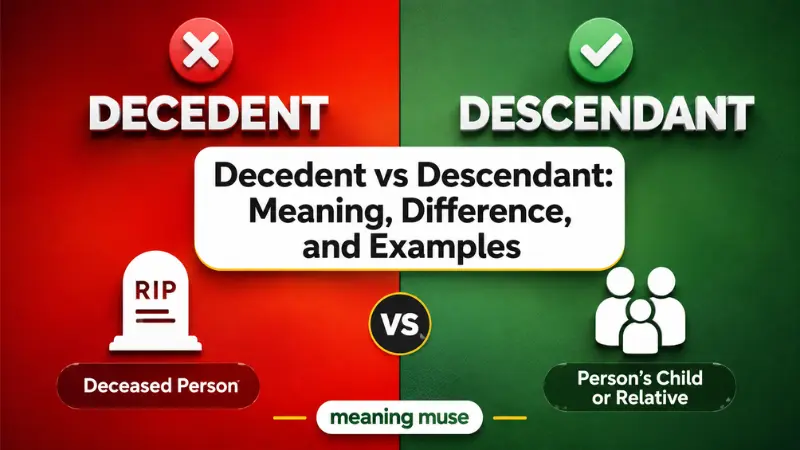
A decedent is a person who has died. This formal word usually appears in legal, tax, probate, and estate documents.
A descendant is a person who comes from an earlier family member. Your children, grandchildren, and great-grandchildren are your descendants.
The difference matters because both words may appear in the same legal document. A will might discuss the property of the decedent and explain how that property should pass to the decedent’s descendants.
This guide explains the difference between decedent and descendant, how to pronounce each word, and how to use them correctly in American English.
Decedent vs descendant are two commonly confused words because they look and sound similar, but they have completely different meanings. Decedent refers to a person who has died, while descendant means a person who comes from a family line or ancestor.
Quick Answer
Decedent means a person who has died. Descendant means a child, grandchild, or another person from a later family generation.
Use decedent when talking about the person whose death created an estate or legal case.
Use descendant when talking about someone’s family line.
The decedent left a house to her descendants.
In this sentence, the decedent is the person who died. Her descendants are her children, grandchildren, or later family members.
Cornell Law School’s Legal Information Institute defines a decedent as a person who has died and a descendant as someone in a later direct family line. Confuse Them
People often confuse decedent and descendant because the words share several letters:
- Decedent
- Descendant
Both words also appear in discussions about families, death, wills, inheritance, and property.
However, they do not name the same person.
A decedent is identified by death. A descendant is identified by family connection.
The words also have different sounds. In decedent, the stressed part sounds like “SEE.” In descendant, the stressed part sounds like “SEN.”
Remember this simple clue:
- Decedent → deceased
- Descendant → descends from a family member
Key Differences at a Glance
| Context | Best Choice | Why |
|---|---|---|
| A person who has died | Decedent | It is a formal legal term for a deceased person |
| A child or grandchild | Descendant | The person comes from an earlier generation |
| A dead person’s property | Decedent | The property may form the decedent’s estate |
| A family tree | Descendant | It shows later generations |
| Probate documents | Decedent | It identifies the person whose estate is being handled |
| Future family generations | Descendant | It refers to people who come later in the family line |
| Genealogy research | Descendant | It describes a person related through ancestry |
| A will discussing both groups | Both | The decedent may leave property to descendants |
The main difference is simple:
Decedent relates to death. Descendant relates to family descent.
Meaning and Usage Difference
What Does Decedent Mean?
A decedent is a person who has died.
It is a countable noun, so its plural form is decedents.
The term is mainly used in formal American legal and financial writing. Lawyers, courts, tax agencies, executors, and estate administrators may use it when discussing a person’s property after death.
Examples include:
- the decedent’s estate
- the decedent’s will
- the decedent’s property
- the decedent’s final tax return
- the decedent’s surviving spouse
The Internal Revenue Service uses decedent for an individual who has died and whose property or tax matters must be handled by a personal representative.
The executor paid the decedent’s debts before giving the remaining property to the beneficiaries.
In everyday conversation, people usually say the deceased person, the person who died, or use the person’s name. Decedent can sound too formal outside a legal setting.
What Does Descendant Mean?
A descendant is a person who comes from another person through a direct family line.
A person’s descendants normally include:
- children
- grandchildren
- great-grandchildren
- later generations in the same family line
The plural form is descendants.
Example:
Many of her descendants still live in the same town.
A descendant does not need to be alive after the original person dies. The word describes the family relationship, not the person’s current life status.
For example, a grandfather’s son is his descendant. That remains true even if the son dies before the grandfather.
In ordinary English, descendant can also describe an animal, plant, object, system, or idea that developed from an earlier one.
Modern smartphones are descendants of earlier mobile phones.
Cambridge Dictionary and Merriam-Webster both recognize the family meaning and the broader meaning of something developed from an earlier form. ext, and Formality
Decedent Is Formal and Legal
Decedent belongs mainly to legal and official language.
You may see it in:
- wills
- trusts
- probate papers
- court decisions
- estate records
- tax forms
- insurance documents
- medical examiner reports
A lawyer might write:
The decedent owned the property at the time of death.
In a family conversation, a person would more naturally say:
My grandfather owned the property when he died.
Both sentences can describe the same situation, but the first one has a formal legal tone.
Descendant Works in Formal and Everyday English
Descendant is common in both formal and ordinary English.
It can appear in:
- family history
- genealogy
- legal documents
- history books
- science writing
- normal conversations
Examples:
She is a descendant of the town’s first mayor.
His descendants gathered for a family reunion.
The will divided the property among the decedent’s descendants.
The last sentence is formal because it uses both words in an estate context.
Decedent vs Descendant in Legal Documents
Decedent and descendant often appear together in wills and probate records.
Consider this sentence:
If the decedent’s child has already died, that child’s descendants may receive the child’s share.
Here is what each word means:
- Decedent: the person whose estate is being handled
- Child: the decedent’s son or daughter
- Descendants: the child’s children or later generations
A decedent’s estate may contain property owned by the person at death. The estate may remain active while debts, taxes, and distributions are handled. hts of descendants depend on the will, trust, state law, adoption status, and other facts. A language guide can explain the words, but it cannot decide who legally receives an estate.
Descendant, Heir, and Beneficiary
These three terms are related, but they do not always mean the same thing.
Descendant
A descendant is connected to a person through a later family generation.
Ava is her grandmother’s descendant.
Heir
An heir is a person who may inherit under the law, especially when someone dies without a valid will.
A surviving spouse may be an heir even though the spouse is not a descendant.
Beneficiary
A beneficiary is a person or organization named to receive money or property through a will, trust, insurance policy, or another arrangement.
A charity can be a beneficiary, but it cannot be a family descendant.
A person can be all three:
The decedent’s daughter was a descendant, an heir, and a named beneficiary.
A person can also be a descendant without receiving anything from a certain will. Cornell Law notes that an heir and a beneficiary are not automatically the same: an heir inherits according to law, while a beneficiary is selected to receive property through an estate plan or similar document. Should You Use?
Choose the word by asking one question:
Did the person die?
Use decedent when the person is being discussed as the deceased person in a legal or estate matter.
The decedent signed the will in 2022.
Is the person part of a later family generation?
Use descendant.
The author’s descendants donated her papers to a museum.
Are both ideas present?
You may need both words.
The decedent’s descendants challenged the will.
The decedent is the person who died. The descendants are later family members.
Simple Memory Trick
Connect the beginning of each word with a related idea:
- Dece- in decedent → think of deceased
- Descend- in descendant → think of a family line descending through generations
When One Choice Sounds Wrong
Use of the wrong word can change the meaning of a sentence.
Incorrect
The descendant’s body was taken to the medical examiner.
This sentence may be grammatically possible, but it does not clearly mean “the person who died.” It only says the person was someone’s family descendant.
Better
The decedent’s body was taken to the medical examiner.
Incorrect
Her children and grandchildren are her decedents.
This wrongly suggests that all of them have died.
Correct
Her children and grandchildren are her descendants.
Incorrect
The lawyer contacted every decedent named in the will.
A decedent cannot normally be contacted because a decedent has died.
Possible Correction
The lawyer contacted every descendant named in the will.
The correct choice depends on the intended meaning.
Common Mistakes and Quick Fixes
Mistake 1: Treating Them as Two Spellings of One Word
Decedent and descendant are not spelling variations.
They are two separate words with different meanings.
Fix: Check whether the sentence is about death or family descent.
Mistake 2: Calling Every Relative a Descendant
Parents, grandparents, children, cousins, and siblings are all relatives, but they are not all descendants.
Your children and grandchildren are your descendants.
Your parents and grandparents are your ancestors.
Your siblings and cousins share family connections with you, but they do not descend directly from you.
Cornell describes lineal descendants as people in generations below a person, such as children, grandchildren, and great-grandchildren. : Using Decedent in Casual Conversation
Decedent is correct, but it can sound cold or overly legal in an ordinary conversation.
Formal:
The decedent was survived by two children.
More natural in conversation:
He left behind two children.
Mistake 4: Assuming Every Descendant Is a Beneficiary
Being a descendant does not always mean a person will receive property.
A will may name different beneficiaries. State inheritance laws may also affect who receives an estate.
Fix: Use descendant only for the family relationship. Use beneficiary for someone named to receive something.
Mistake 5: Confusing Descendant With Ancestor
An ancestor comes before you in the family line.
A descendant comes after you.
Your great-grandmother is your ancestor.
You are her descendant.
Everyday Examples
Examples With Decedent
- The decedent left no written will.
- The attorney reviewed the decedent’s financial records.
- The executor gathered the decedent’s property.
- The court confirmed the identity of the decedent.
- The decedent’s final tax return was filed on time.
- The family followed the wishes of the decedent.
- The decedent owned two homes at the time of death.
- The report listed the decedent’s full legal name.
- The estate paid the decedent’s remaining bills.
- The decedent had named her sister as executor.
Examples With Descendant
- Maria is a descendant of the family that built the farm.
- His children are his direct descendants.
- The historian spoke with a descendant of the town’s founder.
- Her descendants kept the family letters.
- Each descendant received a copy of the family tree.
- He has no living descendants.
- The museum contacted the artist’s descendants.
- A grandchild is a descendant.
- Future descendants may learn about us through these records.
- The plant is a descendant of an older wild variety.
Examples Using Both Words
- The decedent left the cabin to her descendants.
- The decedent’s only living descendant was his grandson.
- The attorney asked whether the decedent had any descendants.
- The decedent named three descendants in the trust.
- The court identified the decedent’s surviving descendants.
- Each descendant received part of the decedent’s estate.
- The form asked for the names of the decedent and all direct descendants.
- The decedent’s descendants lived in several different states.
Dictionary-Style Word Details
Pronunciation
Decedent: dih-SEE-dent
Descendant: dih-SEN-dent
The middle sound is the easiest way to hear the difference:
- de-SEE-dent
- de-SEN-dant
Cambridge lists different pronunciations for the two words, matching their different spellings and meanings. ecedent:** A person who has died, especially in legal writing.
The decedent’s estate entered probate.
Descendant: A person, animal, object, or later form that comes from an earlier person or form.
She is a descendant of one of the early settlers.
Both words are countable nouns:
- one decedent, two decedents
- one descendant, two descendants
Verb
Neither decedent nor descendant is normally used as a verb.
Use related verbs instead:
- die
- decease in very formal contexts
- descend
- inherit
The family descends from early immigrants.
Do not write:
She descendant from the family.
Write:
She descends from the family.
Synonyms
Closest alternatives for decedent:
- deceased person
- the deceased
- person who died
Closest alternatives for descendant:
- offspring
- child
- grandchild
- later generation
- successor
These alternatives are not always exact matches. For example, child is only one type of descendant.
Antonyms and Opposites
The clearest opposite of descendant is ancestor.
- ancestor → earlier family generation
- descendant → later family generation
Decedent does not have one perfect opposite. Depending on the sentence, possible contrasts include:
- living person
- survivor
- living individual
Word History
Decedent is related to a Latin word connected with departing or dying. It became established as a formal legal word for a deceased person.
Descendant developed from forms connected with the verb descend, meaning to move downward or come from an earlier source. This history fits the idea of a family line moving from one generation to the next. rases
Phrases with decedent include:
- decedent’s estate
- decedent’s property
- decedent’s will
- decedent’s final return
- estate of the decedent
- debts of the decedent
Phrases with descendant include:
- direct descendant
- lineal descendant
- living descendant
- surviving descendant
- descendant of
- future descendants
FAQs
Is Decedent the Same as Descendant?
No. A decedent is a person who has died. A descendant is a child, grandchild, or person in a later family generation. They are separate words, not alternate spellings.
What Is a Decedent in a Will?
In a will or probate case, the decedent is the person who died and whose property is being handled. The person’s money, real estate, and other assets may become part of the decedent’s estate.
Is a Child a Descendant?
Yes. A child is a direct descendant of their parent. Grandchildren and great-grandchildren are also descendants because they belong to later generations in the direct family line.
Can a Descendant Also Be a Decedent?
Yes. A descendant is a family relationship, while decedent describes a person who has died. A deceased grandchild could be both someone’s descendant and a decedent in a separate estate case.
What Is the Opposite of a Descendant?
The opposite of a descendant is an ancestor. Parents, grandparents, and great-grandparents are ancestors. Children, grandchildren, and great-grandchildren are descendants.
Is a Descendant Always an Heir?
No. A descendant may qualify as an heir, but the result depends on state law and the person’s family situation. A will or trust may also name beneficiaries who are not descendants.
Is a Spouse a Descendant?
No. A spouse is related through marriage, not through direct descent. A spouse may be an heir or beneficiary, but the spouse is not the other spouse’s descendant.
What Is the Plural of Decedent?
The plural is decedents.
The report included information about several decedents.
What Is the Plural of Descendant?
The plural is descendants.
Her descendants organized a family reunion.
Should I Use Decedent or Deceased?
Use decedent mainly as a noun in legal and estate writing:
The decedent owned the house.
Use deceased as an adjective or formal noun:
The deceased owner had no will.
In everyday writing, the person who died may sound more natural and sensitive.
Conclusion
The difference between decedent vs descendant depends on two ideas: death and family descent.
A decedent is a person who has died. The word appears most often in legal, tax, probate, and estate documents.
A descendant is a child, grandchild, or another person in a later family generation. It is common in genealogy, history, legal writing, and everyday conversations.
Use this memory trick:
- Decedent = deceased person
- Descendant = person who descends from an ancestor
A single sentence can contain both words:
The decedent left her property to her descendants.
The decedent died. The descendants belong to later generations of her family.
:::
This version is structured for an answer box, related-question coverage, voice-search responses, and clear beginner reading while keeping the legal claims appropriately qualified.