Educe and deduce look and sound similar, but they usually express different ideas.
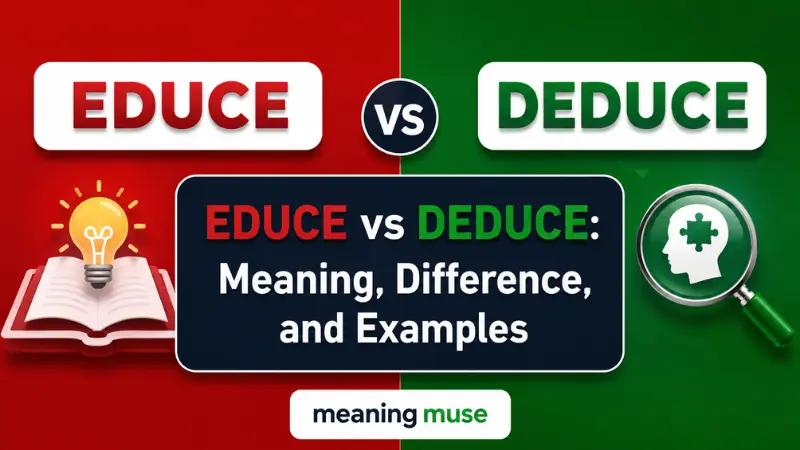
Use educe when something is drawn out, developed, or brought into view. Use deduce when someone reaches a conclusion by studying facts or evidence.
For example:
- The teacher’s questions educed thoughtful answers from the class.
- From the wet footprints, Maya deduced that someone had entered the house.
The easiest way to remember the difference is this:
Quick Answer
Educe means to draw out, bring forth, or develop something that was hidden or not yet clear.
Deduce means to reach a conclusion by using facts, clues, evidence, or logical thinking.
| Situation | Correct Word | Example |
|---|---|---|
| Drawing out a response | Educe | The interview educed an honest answer. |
| Developing hidden ability | Educe | The lesson educed her creative talent. |
| Reaching a conclusion | Deduce | We deduced that the store was closed. |
| Studying clues | Deduce | The detective deduced who took the key. |
In most modern writing, the two words are not interchangeable.
Educe vs Deduce at a Glance
Here is the main difference:
- Educe: Bring something hidden or undeveloped into view.
- Deduce: Reach an answer through reasoning.
Both words are verbs. However, deduce is much more common in everyday American English. Educe is formal and appears more often in academic, legal, educational, or technical writing. Cambridge labels educe as a formal verb, while deduce is used for reaching an answer through careful thought.
What Does Educe Mean?
Educe means to draw out, bring forth, or make something appear.
The thing being educed may already exist in a hidden, quiet, or undeveloped form. A question may educe a response. An experience may educe a skill. A discussion may educe new ideas.
Simple definition
Examples of educe
- The counselor tried to educe the child’s true feelings.
- Her questions educed several useful ideas.
- The activity was designed to educe creativity.
- Careful testing may educe information that was missed earlier.
- The coach’s encouragement educed confidence in the young player.
Merriam-Webster defines the main sense of educe as bringing out something latent or hidden. It also connects the word with verbs such as elicit and evoke.
What Does Deduce Mean?
Deduce means to reach an answer or conclusion by using facts, clues, or reasoning.
When you deduce something, you do not simply guess. You look at the available information and decide what it most likely means.
Simple definition
Examples of deduce
- From the empty parking lot, we deduced that the office was closed.
- The police deduced that the window had been opened from inside.
- I deduced from her message that she would arrive late.
- Scientists can deduce information from the test results.
- Liam saw the cake box and deduced that a party was planned.
Major dictionaries describe deduce as reaching a conclusion through reasoning or careful thought about known facts.
What Is the Main Difference Between Educe and Deduce?
The difference lies in what happens.
Educe brings something out.
Deduce works something out.
When you educe something, you help reveal or develop it.
When you deduce something, you reach a conclusion about it.
Compare these sentences:
- The teacher’s open questions educed several creative responses.
- After reading the responses, the teacher deduced that the class understood the lesson.
In the first sentence, the questions brought the responses out.
In the second sentence, the teacher studied the responses and reached a conclusion.
That is the clearest difference between educe and deduce.
Are Educe and Deduce Interchangeable?
Usually, no.
Although Merriam-Webster records deduce as a secondary sense of educe, modern readers normally understand these words differently. Using educe when you simply mean “reach a conclusion” may sound old-fashioned, highly formal, or unclear.
For clear modern American English:
- Use educe for drawing out or developing something.
- Use deduce for reaching a conclusion through reasoning.
Less clear
- From the evidence, the detective educed that the door was unlocked.
Clearer
- From the evidence, the detective deduced that the door was unlocked.
The second version is more natural for most modern readers.
How to Pronounce Educe and Deduce
The words sound similar, but their first syllables are different.
- Educe: ih-DOOS
- Deduce: dih-DOOS
In American English, both words normally end with a sound like “doos.” Cambridge gives the US pronunciations as /ɪˈduːs/ for educe and /dɪˈduːs/ for deduce.
The word educe begins with a short “ih” sound.
The word deduce begins with a “dih” sound.
How to Use Educe in a Sentence
Educe is a transitive verb. This means it normally takes an object. You educe something, such as an answer, response, idea, emotion, fact, or ability.
Common sentence pattern
Subject + educe + object
- The question educed a response.
- The training educed her natural ability.
- The discussion educed several concerns.
Educe something from someone
You may also use the pattern:
Educe + something + from + someone or something
- The lawyer tried to educe more details from the witness.
- The teacher educed several ideas from the students.
- The interview educed an emotional response from the actor.
However, elicit is often more natural than educe in everyday American English:
- The question elicited a response.
- The question educed a response.
Both can be correct, but elicited will sound more familiar to most readers.
How to Use Deduce in a Sentence
Deduce is also a transitive verb. It often appears with an object, a that-clause, or the preposition from.
Deduce something from something
- We deduced the answer from the available evidence.
- Researchers deduced the cause from the test results.
- She deduced his location from the photograph.
Deduce that something is true
- I deduced that the meeting had been canceled.
- The doctor deduced that the pain came from an old injury.
- Investigators deduced that the fire began in the kitchen.
Deduce what, why, or how
- Can you deduce what happened?
- The team could not deduce why the machine had stopped.
- She quickly deduced how the trick worked.
The structure deduce from is especially useful because it shows the evidence used to reach the conclusion.
A Simple Memory Trick
Use this short memory trick:
Both reminder words begin with the same first letter as the word they explain:
- Educe → Extract
- Deduce → Decide
You can also remember:
A teacher may educe an answer from a student.
A detective may deduce an answer from clues.
The teacher draws the answer out. The detective reasons toward the answer.
Common Mistakes With Educe and Deduce
Mistake 1: Using educe for every conclusion
Incorrect or unclear:
From the tire marks, the officer educed that the car turned left.
Better:
From the tire marks, the officer deduced that the car turned left.
The officer reached a conclusion from evidence, so deduced is the natural choice.
Mistake 2: Using deduce for drawing out a response
Incorrect:
The counselor’s gentle questions deduced an honest response.
Correct:
The counselor’s gentle questions educed an honest response.
The questions brought the response out. They did not reach a conclusion.
In everyday writing, elicited may sound even more natural:
- The counselor’s gentle questions elicited an honest response.
Mistake 3: Treating the words as spelling variants
Educe and deduce are not two spellings of the same word. They are separate verbs with their own uses.
Mistake 4: Using educe when a simpler word is better
Because educe is formal and uncommon, it may make a simple sentence harder to understand.
Formal:
The exercise educed several emotional responses.
More natural:
The exercise brought out several emotional responses.
Use educe when its formal tone fits the context. Otherwise, bring out, draw out, or elicit may communicate the idea more clearly.
Educe vs Deduce Examples
Correct examples with educe
- The interview educed details that had not appeared in the report.
- The teacher used pictures to educe ideas from the class.
- The program aims to educe leadership skills in young people.
- The question educed a surprising answer.
- The experience educed strengths she did not know she had.
- The discussion educed strong feelings from both groups.
- Good coaching can educe a player’s natural ability.
- The activity was created to educe curiosity.
- The lawyer struggled to educe a clear response.
- The novel educed memories of his childhood.
Correct examples with deduce
- We deduced that the road was closed.
- The detective deduced the suspect’s route from the camera footage.
- I could deduce from his smile that the news was good.
- Scientists deduced the animal’s age from its bones.
- She deduced that the password had been changed.
- The mechanic deduced the cause of the noise.
- From the muddy shoes, Dad deduced that we had been outside.
- The team could not deduce why the system failed.
- Readers can deduce the character’s feelings from her actions.
- He deduced that the package had been delivered to the wrong house.
Educe and Deduce in the Same Situation
Seeing both words in one example makes the difference clearer.
Classroom example
The teacher’s question educed several answers from the students. From those answers, she deduced that they needed more practice.
Interview example
The interviewer educed new details from the guest. From those details, viewers deduced that a second project was being planned.
Medical example
The doctor’s questions educed more information about the pain. From that information, she deduced that the injury was probably recent.
Investigation example
Careful questioning educed a small detail from the witness. Detectives then deduced where the missing item had been taken.
In every case, educe describes revealing information. Deduce describes reaching a conclusion from that information.
Forms of Educe and Deduce
| Form | Educe | Deduce |
| Base verb | educe | deduce |
| Third-person singular | educes | deduces |
| Past tense | educed | deduced |
| Present participle | educing | deducing |
| Related noun | eduction | deduction |
| Related adjective | educible | deducible |
Examples:
- The activity educes creative responses.
- The detective deduces the answer.
- The discussion educed new ideas.
- We deduced the cause.
- The teacher is educing answers from the group.
- The scientist is deducing what happened.
Synonyms for Educe and Deduce
The best synonym depends on the sentence.
Synonyms for educe
- Draw out
- Bring out
- Elicit
- Evoke
- Develop
- Reveal
- Extract
Example:
- The question educed a response.
- The question elicited a response.
Synonyms for deduce
- Infer
- Conclude
- Reason
- Determine
- Work out
- Figure out
- Gather
Example:
- We deduced that she had left.
- We concluded that she had left.
The synonyms are not always exact replacements. Check the tone and sentence structure before changing the word.
Word Origins
Both words come from Latin roots connected with the idea of leading.
Educe comes from a Latin verb meaning to lead or draw out. That history matches its modern sense of bringing out something hidden or undeveloped.
Deduce comes from a related Latin verb. Its meaning developed into reaching a result through reasoning. Merriam-Webster traces both words to Latin forms built around ducere, meaning “to lead.”
The shared root helps explain why the words look alike, but their prefixes and modern uses make them different.
Which Word Should You Use?
Choose educe when you mean:
- Draw out a response
- Bring forth an idea
- Reveal hidden information
- Develop a quality or skill
- Make something appear
Choose deduce when you mean:
- Reach a conclusion
- Study facts
- Reason from evidence
- Work out an answer
- Decide what likely happened
For most everyday sentences about facts, clues, and conclusions, deduce will be the correct word.
For sentences about drawing out responses, abilities, emotions, or information, educe may fit. However, simpler words such as elicit, develop, or bring out are often easier for a general audience.
FAQs
What is the difference between educe and deduce?
Educe means to draw out, reveal, or develop something. Deduce means to reach a conclusion by studying facts or clues. A question may educe an answer, while a person may deduce a conclusion from that answer.
Is educe a real word?
Yes. Educe is a standard English verb. However, it is formal and much less common than deduce. It usually means to bring out something hidden, undeveloped, or not yet expressed.
Is educe the opposite of deduce?
No. The words are not opposites. They describe different actions. Educe involves bringing something out, while deduce involves reaching a conclusion.
Can educe mean deduce?
Some dictionaries record deduce as a secondary sense of educe. However, this use is uncommon and may confuse modern readers. Use deduce when you mean reaching a conclusion through reasoning.
What does it mean to deduce something?
To deduce something means to decide that it is true by using facts, evidence, or logical thought. For example, you might deduce that it rained because the ground is wet.
What is an example of educe?
An example is: “The teacher’s question educed a thoughtful response.” The question helped bring the response out.
What is an example of deduce?
An example is: “From the wet ground, we deduced that it had rained.” The wet ground provided evidence for the conclusion.
Is deduce the same as guess?
No. A guess may have little or no evidence behind it. A deduction is based on facts, clues, rules, or logical reasoning.
Is educe commonly used in American English?
It is accepted in American English, but it is uncommon and formal. In everyday communication, writers often choose elicit, draw out, bring out, or develop instead.
What are the noun forms of educe and deduce?
The noun related to educe is eduction. The noun related to deduce is deduction. Deduction is much more common in everyday English.
Conclusion
The difference between educe and deduce becomes simple when you focus on the action.
Use educe when something is being drawn out, revealed, or developed:
- The questions educed honest responses.
Use deduce when someone reaches a conclusion through facts or reasoning:
- From the responses, we deduced that the plan needed to change.
Remember this final rule:
In modern American English, deduce is the common choice for clues, evidence, reasoning, and conclusions. Educe is a more formal word for bringing out information, feelings, ideas, or hidden abilities.