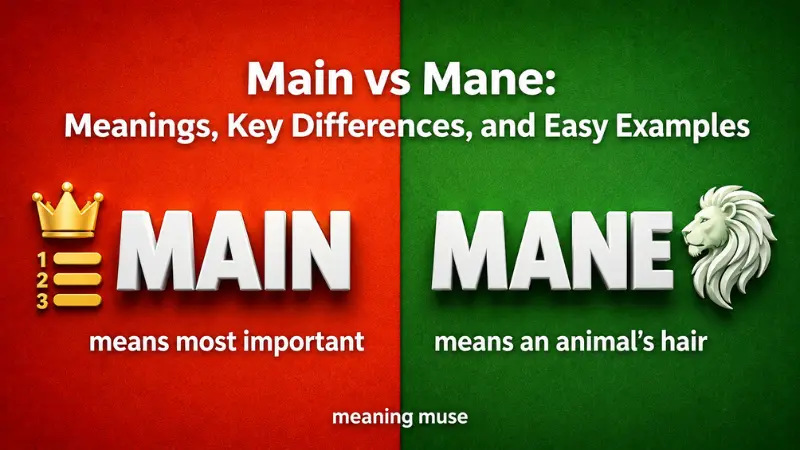
Main and mane sound the same, so they are easy to mix up. However, they do not mean the same thing.
Use main when you mean the most important, largest, or central part of something. For example, you might talk about the main idea, main road, main entrance, or main character.
Use mane when you mean the long hair that grows around the neck of a horse, lion, or certain other animals. The word can also describe a person’s long, thick hair in an informal or descriptive way.
The difference becomes simple once you connect mane with animal hair. This guide explains both words, shows their grammar roles, and gives clear examples to help you choose correctly every time.
Quick Answer
Main means most important, chief, central, or primary.
Mane means the long hair around the head or neck of a horse, lion, or similar animal.
Both words are pronounced like “mayn.” They are homophones, which means they sound alike but have different spellings and meanings.
- The main reason was bad weather.
- The lion shook its mane.
Remember: a mane has hair, while main usually points to importance.
Main vs Mane at a Glance
| Feature | Main | Mane |
|---|---|---|
| Basic meaning | Most important or central | Long hair on an animal’s neck |
| Common grammar role | Adjective | Noun |
| Other grammar role | Noun in terms such as “water main” | Sometimes used for a person’s thick hair |
| Pronunciation | Mayn | Mayn |
| Common examples | Main idea, main road, main entrance | Lion’s mane, horse’s mane |
| Simple memory clue | Main means primary | Mane means hair |
The spelling depends on the meaning of the sentence, not on pronunciation.
What Does Main Mean?
The most common meaning of main is “most important” or “chief.”
It normally appears before a noun and tells readers that the person, place, thing, or idea has the highest importance.
Examples include:
- The main reason
- The main problem
- The main entrance
- The main road
- The main character
- The main goal
- The main event
In each example, main points to the central or most important item.
Main as an Adjective
Main is usually an adjective. An adjective describes a noun.
In the phrase main idea, the noun is idea. The word main tells us that this is the most important idea.
- The main idea appears in the first paragraph.
- Our main goal is to finish before Friday.
- Use the main entrance after 8:00 a.m.
- Rosa played the main character in the school play.
- Heavy rain was the main cause of the delay.
Main often works like primary, chief, leading, or principal.
Main as a Noun
Main can also be a noun, especially when it names a large pipe, cable, or line in a public system.
- A broken water main flooded the street.
- Workers repaired the gas main.
- The house connects to the sewer main.
In these examples, main does not mean “most important.” It refers to a major supply pipe or line.
What Does Mane Mean?
A mane is the long, thick hair that grows around the head or neck of certain animals.
Lions and horses are the animals most often connected with this word.
- The lion had a dark brown mane.
- The horse’s mane moved in the wind.
- She brushed the pony’s mane before the show.
- A male lion’s mane can make its head look larger.
Mane is a noun because it names a thing.
The word may also describe a person’s thick or flowing hair. This use is often colorful or informal.
- Her long black mane fell across her shoulders.
- The singer was known for his curly mane of hair.
This does not mean the person has animal hair. It creates a strong picture of hair that looks long, thick, wild, or full.
Why Do People Confuse Main and Mane?
People confuse these words because they sound exactly alike in standard American English.
You cannot hear the spelling difference in normal speech. You must use the meaning of the sentence to choose the correct word.
Consider these sentences:
- What is the main point?
- The horse has a white mane.
Both bold words sound the same. However, point has nothing to do with animal hair, so main is correct in the first sentence. The second sentence describes a horse’s hair, so mane is correct.
Autocorrect may not catch the mistake because both spellings are real English words. A sentence can contain the wrong word and still pass a basic spelling check.
That is why reading the complete sentence matters.
How Do You Pronounce Main and Mane?
Main and mane have the same pronunciation:
Main: mayn
Mane: mayn
They rhyme with:
- Rain
- Train
- Plain
- Gain
- Lane
- Chain
Because the pronunciation is identical, sound alone cannot help you choose the spelling.
Instead, ask one question:
Am I talking about importance or hair?
Choose main for importance, central position, or a major pipe. Choose mane for long hair around an animal’s neck.
Which Word Should You Use?
Use main when the sentence refers to something that is:
- Most important
- Primary
- Central
- Chief
- Largest
- Leading
Examples:
- The main lesson is about honesty.
- We parked near the main building.
- The team’s main player was injured.
- What is your main concern?
- Dinner will be the main event.
Use mane when the sentence refers to:
- A lion’s neck hair
- A horse’s neck hair
- Long hair on another animal
- A person’s thick or flowing hair
Examples:
- The child drew a lion with a golden mane.
- The rider carefully braided the horse’s mane.
- The wind lifted the animal’s mane.
- Her red mane made her easy to recognize.
A Simple Memory Trick
Connect the final e in mane with the e in horse.
Both words contain the letter e, and a horse can have a mane.
You can also remember this sentence:
The main lion has the biggest mane.
The first word means most important. The second word means hair.
When Main Is Correct
Main is correct when you could replace it with primary, chief, or most important without greatly changing the sentence.
Original:
- The main reason is cost.
Test:
- The primary reason is cost.
The sentence still makes sense, so main is correct.
More correct examples:
- The main office is on the second floor.
- Our main concern is student safety.
- Turn left at the main road.
- The story’s main character is a young pilot.
- The main purpose of the meeting is to set a date.
- Please enter through the main gate.
- The main course will be served at seven.
Main can also appear in proper names:
- Main Street
- Main Hall
- Main Library
Capitalize it only when it forms part of an official name.
- The store is on Main Street.
- Take the main street through town.
In the first sentence, Main Street is a name. In the second, main simply describes the most important street.
When Mane Is Correct
Mane is correct when the sentence describes long hair growing around an animal’s neck or head.
Correct examples:
- The lion’s mane looked golden in the sunlight.
- Mia brushed her horse’s mane.
- The pony had flowers woven into its mane.
- The animal shook water from its mane.
- The artist painted each part of the tiger-like creature’s mane.
- The wind blew through the stallion’s mane.
Mane can also create a strong image when describing human hair:
- He had a thick mane of gray hair.
- Her curly mane reached her shoulders.
Use this human-hair meaning carefully. It is descriptive, not neutral. In some situations, saying long hair or thick hair may sound more natural.
Common Mistakes and Quick Fixes
Mistake 1: Using mane for “most important”
Incorrect:
- The mane reason I called was to thank you.
Correct:
- The main reason I called was to thank you.
Reason refers to importance, not hair.
Mistake 2: Using main for animal hair
Incorrect:
- The horse has a long main.
Correct:
- The horse has a long mane.
The sentence describes animal hair.
Mistake 3: Writing main character as mane character
Incorrect:
- Bella is the mane character in the book.
Correct:
- Bella is the main character in the book.
Main character means the most important person in a story.
Mistake 4: Writing lion’s main
Incorrect:
- The lion’s main was thick and dark.
Correct:
- The lion’s mane was thick and dark.
The apostrophe does not change which spelling you need. The word still refers to the lion’s hair.
Mistake 5: Using mane entrance
Incorrect:
- Meet me at the mane entrance.
Correct:
- Meet me at the main entrance.
The sentence points to the primary entrance.
Mistake 6: Trusting spell-check completely
Both main and mane are correctly spelled words. A spelling checker may not notice that you selected the wrong one.
Always check the meaning of the complete sentence before publishing or submitting your work.
Everyday Examples
Here are natural examples that show the difference clearly.
Examples With Main
- My main goal is to improve my grades.
- The main door was locked.
- Traffic moved slowly on the main highway.
- The teacher asked us to find the main idea.
- Our main office is in Chicago.
- The storm was the main cause of the power failure.
- Pasta was the main course.
- The plumber checked the water main.
- The main character learns an important lesson.
- We met near the main stage.
Examples With Mane
- The lion’s mane was dark and full.
- She brushed the horse’s mane every morning.
- The pony’s mane had several small braids.
- Dust clung to the animal’s mane.
- The wind blew through the horse’s mane.
- The costume included a bright orange lion’s mane.
- His thick mane of hair reached his collar.
- The young lion had not yet grown a full mane.
- The rider decorated the mare’s mane with ribbons.
- The photographer captured the lion shaking its mane.
Main and Mane in the Same Sentence
- The main attraction was a lion with a huge mane.
- Her main job was brushing the horse’s mane.
- The main character rode a horse with a silver mane.
- The lion’s mane was the main focus of the drawing.
- Our main lesson explained why some animals grow a mane.
These paired examples make the meaning difference easy to see.
Dictionary-Style Word Details
Verb
Main: Main is not commonly used as a verb in standard everyday American English.
Mane: Mane is not normally used as a verb. Use phrases such as brush the mane, braid the mane, or trim the mane instead.
Noun
Main: Main can be a noun when it refers to a major pipe, cable, or supply line.
- The water main broke overnight.
- The crew inspected the gas main.
Mane: Mane is a noun that names long hair growing around the head or neck of certain animals.
- The horse had a smooth black mane.
- The lion shook its mane.
Adjective
Main: Main is most often an adjective meaning most important, primary, or central.
- This is the main problem.
- Use the main entrance.
Mane: Mane is not an adjective. The related adjective is maned, as in a maned animal.
Synonyms
Possible synonyms for main include:
- Primary
- Chief
- Principal
- Central
- Leading
- Major
- Most important
The best synonym depends on the sentence.
Mane has no exact everyday synonym. Close descriptive alternatives include:
- Neck hair
- Long animal hair
- Thick hair
- Flowing hair
These alternatives may explain mane, but they do not always replace it naturally.
Antonyms
Possible opposites of main include:
- Minor
- Secondary
- Lesser
- Supporting
- Unimportant
Mane does not have a clear direct opposite because it names a physical feature.
Example Sentences
Main:
- The main reason for the change was safety.
- The main road closes at midnight.
- Workers repaired the damaged water main.
Mane:
- The horse’s mane was soft and clean.
- The lion had a large golden mane.
- Her thick mane of hair moved in the breeze.
Word History
Main and mane are both old English words, but they did not come from the same earlier word.
Main developed from words connected with strength, power, or importance. Over time, it gained its familiar meaning of chief or most important.
Mane developed from an old word for the hair around an animal’s neck. It later gained a descriptive use for a person’s long or heavy hair.
Their matching pronunciation does not show a shared meaning. It is simply why modern writers often confuse them.
Phrases Containing Main
- Main idea
- Main reason
- Main point
- Main goal
- Main entrance
- Main road
- Main character
- Main event
- Main course
- Main office
- Main attraction
- Water main
Phrases Containing Mane
- Lion’s mane
- Horse’s mane
- Flowing mane
- Thick mane
- Golden mane
- Dark mane
- Braided mane
- Shaggy mane
- Full mane
- Mane of hair
FAQs
Are main and mane the same word?
No. Main and mane are different words with different meanings. They are homophones because they sound the same.
Is it main reason or mane reason?
The correct phrase is main reason. Main means chief or most important.
Is it a lion’s main or a lion’s mane?
The correct phrase is a lion’s mane. Mane refers to the long hair around a lion’s head and neck.
Is main an adjective or a noun?
Main is usually an adjective, as in main idea. It can also be a noun when it refers to a large pipe or supply line, as in water main.
Is mane only used for lions?
No. Mane can describe the long neck hair of horses, lions, and certain other animals. It can also describe a person’s long, thick hair.
Do main and mane have different pronunciations?
No. Both are normally pronounced mayn in American English.
How can I remember main vs mane?
Remember that mane means hair. When the sentence has nothing to do with hair, animals, or a person’s thick hairstyle, you probably need main.
Conclusion
Main and mane sound alike, but their meanings are easy to separate.
Use main for something important, primary, central, or leading:
- Main idea
- Main road
- Main reason
- Main character
Use mane for long hair around an animal’s head or neck:
- Lion’s mane
- Horse’s mane
- Flowing mane
The easiest memory rule is:
Main means important. Mane means hair.
Check the meaning of the sentence instead of relying on sound. Once you connect mane with animal hair, choosing between main and mane becomes simple.