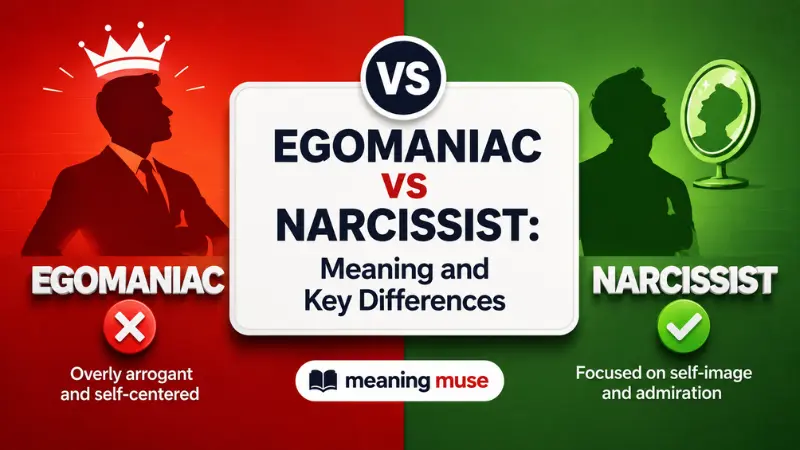
Egomaniac and narcissist both describe someone who seems too focused on themselves. However, the words are not exact synonyms.
An egomaniac is a person with an unusually high opinion of their own importance, talent, or power.
A narcissist is a person who shows strong narcissistic traits, such as excessive self-focus, a need for admiration, or an inflated view of themselves.
The most important difference is simple:
Egomaniac focuses on an oversized ego. Narcissist describes a wider pattern of self-centered traits.
The word narcissist also has a connection to psychology. For that reason, writers should not use it as a casual medical diagnosis.
Quick Answer
An egomaniac acts as though they are extremely important, powerful, or talented.
A narcissist is deeply focused on themselves and may seek praise, attention, status, or special treatment.
The two ideas overlap, but they are not always identical.
| Context | Best Choice | Why |
|---|---|---|
| Someone constantly boasts about their importance | Egomaniac | The focus is on an oversized ego |
| Someone needs constant praise and admiration | Narcissist | The focus is on narcissistic behavior |
| A proud or controlling fictional character | Either may fit | The best word depends on the behavior shown |
| A medical or mental health discussion | Narcissistic traits or NPD | Use accurate clinical language |
| An ordinary selfish act | Neither | One action does not define a person |
An egomaniac may appear narcissistic, but a person should not be called a clinical narcissist based only on arrogance or boasting.
What Does Egomaniac Mean?
An egomaniac is someone who has an extreme sense of self-importance.
The person may believe they are more skilled, intelligent, powerful, or valuable than everyone else. They may talk constantly about their success. They may also expect other people to agree with them.
Merriam-Webster connects egomaniac with egomania, meaning an extremely egocentric state. Cambridge marks the word as disapproving and defines it as someone who considers themselves very important and able to do whatever they want. omaniac meaning
An egomaniac is a person who has an oversized opinion of their own importance.
Common signs of egomaniacal behavior
An egomaniac may:
- Brag about personal success
- Act superior to others
- Take credit for group achievements
- Refuse to admit mistakes
- Turn every discussion toward themselves
- Believe their ideas are always best
- Expect others to follow their wishes
- Become angry when someone challenges them
These actions describe possible behavior. They do not form a medical checklist.
Egomaniac example
Imagine a manager who believes every successful project happened because of them.
The manager ignores the team’s work, demands praise, and refuses all criticism. A coworker might describe that manager as an egomaniac.
In this example, the main issue is the person’s enormous ego.
What Does Narcissist Mean?
A narcissist is a person who displays narcissism.
In general language, narcissism means excessive self-love or self-focus. The American Psychological Association defines it in part as excessive self-love or egocentrism. onversation, people often use narcissist for someone who:
- Wants constant attention
- Needs praise and admiration
- Feels superior
- Has a strong sense of entitlement
- Uses other people for personal gain
- Shows little concern for other people’s needs
- Reacts badly to criticism
However, the word needs care. A person can show a narcissistic trait without having narcissistic personality disorder.
Simple narcissist meaning
A narcissist is someone who shows a strong pattern of excessive self-focus, self-importance, and need for admiration.
Narcissist example
Imagine someone who always needs to be praised.
They become upset when another person receives attention. They expect special treatment and show little interest in how others feel.
People may describe that behavior as narcissistic.
Still, only a qualified professional can decide whether a person has a mental health disorder.
What Is the Main Difference Between an Egomaniac and a Narcissist?
An egomaniac is mainly defined by extreme self-importance.
A narcissist may show a wider group of traits involving self-image, admiration, entitlement, relationships, and reactions to criticism.
Here is the difference in one sentence:
An egomaniac thinks very highly of themselves, while a narcissist may also depend on praise, special treatment, and control to protect that self-image.
Compact comparison
- Egomaniac: “I am the most important person here.”
- Narcissist: “I am special, and everyone should recognize and treat me that way.”
This memory trick is simplified, but it shows the main difference in emphasis.
Are Egomaniac and Narcissist the Same?
No. They overlap, but they are not fully interchangeable.
Both words may describe:
- Self-centered behavior
- An inflated sense of importance
- Arrogance
- Vanity
- A desire for attention
- Difficulty accepting criticism
However, egomaniac is usually a broad, disapproving label. It stresses ego and self-importance.
Narcissist has both an everyday meaning and a psychological connection. It may refer broadly to a self-absorbed person, but it is also associated with narcissistic traits and narcissistic personality disorder.
That medical connection makes narcissist a more serious and sensitive label.
Can an Egomaniac Be a Narcissist?
Yes, an egomaniac may display narcissistic traits.
A person who believes they are better than everyone else may also demand praise, expect special treatment, or show little concern for others.
However, the overlap does not prove that every egomaniac is a narcissist.
It is also unsafe to assume that every arrogant, boastful, or difficult person has narcissistic personality disorder. Personality disorders involve lasting patterns that affect a person’s inner experience, behavior, and relationships. is not enough.
One boastful conversation is not enough.
A pattern must be studied carefully and in context.
Is Egomania a Mental Disorder?
Egomania is a real word, but people usually use it as a general label for extreme egocentrism.
It is not the same term as narcissistic personality disorder.
Merriam-Webster defines egomania as the state of being extremely egocentric. Cambridge describes it as believing that you are highly important and able to do anything you want. n writing, egomaniac works as a strong description or insult. It should not be presented as though it were a professional diagnosis.
Better wording
Instead of writing:
- He was diagnosed as an egomaniac.
Write:
- He often acted like an egomaniac.
- His behavior showed extreme self-importance.
- He constantly bragged and dismissed other people.
These versions describe what happened without making an unsupported medical claim.
Is Every Narcissist Diagnosed With NPD?
No.
People often use narcissist in everyday speech to describe a vain, entitled, or highly self-centered person. That does not mean the person has received a diagnosis.
Narcissistic personality disorder, often shortened to NPD, is a mental health condition. It involves more than ordinary arrogance or selfishness. Cleveland Clinic explains that NPD affects a person’s identity, self-esteem, and relationships with other people. Psychological Association describes NPD as a lasting pattern that may include grandiose self-importance, a strong need for admiration, entitlement, taking advantage of others, and difficulty showing empathy. th professional must look at the full pattern. Friends, family members, writers, and social media users should not try to diagnose someone from a few actions.
Narcissistic Traits vs Narcissistic Personality Disorder
Narcissistic behavior exists in different degrees.
A person may act selfishly in one situation. Another person may show several narcissistic traits over time. A smaller group may meet the full requirements for narcissistic personality disorder.
These are not automatically the same.
Narcissistic trait
A trait is a personal tendency.
Examples may include:
- Wanting praise
- Feeling superior
- Becoming defensive
- Seeking attention
- Caring strongly about status
A person may show one of these traits without having a disorder.
Narcissistic pattern
A pattern happens again and again.
It may affect:
- Work
- Friendships
- Family life
- Romantic relationships
- Reactions to criticism
- Treatment of other people
Narcissistic personality disorder
NPD is a clinical condition.
It cannot be confirmed through an online checklist or a single story. Even research questionnaires that measure narcissistic traits are not automatically diagnostic tests for NPD. vs Narcissist in Everyday Language
In everyday American English, both words are negative.
Neither word is normally used as a compliment.
Use egomaniac when:
- You want to stress someone’s huge ego
- The person boasts constantly
- The person acts as if they are always right
- The person claims too much credit
- The context is informal or descriptive
Example:
- The movie presents the CEO as a power-hungry egomaniac.
Use narcissist when:
- You are discussing narcissism
- The person shows a lasting pattern of self-absorption
- The person constantly needs admiration
- Entitlement and relationships are part of the issue
- The context explains the term carefully
Example:
- The novel explores how a narcissist controls family relationships.
When writing about a real person, it is often better to describe visible actions instead of applying either label.
Why Calling Someone a Narcissist Can Be Misleading
The word narcissist is common online. People may use it for anyone who lies, cheats, argues, seeks attention, or behaves selfishly.
That use can be too broad.
A person may be:
- Arrogant without having NPD
- Selfish without being a narcissist
- Controlling for reasons unrelated to narcissism
- Rude during one event
- Defensive because they feel stressed
- Unkind without having a mental health disorder
Cleveland Clinic notes that NPD is more than arrogance or selfishness. It affects how a person views themselves and relates to others. iting, “My boss is a narcissist,” clearer language may be:
- My boss takes credit for everyone’s work.
- My boss refuses to accept feedback.
- My boss expects special treatment.
- My boss often ignores the team’s concerns.
These statements focus on behavior that can be observed.
How to Use Egomaniac in a Sentence
Egomaniac is a countable noun.
You can write:
- an egomaniac
- the egomaniac
- several egomaniacs
Sentence pattern
Person + linking verb + egomaniac
- The villain is an egomaniac.
- His coworkers consider him an egomaniac.
- The story follows a wealthy egomaniac.
Egomaniac sentence examples
- The coach became an egomaniac after winning the championship.
- No one wanted to work with the arrogant egomaniac.
- The character is a funny but exhausting egomaniac.
- Critics described the fictional leader as a dangerous egomaniac.
- He sounded like an egomaniac when he took all the credit.
- The novel shows how an egomaniac can damage a team.
- Her new boss was not confident; he was an egomaniac.
- The actor played an egomaniac who believed he could never fail.
- Only an egomaniac would claim to have created the project alone.
- His egomaniac behavior pushed his friends away.
The related adjective is egomaniacal:
- His egomaniacal speech lasted for an hour.
- The show follows an egomaniacal business owner.
How to Use Narcissist in a Sentence
Narcissist is also a countable noun.
You can write:
- a narcissist
- the narcissist
- several narcissists
Narcissist sentence examples
- The book’s main character is a charming narcissist.
- She worried that her partner might be a narcissist.
- A narcissist may seek praise from everyone in the room.
- The article used the word narcissist too loosely.
- He called his coworker a narcissist after one argument.
- The counselor warned against diagnosing someone as a narcissist.
- The drama centers on a powerful narcissist who fears criticism.
- Online users often label selfish people as narcissists.
- The writer described narcissistic behavior without calling anyone a narcissist.
- The word narcissist should be used with care in mental health discussions.
The related adjective is narcissistic:
- The character displays narcissistic behavior.
- Her need for praise seemed narcissistic.
- One narcissistic act does not prove a disorder.
Egomaniac and Narcissist in the Same Example
These examples show how the emphasis changes.
Workplace example
Darren constantly talked about being the smartest employee in the company. His coworkers called him an egomaniac.
He also demanded praise, expected special treatment, and became furious when anyone questioned him. Those actions could be described as narcissistic traits.
Celebrity example
The fictional celebrity was an egomaniac because he believed every event should center on him.
The story also portrayed him as a narcissist because he used other people, needed constant admiration, and could not handle criticism.
Team example
The captain looked like an egomaniac when she took credit for every victory.
Calling her a narcissist, however, would make a wider claim about her personality. The reader would need more evidence and context.
Common Mistakes and Quick Fixes
Mistake 1: Treating the words as spelling variants
Egomaniac and narcissist are separate words.
They are not American and British spellings of one term.
Mistake 2: Calling every confident person an egomaniac
Confidence is not the same as egomania.
A confident person believes in their abilities. An egomaniac places extreme importance on themselves and may dismiss everyone else.
Mistake 3: Calling every selfish person a narcissist
Selfishness can happen in one moment.
The label narcissist suggests a broader pattern. In clinical contexts, NPD involves a lasting and serious group of traits.
Mistake 4: Using narcissist as a formal diagnosis
Incorrect:
- I know he has NPD because he is a narcissist.
Better:
- He often seeks praise and reacts badly to criticism.
- His behavior seems self-centered.
- A professional would need to assess whether a disorder is present.
Mistake 5: Assuming all narcissism looks bold
Narcissistic behavior is often linked with open pride and superiority. However, psychology also discusses vulnerable narcissism, which may involve fragile self-worth, shame, a strong need for validation, and sensitivity to criticism. rcissistic traits do not always look loud or confident.
Egomaniac vs Narcissist Synonyms
These words have related alternatives, but the alternatives are not always exact.
Closest alternatives for egomaniac
- Egotist
- Braggart
- Boaster
- Self-important person
- Conceited person
- Arrogant person
- Know-it-all
Closest alternatives for narcissist
- Self-absorbed person
- Vain person
- Egocentric person
- Self-centered person
- Narcissistic person
Use caution with words such as narcissist and narcissistic person because they may sound psychological or diagnostic.
Helpful opposites
Possible opposites include:
- Humble person
- Modest person
- Considerate person
- Selfless person
- Empathetic person
These are broad contrasts rather than perfect dictionary opposites.
Pronunciation
Egomaniac
Egomaniac is pronounced:
ee-goh-MAY-nee-ak
The strongest stress falls on MAY. Cambridge gives the American pronunciation as /ˌiː.ɡoʊˈmeɪ.ni.æk/. t
Narcissist is commonly pronounced:
NAR-suh-sist
The first syllable receives the strongest stress.
The words do not sound alike, so pronunciation is not the main cause of confusion. Readers confuse them because their meanings overlap.
Word History
Egomaniac
Egomaniac comes from ego and mania.
The word ego refers to the self. In everyday language, it can also mean a person’s sense of importance.
The ending -maniac describes someone with an extreme or uncontrolled focus on something.
The modern word therefore suggests someone with an extreme focus on their own ego.
Narcissist
Narcissist is connected to Narcissus from Greek mythology.
In the well-known story, Narcissus becomes absorbed in his own reflection. His name later became linked with excessive self-admiration.
The word developed both a general meaning and a psychological meaning. Oxford describes a narcissist in general language as someone who admires themselves too much. Should You Use?
Choose egomaniac when the main idea is:
- A huge ego
- Constant boasting
- Extreme self-importance
- Acting as if one person deserves all the credit
- Believing one’s ideas are always best
Choose narcissist when the main idea is:
- Excessive self-focus
- A strong need for praise
- Entitlement
- A wider pattern of narcissistic traits
- A discussion about narcissism
Choose neither word when:
- You have seen only one selfish act
- You are angry after one disagreement
- You do not know the person well
- You are trying to make a medical diagnosis
- A clear behavior description would be more accurate
For most careful writing, describing the behavior is better than attaching a label.
FAQs
What is the difference between an egomaniac and a narcissist?
An egomaniac has an extreme sense of self-importance. A narcissist shows a wider pattern of excessive self-focus and may strongly need praise, status, or special treatment. The terms overlap, but they are not exact synonyms.
Is an egomaniac always a narcissist?
No. An egomaniac may show narcissistic traits, but extreme pride alone does not prove that someone is a narcissist or has narcissistic personality disorder.
Is a narcissist the same as a selfish person?
Not always. A selfish person may put their needs first in one situation. Narcissism suggests a broader pattern involving self-image, admiration, entitlement, or relationships.
Is egomaniac a medical term?
People mainly use egomaniac as a general or disapproving label for someone who is extremely egocentric. It should not be presented as a formal diagnosis.
Does narcissist mean someone has NPD?
Not automatically. People often use narcissist informally. Narcissistic personality disorder is a clinical condition that requires proper assessment by a qualified professional.
Can a confident person be called an egomaniac?
Confidence alone does not make someone an egomaniac. Healthy confidence includes belief in one’s skills without treating everyone else as less important.
Can narcissists have low self-esteem?
Some forms of narcissistic behavior may involve fragile self-worth and strong sensitivity to criticism. This is sometimes discussed as vulnerable narcissism. iac an insult?
It is usually disapproving and can be insulting. It suggests that someone has an extreme and unpleasant opinion of their own importance.
What is stronger: egomaniac or narcissist?
Neither word is always stronger. Egomaniac strongly attacks a person’s ego. Narcissist may carry more serious psychological meaning, especially when readers connect it with NPD.
What is a safer alternative to calling someone a narcissist?
Describe the behavior directly. You might say the person constantly seeks praise, ignores other people’s feelings, refuses criticism, takes credit for group work, or expects special treatment.
Conclusion
The difference between egomaniac and narcissist depends on emphasis.
An egomaniac has an oversized sense of personal importance. The word focuses on ego, pride, boasting, and superiority.
A narcissist shows excessive self-focus and may also seek admiration, expect special treatment, or struggle with criticism. The word has a wider meaning and a connection to psychology.
Remember this simple rule:
An egomaniac has a huge ego. A narcissist shows a wider pattern of narcissistic traits.
The two labels may overlap, but neither should be used carelessly. When discussing a real person, clear descriptions of their actions are often fairer and more accurate than a strong personality label.