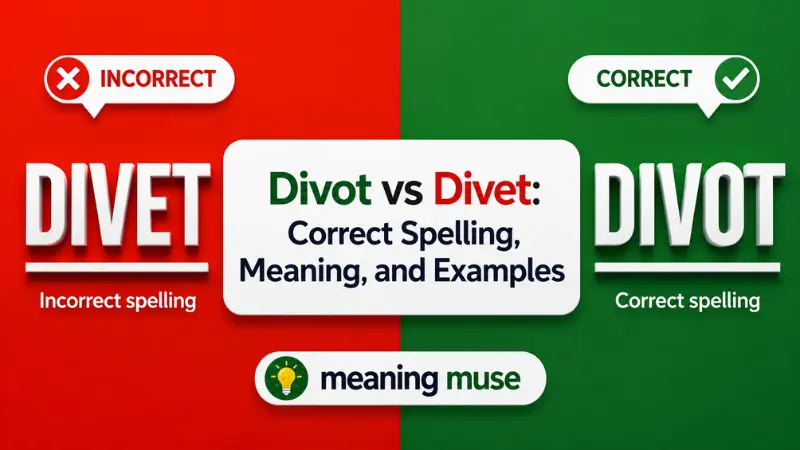
The divot vs divet question has one clear answer for modern writing: divot is the standard spelling. It describes a piece of turf removed from the ground or the small hole, dent, or depression left behind.
You will see the word most often in golf. A club may cut a piece of grass and soil from the fairway during a swing. Both the displaced turf and the damaged spot may be called a divot.
The spelling divet is not the normal choice in present-day American or British English. It appears in historical and dialect records, so calling it completely invented would be inaccurate. In current everyday, academic, business, and sports writing, however, you should use divot.
Quick Answer
Use divot in modern English.
- Divot is the established spelling.
- Divet is an archaic spelling that now usually appears as an error.
- The correct plural is divots.
- American and British English both normally use divot.
Correct: “The golfer replaced the divot.”
Usually incorrect: “The golfer replaced the divet.”
Keep divet only when reproducing a historical source, title, quotation, or dialect passage that originally used that spelling.
Why People Confuse Them
The confusion usually begins with pronunciation. Divot is commonly pronounced like “DIV-uht.” The second vowel is weak, so listeners may not hear a clear “o.”
Someone who has heard the word but never seen it written may therefore choose divet. The ending may sound similar to familiar words that contain an “e,” even though the standard spelling contains an “o.”
The word’s unusual history also adds confusion. Older Scottish and dialect sources used several spellings. Modern dictionaries eventually settled on divot, but historical forms can still appear in old books and online word lists.
Key Differences At A Glance
- Divot: The standard modern spelling used in dictionaries, golf writing, journalism, and general English.
- Divet: A documented archaic form that should usually be avoided in present-day writing.
- Meaning: Historically, both forms refer to the same basic word rather than two words with different meanings.
- Regional use: There is no normal modern US-versus-UK spelling split.
- Best editorial choice: Use divot unless preserving original historical wording.
Are They the Same Word?
Historically, divot and divet represent spelling forms of the same word. They do not describe two separate objects or actions.
Their current status is different, though. Divot became the established modern form. Divet remained in older dictionaries, regional material, and dialect records.
That makes this comparison more precise than simply saying one form exists and the other does not. Divet has historical evidence, but historical evidence does not make it an equally acceptable modern spelling.
In current writing, the pair functions like a standard form and an outdated variant—not like two interchangeable alternatives.
The usual pronunciation of divot is “DIV-uht.” Because the final vowel is reduced in speech, pronunciation offers little help with the middle letter. Writers must remember the established written form.
US vs UK Preference
Both American and British dictionaries use divot as the normal headword. British definitions often emphasize a piece of turf removed by a golf club or a horse’s hoof. American definitions also include the broader sense of a dent, hollow, or small depression.
There is no useful modern rule such as “divot in the United States, divet in Britain.” That division is unsupported.
The spelling divet is better understood as historical or dialectal. It should not be presented as the standard British counterpart of divot.
For an American audience, use divot. The same advice applies to international and present-day British writing.
Which Spelling Should You Use?
| Context | Best Choice | Why |
|---|---|---|
| Modern American writing | Divot | It is the established US spelling |
| Modern British writing | Divot | Major British dictionaries use this form |
| Golf instructions | Divot | It is the recognized golf term |
| A dent or small hollow | Divot | Modern dictionaries recognize this broader meaning |
| Historical quotation | Preserve the original | The source may intentionally contain divet |
| Discussion of old spellings | Divet may be mentioned | It is relevant when explaining language history |
| School or professional writing | Divot | Divet will usually be treated as an error |
A simple memory aid is to connect the o in divot with the o in golf. This is not a language rule, but it can help you remember the spelling.
When One Spelling Looks Wrong
Divet looks wrong in most current sentences because readers expect the standard form divot.
Incorrect in normal modern writing:
“The ball landed in a deep divet.”
Correct:
“The ball landed in a deep divot.”
The situation changes when the word appears in a historical context:
“The regional glossary records divet as a form meaning turf or sod.”
Here, divet is not being recommended for everyday use. The sentence is discussing the old spelling itself.
Do not automatically correct divet inside a direct historical quotation. Altering the source may make the quotation inaccurate. You can add an editorial explanation when readers need clarification.
Common Mistakes (and Quick Fixes)
One common mistake is assuming that divet must be British because many spelling comparisons involve regional variation. It is not the normal modern British spelling. Use divot in both varieties.
Another error is writing divet because the final syllable sounds like “it” or “ut.” Pronunciation does not reveal the middle vowel clearly. Memorize the written form instead.
Writers may also use divot only for the loose piece of grass. Depending on context, the word can refer to the displaced turf or the hollow left in the surface.
Avoid confusing divot with davit. A davit is a small crane-like structure used for raising or lowering equipment, particularly on ships. It is a separate word.
Finally, write the plural as divots, not divot’s. An apostrophe normally marks possession, not a regular plural.
Everyday Examples
- The golfer replaced the divot before walking toward the green.
- Her iron shot created a long divot in the wet fairway.
- Please repair any divots you make during practice.
- The horse’s hoof left a divot in the soft field.
- A small divot appeared in the wooden tabletop.
- The dropped appliance left a divot in the kitchen floor.
- Press a shallow divot into the center of each piece of dough.
- The ball settled inside an old divot.
- Groundskeepers filled the divots with a mixture of sand and seed.
- The metal panel had a noticeable divot near its edge.
In all these modern examples, divot is the appropriate spelling.
Dictionary-Style Word Details
Verb
- Divot: Historical Scottish records show rare verb uses meaning to cut turf or cover something with turf. This verb is uncommon in standard modern American English.
- Divet: Not normally used as a modern verb. Historical dialect material may contain related variant spellings.
In current writing, use a clearer verb such as dent, gouge, cut, remove, or damage, depending on the sentence.
Noun
- Divot: A piece of turf removed from the ground, especially by a golf club or an animal’s hoof. It can also mean the hole, dent, hollow, or depression left in a surface.
- Divet: An archaic spelling of the same noun. It is not the recommended form for ordinary modern writing.
The standard plural is divots.
Synonyms
Exact substitutes depend on the meaning.
For removed grass or soil, the closest plain alternatives include:
- piece of turf
- clump of sod
- chunk of grass
- turf fragment
For a mark or hollow, the closest plain alternatives include:
- dent
- depression
- indentation
- hollow
- gouge
- pit
These words are not interchangeable in every sentence. A dent in metal may be called a divot informally, but a piece of turf has a more specific golf or ground-related sense.
There is no single exact antonym. Depending on the context, possible contrasts include bump, raised area, smooth surface, or level ground.
Example Sentences
- Divot: The club removed a thick divot from the fairway.
- Divot: A deep divot in the road made the bicycle shake.
- Divot: Make a small divot in the dough with your thumb.
- Divot: The workers repaired the divots before the next game.
- Divet: The old regional dictionary lists divet as a word for turf.
- Divet: The editor kept divet because it appeared in the original historical quotation.
The last two examples discuss the archaic spelling. They do not present it as the standard modern form.
Word History
Divot entered English through Scottish usage and originally referred to turf or sod. Older records contain forms such as devat, diffat, and divet.
The word later became closely associated with golf, where it referred to turf displaced during a stroke. Its meaning expanded beyond grass to include a small dent, hollow, or depression in another surface.
The exact deeper origin is uncertain. It is safer to acknowledge that uncertainty than to attach the word to an unsupported historical story.
Phrases Containing
Common modern combinations include:
- take a divot
- replace a divot
- repair a divot
- fill a divot
- fairway divot
- deep divot
- divot pattern
- divot mark
- divot repair
- divot tool
These phrases should use divot, not divet, in current writing.
FAQs
Is it spelled divot or divet?
Divot is the correct spelling in modern English. It refers to a piece of turf removed from the ground or the dent or hollow left behind. Divet is an archaic spelling and usually appears as a spelling mistake today.
Is divet a real word?
Yes, divet appears in some historical and dialect records as an older spelling of divot. However, it is not considered a standard spelling in modern American or British English. Use divot in everyday, academic, and professional writing.
What does divot mean in golf?
In golf, a divot is a piece of grass and soil removed when a club strikes the ground during a shot. The word can also refer to the damaged area left on the course. Golfers often replace or repair their divots.
Is divot the British spelling and divet the American spelling?
No. Divot is the standard spelling in both American and British English. Divet is not the accepted American alternative. It is mainly an outdated spelling or a common modern error.
Can divot mean a dent?
Yes. Besides its golf meaning, divot can describe a small dent, indentation, or depression in a surface. For example, a dropped object may leave a divot in a wooden floor, wall, or piece of furniture.
What is the plural of divot?
The plural of divot is divots. Simply add -s without an apostrophe.
Correct: “The groundskeeper repaired several divots.”
Incorrect: “The groundskeeper repaired several divot’s.”
Use an apostrophe only when showing possession, as in “the divot’s depth.”
Conclusion
For modern English, the correct choice in divot vs divet is divot. It is the standard spelling in both American and British English and can describe removed turf, the resulting hole, or another small dent or depression.
Divet is not completely invented. Historical and dialect sources record it as an older form of the same word. However, it is no longer an equal modern alternative and will usually look like a spelling mistake.
Use divot in golf articles, school assignments, professional communication, captions, instructions, and everyday sentences. Retain divet only when discussing or accurately reproducing historical language.