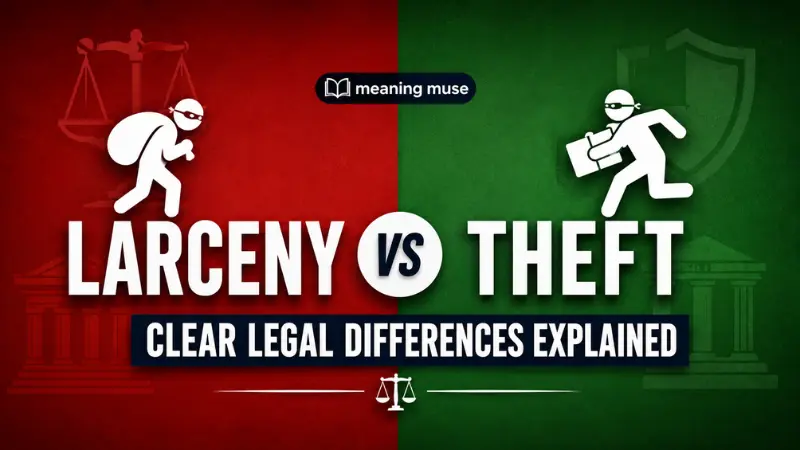
Larceny and theft both involve taking property that belongs to someone else. Because the words often describe the same basic act, many people use them as if they mean exactly the same thing.
However, there can be an important legal difference.
Theft is the more common and often broader term. It may cover several ways of taking or keeping property without permission. Larceny is an older legal term that traditionally describes the wrongful taking and carrying away of another person’s property with the intent to deprive the owner of it.
The exact meaning depends on the law of the state or court handling the case. Some states use the word theft, while others still use larceny. Some laws combine several property crimes under one name.
This guide explains larceny vs theft in plain English, with simple examples and clear legal context.
Legal note: This article gives general information. Criminal laws and penalties vary by location. It is not legal advice.
Quick Answer
Theft is usually the broader and more familiar term. Larceny is a traditional legal form of theft involving the unlawful taking of someone else’s property.
In normal conversation, theft is usually the best word. In a legal case, use the exact term found in the law, police report, court document, or criminal charge.
The FBI even uses the combined category “Larceny/Theft Offenses” when reporting certain property crimes.
Larceny vs Theft at a Glance
| Context | Best Choice | Why |
|---|---|---|
| Everyday conversation | Theft | It is the clearer and more common term |
| General news writing | Theft | Most readers understand it quickly |
| Traditional criminal law | Larceny | It describes a specific common-law property offense |
| State criminal charge | Follow the state statute | Different states use different legal names |
| FBI crime reporting | Larceny/theft | The FBI groups the terms in one offense category |
| Taking property by force | Robbery | Force or threats change the offense |
| Entering a building to commit a crime | Burglary | Burglary focuses on unlawful entry |
The main point is simple: all larceny involves theft in a general sense, but not every act called theft must fit the narrow, traditional definition of larceny.
What Does Theft Mean?
Theft generally means taking another person’s property without permission and with dishonest intent.
Cornell Law School’s Legal Information Institute describes theft as taking another person’s personal property with the intent to deprive that person of its use. It also notes that theft may be referred to as larceny.
In everyday American English, theft can describe many situations:
- Taking a phone from a table
- Stealing products from a store
- Keeping money that belongs to an employer
- Taking packages from someone’s porch
- Using another person’s property without permission
- Obtaining property through dishonest acts
However, the legal meaning may be wider or narrower depending on the statute.
For example, California Penal Code Section 484 uses theft as a broad legal offense. The law covers stealing property, fraudulently taking property that was entrusted to someone, and obtaining property through false statements or pretenses.
This shows why theft can work as an umbrella term in modern criminal law.
What Does Larceny Mean?
Larceny is a traditional criminal-law term.
At common law, larceny generally involved:
- Wrongfully taking property
- Carrying the property away
- Taking property belonging to another person
- Acting without the owner’s permission
- Intending to deprive the owner of the property
Cornell’s legal reference defines larceny as the unlawful taking of another person’s property with the intent to deprive the owner of it.
A simple example would be:
A person sees a laptop in a coffee shop, takes it, and leaves with no plan to return it.
That act would fit the traditional idea of larceny because the person took and carried away property that belonged to someone else.
The word larceny often appears in phrases such as:
- Grand larceny
- Petit larceny
- Petty larceny
- Larceny by trick
- Felony larceny
- Misdemeanor larceny
These labels do not have one fixed meaning across the entire United States. Their meaning and penalties depend on the law that applies.
Are Larceny and Theft the Same Crime?
Sometimes yes, but not always.
In many conversations, larceny and theft point to the same basic wrongdoing: taking property that is not yours.
Some legal dictionaries even describe theft as another name for larceny.
Still, the terms are not perfectly interchangeable in every legal system.
Traditional larceny had a narrower set of elements. It focused on the wrongful taking and movement of personal property. Other acts, such as embezzlement or obtaining property through false pretenses, were treated as separate offenses.
Modern laws often combine those older crimes.
Massachusetts provides a clear example. Its larceny law covers stealing, obtaining property through false pretenses, and unlawfully converting or embezzling another person’s property.
California takes a similar broad approach but uses the term theft.
Therefore, two people may commit similar acts but face charges with different names because the states use different legal wording.
Why Does the Legal Name Change by State?
The United States does not use one single state criminal code.
Each state writes its own criminal statutes. Federal laws also create separate offenses for property connected to the federal government, federal programs, banks, mail, military service, and other areas.
As a result, one state may call an offense:
- Theft
- Larceny
- Grand theft
- Grand larceny
- Petty theft
- Petit larceny
Another state may divide the same conduct into numbered degrees.
California’s criminal code uses theft as the main offense name, even though the chapter containing the law is titled “Larceny.”
Massachusetts continues to use larceny and defines it broadly enough to include several forms of dishonest property taking.
Federal law also uses the terms in different ways. For example, the military justice code defines larceny as wrongfully taking, obtaining, or withholding property with the intent to permanently deprive or defraud the owner. It treats temporary deprivation as wrongful appropriation instead.
The correct legal term therefore depends on the jurisdiction and statute.
Main Elements and Simple Examples
Although definitions vary, theft and larceny cases often involve several basic ideas.
The property belonged to someone else
The item, money, or property must belong to another person, business, or organization.
Example: Mia takes a bicycle that belongs to her neighbor.
The person acted without permission
Borrowing an item with the owner’s permission is not usually theft. Taking it without permission may be.
Example: Noah takes a coworker’s tablet from a locked desk without asking.
The person acted intentionally
An honest mistake is different from a planned taking.
Example: Two shoppers own the same black umbrella. One shopper picks up the wrong umbrella by mistake. That mistake alone does not show an intent to steal.
The person intended to deprive the owner
A prosecutor usually must prove the required criminal intent.
Example: Ava hides store products in her bag and leaves without paying.
The property may have been moved, kept, or converted
Traditional larceny focused on taking and carrying away property. Modern theft laws may also cover keeping, converting, or obtaining property through deception.
Example: An employee is trusted to deposit company money but keeps it for personal use. That conduct may fall under embezzlement, theft, larceny, or another offense depending on the law.
Grand Larceny, Petty Larceny, Grand Theft, and Petty Theft
The words grand and petty usually describe the seriousness of the offense.
Grand theft or grand larceny
These terms often apply when:
- The property has a high value
- A special type of property was taken
- The property was taken directly from a person
- Another fact makes the offense more serious
Petty theft or petit larceny
These terms usually apply when the stolen property falls below the state’s higher-value level and no special factor raises the charge.
The dollar line between the lower and higher offense is not the same in every state. The type of property can also matter.
For example, New York uses grand larceny, while California uses grand theft. The different names do not automatically mean one offense is more serious than the other. The statute, property value, facts, and charge level matter more than the label.
Writers should avoid giving one nationwide dollar amount for grand larceny or grand theft. A number that is correct in one state may be wrong in another.
Larceny vs Robbery, Burglary, and Embezzlement
Larceny and theft are often confused with other property crimes.
Larceny vs robbery
Larceny does not normally require force or threats.
Robbery involves taking property from a person or in the person’s presence through force, violence, or threats.
Example:
- Secretly taking a wallet from an empty chair may be larceny or theft.
- Threatening the owner and demanding the wallet may be robbery.
Theft vs burglary
Burglary is not simply another word for stealing.
Burglary generally focuses on unlawful entry into a building or protected place with the intent to commit a crime inside. A person may commit burglary even if nothing is successfully stolen.
Example: A person breaks into a closed store planning to steal electronics but runs away before taking anything. The case may still involve burglary.
Larceny vs embezzlement
Embezzlement usually involves property that was first trusted to the accused.
The person may have received the money or property lawfully but later used or kept it dishonestly. Cornell explains that embezzlement differs from traditional larceny because the person already had lawful possession or control of the property.
Example: A bookkeeper has permission to handle company funds but transfers them into a personal account.
Theft vs fraud
Fraud often involves deception used to obtain money, property, services, or another benefit.
Some modern theft laws include conduct that older legal systems treated as false pretenses or fraud. However, fraud and theft can still be separate charges.
Which Term Should You Use?
Use theft in most everyday writing.
It is short, clear, and widely understood.
Correct examples:
- Police investigated the theft of several packages.
- The store added cameras to prevent theft.
- Car theft increased in the neighborhood.
- She reported the phone as stolen.
Use larceny when discussing:
- A specific criminal charge
- A law that uses the term
- Traditional common-law rules
- Grand or petit larceny
- A court opinion or legal document
- FBI crime categories using “larceny-theft”
Correct examples:
- He was charged with grand larceny under state law.
- The class studied the traditional elements of larceny.
- The report listed several larceny-theft offenses.
Do not replace the official name of a charge just to make the wording sound simpler.
If a court record says grand larceny, keep that term. If the statute says grand theft, use grand theft.
FAQs
Is larceny worse than theft?
Not automatically. The seriousness depends on the facts, the property value, the offense level, prior convictions, and the law of the jurisdiction. The word larceny is not always more serious than theft.
Is shoplifting theft or larceny?
Shoplifting is a form of unlawful property taking. A state may charge it as shoplifting, retail theft, petty theft, larceny, or another named offense. The FBI lists shoplifting under larceny/theft offenses.
Is stealing a car larceny?
It can be treated as theft, larceny, motor vehicle theft, unauthorized use, or another offense. The exact charge depends on the law and whether the person intended to keep the vehicle or only use it temporarily.
Can larceny involve money?
Yes. Money can be the property involved in a larceny or theft offense.
Does larceny require carrying property away?
Traditional common-law larceny included taking and carrying away property. Modern statutes may use broader wording and may cover obtaining, withholding, converting, or keeping property.
Is larceny always a felony?
No. Larceny may be charged as a misdemeanor or felony. The level often depends on property value and other facts.
What is the simplest difference between larceny and theft?
Theft is the broader everyday term. Larceny is a traditional legal term for unlawfully taking another person’s property. State laws may use either word or define them differently.
Conclusion
The difference between larceny and theft is mostly about legal scope and wording.
Theft is the best general term for taking property without permission. It is common in everyday speech, news reports, and many modern criminal statutes.
Larceny is a traditional legal term. It usually refers to intentionally taking another person’s property, but modern laws may define it more broadly.
Neither word is always more serious. The exact charge depends on the statute, the value and type of property, the person’s intent, and the facts of the case.
For clear writing, use theft in general discussion. Use larceny when it is the official legal term or when explaining the traditional crime.