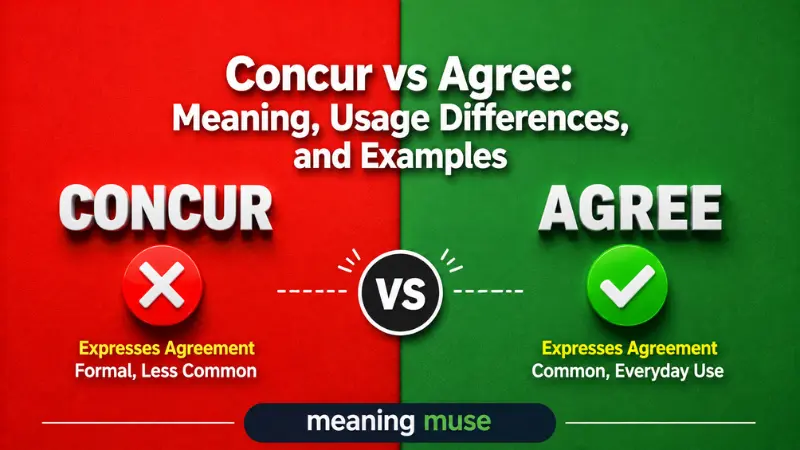
Concur and agree can both mean that two people have the same opinion. However, they do not always fit the same situations.
Agree is the more common and flexible word. You can agree with a person, agree to a plan, agree on a price, or agree that an idea is correct.
Concur is more formal. It often shows that you support another person’s opinion, statement, finding, or decision. You may see it in business reports, formal meetings, legal writing, and court opinions.
For example, “I agree with you” sounds natural in daily conversation. “I concur with your conclusion” sounds more formal and careful.
This guide explains the difference between concur vs agree, including meaning, tone, grammar, prepositions, common mistakes, and simple examples.
Quick Answer
Agree is the best choice for most everyday situations. It means to share an opinion, say yes to a plan, or reach a decision with someone.
Concur also means to share an opinion, but it is more formal and often shows approval of another person’s statement or decision. Therefore, use agree in normal conversation and concur in formal, professional, academic, or legal contexts.
Examples:
- I agree with your idea.
- The experts concur with the report’s findings.
Concur vs Agree at a Glance
| Context | Best Choice | Why |
|---|---|---|
| Everyday conversation | Agree | It sounds natural and friendly. |
| Sharing an opinion | Either | Both can show the same opinion. |
| Accepting a plan | Agree | “Agree to” is the normal form. |
| Reaching a decision | Agree | People agree on a choice or price. |
| Formal report | Concur | It sounds careful and professional. |
| Court opinion | Concur | Judges may concur with a decision. |
| Supporting findings | Concur | Reports may concur with earlier research. |
| Grammar relationship | Agree | A subject agrees with its verb. |
| Something suits your health | Agree | A climate or food may agree with you. |
| Events happen together | Concur | This is a less common meaning of concur. |
What Does Agree Mean?
Agree is a common verb that has several meanings.
To share the same opinion
Use agree when people think the same way.
- I agree with Mia.
- We agree that the rule is fair.
- They do not agree about the cause.
To accept a plan or request
Agree can also mean to say yes.
- She agreed to help us.
- The owner agreed to lower the price.
- We agreed to meet on Friday.
To reach a shared decision
People can agree on a plan, date, price, or solution.
- We agreed on a meeting time.
- The two sides agreed on the final price.
- They could not agree on a name.
To match or correspond
Facts, reports, stories, and numbers can agree.
- The two reports agree on the main facts.
- His story does not agree with the evidence.
To match in grammar
A subject and verb must agree in number.
- “She works” has correct subject-verb agreement.
- “She work” does not agree grammatically.
To suit someone
Something may agree with you if it makes you feel well.
- The warm weather agrees with him.
- Spicy food does not agree with me.
Major dictionaries list these wider meanings and patterns for agree, making it more flexible than concur.
What Does Concur Mean?
Concur is a formal verb. Its main meaning is to share or support the same opinion.
- I concur with your decision.
- The doctors concurred that more tests were needed.
- The report concurs with earlier findings.
Concur often suggests that one person considers another person’s view and then supports it. For that reason, it appears more often in formal discussions, official statements, reports, and legal writing.
It can also mean that two things happen at the same time or work together. However, this meaning is less common in everyday English.
- Several events concurred to create the problem.
- The two changes concurred with a rise in demand.
Cambridge labels concur as formal, while Merriam-Webster notes that it often implies approval of another person’s statement or decision.
Meaning and Usage Difference
The main difference is not the basic idea of agreement. The difference is range, tone, and context.
Agree has a wider meaning
You can use agree to:
- Share an opinion
- Accept a request
- Approve a plan
- Reach a decision
- Match a fact
- Show grammatical harmony
- Describe something that suits your health
Concur has a narrower meaning
You mainly use concur to:
- Share a formal opinion
- Support a statement
- Approve a conclusion
- Join a legal decision
- Show that findings match
- Describe events happening together
Therefore, concur can replace agree only when the meaning is “share the same opinion” or “support the same conclusion.”
Compare:
- I agree with your opinion.
- I concur with your opinion.
Both are correct, but the second sentence sounds more formal.
Now compare:
- She agreed to join the team.
- She concurred to join the team.
The first sentence is natural. The second is not normal standard usage because concur does not usually replace agree to when accepting an action or request.
Tone and Formality
Agree sounds natural and neutral
Use agree in:
- Daily conversation
- Text messages
- School discussions
- Friendly emails
- Workplace conversations
- Most general writing
Examples:
- I agree with you.
- We agreed to meet later.
- Do you agree with this idea?
Concur sounds formal
Use concur in:
- Business reports
- Formal meetings
- Research writing
- Official statements
- Legal discussions
- Court opinions
- Professional reviews
Examples:
- The committee concurred with the recommendation.
- Our findings concur with the earlier report.
- The judge concurred in the court’s decision.
In casual speech, “I concur” may sound very serious, old-fashioned, or humorous. “I agree” is usually the safer and more natural choice. Cambridge identifies concur as formal, while agree appears across basic and everyday uses.
Agree With, Agree To, or Agree On?
The preposition changes the meaning of agree.
Agree with a person or opinion
Use agree with when you share someone’s view or support an idea.
- I agree with Sara.
- We agree with your main point.
- He does not agree with the new rule.
Agree to a plan or request
Use agree to when someone accepts something.
- She agreed to the proposal.
- They agreed to our terms.
- I agreed to help after school.
You can also use agree to + verb:
- We agreed to wait.
- He agreed to pay.
- They agreed to leave early.
Agree on a topic or decision
Use agree on when people reach the same decision about something.
- We agreed on a price.
- They agreed on the final design.
- The family agreed on where to eat.
Agree that something is true
Use agree that before a complete idea.
- I agree that the plan needs work.
- We agree that safety comes first.
- They agreed that the test was difficult.
These patterns are common and standard in American English.
Concur With, Concur That, or Concur In?
Concur uses fewer common patterns.
Concur with someone or something
Use concur with to support a person, view, finding, or decision.
- I concur with the manager.
- The report concurs with our results.
- Most doctors concur with that advice.
Concur that something is true
Use concur that before a full statement.
- We concur that the change is needed.
- The board concurred that the offer was fair.
- Experts concur that more study is required.
Concur in a decision or judgment
Concur in appears mainly in formal or legal writing.
- The judge concurred in the decision.
- Three members concurred in the final judgment.
- The committee concurred in the recommendation.
In US law, a judge may agree with the court’s result and write a separate concurring opinion. Such an opinion supports the outcome but may use different reasoning.
When Can Concur Replace Agree?
Concur can replace agree when both words mean to share the same opinion.
Both words work
- I agree with your conclusion.
- I concur with your conclusion.
- The experts agree that the change is needed.
- The experts concur that the change is needed.
- Our results agree with the report.
- Our results concur with the report.
The sentences with concur sound more formal.
Only agree sounds natural
Use agree, not concur, when someone accepts a request or makes an arrangement.
- Correct: She agreed to call me.
- Unnatural: She concurred to call me.
- Correct: We agreed on a price.
- Unnatural: We concurred on a price.
- Correct: The company agreed to the terms.
- Unnatural: The company concurred to the terms.
Use concur for matching opinions or conclusions. Use agree for plans, actions, arrangements, and everyday approval.
Concur vs Agree in Different Situations
Everyday conversation
Use agree.
- I agree with you.
- We both agree.
- I do not agree with that.
“I concur” is correct, but it may sound too formal for a relaxed conversation.
Business communication
Both words can work.
- I agree with the proposed schedule.
- I concur with the report’s recommendation.
Choose agree for a direct and natural tone. Choose concur when you want a more formal tone.
Academic writing
Concur is useful when studies, results, or experts reach the same conclusion.
- These findings concur with earlier research.
- Most experts concur that the method is safe.
However, agree is also correct:
- These findings agree with earlier research.
Legal writing
Concur has a special role in court language.
A judge may concur with the court’s decision. The judge agrees with the result but may explain a different reason.
- Justice Lee concurred in the judgment.
- The judge wrote a concurring opinion.
Making plans
Use agree.
- We agreed to meet at noon.
- They agreed on a date.
- I agreed to the new schedule.
Do not normally use concur for these actions.
Common Mistakes and Quick Fixes
Mistake 1: Using concur in casual conversation
- Too formal: I concur that pizza sounds good.
- Natural: I agree that pizza sounds good.
Quick fix: Use agree for normal daily speech.
Mistake 2: Saying “concur to”
- Incorrect: We concurred to the plan.
- Correct: We agreed to the plan.
- Correct: We concurred with the plan’s main idea.
Quick fix: Use agree to when accepting a proposal or action.
Mistake 3: Confusing “agree with” and “agree to”
- Incorrect: I agree to your opinion.
- Correct: I agree with your opinion.
Quick fix: Agree with a person or opinion. Agree to a request or plan.
Mistake 4: Using concur for every meaning of agree
- Incorrect: This warm weather concurs with me.
- Correct: This warm weather agrees with me.
Quick fix: Concur mainly refers to opinions, findings, decisions, or events.
Mistake 5: Spelling the word “concurr”
- Incorrect: I concurr with the report.
- Correct: I concur with the report.
Quick fix: The base word has one final r: concur. Its past form is concurred, and its -ing form is concurring.
Everyday Examples
Examples with agree
- I agree with your answer.
- We agreed to work together.
- The children agreed on a game.
- My parents agree that school is important.
- The two reports agree on the main facts.
- Cold weather does not agree with him.
- The subject must agree with the verb.
- Did you agree to the new rules?
- Our group agreed on a final name.
- I agree that we should leave early.
Examples with concur
- I concur with your opinion.
- The doctor concurred with the test results.
- The board concurred that the plan was fair.
- Our findings concur with earlier studies.
- The experts concurred with the final report.
- The judge concurred in the decision.
- Most members concur with the recommendation.
- The review panel concurred that changes were needed.
- Her statement concurs with the known facts.
- The two events concurred at an unusual time.
Side-by-side examples
- Everyday: I agree with your idea.
- Formal: I concur with your conclusion.
- Arrangement: We agreed to meet tomorrow.
- Formal opinion: We concurred that the change was needed.
- Shared choice: They agreed on a price.
- Supporting findings: The experts concurred with the report.
Dictionary-Style Word Details
Verb
Agree: A common verb meaning to share an opinion, accept something, reach a decision, match, or suit someone.
Word forms:
- agree
- agrees
- agreed
- agreeing
Concur: A formal verb meaning to share an opinion, approve a statement or decision, match a finding, or happen at the same time.
Word forms:
- concur
- concurs
- concurred
- concurring
Noun
Neither agree nor concur is normally used as a noun.
The related nouns are:
- Agreement: The act or state of agreeing; it can also mean a deal or arrangement.
- Concurrence: Agreement or events happening at the same time.
- Concurrence: In legal writing, support for a court’s decision, sometimes given in a separate opinion.
Synonyms
Synonyms for agree when sharing an opinion:
- accept
- approve
- consent
- support
- assent
- see eye to eye
- be of the same mind
Synonyms for concur:
- agree
- approve
- coincide
- correspond
- be in agreement
- support the conclusion
A clear antonym for both words is disagree. In formal debate or legal writing, dissent may also fit.
Example Sentences
Agree:
- We agree on most school rules.
- I agreed to help my neighbor.
- Her answer agrees with the facts.
Concur:
- I concur with your final point.
- The board concurred with the recommendation.
- These results concur with earlier findings.
Word History
Agree came into English through Anglo-French. Its earlier sense was linked with being pleased, giving approval, or sharing the same view.
Concur came through Latin and carried the idea of coming together, acting together, or being in agreement.
Both words have been used in English since around the 15th century. However, agree became the broader everyday word, while concur kept a more formal tone.
Phrases Containing
Common phrases with agree:
- agree with someone
- agree with an opinion
- agree to a plan
- agree to help
- agree on a price
- agree on a date
- agree that
- agree to disagree
- strongly agree
- completely agree
Common phrases with concur:
- concur with someone
- concur with a decision
- concur with the findings
- concur that
- concur in the judgment
- fully concur
- respectfully concur
- concurring opinion
- concur with the recommendation
- concur with the report
FAQs
Are concur and agree the same?
They share one main meaning: having the same opinion. However, agree has many more uses. It can describe accepting plans, reaching decisions, matching facts, grammar, and something that suits your health. Concur is narrower and more formal.
Is concur more formal than agree?
Yes. Concur is usually used in formal, professional, academic, or legal contexts. Agree is neutral and works well in both casual and formal situations. Therefore, “I agree” is more common in everyday conversation.
Can I say “I concur with you”?
Yes. “I concur with you” is grammatically correct and means “I agree with you.” However, it sounds more formal. In a normal conversation, “I agree with you” will usually sound more natural.
Do you concur with or concur to something?
Use concur with for a person, opinion, report, or decision. You can also use concur that before a full statement. Avoid concur to when accepting a plan. Use agree to instead.
What is the difference between agree with and agree to?
Use agree with when you share a person’s opinion: “I agree with Maya.” Use agree to when you accept a request, plan, or action: “I agreed to help.” The preposition changes the meaning.
Can concur be used in everyday conversation?
Yes, but it may sound very formal or humorous. “I concur” is correct, yet “I agree” is more natural in most daily conversations. Save concur for times when a formal tone fits the situation.
What does concur mean in court?
In court language, a judge who concurs agrees with the court’s result. The judge may still have different reasons and may write a separate concurring opinion to explain those reasons.
Conclusion
Agree and concur can both mean to share the same opinion, but they are not fully interchangeable.
Use agree for most daily situations. It works when people share an opinion, accept a request, make a plan, or reach a decision.
Use concur when you need a more formal word for supporting an opinion, finding, recommendation, or legal decision.
Remember this simple rule:
Use “agree” for everyday and general situations. Use “concur” for formal agreement with a view, statement, finding, or decision.