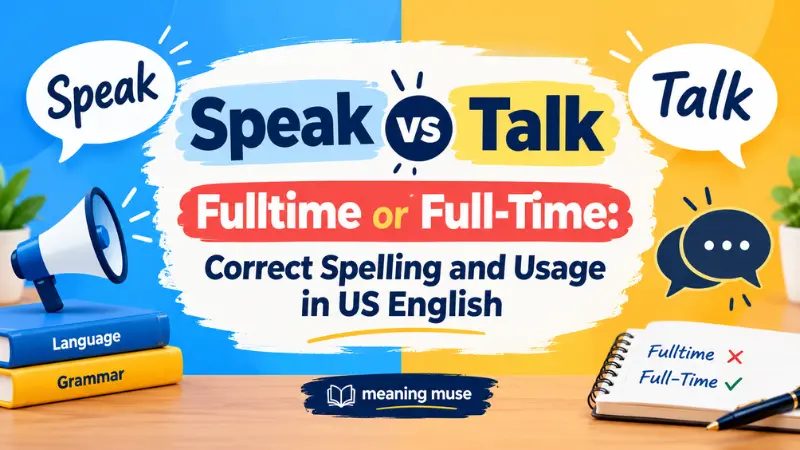
Fulltime or full-time? If you are writing in American English, the normal form is full-time when the word comes before a noun.
For example:
- a full-time job
- a full-time employee
- a full-time student
- a full-time position
However, there is an important detail: full time is also correct when the expression works as an adverb or noun phrase.
For example:
- I work full time.
- She studies full time.
- He works full time at the hospital.
The one-word spelling fulltime is generally not the standard choice in modern US professional writing.
Quick Answer
The short answer is:
Use “full-time” before a noun and “full time” when it follows the verb or works as an open phrase. Avoid “fulltime” in standard US writing.
| Context | Best Choice | Why |
|---|---|---|
| Before a noun | full-time | It acts as a compound modifier |
| After a verb | full time | It works as an adverbial expression |
| As a noun phrase | full time | The expression remains open |
| One-word spelling | fulltime | Not the normal standard US form |
Examples:
She found a full-time job.
She works full time.
This distinction is also reflected in US editorial style guides. Several recommend the hyphen when the phrase modifies a noun and no hyphen when it follows the verb.
Why People Confuse Them
The confusion happens because English often changes hyphenation depending on how words work in a sentence.
“Full” and “time” are both ordinary words. When they work together before a noun, the hyphen helps readers understand that they form one modifier.
Compare:
a full-time employee
Here, “full-time” describes the employee.
But in:
The employee works full time.
The expression describes how the employee works. It does not directly sit before a noun as a compound modifier.
This is why both full-time and full time can be correct.
The extra confusion comes from fulltime, which may look like a natural one-word form. Some dictionaries list it as an alternative form, but major US dictionaries and professional style guidance favor the hyphenated or two-word forms in standard writing.
Key Differences At A Glance
The easiest way to remember the difference is to look at the word that comes next.
Full-time + noun
- full-time employee
- full-time worker
- full-time student
- full-time position
Verb + full time
- work full time
- study full time
- attend full time
Quick comparison
| Feature | fulltime | full-time |
|---|---|---|
| Standard US professional writing | Usually avoid | Standard choice |
| Before a noun | Not recommended | Preferred |
| Compound modifier | No | Yes |
| Example | a fulltime job ❌ | a full-time job ✅ |
There is also a standard open form, full time, which is important in sentences such as “I work full time.”
Are They the Same Word?
The expressions refer to the same basic idea: something done for the whole normal period of work or study rather than only part of it.
The main issue is written form and grammatical position, not a different meaning.
For example:
She is a full-time employee.
and
She works full time.
Both describe someone working on a full-time basis.
The spelling changes because the expression has a different role in the sentence.
The one-word form fulltime should not normally be used simply because the phrase has one meaning. Standard US writing generally uses full-time or full time, depending on the sentence.
US vs UK Preference
American and British English both commonly use full-time as a hyphenated adjective.
For example:
- full-time student
- full-time work
- full-time employee
Both varieties also use full time in appropriate contexts.
For example:
- She works full time.
The important point is that this is not mainly a US-versus-UK spelling difference.
The main distinction is grammatical and stylistic: hyphenated before a noun when functioning as a compound modifier, but commonly open when used after the verb or as a noun phrase.
Some individual style guides may set their own preferences, so a publication’s house style can matter.
Which Spelling Should You Use?
For most US writing, use this simple rule:
Use “full-time” before a noun.
Examples:
- full-time job
- full-time student
- full-time employee
- full-time schedule
- full-time position
Use “full time” after the verb.
Examples:
- I work full time.
- She studies full time.
- They attend school full time.
- He works full time from home.
Do not normally use “fulltime” as one word.
If you are writing a résumé, cover letter, school paper, business document, website, or professional email, full-time and full time are the safer standard forms.
When One Spelling Looks Wrong
Some forms look wrong because the hyphen is missing.
For example:
She applied for a fulltime position. ❌
A standard US version is:
She applied for a full-time position. ✅
The reason is simple. “Full-time” comes directly before “position” and describes it.
Now consider:
She wants to work full-time.
Some style guides allow or prefer the hyphenated form even when the phrase follows the verb, while others recommend the open form work full time. US style guides commonly distinguish the compound modifier from the open adverbial phrase.
For a clean, widely accepted US style, use:
She wants to work full time.
The key rule is not “always use a hyphen.” The position and function of the phrase matter.
Common Mistakes (and Quick Fixes)
Mistake 1: Using “fulltime” before a noun
Wrong: He has a fulltime job.
Better: He has a full-time job.
Mistake 2: Adding a hyphen everywhere
Less preferred in many US style guides: She works full-time.
Common standard form: She works full time.
Mistake 3: Thinking “full time” is always wrong
It is not.
Correct: I work full time.
Mistake 4: Thinking “full-time” is always wrong
It is not.
Correct: I have a full-time position.
Mistake 5: Treating “fulltime” as the normal US spelling
In standard professional writing, choose full-time or full time instead.
Everyday Examples
Here are natural US-English examples:
- Maria has a full-time job at a local bank.
- My brother is a full-time student.
- The company is hiring a full-time employee.
- She works full time during the school year.
- He attends college full time.
- The position is full time, not part time.
- We are looking for a full-time office manager.
- She decided to study full time.
- His new full-time position starts Monday.
- I have worked full time since January.
Notice the pattern: before a noun, full-time is common; after the verb, full time is commonly used.
Dictionary-Style Word Details
Verb
fulltime: Not normally used as a standard verb in US English.
full-time: Not a verb. It functions mainly as an adjective and can also be used adverbially in some dictionary descriptions.
Examples:
- a full-time employee
- full-time work
Noun
fulltime: Not the standard noun form in US professional writing.
full time: Can function as a noun phrase in contexts referring to the normal or customary amount of working time.
Example:
The position is full time.
The exact treatment can vary by dictionary and style guide, but the open form is well established.
Synonyms
The expression does not have a single perfect one-word synonym in every sentence.
Closest plain alternatives include:
- on a full-time basis
- regular full-time work
- working the full schedule
The best alternative depends on the sentence.
Example Sentences
Full-time:
- She accepted a full-time position.
- He is a full-time student.
- We need a full-time assistant.
Full time:
- She works full time.
- He studies full time.
- They attend the program full time.
Fulltime:
- Avoid fulltime in standard US professional writing.
Word History
The expression is formed from the ordinary words full and time.
The hyphenated form has long been established in English. Collins gives historical information for full-time, while current dictionaries and style references document its adjective and adverb uses.
The important modern point is not its history but its current written form: full-time and full time are the standard choices readers are most likely to expect, depending on sentence structure.
Phrases Containing
Common phrases include:
- full-time job
- full-time employee
- full-time student
- full-time worker
- full-time position
- full-time schedule
- full-time work
- work full time
- study full time
- attend school full time
These examples show why the hyphen cannot simply be added or removed in every sentence.
FAQs
Is it fulltime or full-time?
Full-time is the standard choice when the phrase comes before a noun, such as full-time job or full-time employee. The one-word form fulltime is generally avoided in standard US writing.
Is full-time one word or two words?
It depends on how it is used. Use full-time before a noun as a compound modifier. Use full time in sentences such as “I work full time.”
Is fulltime correct in American English?
Fulltime is not the normal form in standard US professional writing. In most cases, use full-time or full time, depending on its position in the sentence.
Should I write full-time job or full time job?
Write full-time job. The hyphen connects the words because they work together to describe the noun job.
Is it correct to say I work full-time?
Many style guides prefer “I work full time” when the phrase follows the verb. The open form is a standard choice in American English.
When should I use full-time?
Use full-time when it comes directly before a noun.
Examples:
When should I use full time?
Use full time when the expression follows a verb or works as an open phrase.
Examples:
I work full time.
She studies full time.
He attends college full time.
Is full-time hyphenated?
Yes, full-time is hyphenated when it acts as a compound modifier before a noun, such as full-time work or full-time employee.
Is full time without a hyphen correct?
Yes. Full time is correct when the phrase is used openly, especially after a verb.
Example:
She works full time from home.
Is fulltime a misspelling?
In standard US professional writing, fulltime is generally not the preferred form. Use full-time before a noun or full time when the phrase is used openly.
Is full-time American or British English?
Full-time is used in both American and British English. The main issue is not a US-versus-UK spelling difference but how the phrase functions in a sentence.
What is the correct spelling for a full-time employee?
The correct form is full-time employee because full-time modifies the noun employee.
What is the correct spelling: full-time student or full time student?
Use full-time student. The hyphen makes full-time a clear compound modifier before student.
What is the easiest way to remember full-time vs full time?
Use this simple rule:
Before a noun → full-time
After a verb → full time
One word → avoid fulltime
Is full-time work correct?
Yes. Full-time work is correct because full-time comes before and describes the noun work.
Is full time work correct?
When work is being modified by the phrase, standard US writing normally uses full-time work.
Is full-time a noun?
Full-time is mainly used as an adjective, while full time can function as an open phrase in noun-like or adverbial uses depending on the sentence.
Does fulltime have a hyphen?
No. Fulltime is written as one word, but it is generally not the preferred standard form in US professional writing. Use full-time or full time instead.
Which should I use in a résumé: full-time or full time?
Use full-time when it describes a noun, such as full-time employee or full-time position. Use full time when it follows the verb, such as wo
Conclusion
For standard US English, fulltime is not the normal choice.
Use full-time when the expression comes before a noun as a compound modifier:
She has a full-time job.
Use full time when the expression is used openly, especially after a verb:
She works full time.
The easiest rule is: