Quantify and qualify look and sound similar, but they do not mean the same thing.
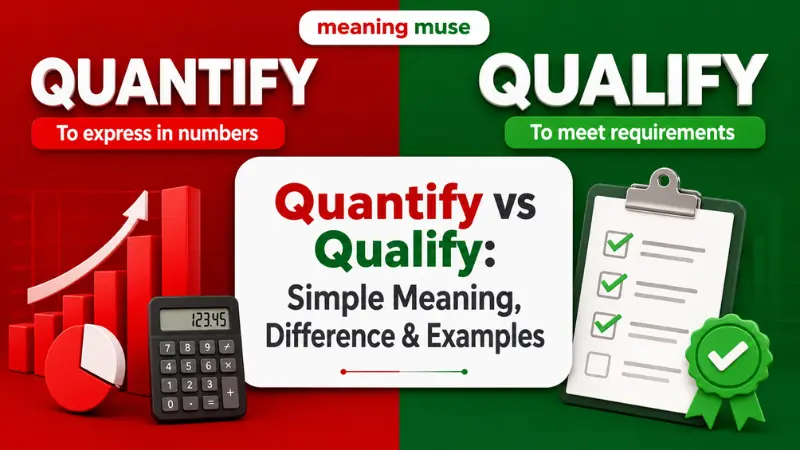
Use quantify when you want to measure or express how much, how many, or how large something is.
Use qualify when someone or something meets a requirement, becomes eligible, or has the needed skills. Qualify can also mean adding limits or details to a statement.
Here is the easiest way to remember the difference:
Quantify = measure an amount.
Qualify = meet a condition or requirement.
For example:
“The study tried to quantify the cost.”
“She qualified for the scholarship.”
Both sentences are correct, but the words cannot be exchanged because they perform different jobs. Dictionaries define quantify around measuring or expressing quantity, while qualify has meanings connected with meeting standards, becoming eligible, and limiting or modifying a statement.
Quick Answer
The difference between quantify vs qualify is simple.
Quantify means to measure or state the amount, number, size, or level of something.
Qualify usually means to meet the rules or standards needed for something. It can also mean making a statement more limited or exact.
Examples:
“She tried to quantify the damage.”
“He qualified for the final round.”
Think:
QUANTITY → QUANTIFY
QUALIFICATION → QUALIFY
That small connection can help you choose the correct word.
What Does Quantify Mean?
Quantify is a verb.
It means to measure something or express its amount, number, size, or level.
Cambridge describes quantify as measuring or judging the amount or number of something. Merriam-Webster similarly gives the everyday meaning of determining, expressing, or measuring quantity.
For example:
“We need to quantify the total cost.”
The speaker wants to find or state how much the cost is.
Another example:
“It is hard to quantify the damage.”
This means the damage may be difficult to measure in a clear amount.
You can also quantify things that are not simple physical objects.
For example:
“The survey helped quantify customer satisfaction.”
“The team quantified the financial risk.”
“Researchers tried to quantify the effect of the change.”
In each case, the goal is to put some kind of measurement, amount, number, or clear scale on something.
Simple Meaning of Quantify
A simple definition is:
Quantify = say how much or how many.
If a sentence is about numbers, measurements, amounts, levels, costs, percentages, or totals, quantify may be the word you need.
What Does Qualify Mean?
Qualify is also a verb, but its meaning is different.
One of its most common meanings is to meet the requirements needed for something.
For example:
“She qualified for the competition.”
This means she met the required standard and was allowed to enter or continue.
“He may qualify for financial aid.”
This means he may meet the rules needed to receive that aid.
Cambridge lists uses of qualify involving having the necessary skills or meeting conditions, while Merriam-Webster includes being or becoming fit, meeting a required standard, and being made eligible through training or ability.
Qualify Can Also Mean Become Trained
You can use qualify when a person completes the training or requirements needed for a profession.
For example:
“She qualified as a doctor.”
“He hopes to qualify as an electrician.”
The idea is still about meeting a required standard.
Qualify Can Also Limit a Statement
Qualify has another important meaning.
It can mean to add information that makes a statement less broad, less certain, or more limited.
For example:
“I agree, but I should qualify that statement.”
The speaker is about to add a condition or limitation.
Merriam-Webster includes the meaning of reducing something from a general form to a more restricted one or limiting its meaning. Cambridge also records the use of qualify for adding information that makes what was said less certain or broad.
Quantify vs Qualify at a Glance
| Context | Best Choice | Why |
|---|---|---|
| Measuring a cost | Quantify | You are finding an amount |
| Measuring a risk | Quantify | You are expressing its size or level |
| Counting an effect | Quantify | You are putting it into measurable terms |
| Meeting job requirements | Qualify | You meet the needed conditions |
| Entering a competition | Qualify | You meet the required standard |
| Receiving a benefit | Qualify | You are eligible |
| Limiting a statement | Qualify | You add a condition or restriction |
A quick comparison also helps:
- Quantify: asks how much? or how many?
- Qualify: asks does it meet the requirements?
- Quantify: connects with quantity.
- Qualify: connects with qualification.
- Quantify: often appears with data, cost, risk, effect, impact, or amount.
- Qualify: often appears with for, as, requirements, eligibility, jobs, benefits, contests, or statements.
Why People Confuse Quantify and Qualify
The words are easy to mix up because they share a similar shape.
Look at them:
quantify
qualify
Both end in -ify, and both begin with qua-.
They are also verbs, so they can appear in similar places in a sentence.
Compare:
“We need to quantify the result.”
“We need to qualify for the program.”
The grammar may look similar, but the meanings are very different.
The best way to avoid confusion is not to focus only on the spelling.
Instead, ask what the sentence means.
Are you trying to measure something?
Use quantify.
Are you talking about meeting a condition or standard?
Use qualify.
Are Quantify and Qualify the Same Word?
No.
Quantify and qualify are two separate words.
They are not American and British spellings of the same word.
They are not interchangeable spellings.
They also do not have the same meaning.
Quantify deals mainly with quantity or measurement.
Qualify deals mainly with requirements, eligibility, ability, or limitations placed on a statement.
For example:
“Can you quantify the loss?”
The question asks for the size or amount of the loss.
“Do I qualify for the discount?”
The question asks whether the person meets the rules for receiving the discount.
Changing one word to the other would change the meaning.
Quantify vs Qualify Pronunciation
The pronunciations are similar, but not identical.
Quantify is pronounced roughly:
KWAN-tuh-fy
Cambridge gives the American pronunciation with the first part sounding like “kwan.”
Qualify is pronounced roughly:
KWAH-luh-fy
Cambridge gives the American pronunciation with a clear middle l sound.
Listen for the middle:
quan-ti-fy
qua-li-fy
The t sound points toward quantify.
The l sound points toward qualify.
When to Use Quantify
Use quantify when something needs to be measured or expressed as an amount.
Common situations include:
Cost
“We cannot yet quantify the repair cost.”
Risk
“The report attempts to quantify the risk.”
Damage
“It was difficult to quantify the storm damage.”
Impact
“The company wants to quantify the impact of the new policy.”
Results
“The test helped quantify the improvement.”
Benefits
“It can be difficult to quantify every benefit of the program.”
The common idea is measurement.
You are trying to answer a question such as:
How much?
How many?
How large?
To what degree?
When to Use Qualify
Use qualify when a person or thing must meet a rule, standard, or condition.
Qualify for Something
Use qualify for when someone becomes eligible for a benefit, program, contest, job, loan, or similar opportunity.
Examples:
“She qualifies for free lunch.”
“Do we qualify for the discount?”
“He qualified for the state championship.”
“You may qualify for assistance.”
Qualify as Something
Use qualify as when someone meets the requirements for a profession or when something fits a category.
Examples:
“She qualified as a nurse.”
“He qualified as an engineer.”
“That may qualify as an emergency.”
Qualify to Do Something
You may also see qualify to when someone has the required ability or permission to do something.
Example:
“The certificate qualifies her to teach the course.”
Cambridge and Merriam-Webster both show these eligibility, training, and competency uses.
Quantify or Qualify: Which Word Should You Use?
Use this quick test.
Ask “Can I Measure It?”
If yes, choose quantify.
“We need to ___ the financial loss.”
Can you measure the loss?
Yes.
Correct:
“We need to quantify the financial loss.”
Ask “Does It Meet a Requirement?”
If yes, choose qualify.
“Does she ___ for the program?”
The question is about eligibility.
Correct:
“Does she qualify for the program?”
Ask “Am I Limiting What I Said?”
If yes, qualify may also be correct.
“I need to ___ my earlier statement.”
The speaker wants to add a limitation.
Correct:
“I need to qualify my earlier statement.”
Common Mistakes With Quantify and Qualify
Mistake 1: Using Qualify for Measurement
Incorrect: We need to qualify the exact financial loss.
If you mean measure the amount of the loss, use:
Correct: We need to quantify the exact financial loss.
Mistake 2: Using Quantify for Eligibility
Incorrect: She quantified for the scholarship.
A scholarship has requirements. The person meets or does not meet them.
Use:
Correct: She qualified for the scholarship.
Mistake 3: Confusing Qualified and Quantified
Incorrect: The researchers qualified the amount of waste.
If they measured the amount, write:
Correct: The researchers quantified the amount of waste.
But this sentence is different:
“He is qualified for the position.”
Here, qualified means that the person has the needed skills or meets the requirements.
Mistake 4: Assuming One Is a Misspelling
Neither word is a misspelling.
Both are standard English verbs.
The correct choice depends on meaning.
Easy Trick to Remember Quantify vs Qualify
The strongest memory trick is inside the words themselves.
Quantify → Quantity
Both begin with:
QUANTI-
A quantity is an amount.
So:
Quantify = find or express a quantity.
Qualify → Qualification
Both begin with:
QUALI-
A qualification can be a skill, condition, or requirement that makes someone suitable or eligible.
So:
Qualify = meet a qualification or condition.
Remember this short rule:
Quantify the amount. Qualify for the opportunity.
Quantify vs Qualify Examples
Here are examples using quantify:
“The company tried to quantify its losses.”
“Can you quantify the benefits?”
“The survey helped quantify customer demand.”
“We cannot easily quantify the emotional impact.”
“The team quantified the total cost.”
“Researchers wanted to quantify the difference.”
Now compare examples using qualify:
“She qualified for the final.”
“He may qualify for a lower rate.”
“Her training qualifies her for the job.”
“They qualified for the tournament.”
“I should qualify my earlier answer.”
“The experience may qualify him to apply.”
The easiest clue is the purpose of the sentence.
Measurement points to quantify.
Eligibility, requirements, or limitations point to qualify.
Dictionary-Style Word Details
Verb
Quantify: A verb meaning to measure, determine, or express the amount or quantity of something. It normally takes an object: you quantify something.
Qualify: A verb with several related uses. It can mean meeting requirements, making someone eligible, completing professional requirements, or limiting a statement. It can be used both with and without a direct object depending on the meaning.
Noun
Neither quantify nor qualify is normally used as a noun.
Related nouns include:
Quantify → quantity, quantification
Qualify → qualification
Cambridge defines quantification as the act of measuring or judging an amount or size.
Synonyms
For quantify, close alternatives depend on context:
measure
calculate
estimate
determine
express numerically
Not every alternative means exactly the same thing in every sentence.
For qualify, possible alternatives also depend on meaning:
For eligibility:
be eligible
meet the requirements
be suitable
be entitled
For limiting a statement:
limit
modify
restrict
clarify
Because qualify has several meanings, there is no single replacement that works everywhere.
Example Sentences
Quantify:
“We need more data to quantify the change.”
“Can the team quantify the savings?”
“It is hard to quantify the total effect.”
Qualify:
“She qualified for the race.”
“His experience qualifies him for the role.”
“I need to qualify that statement.”
Word History
The two words come from different word families, which helps explain their different meanings.
Merriam-Webster traces quantify through a Latin root connected with the idea of how much, which matches its modern connection with quantity and measurement.
It traces qualify through a different Latin root connected with what kind, which developed into meanings involving qualities, conditions, fitness, and limits.
You do not need to remember the history to use the words correctly. The modern memory rule is easier:
quantity → quantify
qualification → qualify
Phrases Containing
Common patterns with quantify include:
quantify the risk
quantify the impact
quantify the cost
quantify the benefits
quantify the difference
difficult to quantify
Common patterns with qualify include:
qualify for a job
qualify for assistance
qualify for a loan
qualify for the final
qualify as a doctor
qualify to apply
qualify a statement
These patterns show the difference clearly: quantify commonly appears around measurement, while qualify commonly appears around eligibility, standards, or limits.
FAQs
What is the difference between quantify and qualify?
Quantify means to measure or express an amount. Qualify usually means to meet a requirement or become eligible. Qualify can also mean limiting or modifying a statement.
Does quantify mean measure?
Yes. In normal usage, quantify means to determine, measure, or express the amount or quantity of something.
What does qualify mean?
Qualify often means meeting the conditions needed for something. For example, a student may qualify for a scholarship, or an athlete may qualify for a final. The word can also mean limiting a statement.
Is it quantify or qualify the risk?
Usually, quantify the risk is correct when you mean measuring the size or level of the risk.
Is it quantify or qualify for a job?
Use qualify for a job when you mean having the skills or meeting the requirements needed for the position.
Is quantify the same as calculate?
They can overlap, but they are not always identical. Calculate usually suggests working out a numerical answer. Quantify more broadly means expressing or measuring something in terms of quantity.
Can qualify mean to change a statement?
Yes. Qualify can mean adding a limit, condition, or detail that makes a statement less broad or absolute.
Are quantify and qualify interchangeable?
No. Quantify concerns quantity or measurement. Qualify concerns eligibility, requirements, fitness, or limiting a statement. They are separate words.
Conclusion
The difference between quantify vs qualify is easy once you connect each word with its word family.
Quantify comes naturally with the idea of quantity. Use it when you need to measure or express how much, how many, or how large something is.
Qualify connects with qualification. Use it when someone meets a standard, becomes eligible, or has the required skills. It can also mean adding limits to a statement.
Remember:
Quantify = measure the amount.
Qualify = meet the requirement.
Or use this one-line memory trick:
Quantify the numbers; qualify for the opportunity.