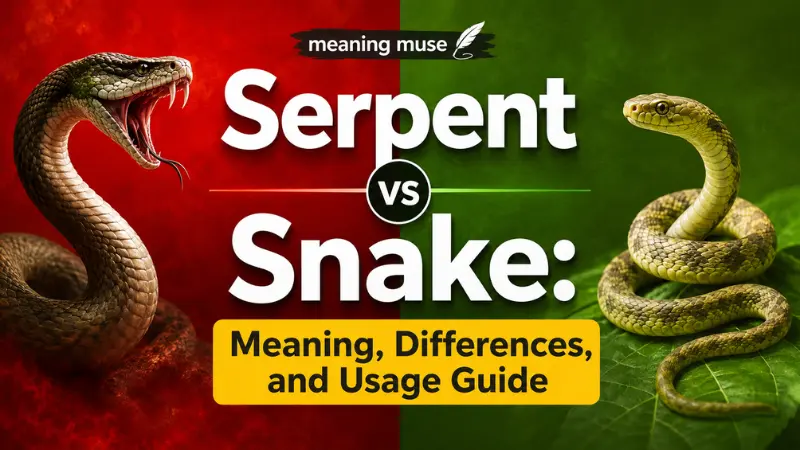
Serpent vs snake can be confusing because both words can describe the same long, legless reptile. However, people do not normally use them in the same situations.
Snake is the common word in everyday English. You would use it when talking about an animal in your yard, at a zoo, on a hiking trail, or in a science lesson.
Serpent sounds more formal, literary, old-fashioned, religious, or symbolic. It often appears in myths, stories, ancient art, and descriptions meant to sound dramatic.
So, the main difference is not the animal itself. The difference is usually tone and context.
Quick Answer
A snake is a long, legless reptile. It is the normal word used in modern American English.
A serpent can also mean a snake, but the word usually sounds more literary, symbolic, religious, or old-fashioned.
For example:
- “A snake crossed the trail” sounds natural and ordinary.
- “A serpent guarded the ancient temple” sounds dramatic or mythical.
For clear everyday writing, snake is usually the better choice.
Why People Confuse Them
People confuse serpent and snake because the two words can refer to the same animal.
If you see a cobra, python, or rattlesnake, it can be described as a snake. A writer may also call such an animal a serpent when trying to create a dramatic, ancient, mysterious, or threatening mood.
That does not mean serpent is another species of animal.
The confusion grows because serpent appears often in mythology, religious writing, fantasy stories, and symbolic art. Readers may therefore think a serpent is always a special or magical kind of snake.
In most cases, it is not.
The word simply carries a different feeling.
Key Differences At A Glance
| Context | Best Choice | Why |
|---|---|---|
| Everyday conversation | Snake | Normal modern word |
| Animal or nature writing | Snake | Clear and direct |
| School science | Snake | Standard animal term |
| Hiking or safety advice | Snake | Easy to understand |
| Literature | Serpent | Can sound dramatic or poetic |
| Mythology | Serpent | Common in legendary descriptions |
| Religious language | Serpent | Often carries symbolic meaning |
| Fantasy writing | Serpent | Creates an ancient or mysterious tone |
| Figurative writing | Either | Choice depends on tone |
A simple way to remember the difference is:
- Snake = everyday and factual
- Serpent = literary, symbolic, or dramatic
Are They the Same Word?
No. Serpent and snake are two different words, even though they can share the same basic animal meaning.
They are not alternate spellings.
You cannot treat them like pairs such as color/colour or canceled/cancelled.
When both words refer to an animal, they may point to the same type of creature. However, the feeling of the sentence can change.
Compare:
The snake moved through the grass.
This sounds simple and factual.
The serpent moved through the shadows.
This sounds darker and more dramatic.
The animal could be exactly the same. The writer’s word choice changes the mood.
This is why understanding serpent vs snake is mostly about usage, style, and tone.
US vs UK Preference
There is no major American-versus-British spelling rule for serpent vs snake.
Both words exist in American and British English.
In modern American English, snake is the ordinary word for the animal.
People say:
- snake bite
- snake venom
- pet snake
- poisonous snake
- venomous snake
- water snake
- rattlesnake
Using serpent in these everyday situations may sound unusual.
For example:
Natural: “We saw a snake near the lake.”
Unusual in normal conversation: “We saw a serpent near the lake.”
The second sentence is understandable, but it sounds as if it belongs in a story, myth, or dramatic description.
British English follows a similar general pattern. Serpent is still understood, but snake is normally the everyday animal word.
Which Word Should You Use?
Use snake when you simply mean the animal.
This is the safest choice for:
- everyday conversation
- school writing
- news reports
- animal facts
- wildlife information
- safety instructions
- scientific explanations
- pet care
- normal descriptions
Example:
A snake was hiding under the rock.
Use serpent when you want a more literary, symbolic, ancient, religious, or mythical feeling.
Example:
The stone serpent curled around the entrance to the temple.
You may also see serpent in stories about dragons, sea monsters, ancient gods, or legendary creatures.
The word can make an image feel larger, older, stranger, or more powerful.
Quick Choice Rule
Ask yourself one question:
Am I talking about a real animal in a normal way?
If yes, choose snake.
If you are writing about symbolism, myth, religion, fantasy, or poetic imagery, serpent may fit better.
When One Word Sounds Wrong
Neither word is automatically wrong. The problem is often the context.
Imagine a wildlife officer saying:
“Be careful. A venomous serpent was seen beside the trail.”
The meaning is clear, but snake would sound more natural:
“Be careful. A venomous snake was seen beside the trail.”
Now imagine a fantasy story:
“A giant snake rose from the black sea and wrapped itself around the ruined tower.”
This sentence works.
However:
“A giant serpent rose from the black sea and wrapped itself around the ruined tower.”
The word serpent gives the scene a more legendary and threatening tone.
The best word therefore depends on what the sentence needs to do.
Use snake for clarity.
Use serpent for effect.
Common Mistakes (and Quick Fixes)
Mistake: Thinking a serpent is always venomous
A serpent does not automatically mean a venomous snake.
Better approach: Look at the actual animal being discussed. The word serpent alone does not tell you whether it has venom.
Mistake: Thinking serpent means a larger snake
Some writers use serpent for large or frightening snakes, but size is not the main difference between the two words.
Better approach: Choose based on context and tone rather than size.
Mistake: Treating them as alternate spellings
Serpent is not another spelling of snake.
They are separate words that sometimes share a meaning.
Mistake: Using serpent in ordinary animal advice
Awkward: “Call animal control if a serpent enters your garage.”
Natural: “Call animal control if a snake enters your garage.”
Mistake: Using snake when a symbolic tone matters
A writer may choose serpent when talking about an ancient symbol, myth, or religious image because the word carries a stronger literary feeling.
Mistake: Assuming every serpent is a real animal
In stories and myths, a serpent may be imaginary, supernatural, symbolic, or monster-like.
Always read the surrounding context.
Everyday Examples
Here are natural examples showing how each word works.
Snake Examples
A snake slid across the road.
This is a normal description of an animal.
She saw a small snake in the garden.
Again, snake is the natural everyday choice.
The ranger warned us about venomous snakes.
The sentence gives practical wildlife information.
My cousin keeps a snake as a pet.
Using serpent here would sound overly dramatic.
The snake coiled around the branch.
This is a simple physical description.
Serpent Examples
The ancient carving showed a winged serpent.
The word fits an old or symbolic image.
A huge sea serpent appeared in the legend.
This sounds mythical rather than scientific.
The hero faced a serpent beneath the ruined city.
The word creates a fantasy tone.
The serpent became a symbol of danger in the story.
Here, symbolism is more important than zoology.
A golden serpent was carved into the temple door.
The word helps create an ancient and dramatic mood.
Compare the Tone
Snake: “A snake was lying beside the river.”
Plain and factual.
Serpent: “A dark serpent waited beside the river.”
More literary and dramatic.
Both sentences could describe a similar creature, but they do not create the same feeling.
Dictionary-Style Word Details
Verb
Serpent: Serpent is not commonly used as a verb in standard modern American English.
Snake: Snake can be a verb. It means to move, bend, or stretch along a twisting path.
Example:
The road snakes through the mountains.
Another example:
The line snaked around the building.
In these sentences, nothing is literally a snake. The verb describes a winding shape or movement.
Noun
Serpent: A noun that can mean a snake. It often appears in literary, religious, mythical, or symbolic language.
Example:
The mural showed a feathered serpent.
Snake: A noun for a long, legless reptile. It is the ordinary modern word.
Example:
A snake was hiding beneath the porch.
Both nouns may describe the same kind of animal, but their usual tone differs.
Synonyms
When referring to the animal, snake and serpent can sometimes work as synonyms.
Other related animal words include:
- reptile
- viper
- cobra
- python
- boa
- rattlesnake
These words are not always interchangeable.
For example, a cobra is a specific kind of snake. A python is also a specific kind of snake.
So do not replace snake with one of these words unless the animal truly belongs to that group.
For serpent in literary writing, the closest plain alternative is often simply snake.
Example Sentences
Serpent: The statue showed a serpent wrapped around a staff.
Snake: We found a snake near the woodpile.
Serpent: The old tale describes a serpent living beneath the sea.
Snake: The snake disappeared into the tall grass.
Serpent: A silver serpent decorated the shield.
Snake: The wildlife guide identified the snake as harmless.
Serpent: The author used the serpent as a sign of danger.
Snake: The snake curled beneath a warm rock.
These examples show why context matters. Snake usually names the animal directly. Serpent often adds style or symbolism.
Word History
Serpent entered English through French and ultimately comes from a Latin word connected with creeping or crawling.
The word has a long history in stories, religion, myth, and symbolic writing. That history helps explain why serpent can sound ancient or dramatic today.
Snake has Germanic roots and comes from an Old English word for the animal.
Over time, snake became the common everyday English term.
That history helps explain the modern difference. The two words can point to the same animal, but snake feels ordinary while serpent often feels more formal or literary.
Phrases Containing
Common expressions with snake include:
- snake bite
- snake venom
- pet snake
- snake in the grass
- snake its way
- snake oil
- water snake
- rattlesnake
Examples:
The path snakes its way through the woods.
He was afraid of getting a snake bite.
Common combinations with serpent include:
- sea serpent
- feathered serpent
- serpent symbol
- serpent imagery
- ancient serpent
- mythical serpent
Examples:
Sailors told stories about a giant sea serpent.
The museum displayed an image of a feathered serpent.
The phrases themselves show the difference in normal usage. Snake appears often in practical and everyday language. Serpent appears more often in mythic, artistic, religious, and symbolic settings.
FAQs
Is a serpent the same as a snake?
A serpent can be a snake, but the words are used differently. Snake is the normal everyday term, while serpent often sounds literary, symbolic, or old-fashioned.
Is a serpent a special type of snake?
Not usually. In general English, serpent is not the name of one special snake species. Context may describe a particular real or mythical creature.
Is a serpent always venomous?
No. The word serpent does not by itself mean that the animal is venomous.
Why do writers use serpent instead of snake?
Writers may choose serpent because it sounds more dramatic, ancient, mysterious, religious, or symbolic.
Which word should I use in American English?
Use snake for most normal situations. Choose serpent when a literary, mythical, religious, or symbolic tone better fits the sentence.
Conclusion
The difference between serpent vs snake is mainly about word choice, tone, and context.
A snake is the normal everyday word for a long, legless reptile. Use it in conversation, school writing, wildlife information, science, safety advice, and most factual descriptions.
A serpent can refer to the same animal, but it usually sounds more literary, symbolic, religious, ancient, or dramatic.
Remember the simplest rule:
Use “snake” for the ordinary animal. Use “serpent” when the context calls for a stronger literary or symbolic tone.
That choice keeps your writing clear while also giving you control over the feeling of the sentence.