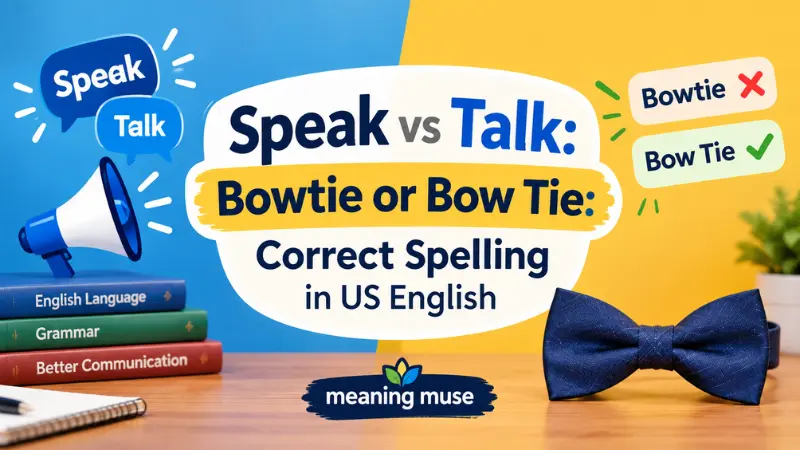
If you are wondering whether to write bowtie or bow tie, both forms are found in English.
However, for standard American English, bow tie is the clearest and safest choice.
Major dictionaries such as Oxford and Collins use bow tie as the main form. Other sources also record bowtie as an alternative form.
So the simple answer is:
Use “bow tie” in most U.S. writing.
The word refers to a type of necktie that is tied or shaped like a bow and does not hang down like a traditional long necktie.
Quick Answer
Bow tie is the standard two-word spelling to use in general U.S. English.
Bowtie is also an established alternative form and is found in English dictionaries and usage sources. It refers to the same type of neckwear.
| Context | Best Choice | Why |
|---|---|---|
| Standard U.S. writing | bow tie | Main dictionary form |
| School writing | bow tie | Clear standard form |
| Business writing | bow tie | Conventional and easy to read |
| Formal writing | bow tie | Safest general choice |
| Informal usage | bowtie | Recognized alternative form |
| Search queries or names | bowtie may appear | Closed form is also used |
The key point is that bowtie and bow tie generally refer to the same item when they mean the neckwear.
Why People Confuse Them
The confusion comes from the way compound words develop in English.
The expression combines bow and tie. English compounds can sometimes appear as two words, hyphenated words, or closed words.
That is why you may see:
- bow tie
- bowtie
- bow-tie
However, these forms should not automatically be treated as equally preferred in every context.
For ordinary American English, bow tie is the easiest form to use because major U.S. dictionary references list it as the main form.
The closed form bowtie is still recognizable and documented as an alternative.
Key Differences At A Glance
The main difference is spacing, not meaning.
| Feature | bowtie | bow tie |
|---|---|---|
| Meaning as neckwear | Same | Same |
| Spelling | One word | Two words |
| Standard dictionary headword in major U.S. references | Less common | Yes |
| Accepted alternative form | Yes | Yes |
| Best general U.S. choice | Alternative | Preferred general form |
| Pronunciation | Same | Same |
There is no need to create a different meaning for the two spellings.
When the term refers to neckwear, both forms can point to the same item.
Are They the Same Word?
Yes, in the usual clothing sense, bowtie and bow tie refer to the same kind of neckwear.
Oxford defines bow tie as a man’s tie tied in the shape of a bow that does not hang down. Collins similarly defines it as a small necktie tied in a bow.
The closed form bowtie is also documented as an alternative form of the same noun.
For example:
He wore a black bow tie to the wedding.
You could also encounter:
He wore a black bowtie to the wedding.
The object being described is the same.
The difference is mainly the written form.
US vs UK Preference
There is no simple American-versus-British meaning difference between bowtie and bow tie.
Both forms can be found in English, while major dictionaries use bow tie as the principal dictionary form. Oxford’s American dictionary lists bow tie, and Collins also presents bow tie as its main entry.
This means U.S. writers do not need to change the word because of a special American spelling rule.
For a U.S. audience, bow tie is the safest standard choice.
Which Spelling Should You Use?
Use bow tie when you want the clearest standard form for general American English.
This is especially useful in:
- School assignments
- Business documents
- Formal writing
- Websites
- Product descriptions
- Articles
- Emails
- General professional communication
For example:
He bought a new bow tie for the wedding.
The invitation says that guests should wear a bow tie.
His blue bow tie matched his suit.
Bowtie can also be encountered and understood, but bow tie is the more straightforward choice when you want to follow the main dictionary form used by major references.
When One Spelling Looks Wrong
Bowtie can look unusual if you are accustomed to seeing bow tie in dictionaries and formal writing.
But it should not automatically be called a spelling error.
Dictionary sources document bowtie as an alternative form.
For example:
He adjusted his bowtie before the ceremony.
This closed form is understandable and documented.
Still, if you are writing a formal article for a broad U.S. audience, bow tie is the safer choice.
A useful distinction is:
Less familiar does not always mean incorrect.
That is especially important with compound words.
Common Mistakes (and Quick Fixes)
Mistake 1: Treating bowtie as completely wrong
❌ “Bowtie is never an English word.”
That is too strong. Dictionary sources document bowtie as an alternative form.
Better: Use bow tie as your standard general form, while recognizing bowtie as an alternative.
Mistake 2: Assuming the two forms have different meanings
Bowtie and bow tie do not normally describe different pieces of neckwear.
The main difference is how the compound is written.
Mistake 3: Using inconsistent forms
A writer may use bow tie in one paragraph and bowtie in the next without a reason.
For polished writing, choose one form and use it consistently.
Mistake 4: Confusing the word with other meanings
The word bow has several meanings and pronunciations in English.
In bow tie, the pronunciation is different from the verb bow meaning to bend forward. Collins gives the American pronunciation of bow tie as /boʊ ˈtaɪ/.
Everyday Examples
Here are natural examples for U.S. English:
- He wore a black bow tie to the wedding.
- I need to buy a bow tie for the formal dinner.
- Her red bow tie matched her dress.
- He adjusted his bow tie before taking the photo.
- The store sells handmade bow ties.
- My son chose a blue bow tie for graduation.
- The invitation requested a suit and bow tie.
- He learned how to tie a bow tie himself.
- The bow tie was made from silk.
- She gave him a bow tie as a birthday gift.
You may also see the closed form:
He adjusted his bowtie before the ceremony.
The meaning is still clear.
Dictionary-Style Word Details
Verb
Bow tie is primarily a noun, not a standard verb.
The verb in a sentence such as:
He tied his bow tie.
is tied.
The expression bow tie names the item being tied.
Bowtie is likewise primarily used as a noun when referring to the neckwear.
Noun
Bow tie: a necktie tied or shaped like a bow and worn around the collar.
Bowtie: an alternative closed form referring to the same type of neckwear.
Plural forms are:
- bow ties
- bowties
If you use the standard two-word form, write the plural as bow ties.
Example:
The store sells several colorful bow ties.
Synonyms
There is no need for an exact synonym because bow tie is already the specific name for this type of neckwear.
Closest plain alternatives include:
- neckwear
- necktie
However, these are broader terms. A regular necktie is not necessarily a bow tie.
So bow tie is the most precise term.
Example Sentences
Bow tie:
He wore a white bow tie with his tuxedo.
She bought a new bow tie for the ceremony.
The bow tie matched his jacket.
Bowtie:
He adjusted his bowtie before the photograph.
The website sells handmade bowties.
Both forms can refer to the same type of neckwear.
Word History
The term is a compound formed from bow and tie. Dictionary sources connect bowtie with these two words and record bow tie and bow-tie as alternative forms.
The important point for modern writers is not the historical development of the compound but its current spelling.
Major dictionaries currently use bow tie as the main form, while other sources recognize bowtie as an alternative.
Phrases Containing
Common phrases include:
- black bow tie
- white bow tie
- bow tie shirt
- bow tie clip
- bow tie set
- silk bow tie
- self-tie bow tie
- clip-on bow tie
- bow tie pattern
- bow tie and tuxedo
Examples:
He wore a black bow tie with his tuxedo.
She bought a silk bow tie for the ceremony.
He prefers a self-tie bow tie rather than a pre-tied one.
FAQs
Is it “bowtie” or “bow tie”?
Bow tie is the standard two-word spelling commonly used in U.S. English. Bowtie is also an accepted alternative form.
Is “bowtie” a correct spelling?
Yes. Bowtie is an attested spelling for the same type of neckwear. However, bow tie is the clearer standard form for general American English writing.
Is “bow tie” one word or two words?
The standard spelling is bow tie, written as two words.
Should “bow tie” be hyphenated?
For the noun referring to neckwear, bow tie is normally written as two words. The hyphenated form bow-tie is also found in English, but it is not necessary for the standard noun form.
What is the correct spelling: bowtie or bow tie?
For most U.S. writing, use bow tie. Bowtie is also used and understood as an alternative spelling.
Does “bowtie” mean something different from “bow tie”?
No. When referring to the neckwear worn around the collar, bowtie and bow tie refer to the same item. The difference is mainly in how the word is written.
What is the plural of bow tie?
The usual plural is bow ties.
How do you use “bow tie” in a sentence?
You can write: “He wore a black bow tie to the wedding.”
Is “bow tie” used in American English?
Yes. Bow tie is a normal and widely recognized term in American English for a necktie tied in the shape of a bow.
Is “bowtie” acceptable in formal writing?
Yes, bowtie is an attested form, but bow tie is the safer choice when you want a clear, conventional form in general U.S. writing.
How do you remember the spelling of bow tie?
A simple trick is to think of the two parts: bow + tie = bow tie. The two-word form is easy to recognize and is a good default for American English.
Conclusion
For standard U.S. English, bow tie is the safest and clearest choice.
Bowtie is also an established alternative form and can be found in English usage and dictionary sources.
The two forms normally refer to the same type of neckwear. The main difference is simply whether the compound is written as one word or two.
For school, business, website, and other general U.S. writing, use:
bow tie
Example:
He wore a black bow tie to the wedding.