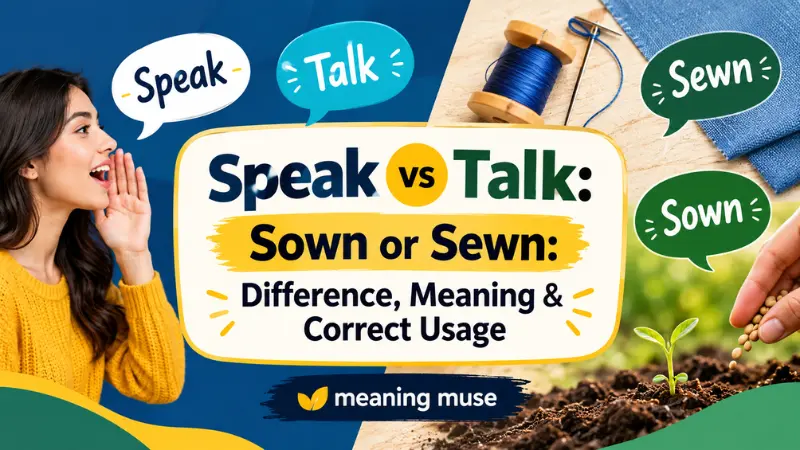
Sown or sewn? Both words are correct, but they are not interchangeable.
The difference is based on meaning:
- Sown comes from sow and usually relates to planting or spreading seeds.
- Sewn comes from sew and relates to joining or repairing something with thread and a needle.
The two words can sound alike when sow means “plant seeds” and sew means “join with thread.” That makes them easy to confuse when you hear them but much easier to separate when you look at the meaning.
Quick Answer
Use sown when you are talking about seeds, crops, or something that has been planted or spread.
The farmer had sown the seeds before the rain came.
Use sewn when you are talking about fabric, clothing, stitches, or something joined with thread.
The button had been sewn back onto the shirt.
Easy rule:
Sown = seeds.
Sewn = stitches.
Neither spelling is a “wrong version” of the other. They come from two different verbs.
Why People Confuse Them
The main reason is pronunciation.
The verb sow, when it means “to plant seeds,” is pronounced like “so.” The verb sew is also pronounced like “so.” Oxford and Cambridge both identify sow and sew as homophones in this sense.
That means you can hear:
The seeds were sown.
and:
The dress was sewn.
The words sound very similar, but the meanings are completely different.
There is another reason for confusion: sown and sewn are both past participles. Cambridge lists sown as the past participle of sow and sewn as the past participle of sew.
So the key is not pronunciation. The key is the action.
Key Differences At A Glance
| Context | Best Choice | Why |
|---|---|---|
| Planting seeds | sown | Sown is the past participle of sow. |
| Planting crops | sown | It describes seeds or crops being planted. |
| Spreading an idea or feeling | sown | Sow can also mean to cause or spread something such as doubt. |
| Joining fabric | sewn | Sewn comes from sew, meaning to join with thread. |
| Repairing clothing | sewn | The material is repaired with stitches. |
| Joining pieces of material | sewn | The pieces are connected by sewing. |
A Simple Memory Trick
Think:
SOWN → SOW → SEEDS
SEWN → SEW → THREAD
If you can connect the sentence to seeds, choose sown.
If you can connect it to stitches, choose sewn.
Are They the Same Word?
No.
Sown and sewn are not spelling variants of the same word. They are forms of two different verbs.
Sown is connected to sow, meaning to put seeds in or on the ground. Sow can also be used figuratively for causing something, such as doubt or confusion, to develop.
Sewn is connected to sew, meaning to join pieces of cloth or other material with thread and a needle.
They are therefore homophones in their relevant verb senses, not alternative spellings.
Their Main Difference
- sown → planting or spreading
- sewn → stitching or joining
For example:
The garden was sown with wildflower seeds.
The patch was sewn onto the jacket.
The spelling changes because the underlying verbs are different.
US vs UK Preference
For this pair, there is no meaningful US-versus-UK spelling choice.
American English uses sown and sewn according to their meanings, just as other major varieties of English do.
Cambridge’s American Dictionary entries list sown as the past participle of sow and sewn as the past participle of sew.
So a US writer should not choose between them based on nationality or regional spelling.
Instead, choose according to meaning:
Planting → sown
Stitching → sewn
This is an important difference from pairs such as color/colour or canceled/cancelled, where regional spelling conventions can matter.
Which Spelling Should You Use?
Use sown when the sentence comes from the verb sow.
Examples:
- The seeds were sown in early spring.
- The farmer had sown the field with wheat.
- The garden was sown with wildflowers.
- Seeds had already been sown before the storm.
Use sewn when the sentence comes from the verb sew.
Examples:
- The button was sewn onto the coat.
- The tear had been sewn closed.
- The pieces were carefully sewn together.
- The patch was sewn onto the backpack.
The best choice is determined by the action, not by US or UK spelling preference.
When One Spelling Looks Wrong
A useful test is to look at what comes immediately around the word.
If the sentence contains:
- seeds
- crops
- fields
- gardens
- wheat
- plants
then sown is usually the word you need.
If the sentence contains:
- fabric
- clothes
- thread
- needle
- button
- patch
- stitches
then sewn is usually the word you need.
Compare:
❌ The seeds were sewn in the garden.
✅ The seeds were sown in the garden.
And:
❌ The button was sown onto the shirt.
✅ The button was sewn onto the shirt.
The incorrect form may look believable because the words sound alike. The meaning reveals the error.
Common Mistakes (and Quick Fixes)
Mistake 1: Using “sewn” for seeds
❌ The farmer had sewn the corn seeds.
✅ The farmer had sown the corn seeds.
Fix: Seeds are sown.
Mistake 2: Using “sown” for clothing
❌ The patch was sown onto my jacket.
✅ The patch was sewn onto my jacket.
Fix: Fabric and patches are sewn.
Mistake 3: Choosing by sound
Both words can sound like “so.”
Do not decide from pronunciation alone.
Ask:
What action is happening?
- Planting → sown
- Stitching → sewn
Mistake 4: Treating them as spelling variants
Sown and sewn are not two spellings of one word.
They come from different verbs and carry different meanings.
Everyday Examples
Here are simple examples that show the difference in natural American English.
Examples with “sown”
- The seeds were sown in the backyard garden.
- The farmer had sown the wheat before the weather changed.
- Wildflower seeds were sown along the walking path.
- The garden had been sown with a mix of vegetables.
- The seeds were sown several weeks before planting season ended.
Examples with “sewn”
- She had sewn a button onto her jacket.
- The torn pocket was carefully sewn back together.
- The patch was sewn onto the child’s backpack.
- The costume was sewn by hand.
- The two pieces of fabric were sewn together.
Side-by-Side Example
The farmer had sown the seeds.
The tailor had sewn the fabric.
That one-letter difference changes the meaning because the words come from different verbs.
Dictionary-Style Word Details
Verb
- Sown: the past participle of sow. It refers to planting or spreading seeds and can also describe causing something to develop, such as doubt or confusion.
- Sewn: the past participle of sew. It refers to joining or repairing material with thread and a needle.
Both forms are verbs only through their connection to their respective base verbs.
Noun
- Sown: not normally used as a noun in standard US English.
- Sewn: not normally used as a noun in standard US English.
Both words are primarily used as verb forms, especially as past participles.
Synonyms
Because the words have different meanings, their closest plain alternatives are different.
- Sown: planted, scattered, spread
- Sewn: stitched, joined, stitched together
These alternatives depend on the specific sentence.
For example:
The seeds were sown.
can become:
The seeds were planted.
But:
The button was sewn onto the shirt.
can become:
The button was stitched onto the shirt.
Example Sentences
Sown:
The seeds had been sown before the first spring rain.
The farmer sowed the field, and the seeds were later sown across several rows.
Sewn:
The torn sleeve had been sewn back together.
The label was sewn into the inside of the jacket.
Word History
The two words have separate histories because they come from separate verbs.
Oxford traces sow to Old English sāwan and identifies it as a word of Germanic origin. Its modern verb forms include sowed and sown.
Sewn belongs to the verb sew, whose meaning involves joining material with needle and thread. Cambridge lists sewed and sewn as forms of sew.
The important point for modern writers is that these forms developed from different verbs. Their similar pronunciation does not make them interchangeable.
Phrases Containing
Common phrases with sown include:
- sown seeds
- sown in the field
- sown in the spring
- sown with wheat
- reap what you have sown
- sow the seeds of something
Common phrases with sewn include:
- sewn together
- sewn onto
- sewn by hand
- sewn into fabric
- sewn shut
- sewn up
The phrase “sewn up” can also have a figurative meaning, such as having something secured or settled.
FAQs
Is it sown or sewn?
Both sown and sewn are correct, but they have different meanings. Use sown for planting or spreading seeds. Use sewn for joining or repairing something with thread.
What is the difference between sown and sewn?
Sown comes from sow and relates to planting seeds. Sewn comes from sew and relates to joining material with stitches.
Is “sown” correct for seeds?
Yes. Sown is the correct word when talking about seeds that have been planted or spread.
Example: The seeds were sown in the garden.
Is “sewn” correct for clothes?
Yes. Sewn is used when something is joined, repaired, or attached with thread.
Example: The button was sewn onto the shirt.
Are sown and sewn pronounced the same?
In their relevant meanings, sown and sewn are commonly pronounced the same. They are therefore easy to confuse when heard aloud.
Is sown American or British English?
Sown is used in both American and British English. It is the past participle of sow.
Is sewn American or British English?
Sewn is also used in both American and British English. It is the past participle of sew.
Can I use sown and sewn interchangeably?
No. They are not interchangeable because they come from different verbs and have different meanings.
Sown = planted or spread.
Sewn = stitched or joined.
What is the easiest way to remember sown vs sewn?
Use this simple memory trick:
SOWN → SEEDS
SEWN → STITCHES
If you are talking about planting, choose sown. If you are talking about sewing, choose sewn.
What is the past tense of sow?
The past tense of sow is usually sowed. Its past participle can be sown or, in some contexts, sowed.
Example: She sowed the seeds in April.
What is the past participle of sew?
Sewn is a standard past participle of sew.
Example: The dress was sewn by hand.
Is “sown” a spelling variant of “sewn”?
No. Sown and sewn are different words with different meanings. Their similar pronunciation is what often causes confusion.
Which is correct: “seeds were sown” or “seeds were sewn”?
The correct phrase is “seeds were sown.”
Example: The flower seeds were sown in early spring.
Which is correct: “the shirt was sown” or “the shirt was sewn”?
The correct phrase is “the shirt was sewn.”
Example: The shirt was sewn by hand.
Conclusion
Sown and sewn are both correct words, but they are not interchangeable.
Use sown when you mean planted or spread, especially in connection with seeds:
The seeds were sown in the garden.
Use sewn when you mean joined or repaired with stitches:
The tear was sewn closed.
The easiest way to remember the difference is:
SOWN = SEEDS
SEWN = STITCHES
For American English writing, there is no US-versus-UK spelling rule that decides between these two. Meaning decides the spelling.