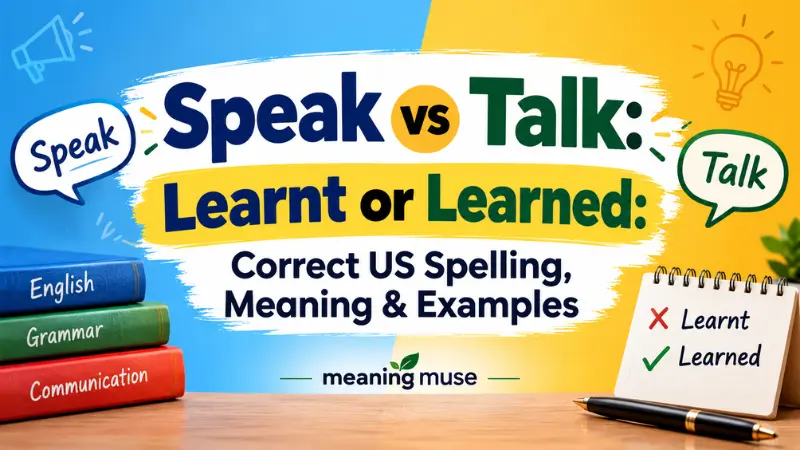
Learnt or learned? Both forms are correct past forms of the verb learn, but they are used differently across English varieties.
For a US audience, learned is the standard and usual choice. Learnt is strongly associated with British English and is also used in other varieties of English.
The meaning is the same when the words are used as the past tense or past participle of learn. The main difference is regional preference.
For example:
I learned something new today.
In British English, you may also see:
I learnt something new today.
Both sentences mean the same thing.
Quick Answer
Learned is the preferred form in American English.
Learnt is also a correct English form, but it is especially associated with British English.
Use:
- learned for standard US English
- learnt when following British English or a style that uses it
Examples:
She learned how to drive when she was sixteen.
He learned a valuable lesson from the experience.
British English may use:
She learnt how to drive when she was sixteen.
He learnt a valuable lesson from the experience.
So, if you are writing for a general US audience, learned is the natural choice.
Why People Confuse Them
The confusion comes from the fact that English has more than one accepted past form of learn.
The present form is simple:
I learn every day.
The past forms can be:
I learned yesterday.
or:
I learnt yesterday.
Cambridge lists learned as the US form and learnt as the UK form. Oxford also lists both forms and identifies learnt as especially British.
The two forms do not normally represent different meanings. Instead, they reflect different regional habits.
This is similar to other English verbs that have different past forms in different varieties.
Key Differences At A Glance
| Context | Best Choice | Why |
|---|---|---|
| Standard US English | learned | This is the normal American form |
| British English | learnt or learned | Both forms are used |
| US school writing | learned | Fits standard American usage |
| US business writing | learned | Natural for American readers |
| British-focused writing | learnt can fit | Common British form |
| Past tense of learn | learned / learnt | Both are accepted forms |
| Past participle of learn | learned / learnt | Both can serve this role |
Simple Comparison
- Learned: usual US English form
- Learnt: especially associated with British English
- Meaning: the same when both are past forms of learn
- Grammar: both can be the past tense and past participle
- US choice: learned
Are They the Same Word?
Yes. Learned and learnt are two accepted forms of the verb learn when used as its past tense or past participle.
They do not describe two different actions.
I learned the answer yesterday.
and
I learnt the answer yesterday.
Both describe gaining knowledge in the past.
The difference is mainly regional.
There is one useful extra point: learned can also function as an adjective. For example:
She is a learned professor.
Here, learned means highly educated or knowledgeable. This adjective use is separate from the ordinary past-tense form.
The adjective learned can also have a different pronunciation from the past-tense form. That distinction does not apply to learnt in the same way.
US vs UK Preference
The clearest practical difference is regional.
American English
American English normally uses learned as the past simple and past participle of learn.
Examples:
I learned a lot from that class.
We learned how to use the new software.
She has learned several useful skills.
They learned from their mistakes.
British English
British English commonly uses learnt, although learned is also used.
Examples:
I learnt a lot from that class.
We learnt how to use the new software.
She has learnt several useful skills.
They learnt from their mistakes.
This means the simple rule “learned is American and learnt is British” is useful for quick guidance, but it should not be treated as an absolute rule. Both forms occur in British English, while learned is the normal choice for US English.
Which Spelling Should You Use?
If your audience is in the United States, choose learned.
This applies to:
- school assignments
- college writing
- business writing
- websites for US readers
- general American communication
- reports and professional documents
Examples:
I learned how to use the program.
The students learned the new formula.
We learned several important lessons.
She learned the skill through practice.
For a British-English audience, learnt may be the more natural regional choice.
The most important point is consistency. If you are writing a US-focused article, use learned throughout when you mean the past tense or past participle.
When One Spelling Looks Wrong
Learnt can look unusual to an American reader, but that does not make it an invalid English word.
For example:
I learnt something important today.
This is a valid sentence, but I learned something important today will sound more natural to most US readers.
On the other hand, learned is not limited to American English. British English also uses it.
So avoid this false rule:
“Learnt is wrong.”
A better rule is:
Learnt is a valid form, especially associated with British English. Learned is the normal form for American English.
Example
For a US audience:
We learned about the new policy yesterday.
For a British-English audience:
We learnt about the new policy yesterday.
The meaning stays the same.
Common Mistakes (and Quick Fixes)
Mistake 1: Calling “learnt” incorrect
❌ Learnt is always wrong.
✅ Learnt is a valid past form of learn, especially associated with British English.
Mistake 2: Using “learnted”
❌ I learnted the lesson.
✅ I learned the lesson.
or:
✅ I learnt the lesson.
Do not combine learnt with another past-tense ending.
Mistake 3: Using “learned” and “learnt” randomly
If you are writing for a US audience, switching between the two forms without a reason can make the writing look inconsistent.
For US English, choose learned and use it consistently.
Mistake 4: Thinking the words have different basic meanings
❌ Learned means one thing, while learnt means another.
✅ As past forms of learn, they have the same basic meaning. The main difference is regional usage.
Mistake 5: Forgetting the adjective “learned”
Learned has another important use:
She is a learned professor.
Here, learned means knowledgeable or highly educated.
This adjective is not simply another past-tense example.
Everyday Examples
Past tense
I learned something new at work yesterday.
She learned to play the guitar as a child.
We learned the answer after checking the records.
He learned an important lesson from the mistake.
Past participle
I have learned a lot from this experience.
She has learned how to manage the project.
They had learned the rules before the game started.
We have learned that preparation matters.
British-style examples with “learnt”
I learnt something new at work yesterday.
She learnt to play the guitar as a child.
We learnt the answer after checking the records.
He learnt an important lesson from the mistake.
The meaning does not change. The form reflects the variety of English being used.
Dictionary-Style Word Details
Verb
- Learned: the standard US past simple and past participle form of learn.
- Learnt: an accepted past simple and past participle form of learn, especially associated with British English.
Examples:
I learned the answer.
I learnt the answer.
Both use the past form of the same verb.
Noun
- Learned: not a noun when used as the past form of learn. It can function as an adjective in other contexts.
- Learnt: not a noun. It functions as a past simple or past participle form of learn.
The noun related to the process of gaining knowledge is learning, not either of these two forms.
Synonyms
When learned and learnt mean “gained knowledge or skill,” useful closest plain alternatives can include:
- discovered
- understood
- mastered
- acquired knowledge of
- found out
The best alternative depends on the sentence.
For example:
She learned the answer.
can sometimes become:
She found out the answer.
But learned and found out are not exact replacements in every context.
Example Sentences
Learned:
I learned how to use the new software.
She learned an important lesson from the experience.
We have learned a great deal this year.
Learnt:
I learnt how to use the new software.
She learnt an important lesson from the experience.
We have learnt a great deal this year.
For American English, use learned in these examples.
Word History
Learn comes from Old English and has a long history in English. Oxford traces the verb to Old English leornian and notes its West Germanic connections.
The different past forms reflect the history of English verb patterns. Modern English continues to use both learned and learnt, with different regional preferences.
For today’s US writing, the important point is simple: learned is the normal American form, while learnt is especially associated with British English.
Phrases Containing
Common phrases using learned include:
- learned a lesson
- learned the hard way
- learned from experience
- learned from a mistake
- learned how to
- have learned
- had learned
The same phrases can use learnt in varieties that prefer that form:
- learnt a lesson
- learnt the hard way
- learnt from experience
- learnt from a mistake
- learnt how to
- have learnt
- had learnt
The phrase structure and meaning remain the same; the past form changes according to regional preference.
FAQs
Is it “learnt” or “learned”?
Both learnt and learned are correct past forms of the verb learn. For American English, learned is the standard and more usual choice.
Is “learnt” correct in American English?
Yes, learnt is a valid English form, but it is much more closely associated with British English. In standard US writing, learned is normally preferred.
Is “learned” American or British?
Learned is the standard form in American English, but it is also used in British English. British English commonly uses both learned and learnt.
What is the difference between “learnt” and “learned”?
When they are used as past forms of learn, they have the same basic meaning. The main difference is regional preference: learned is usual in US English, while learnt is especially common in British English.
Which is correct in the USA: “learnt” or “learned”?
For a US audience, learned is the preferred choice.
Example: “I learned a lot from the experience.”
Can I use “learnt” in a US English article?
You can, because learnt is a valid English form. However, if your article is written specifically for American readers, learned will usually sound more natural and consistent.
Is “learnt” grammatically correct?
Yes. Learnt is a grammatically correct past simple and past participle form of learn. Its use is especially common in British English.
Is “learned” the past tense of “learn”?
Yes. Learned is the standard past tense and past participle form of learn in American English.
Example: “She learned the answer yesterday.”
Can “learnt” and “learned” be used interchangeably?
They can often be substituted when they are used as the past form of learn, because their basic meaning is the same. However, regional style may favor one form over the other.
Why do British English speakers use “learnt”?
Learnt is an established form of the verb learn and is especially common in British English. American English generally favors learned instead.
Is “learned” ever an adjective?
Yes. Learned can also be an adjective meaning highly educated or knowledgeable.
Example: “She is a learned scholar.”
This adjective use is different from the ordinary past form of learn.
What is the easiest way to remember “learnt” vs “learned”?
Learned = standard American choice.
Learnt = especially British choice.
If you are writing for American readers, learned is usually the safest choice.
Conclusion
Learnt or learned? Both are correct forms of the verb learn, but learned is the standard choice for American English.
Use learned when writing for a US audience:
I learned something new today.
Use learnt when following British English or another variety that commonly uses that form:
I learnt something new today.
The meaning is the same when they function as the past tense or past participle of learn. The main difference is regional usage.
For your US-focused writing, the simple rule is:
Choose “learned.”