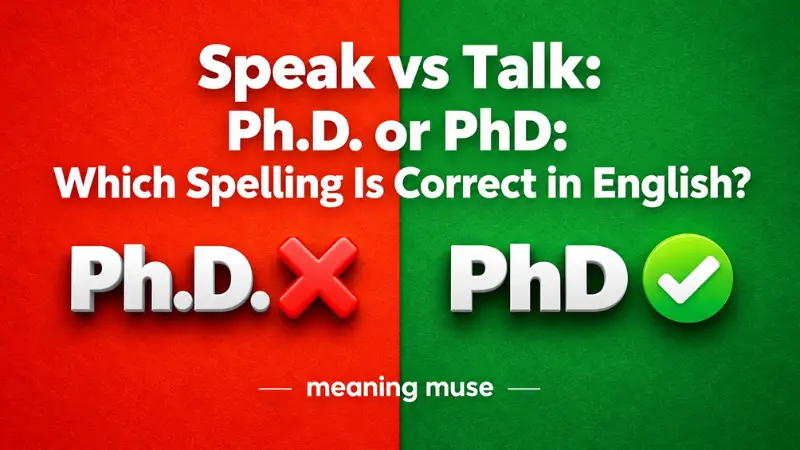
Ph.d. or phd is a common formatting question for students, researchers, teachers, and professional writers.
The standard forms are Ph.D. and PhD. Both refer to Doctor of Philosophy, the academic degree.
The main difference is not meaning. It is the way the abbreviation is written. Some writing styles use periods, while others leave them out.
For US English, the best choice depends on the style guide, school, publisher, workplace, or publication you are following.
Quick Answer
Ph.D. and PhD are both accepted forms of the abbreviation for Doctor of Philosophy.
Ph.D. uses periods after the abbreviated letters.
PhD does not use periods.
If your school, employer, publisher, or journal has a style guide, follow that guide. If no specific style is required, choose one form and use it consistently.
For example:
- She earned a Ph.D. in biology.
- She earned a PhD in biology.
Both sentences communicate the same basic information.
Why People Confuse Them
People often wonder whether the periods in Ph.D. are required.
They are not universally required. Academic abbreviations can be formatted differently depending on the style being followed.
Some American publications and institutions prefer abbreviations without periods, such as PhD. Others continue to use forms such as Ph.D.
This creates confusion because readers may see both forms in professional and academic writing.
The important point is simple: the presence or absence of periods does not create a different degree.
Key Differences At A Glance
| Context | Best Choice | Why |
|---|---|---|
| A style guide specifies PhD | PhD | Follow the required house style |
| A style guide specifies Ph.D. | Ph.D. | Follow the required punctuation |
| Academic credential after a name | PhD or Ph.D. | Depends on the institution or style |
| General academic writing | Either | Consistency matters |
| Mixed documents | Choose one | Avoid inconsistent formatting |
Quick comparison:
- Ph.D. — abbreviation with periods
- PhD — abbreviation without periods
- Meaning — the same
- Pronunciation — normally the same
- Main difference — punctuation/style
Are They the Same Word?
Yes, Ph.D. and PhD represent the same academic degree.
The abbreviation stands for Doctor of Philosophy.
It does not mean that one form represents a different level of education.
For example:
Maria earned a Ph.D. in chemistry.
and
Maria earned a PhD in chemistry.
Both refer to the same type of doctoral degree.
The difference is simply how the abbreviation is punctuated.
The abbreviation is pronounced as the individual letters: “P-H-D.”
US vs UK Preference
Both PhD and Ph.D. appear in English-language academic writing.
Cambridge recognizes PhD as well as the American Ph.D. form.
In modern US academic and institutional writing, PhD without periods is widely used. Some American institutions and publications still prefer Ph.D., especially in particular editorial contexts.
So it is better not to treat one form as universally correct and the other as wrong.
Instead, check the style required by the publication or institution.
Which Spelling Should You Use?
If you are writing for a US audience and no specific style guide has been provided, PhD is a practical modern choice.
For example:
James completed his PhD in computer science.
However, Ph.D. is also acceptable when that is the established style.
For example:
James completed his Ph.D. in computer science.
If you are submitting a paper, dissertation, application, résumé, or article, check the instructions first.
Consistency is more important than switching between forms randomly.
If you begin with PhD, continue using PhD throughout the document unless a specific context requires another format.
When One Spelling Looks Wrong
A form can look wrong when it does not match the style used by the surrounding text.
For example, imagine a university document uses:
BA, MA, PhD
Writing:
BA, MA, Ph.D.
may look inconsistent with that document’s style.
Likewise, if a publication consistently uses:
B.A., M.A., Ph.D.
suddenly changing to:
PhD
may look out of place.
That does not necessarily mean the form is grammatically incorrect. It may simply fail to match the publication’s preferred style.
The key question is not always “Which one is correct?”
Often, the better question is:
“Which form does this publication or institution use?”
Common Mistakes (and Quick Fixes)
Mistake 1: Treating PhD as a different degree
Wrong idea: PhD and Ph.D. represent different qualifications.
Fix: They are two punctuation styles for the same degree abbreviation.
Mistake 2: Mixing both forms
She earned a PhD, but her résumé says Ph.D.
Fix: Pick the form required by your style guide and use it consistently.
Mistake 3: Writing ph.d. in normal academic usage
The standard abbreviation is normally written with capital letters:
Ph.D. or PhD
not:
ph.d.
Mistake 4: Adding an unnecessary apostrophe to the plural
Avoid:
Ph.D.’s
For plural use, follow the chosen style, such as PhDs or Ph.D.s.
Mistake 5: Assuming periods are always required
Periods depend on the style being followed. They are not an absolute requirement in every English-language publication.
Everyday Examples
Here are simple examples of both forms:
- She earned a PhD in psychology.
- She earned a Ph.D. in psychology.
- Dr. Lee has a PhD in physics.
- Dr. Lee has a Ph.D. in physics.
- He is working toward a PhD in history.
- He is working toward a Ph.D. in history.
- Her PhD research focuses on education.
- Her Ph.D. research focuses on education.
FAQs
Is Ph.D. or PhD correct?
Both forms are accepted. The preferred form depends on the style guide or publication.
Is PhD more correct than Ph.D.?
No. Neither is universally more correct. Different institutions and publications use different conventions.
Should I use PhD in American English?
PhD is a common modern US form, but Ph.D. is also used. Follow the style required by your institution or publication.
Can I write PhD after a person’s name?
Yes. A doctoral credential can appear after a person’s name, subject to the applicable style.
Should PhD have periods?
Not necessarily. PhD has no periods, while Ph.D. uses periods.
Does PhD mean Doctor of Philosophy?
Yes. PhD is an abbreviation for Doctor of Philosophy.
Are PhD and Ph.D. pronounced differently?
Normally, no. Both are pronounced by saying the letters P-H-D.
Dictionary-Style Word Details
Verb
Ph.D. — Not a verb. It is an abbreviation for an academic degree.
PhD — Not a verb. It is the same academic-degree abbreviation without periods.
Noun
Ph.D. — A noun abbreviation referring to a Doctor of Philosophy degree or, in some contexts, a person who holds that degree.
PhD — The same noun abbreviation, written without periods.
For example:
She has a PhD in economics.
Synonyms
Neither spelling has a separate synonym because Ph.D. and PhD represent the same degree.
Closest plain alternatives include:
- doctorate
- doctoral degree
- Doctor of Philosophy
These alternatives are not identical in every sentence, so choose the wording that fits your context.
Example Sentences
Ph.D.:
Michael earned his Ph.D. in engineering.
PhD:
Michael earned his PhD in engineering.
Both examples communicate the same basic information.
Word History
PhD comes from the abbreviation of Doctor of Philosophy, traditionally derived from the Latin expression Philosophiae Doctor.
Major dictionaries recognize both PhD and Ph.D. as abbreviations for Doctor of Philosophy.
The important modern difference for writers is the punctuation rather than the meaning.
Phrases Containing
Common phrases include:
- PhD student
- PhD program
- PhD candidate
- PhD thesis
- PhD research
- Ph.D. student
- Ph.D. program
- Ph.D. candidate
- Ph.D. thesis
- Ph.D. research
Choose the version that matches the style of the document.
Conclusion
Ph.D. or PhD? Both forms are accepted for Doctor of Philosophy.
The difference is mainly punctuation and style. PhD is widely used in modern academic and professional writing, while Ph.D. remains an accepted form.
For US English, do not assume that one form is always wrong. Instead, check the relevant style guide and stay consistent.
The easiest rule is: