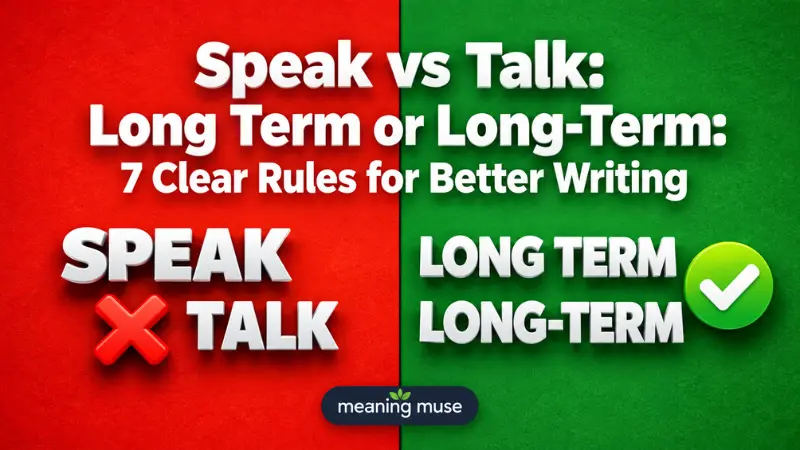
Long term or long-term is a common English usage question. The two forms are closely related, but they do not normally serve the same grammatical function.
The simple rule is easy:
- long-term is normally used before a noun as a compound adjective.
- long term is normally used as a noun phrase when referring to an extended period.
For example:
We need a long-term plan.
But:
We are planning for the long term.
Both forms are standard. The hyphen depends on how the phrase functions in the sentence, not on American versus British spelling.
Cambridge lists long-term as an adjective meaning continuing far into the future, while its Business English entry also lists long term as a noun.
Quick Answer
Use long-term when the phrase directly describes a noun.
Example:
She has a long-term goal.
Use long term when the phrase refers to an extended period by itself.
Example:
She is planning for the long term.
A useful memory rule is:
Before a noun → usually long-term.
As a period of time → usually long term.
This distinction is supported by usage guidance from the Washington State Office of Financial Management and Cambridge Dictionary.
Why People Confuse Them
The confusion is understandable because the words have the same basic idea.
Both forms relate to something that continues or matters over an extended period. The only visible difference is the hyphen.
That small mark changes how the words work together.
Compare:
They made a long-term investment.
Here, long-term describes the noun investment.
Now compare:
They are investing for the long term.
Here, long term refers to the future period itself.
Because both sentences discuss the same general idea, writers often use the two forms interchangeably. In polished writing, however, the grammatical role should guide the choice.
Key Differences At A Glance
| Context | Best Choice | Why |
|---|---|---|
| Before a noun | long-term | It works as a compound adjective |
| After “the” | long term | It functions as a noun phrase |
| “In the ___” | long term | It refers to a period |
| “A ___ plan” | long-term | It describes the plan |
| “For the ___” | long term | It names an extended period |
| “___ effects” | long-term | It modifies “effects” |
Quick comparison:
- long-term = descriptive form
- long term = period of time
- longterm = not the standard form in ordinary edited English
Are They the Same Word?
They are closely related forms built from the same two words, but their grammatical roles differ.
Long-term works as a compound adjective. It describes something that continues, exists, or has an effect over a long period.
The company needs a long-term strategy.
Long term is commonly used as a noun phrase.
The company is thinking about the long term.
So the difference is mainly about hyphenation and grammatical function, rather than a completely different meaning.
Cambridge’s entries support this distinction by listing long-term as an adjective and long term as a noun in Business English.
US vs UK Preference
There is no major US-versus-UK spelling difference here.
American and British English both use long-term as a compound adjective and long term in noun-phrase constructions.
For example, both varieties can use:
a long-term agreement
and:
planning for the long term
Cambridge gives long-term in both its US and UK dictionary information.
This means you should not treat the hyphen as an American spelling choice or a British spelling choice. It is primarily a matter of grammatical function and sentence structure.
Which Spelling Should You Use?
For American English, use the same basic rule:
Use long-term before a noun when the two words work together as one description.
Examples:
- long-term plan
- long-term goal
- long-term contract
- long-term investment
- long-term solution
- long-term effects
Use long term when you are referring to the period itself.
Examples:
- in the long term
- over the long term
- for the long term
- think about the long term
If you remember only one rule, remember this:
A noun follows? Use long-term. A period is being discussed? Use long term.
When One Spelling Looks Wrong
The wrong form often becomes obvious when you look at the word that follows.
Consider:
We need a long-term solution.
The phrase long-term directly describes solution, so the hyphen makes the relationship clear.
Now consider:
This decision will help us in the long term.
Here, long term does not directly describe another noun. It refers to a future period.
A common error is:
We need a long term solution.
In careful writing, long-term solution is preferable because the two words form a compound modifier before the noun.
Another common error is:
It will help us in the long-term.
The usual form is:
It will help us in the long term.
Common Mistakes
Mistake 1: Writing “long term” before a noun
Incorrect or less polished:
We need a long term strategy.
Better:
We need a long-term strategy.
Mistake 2: Adding the hyphen after “the”
Incorrect in the usual construction:
We are planning for the long-term.
Better:
We are planning for the long term.
Mistake 3: Writing “longterm”
Avoid:
longterm planning
Use:
long-term planning
The standard forms are long term and long-term, depending on function.
Mistake 4: Treating the hyphen as optional everywhere
The hyphen is not simply a decoration. It helps show that two words work together as a single modifier before a noun.
Everyday Examples
Here are natural examples for American English:
- She has a long-term goal of buying a home.
- We need a long-term solution to the problem.
- The company signed a long-term contract.
- They are making a long-term investment.
- This decision may benefit the community in the long term.
- We need to think about the long term.
- The new policy could produce long-term effects.
- He is saving money for the long term.
- They developed a long-term plan for the business.
- Small changes can make a difference over the long term.
Notice the pattern: when the phrase comes before and describes a noun, the hyphen is normally used. When the phrase refers to the period itself, it is normally open.
Dictionary-Style Word Details
Verb
Neither long term nor long-term is primarily a verb.
The standard uses relevant to this comparison are noun and adjective functions.
Noun
Long term can function as a noun phrase referring to an extended period, especially a future period.
Examples include:
in the long term
for the long term
over the long term
Cambridge identifies long term as a noun in its Business English entry.
Long-term is normally an adjective rather than a noun in the standard usage covered here.
Synonyms
Exact replacements depend on the sentence.
For long-term, close alternatives can include:
- lasting
- extended
- prolonged
- long-lasting
Merriam-Webster lists several related words, including long, lengthy, extended, and prolonged.
For long term, a close plain alternative is:
- the long run
For example:
It should help in the long run.
However, the alternatives do not always fit every sentence exactly.
Example Sentences
Long-term:
The hospital developed a long-term care plan.
She is working toward a long-term career goal.
Long term:
The change should save money in the long term.
We need to consider the long term before making a decision.
Word History
The important point for modern writers is not a separate history for each form, but how the hyphenated and open forms are used today.
Current dictionary and style references distinguish long-term as an adjective from long term as a noun phrase. Cambridge provides both uses, while the Washington State Office of Financial Management gives the same practical distinction.
Phrases Containing
Common expressions with long-term include:
- long-term plan
- long-term goal
- long-term care
- long-term effects
- long-term investment
- long-term contract
- long-term solution
Common expressions with long term include:
- in the long term
- over the long term
- for the long term
- think about the long term
- plan for the long term
FAQs
Is long term or long-term correct?
Both forms are correct, but they are used differently. Use long-term when it works as a compound adjective before a noun and long term when it functions as a noun phrase.
Is long-term always hyphenated?
No. The hyphen is normally used when long-term functions as a compound adjective, especially before a noun. The phrase is usually written long term when it refers to a period of time by itself.
Should I write “in the long term” or “in the long-term”?
Write in the long term. Here, the phrase refers to an extended period and does not directly modify a following noun.
Is “long term” one word?
No. In standard English, it is either long term as two separate words or long-term with a hyphen when it functions as a compound adjective.
Is long-term used in American English?
Yes. Long-term is standard American English. Cambridge’s American Dictionary lists it as an adjective meaning continuing for many years or far into the future.
Which is correct: long-term goal or long term goal?
Long-term goal is the standard choice. The two words work together to describe the noun goal, so the hyphen helps connect them.
Is “longterm” correct?
Longterm is not the standard form for ordinary edited English. Use long-term when the phrase is a compound adjective and long term when it is used as a noun phrase.
Conclusion
The choice between long term or long-term is mainly about how the phrase functions in a sentence.
Use long-term when it directly describes a noun:
a long-term plan
Use long term when you refer to an extended period:
in the long term
The easiest rule is:
Before a noun → long-term.
As a period of time → long term.
Both forms are standard in American English, so you do not need to choose between them based on US or UK spelling. Instead, look at the sentence and decide whether the phrase is describing a noun or naming a period of time.
Suggested Internal Links
- Affect vs Effect →
/affect-vs-effect/ - Analyse vs Analyze →
/analyse-vs-analyze/ - Amicable vs Amiable →
/amicable-vs-amiable/ - Brooch vs Broach →
/brooch-vs-broach/ - Waive vs Wave →
/waive-vs-wave/
Sources
- Cambridge Dictionary — long-term
- Merriam-Webster — long-term
- Washington State Office of Financial Management Style Guide — long-term vs. long term
- Scribbr — Hyphen Rules