Should you write ingage or engage?
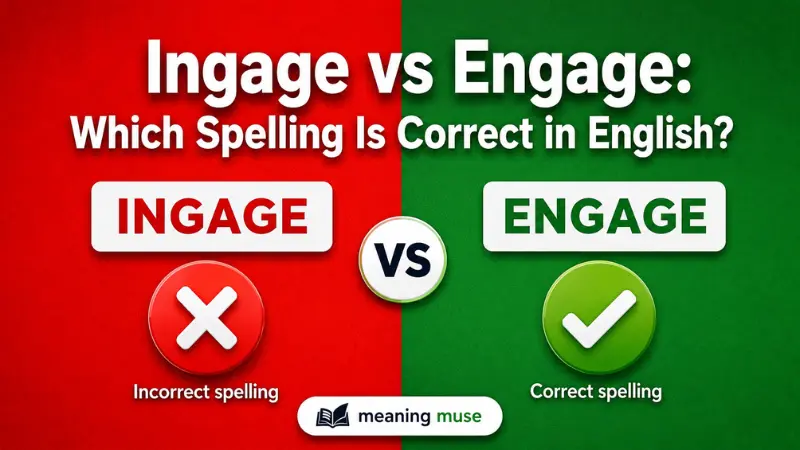
In modern English, engage is the correct spelling. It is a common verb used when someone becomes involved, holds another person’s attention, takes part in an activity, hires a worker, or connects part of a machine.
Ingage is not the normal spelling today. It appeared as an older spelling of engage, but modern readers may see it as a spelling error.
Use engage in schoolwork, emails, business writing, website content, social posts, and daily messages.
This guide explains the spelling difference, the meaning of engage, its common forms, and the mistakes writers should avoid.
Quick Answer
Engage is the correct spelling in modern English. Ingage is an obsolete spelling and should not be used in normal writing.
Correct:
Good teachers engage their students.
Incorrect in modern English:
Good teachers ingage their students.
The easiest rule is:
Always use engage unless you are quoting an old historical text.
Engage is correct in both American and British English.
Why People Confuse Them
People often confuse these spellings because engage begins with a sound that may seem close to “in.”
The word is pronounced:
en-GAYJ
When people spell a word by sound, they may write ingage. This is more common among young learners and people who have heard the word but have not seen it written often.
The ending can also cause confusion. Writers may try forms such as:
- ingage
- engadge
- engauge
- engaje
The correct spelling is:
e-n-g-a-g-e
Another reason for the confusion is that ingage did appear in older English writing. However, a historical form is not always suitable for present-day use.
Modern English has settled on engage.
Key Differences At A Glance
| Context | Best Choice | Why |
|---|---|---|
| Modern American English | engage | Standard spelling |
| Modern British English | engage | Standard spelling |
| School assignment | engage | Correct and expected |
| Business email | engage | Clear and professional |
| Website or social post | engage | Normal modern form |
| Historical quotation | ingage may appear | Preserve the original wording |
| Everyday sentence | engage | Ingage looks misspelled |
Compact comparison:
- Engage: correct modern spelling
- Ingage: obsolete historical spelling
- Meaning today: use engage for all normal meanings
- Part of speech: mainly a verb
- Pronunciation: en-GAYJ
- Best choice: engage
Are They the Same Word?
Historically, ingage and engage referred to the same word. Older writers sometimes used ingage, but that spelling is now obsolete.
That means ingage is not a modern regional option like color and colour. It is also not a casual alternative that writers can freely choose.
Today, only engage is appropriate in standard writing.
Engage has several related meanings.
It can mean to attract and hold attention:
The colorful book engaged the children.
It can mean to involve someone in an activity:
The coach engaged the team in a short practice drill.
It can mean to take part in something:
Students engaged in a class discussion.
It can mean to hire someone:
The family engaged a lawyer.
It can also describe machine parts connecting:
Press the pedal to engage the clutch.
In each meaning, the spelling stays engage.
Pronunciation
Engage is pronounced:
en-GAYJ
The first part sounds like en, not a clear in. The second part rhymes with page.
The related forms keep the same basic sound:
- engaged
- engages
- engaging
- engagement
US vs UK Preference
There is no modern American-versus-British spelling difference.
Both varieties use:
engage
American English:
The lesson should engage every student.
British English:
The lesson should engage every student.
The spelling does not change.
Ingage should not be treated as a normal British form. It is an old spelling that may appear in historical writing, scanned books, old letters, or quotations.
For a modern US audience, use engage every time.
Which Spelling Should You Use?
Use engage in all normal modern writing.
Choose engage when you mean to hold attention:
The speaker used a story to engage the audience.
Choose engage when you mean to involve someone:
We engaged the children in a simple game.
Choose engage when you mean to take part:
The students engaged in a friendly debate.
Choose engage when you mean to hire a person or service:
The company engaged a design firm.
Choose engage when parts connect:
The gears will not engage.
Choose engage when people enter a discussion or deal with an issue:
The mayor agreed to engage with local residents.
You should use ingage only when copying the exact spelling from an old source.
For example:
The letter used the old spelling “ingage.”
In that sentence, you are discussing or quoting the historical spelling. You are not using it as the modern verb.
When One Spelling Looks Wrong
In modern writing, ingage usually looks wrong.
It may lower trust in a:
- resume
- school essay
- business proposal
- customer email
- news article
- blog post
- product page
- social caption
For example:
Incorrect:
We want to ingage more customers.
Correct:
We want to engage more customers.
The corrected sentence looks natural and professional.
When ingage may be acceptable
Ingage may appear in an exact historical quotation:
The old document says the leader would “ingage” more workers.
It may also appear in a historical discussion:
Ingage was once used as a spelling of engage.
In these cases, quotation marks or clear context help readers understand that the older form is intentional.
Proper names
A company, app, product, or username may use unusual spelling as part of a proper name. Keep that spelling only when referring to the official name.
That special use does not make ingage correct in an ordinary sentence.
Common Mistakes (and Quick Fixes)
Mistake 1: Writing ingage by sound
Incorrect:
The video will ingage young viewers.
Correct:
The video will engage young viewers.
Quick fix: Remember that the word begins with en-.
Mistake 2: Writing engage with an extra letter
Incorrect:
engauge
Correct:
engage
The word does not contain the letter u.
Mistake 3: Dropping the final e in the base form
Incorrect:
eng ag
Correct:
engage
The base verb ends in -ge.
Mistake 4: Adding the suffix incorrectly
Incorrect:
engageing
Correct:
engaging
When adding -ing, remove the final silent e:
engage → engaging
Mistake 5: Misspelling the past form
Incorrect:
ingaged
Correct:
engaged
Add -d to engage:
engage → engaged
Mistake 6: Confusing engaged with married
Engaged can mean promised to marry, but that is only one meaning.
Maya and Luis are engaged.
It can also mean involved or busy:
The workers are engaged in training.
The sentence tells you which meaning applies.
Mistake 7: Using engage without the right preposition
Use engage in for taking part in an activity:
The class engaged in a discussion.
Use engage with for becoming involved with a person, issue, or idea:
The teacher engaged with the students.
Use engage someone in when you involve another person:
She engaged him in conversation.
Everyday Examples
Here are natural examples for modern American English:
The teacher used pictures to engage the class.
A strong opening can engage the reader.
We should engage customers through helpful answers.
The children engaged in a science activity.
She tried to engage her brother in conversation.
The company engaged a lawyer to review the contract.
The new program will engage local families.
Great stories engage both children and adults.
The gears did not engage properly.
He engaged the parking brake before leaving the car.
The group refused to engage in the argument.
Our team needs to engage with customer concerns.
The game kept everyone engaged for an hour.
Her engaging smile made visitors feel welcome.
The couple became engaged last spring.
Incorrect and correct examples
Incorrect:
The lesson did not ingage the students.
Correct:
The lesson did not engage the students.
Incorrect:
We ingaged a photographer for the event.
Correct:
We engaged a photographer for the event.
Incorrect:
He is engageing with the audience.
Correct:
He is engaging with the audience.
Incorrect:
The players were ingaged in practice.
Correct:
The players were engaged in practice.
Engage in vs engage with
Use engage in before an activity:
They engaged in volunteer work.
Use engage with before a person, group, subject, or problem:
They engaged with the local community.
The report engages with an important question.
Engage vs involve
Engage and involve can sometimes express similar ideas.
The teacher engaged the students in the lesson.
The teacher involved the students in the lesson.
Engage often suggests active attention or interest. Involve focuses more on taking part.
Dictionary-Style Word Details
Verb
Engage: A standard verb with several uses. It can mean to attract attention, involve someone, take part, hire a person, enter a conflict, or connect machine parts.
Examples:
The story engaged the reader.
We engaged a plumber.
The gears engaged smoothly.
Ingage: An obsolete spelling of engage. It is not recommended as a verb in modern American English.
Noun
Engage: Engage is not normally used as a noun. The related noun is engagement.
The event increased student engagement.
They announced their engagement.
I have a dinner engagement tonight.
Ingage: It is not used as a standard modern noun.
Do not write:
The class showed strong ingage.
Write:
The class showed strong engagement.
Synonyms
The best synonym depends on the meaning.
When engage means attract attention, close alternatives include:
- interest
- attract
- hold
- captivate
- absorb
When engage means involve, alternatives include:
- involve
- include
- occupy
- bring in
- draw in
When engage means take part, alternatives include:
- participate
- join
- enter
- take part
When engage means hire, alternatives include:
- hire
- employ
- retain
When engage means connect, alternatives include:
- connect
- interlock
- mesh
- activate
Possible opposites include:
- disengage
- detach
- release
- ignore
- withdraw
- disconnect
Not every synonym or opposite fits every use.
Example Sentences
Engage:
The game will engage young learners.
Please engage the safety lock.
The company engaged an expert.
We want residents to engage with the plan.
Students should engage in class activities.
Ingage:
Avoid this spelling in modern sentences.
Instead of:
The story will ingage readers.
Write:
The story will engage readers.
Word History
Engage came into English through French. Its earlier meanings were linked to making a pledge or binding oneself to an action.
Over time, the word gained more meanings. It came to describe taking part, attracting attention, hiring someone, entering a conflict, and connecting mechanical parts.
The spelling ingage appeared in older English. Modern dictionaries now treat it as obsolete.
This history explains why a person may find ingage in an old book. It does not make it a suitable modern spelling.
Phrases Containing
Common phrases with engage include:
- engage the audience
- engage the reader
- engage customers
- engage students
- engage employees
- engage the community
- engage in conversation
- engage in discussion
- engage in business
- engage in activity
- engage with customers
- engage with an idea
- engage with the issue
- engage someone in conversation
- engage the clutch
- engage the brakes
Related forms and phrases include:
- highly engaged
- actively engaged
- engaged couple
- engaged audience
- employee engagement
- customer engagement
- student engagement
- community engagement
- engaging story
- engaging speaker
- engaging content
All standard modern forms keep the initial e:
engage, engaged, engages, engaging, engagement
Correct:
The activity will engage the students.
Incorrect today:
The activity will ingage the students.
Choosing the standard spelling will make your writing clearer, more natural, and more professional.
FAQs
Is it ingage or engage?
Engage is the correct spelling in modern English. Ingage is an obsolete spelling and should not be used in normal writing.
Is ingage a real word?
Ingage appeared in older English as a spelling of engage. Today, it is considered obsolete. Modern writers should use engage.
What does engage mean?
Engage can mean to attract attention, involve someone, take part in an activity, hire a person, enter a conflict, or connect machine parts.
Is engage correct in American English?
Yes. Engage is the standard spelling in American English. It is also standard in British English.
How do you spell engaging?
The correct spelling is engaging. Remove the final silent e from engage before adding -ing.
engage → engaging
What is the past tense of engage?
The past tense is engaged.
The teacher engaged the students in a game.
What is the noun form of engage?
The main noun form is engagement. It can refer to involvement, an appointment, a work booking, or a promise to marry.
What is the difference between engage in and engage with?
Engage in means to take part in an activity. Engage with means to become involved with a person, subject, idea, or issue.
We engaged in a discussion.
We engaged with the community.
Does engaged always mean promised to marry?
No. Engaged can also mean busy, involved, interested, or connected.
She is engaged in a project.
How can I remember the correct spelling?
Remember the word family:
engage → engaged → engaging → engagement
Every standard form begins with en-.
Conclusion
The correct modern spelling is engage.
Ingage appeared in older English, but it is now obsolete. Do not use it in normal American writing unless you are quoting or discussing a historical source.
Remember this simple rule:
Use engage to mean attract, involve, participate, hire, or connect.