SEO Title
Convocating or Convoking: Meaning, Difference, and Correct Usage
H1
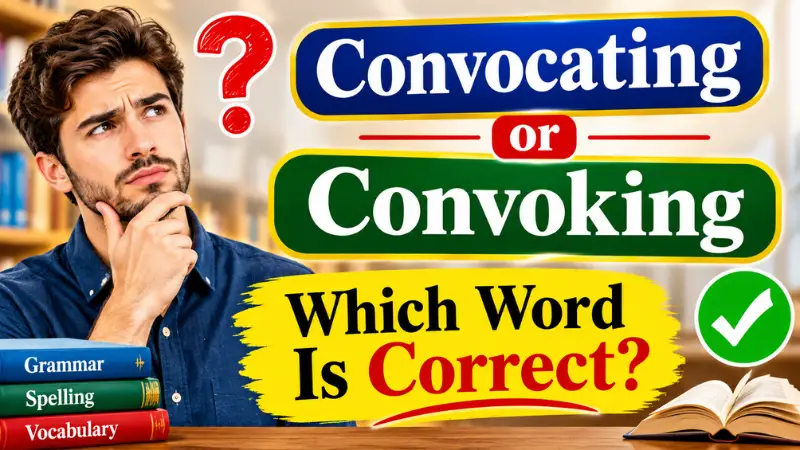
Convocating or Convoking: Which Word Is Correct?
URL Slug
convocating-or-convoking
Meta Description
Learn the difference between convocating and convoking, what each word means, which form is correct, and how to use it naturally in English.
Featured Image Prompt
Create a professional 800 × 450 educational illustration comparing the English words “CONVOCATING” and “CONVOKING,” with a formal meeting of people being called together, subtle dictionary and grammar elements, clean typography, and a modern academic design.
Image Alt Text
Educational illustration comparing convocating and convoking with a formal meeting in the background.
Convocating or Convoking: Which Word Is Correct?
Convocating and convoking are both related to calling people together for a meeting or gathering, but they differ in how commonly they are used. Convoking is the more established and natural choice in modern English. Convocating is a form of the much less common verb convocate, which dictionaries recognize as a variant of convoke.
If you are writing an email, report, academic paper, or formal announcement, convoking is generally the better choice. Understanding their grammatical forms and usage will help you avoid an unusual or outdated expression.
Quick Answer
Both convocating and convoking are grammatically recognizable. However, convoking is the preferred form in modern English. It is the present participle of convoke, meaning to call people together for a formal meeting. Convocating comes from convocate, a less common variant that is often considered obsolete in contemporary usage.
1. What Does ConvokingConvocating or Convoking Mean?
Convoking is the present participle of the verb convoke. It means calling people together or summoning them to attend a formal meeting, assembly, conference, or gathering.
The word usually appears in formal, institutional, political, governmental, or academic contexts.
For example:
- The president is convoking a special meeting of the council.
- The committee is convoking its members to discuss the proposal.
- The organization is convoking an emergency conference.
- The government considered convoking a national assembly.
In each sentence, someone is arranging for a group of people to come together.
Convoke is a formal verb, rather than an everyday substitute for invite. It often suggests an official call or summons. Oxford Learner’s Dictionaries+1
2. What Does ConvocatingConvocating or Convoking Mean?
Convocating is the present participle of convocate, a verb meaning to call people together or summon them to assemble.
It has essentially the same basic meaning as convoking. However, it is considerably less familiar and less useful in ordinary modern English.
Dictionary.com identifies convocate as a less common variant of convoke. Other dictionary-based references describe it as obsolete, reflecting its limited contemporary use. Dictionary.com+1
Examples:
- The officials were convocating members of the council.
- The authorities began convocating representatives for a special assembly.
- The institution was convocating its senior members.
These sentences illustrate the grammatical form, but convoking would sound more natural in contemporary writing.
3. Convocating vs. Convoking: Main Differences
Although the two words share a meaning, their practical usage is different.
| Feature | Convocating | Convoking |
|---|---|---|
| Base verb | Convocate | Convoke |
| Meaning | Calling people together | Calling people together |
| Grammar | Present participle | Present participle |
| Usage | Very uncommon | Established formal usage |
| Modern preference | Generally avoid | Generally preferred |
| Tone | Archaic or unusual | Formal |
The important distinction is not their basic meaning but their level of acceptance and familiarity in modern English.
Choose convoking when you want a clear, conventional expression that readers will recognize.
4. Why Is Convocating or ConvokingConvoking More Commonly Preferred?
The verb convoke has an established place in formal English. It appears in contexts involving official meetings, legislative assemblies, councils, and other organized gatherings.
For example:
- A president may convoke a special session of Congress.
- A university authority may convoke a council meeting.
- A committee chair may convoke an emergency meeting.
By contrast, convocate is a less common alternative. Although its grammatical form convocating can be understood, many readers may find it unusual or outdated.
For this reason, using convoking helps make your writing more natural and recognizable.
5. Convocating or Convoking Grammatical Forms and Examples
Understanding the base verbs makes it easier to use both forms correctly.
Forms of convoke:
| Verb form | Example |
|---|---|
| Base form | Convoke |
| Third-person singular | Convokes |
| Past tense | Convoked |
| Past participle | Convoked |
| Present participle | Convoking |
Examples:
- The governor plans to convoke a special session.
- The chairman convokes the council every year.
- The president convoked an emergency assembly.
- The committee has convoked its members.
- The organization is convoking representatives today.
Forms of convocate:
| Verb form | Example |
|---|---|
| Base form | Convocate |
| Third-person singular | Convocates |
| Past tense | Convocated |
| Past participle | Convocated |
| Present participle | Convocating |
These forms follow the regular grammatical pattern of the verb convocate, but their rarity makes them less suitable for most contemporary writing.
6. When Should You Use ConvokingConvocating or Convoking?
Use convoking when describing an official or organized action that brings people together.
Common situations include:
- Government: Calling a legislative assembly or special session.
- Education: Gathering university officials or academic representatives.
- Organizations: Summoning committee members for an important meeting.
- Politics: Calling representatives together to discuss public matters.
- Religious institutions: Gathering members for a formal council or assembly.
For ordinary situations, simpler alternatives such as calling a meeting, gathering people, or bringing everyone together may sound more natural.
7. Convocating or Convoking Common Mistakes to Avoid
Mistake 1: Treating both words as equally common
Incorrect assumption: Convocating and convoking are equally standard choices.
Better understanding: Both have a related meaning, but convoking is much more established in contemporary English.
Mistake 2: Using convoking as a noun
Incorrect: The convoking was scheduled for Monday.
Better: The convocation was scheduled for Monday.
Convoking is a verb form, although it can also function as a gerund. Convocation is the established noun for the act of assembling or a formal assembly.
Mistake 3: Confusing convocation with convoking
These words are related but have different grammatical roles:
- Convoke: To call people together.
- Convoking: The act of calling people together.
- Convocation: A formal assembly or the act of assembling.
Mistake 4: Using an uncommon form in formal writing
If your goal is straightforward professional communication, choose convoking rather than convocating.
8. Convocating or Convoking Related Words and Their Meanings
Several words are closely related to convoking and can help express the same general idea.
| Word | Meaning |
|---|---|
| Convene | To bring people together for a meeting |
| Summon | To officially or formally call someone to appear |
| Assemble | To gather people in one place |
| Congregate | To gather in a group |
| Gather | To bring people together |
| Convocation | A formal gathering or assembly |
Although these words overlap, they are not always interchangeable.
For example, summon can suggest an authoritative order, while convene often describes arranging or holding a meeting.
FAQs
1. Is convocating a real word?
Yes. Convocating is the present participle of convocate. However, convocate is a rare alternative to convoke, and its use is limited in modern English.
2. Is convoking grammatically correct?
Yes. Convoking is the standard present participle of convoke. It is used when describing the ongoing action of calling people together.
3. Do convocating and convoking mean the same thing?
They have essentially the same meaning: calling people together for a meeting or assembly. The main difference is that convoking is much more established in contemporary English.
4. What is the past tense of convoke?
The past tense of convoke is convoked. For example: “The governor convoked an emergency meeting yesterday.”
5. Is convoking formal or informal?
Convoking is a formal English word. It is most suitable for official meetings, government sessions, academic councils, and institutional gatherings.
6. What is the noun form of convoking?
The related noun is convocation. It can describe the act of calling people together or a formal assembly, including certain university ceremonies and gatherings.
7. What is a simpler alternative to convoking?
Depending on the sentence, you can use calling a meeting, gathering, convening, or summoning. These alternatives are often easier for everyday readers to understand.
Conclusion
Both convocating and convoking are connected to the idea of bringing people together, but they are not equally suitable for modern writing. Convocating comes from the rare verb convocate, while convoking is the established present participle of convoke.
For everyday professional, academic, and formal writing, convoking is the better choice. It communicates the intended meaning clearly without relying on an unusual or outdated word form.