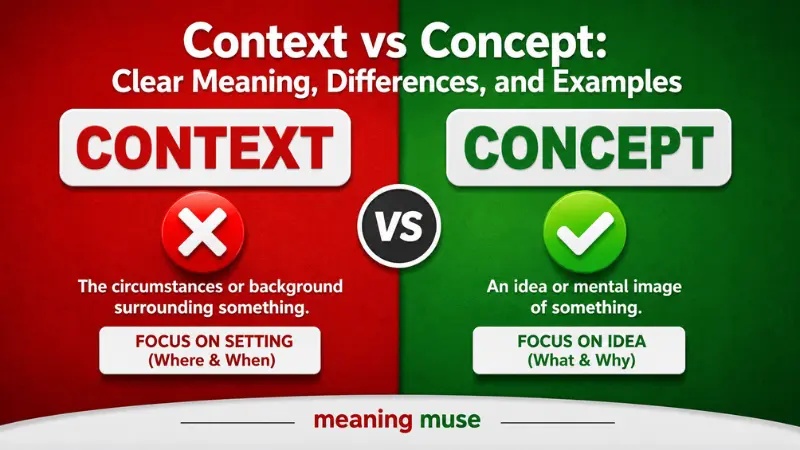
Context vs concept can be confusing because both words relate to understanding information, but they describe different things. Context refers to the background, situation, or circumstances surrounding something, while concept means an idea, thought, or general principle.
Context and concept look and sound similar, but they have different meanings.
Context is the background, setting, or surrounding information that helps you understand something.
Concept is an idea, principle, or thought that exists in the mind.
For example, freedom is a concept. The time, place, and events around a discussion of freedom provide its context.
You may need context to understand why someone said something. You may need an explanation to understand a difficult concept.
The easiest way to remember the difference is:
A concept is the idea. Context is what surrounds the idea.
This guide explains the difference between context and concept with simple rules, common phrases, grammar notes, and everyday examples.
Quick Answer
Use context when you mean the background, situation, or surrounding details that explain something.
Use concept when you mean an idea, principle, plan, or general thought.
Examples:
- I need more context to understand her message.
- The main concept of the lesson is easy.
- The historical context explains why the law was created.
- The concept of fairness is important to children.
Both words are correct. The right choice depends on whether you mean the surrounding situation or the main idea.
Why People Confuse Context and Concept
People confuse these words because they have several things in common.
Both:
- Begin with con-
- End with the letter t
- Are often used in school and work
- Can appear in discussions about ideas
- Are usually used as nouns
Their pronunciations are also close:
- Context: KON-tekst
- Concept: KON-sept
The key difference is in the final part:
- Context relates to the information around words, events, or actions.
- Concept relates to an idea formed in the mind.
The word text inside context can help you remember that context often includes the words around a sentence or phrase.
Context vs Concept at a Glance
| Feature | Context | Concept |
|---|---|---|
| Main meaning | Surrounding information or situation | An idea, principle, or general thought |
| Main question | What is happening around it? | What is the main idea? |
| Common use | Explaining meaning or circumstances | Explaining an idea or theory |
| School example | Use context clues to find the meaning | Learn the concept of gravity |
| Work example | Give the team more context | Explain the project concept |
| Common phrase | Out of context | Proof of concept |
| Related adjective | Contextual | Conceptual |
| Simple synonym | Background | Idea |
What Does Context Mean?
Context means the information, conditions, or setting around something.
These details help explain why something happened or what something means.
Context as a Situation
Context can describe the facts and conditions around an event.
- You need to know the social context of the story.
- The decision makes sense in its historical context.
- Her reaction seems strange without context.
In these examples, context gives the reader a clearer view of the situation.
Context in Language
Context can also mean the words that come before and after a word, sentence, or statement.
These surrounding words help explain the meaning.
- Read the full paragraph for context.
- I guessed the word by using context clues.
- His comment sounded rude when it was taken out of context.
For example, the word bank can mean a place that holds money or the side of a river. The surrounding sentence gives the context needed to choose the correct meaning.
Context in Conversation
When someone asks, “What is the context?” they usually want more background.
They may want to know:
- Who was involved
- What happened before
- Where it happened
- When it happened
- Why it happened
- What was said around the statement
Example:
“She left.”
This sentence gives very little information.
More context might be:
“She left the meeting early because her child was sick.”
The added details make the situation easier to understand.
What Does Concept Mean?
Concept means an idea, principle, or general understanding of something.
A concept may be simple or complex. It can exist in your mind before it becomes a real object, plan, or action.
Concept as an Idea
- The concept of kindness is easy to explain.
- The students learned the concept of fractions.
- He has a new concept for a mobile app.
In each sentence, concept refers to an idea.
Concept as a Principle
A concept can also be a basic rule or principle in a subject.
Examples include:
- The concept of gravity
- The concept of supply and demand
- The concept of equal rights
- The concept of time
- The concept of personal space
These are general ideas that help people understand a larger subject.
Concept as a Creative Plan
In business, art, design, and marketing, a concept may be an early idea for something that will be created.
- The designer presented a new logo concept.
- The movie has an interesting concept.
- We approved the concept for the ad campaign.
- The concept car may never be sold to the public.
The concept is the main idea behind the final product.
The Main Difference Between Context and Concept
The main difference is simple:
- Context surrounds something.
- Concept is the idea itself.
Suppose a teacher is explaining democracy.
The concept is democracy as a form of government.
The context may include the country, historical period, laws, leaders, and events being discussed.
Another example is a movie.
The movie’s concept may be about a child who travels through time.
The movie’s context may include the year it was made, the culture it shows, and the events surrounding each scene.
Ask these questions when choosing a word:
Do I mean an idea?
Use concept.
Do I mean the background or surrounding situation?
Use context.
How Context and Concept Work Together
Context and concept are different, but they often work together.
A concept may be understood differently in different contexts.
For example, the concept of success can change based on context.
- In school, success may mean earning good grades.
- In sports, success may mean winning a game.
- At work, success may mean finishing a project.
- In family life, success may mean having strong relationships.
The concept is success.
The context is the situation in which success is being discussed.
A teacher may also use context to explain a concept.
For example:
- A math teacher gives a shopping example to explain percentages.
- A science teacher uses a falling ball to explain gravity.
- A history teacher describes a war to explain political change.
The concept is the idea being taught. The context makes that idea easier to understand.
When to Use Context
Use context when you are talking about surrounding information, background, or circumstances.
Use Context for Background Information
- Let me give you some context.
- The report needs more context.
- Without context, the chart is confusing.
- This fact makes sense in context.
Use Context for Surrounding Words
- Use context to find the word’s meaning.
- The sentence provides enough context.
- Read the word in context.
- The quote was taken out of context.
Use Context for Historical Situations
- We studied the event in its historical context.
- The law must be viewed in its original context.
- The book reflects the social context of its time.
Use Context for Work and Projects
- The manager gave us more context about the change.
- I need context before I make a decision.
- The document explains the business context.
- Please add context to the data.
Context helps people understand the full picture.
When to Use Concept
Use concept when you are talking about an idea, principle, or early plan.
Use Concept for Ideas
- I understand the basic concept.
- That is a difficult concept.
- The concept sounds useful.
- She explained the concept clearly.
Use Concept for School Subjects
- Students learned the concept of multiplication.
- The book explains several science concepts.
- He understands the concept but made a small mistake.
- This activity teaches a new math concept.
Use Concept for Creative Work
- The artist showed us the first concept.
- The game has a fun concept.
- We need a stronger design concept.
- The team created concept art for the movie.
Use Concept for Business Plans
- The restaurant has a family-friendly concept.
- They tested the product concept.
- The company created a proof of concept.
- Investors liked the business concept.
A concept is usually the main idea behind something.
Context vs Concept in School
Students often use both words, but in different ways.
Context in Reading
In reading, context helps students understand words and sentences.
Example:
The desert was arid, so almost no plants grew there.
A student may use the surrounding words to understand that arid means very dry.
These surrounding details are called context clues.
Concept in Learning
A concept is an idea a student needs to learn.
Examples include:
- Addition
- Gravity
- Democracy
- Photosynthesis
- Cause and effect
A student may understand the words in a lesson but still struggle with the main concept.
Compare:
- I do not understand the context of this quote.
- I do not understand the concept of division.
The first student needs more background.
The second student needs the idea explained more clearly.
Context vs Concept in Business
Both words are common in business communication.
Business Context
Business context includes the conditions around a decision or problem.
It may include:
- Customer needs
- Market conditions
- Company goals
- Budget limits
- Deadlines
- Past results
Example:
- The numbers look better when viewed in context.
- The team needs more context about the new policy.
- Please explain the business context behind this decision.
Business Concept
A business concept is the main idea behind a product, service, or company.
Example:
- The business concept is simple.
- We tested the new store concept.
- The product is still in the concept stage.
- The team created a proof of concept.
A proof of concept is a small test used to show that an idea may work.
Common Mistakes and Quick Fixes
Mistake 1: Using Concept When You Need Background
- Incorrect: I need more concept before I understand the message.
- Correct: I need more context before I understand the message.
Quick fix: Use context when information is missing.
Mistake 2: Using Context for an Idea
- Incorrect: The main context of the lesson is gravity.
- Correct: The main concept of the lesson is gravity.
Quick fix: Use concept for the main idea.
Mistake 3: Saying “Out of Concept”
- Incorrect: The reporter took her words out of concept.
- Correct: The reporter took her words out of context.
Quick fix: The standard phrase is out of context.
Mistake 4: Confusing Context Clues with Concepts
- Context clues help you understand an unknown word.
- Concepts are the ideas you learn in a subject.
These terms are related to learning, but they do not mean the same thing.
Mistake 5: Using Proof of Context
- Incorrect: The developers created a proof of context.
- Correct: The developers created a proof of concept.
Quick fix: A proof of concept tests whether an idea can work.
Mistake 6: Assuming the Words Are Interchangeable
Context and concept may appear in the same sentence, but one cannot normally replace the other.
- The concept becomes clearer when we understand its context.
Here, concept means the idea, and context means the background around it.
Everyday Examples
Examples With Context
- Can you give me more context?
- The joke makes sense in context.
- Read the full message for context.
- Her words were taken out of context.
- The teacher gave us the historical context.
- Context clues helped me understand the word.
- The data needs more context.
- We should consider the problem in context.
- The photo has no clear context.
- This decision makes sense in the current context.
Examples With Concept
- The concept is easy to understand.
- She explained the math concept well.
- I like the concept behind the movie.
- The designer shared a new concept.
- Freedom is an important concept.
- He does not understand the basic concept.
- The business concept may attract families.
- We created a proof of concept.
- The concept art looks amazing.
- The course covers several key concepts.
Side-by-Side Examples
- Context: Tell me what happened before the argument.
- Concept: Tell me the main idea behind the lesson.
- Context: The time and place explain the event.
- Concept: The idea explains what the project is about.
- Context: Read the sentence around the unknown word.
- Concept: Learn the meaning of the main principle.
- Context: The background helps us understand the decision.
- Concept: The idea helps us understand the subject.
Dictionary-Style Word Details
Verb
Context: Context is normally used as a noun in everyday American English. The common verb is contextualize, which means to place something in its proper context.
- The teacher contextualized the event.
- The report contextualizes the numbers.
Concept: Concept is not commonly used as a verb. The related verb is conceptualize, which means to form or develop an idea.
- The designer conceptualized a new layout.
- The team conceptualized the project.
Noun
Context: A noun meaning the background, conditions, setting, or surrounding words that help explain something.
- We need more context.
- Read the quote in context.
Concept: A noun meaning an idea, principle, or general understanding.
- The concept is simple.
- We studied a new concept.
Concept may also appear before another noun:
- concept car
- concept art
- concept album
Synonyms
Closest alternatives for context:
- background
- setting
- situation
- circumstances
- environment
- conditions
- framework
Closest alternatives for concept:
- idea
- notion
- principle
- thought
- theory
- plan
- mental picture
These words are not always exact replacements. The best choice depends on the sentence.
Example Sentences
Context:
- The teacher gave us more context.
- His comment was taken out of context.
- The historical context explains the change.
- Use the context to guess the meaning.
Concept:
- The concept of time can be difficult.
- She explained the main concept.
- The product concept needs more work.
- The students learned three new concepts.
Word History
Context comes from a Latin source connected with weaving or joining things together. This history matches the idea of details being connected around a word or event.
Concept comes from a Latin source connected with conceiving or forming something in the mind. This history matches its modern meaning of an idea or thought.
The two words have different roots and developed different meanings. They are not alternate spellings of one word.
Phrases Containing
Common phrases with context:
- in context
- out of context
- context clues
- historical context
- social context
- cultural context
- political context
- provide context
- give context
- understand the context
Common phrases with concept:
- basic concept
- central concept
- key concept
- abstract concept
- business concept
- design concept
- concept art
- concept car
- proof of concept
- concept of freedom
FAQs
What is the main difference between context and concept?
Context is the background or surrounding situation that helps explain something. Concept is the idea or principle itself. A concept tells you what the idea is, while context tells you what is happening around it.
Are context and concept the same?
No. They are two different English words. Context means background, circumstances, or surrounding words. Concept means an idea, thought, principle, or early plan. They may appear together, but they are not interchangeable.
What is an example of context?
Suppose someone says, “He ran.” More context could explain that he ran because he was late for school. The added information helps the reader understand why the action happened.
What is an example of a concept?
Gravity is a concept. It is a general idea used to explain why objects fall toward Earth. Other examples include fairness, time, freedom, multiplication, and supply and demand.
Is a concept part of context?
A concept can appear within a context. For example, a teacher may explain the concept of freedom in the context of American history. The concept is the idea, while the context is the setting around it.
What does “out of context” mean?
“Out of context” means that words or actions have been separated from the details needed to understand them correctly. A quote may sound different when the sentences around it are removed.
What are context clues?
Context clues are words or details near an unknown word that help explain its meaning. Readers use the rest of the sentence or paragraph to make a good guess about the word.
What is a proof of concept?
A proof of concept is a small test that shows whether an idea may work. Businesses and developers often create one before spending time and money on a complete product.
Is it “main context” or “main concept”?
Use main concept when you mean the central idea. Use main context only when discussing the most important surrounding situation, though that phrase is less common. In most lessons, “main concept” is the natural choice.
Conclusion
Context and concept are both useful words, but they have different jobs.
Use context for the background, setting, surrounding words, or conditions that help explain something.
Use concept for an idea, principle, general thought, or early plan.
Remember this simple rule:
Concept is the idea. Context is what surrounds and explains it.
When you need more information about a situation, ask for context. When you need help understanding an idea, ask someone to explain the concept.