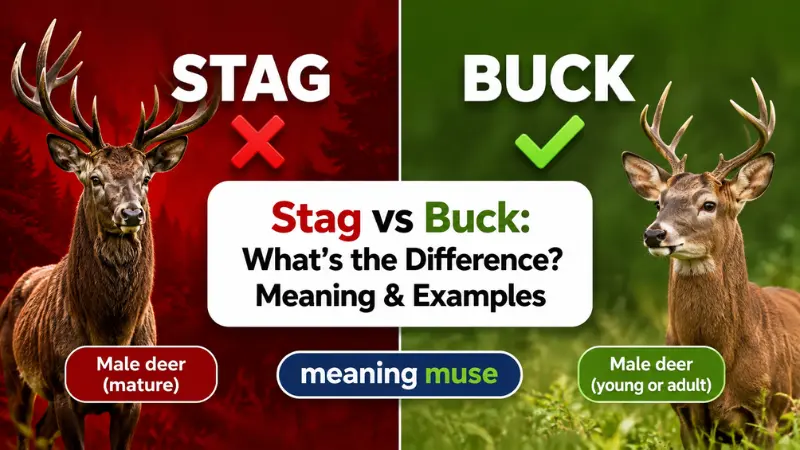
Stag vs buck can be confusing because both words can describe a male deer. However, they are not always used for the same kind of deer.
A stag most often means an adult male red deer. The word can also be used for males of some other deer species.
A buck is a broader term for a male deer. In the United States, people commonly call male white-tailed deer and mule deer bucks.
So, a stag and a buck can both be male deer, but the best word often depends on the species and the context.
For everyday American English, buck is usually the more familiar word when talking about common North American deer.
Quick Answer
A stag is usually an adult male red deer or a male of certain other deer species.
A buck is a male deer and can also be the male of some other animals.
The easiest rule is:
- Red deer adult male → stag
- White-tailed deer male → buck
- Mule deer male → buck
- General male deer → buck is often natural in American English
The two words overlap, but they are not exact replacements in every situation.
Stag vs Buck at a Glance
| Context | Best Choice | Why |
|---|---|---|
| Adult male red deer | Stag | Traditional and standard term |
| Male white-tailed deer | Buck | Common US wildlife term |
| Male mule deer | Buck | Standard American usage |
| General male deer | Buck | Broad and familiar term |
| Larger male deer in literary writing | Stag | Can sound more traditional |
| Male antelope | Buck | Buck has a wider animal meaning |
| Deer in a North American hunting context | Buck | Common American usage |
| Talking about a red deer herd | Stag | Fits the species well |
The biggest point to remember is that stag is more species-specific, while buck has a broader use.
What Does Stag Mean?
A stag is an adult male deer, especially an adult male red deer.
Picture a large red deer with a strong body and branching antlers. That animal would naturally be called a stag.
Example:
A red deer stag stood at the edge of the forest.
The word is also used for males of some other kinds of deer. Still, red deer are strongly linked with the word.
Is a Stag Always a Red Deer?
Not always.
Stag can have a wider deer meaning. However, adult male red deer is one of its clearest and most established uses.
That is why it is safer to avoid a rule such as:
Stag = every male deer
That rule is too broad.
Species matters.
Does Stag Mean an Older Deer?
The word normally points to an adult male. This can make a stag sound older or more mature than a young male deer.
However, you should not decide that an animal is a stag only because it looks large or has big antlers.
The kind of deer still matters.
What Does Buck Mean?
A buck is a male deer.
It is a very common word in American English, especially when people talk about North American deer.
Examples:
A buck crossed the road before sunrise.
We saw two bucks near the field.
The buck had large antlers.
The word can also describe males of some animals other than deer, including certain antelope.
This makes buck broader than stag.
Is Every Buck a Deer?
No.
When people are talking about wildlife, buck often means a male deer. But the word can also refer to males of some other animals.
Context tells you what kind of animal the speaker means.
For example:
A whitetail buck clearly means a male white-tailed deer.
What Is the Main Difference Between a Stag and a Buck?
The main difference between stag and buck is how the words are normally applied to different animals.
A stag is especially an adult male red deer.
A buck is a broader word for a male deer and is the normal term for familiar North American species such as white-tailed deer and mule deer.
That means the difference is not simply:
stag = old deer
buck = young deer
It is also not:
stag = big antlers
buck = small antlers
Those rules are too simple and can be wrong.
A better rule is:
Look at the species first.
If it is an adult male red deer, stag is a natural choice.
If it is a male white-tailed or mule deer in the United States, buck is the normal choice.
Stag vs Buck in American English
For US readers, buck is likely to be the more familiar wildlife word.
White-tailed deer live across much of North America. Their males are commonly called bucks.
Mule deer males are also called bucks.
This is why Americans often hear phrases such as:
- whitetail buck
- mule deer buck
- mature buck
- young buck
- trophy buck
- buck antlers
- buck season
The word stag is still correct English. However, it appears especially when talking about red deer, certain larger deer, traditional wildlife terms, or settings outside everyday North American deer talk.
Which Word Sounds More Natural in the USA?
Consider this sentence:
A buck walked through our backyard.
For a white-tailed deer in the United States, this sounds natural.
Now compare:
A stag walked through our backyard.
The sentence is understandable, but many American readers may picture a different kind of deer or wonder whether the writer means a red deer.
Species gives the word its clearest meaning.
Is a Stag Bigger Than a Buck?
Not necessarily.
This is a common misunderstanding.
The words stag and buck do not create a simple size ranking.
A stag may be large because red deer are large animals. A particular buck may also be large.
Body size depends on factors such as:
- species
- age
- health
- food
- habitat
- genetics
So you cannot look at two male deer and safely say:
The bigger one is the stag.
The animal’s species matters much more than a simple size comparison.
Do Stags and Bucks Both Have Antlers?
Male deer commonly grow antlers, so both stags and bucks may have them.
However, antler size alone does not decide which word you should use.
A white-tailed deer with impressive antlers is still normally called a buck.
An adult male red deer is naturally called a stag.
So this rule is incorrect:
Big antlers = stag
A better question is:
What species of deer is this?
That will usually help you choose the correct term.
Stag vs Buck by Deer Species
Species is one of the easiest ways to understand the difference.
Red Deer
An adult male red deer is commonly called a stag.
Example:
The stag called across the valley during the breeding season.
A female red deer is commonly called a hind.
White-Tailed Deer
A male white-tailed deer is called a buck.
Example:
A white-tailed buck appeared near the trees.
A female is called a doe.
Mule Deer
A male mule deer is also called a buck.
Example:
The mule deer buck stood beside the trail.
A female mule deer is a doe.
Elk
This is where a simple “all male deer are bucks or stags” rule breaks down.
In American wildlife usage, an adult male elk is normally called a bull.
Example:
A bull elk crossed the meadow.
Calling every male member of the deer family a buck would therefore be inaccurate.
Moose
A male moose is also normally called a bull, not a buck or stag.
This shows why animal names depend on the species.
When Should You Use Stag?
Use stag when you are clearly talking about an adult male red deer.
Example:
The red deer stag stood above the herd.
The word also fits well in descriptions where the species traditionally uses stag.
Wildlife Writing
The photographer waited for the stag to enter the clearing.
This works well if the animal is a red deer or another species for which stag is appropriate.
Nature Stories
A great stag stepped quietly between the trees.
The word can give a sentence a strong, traditional wildlife feeling.
Symbolic or Literary Writing
A stag often appears in:
- myths
- legends
- coats of arms
- wildlife art
- fantasy stories
- nature symbolism
In such writing, stag may create a more majestic or traditional image than the general word buck.
Still, literary style should not replace correct species terminology in factual writing.
When Should You Use Buck?
Use buck when talking about male white-tailed deer, mule deer, and many other deer in everyday American English.
Examples:
A buck was feeding beside the road.
The trail camera caught a large buck at night.
Two mule deer bucks were standing on the hill.
In Everyday Conversation
For many Americans, this sounds natural:
I saw a buck on my drive home.
If the deer is a common white-tailed deer, the meaning is clear.
Wildlife and Hunting Contexts
You will often see phrases such as:
- mature buck
- whitetail buck
- mule deer buck
- buck antlers
- buck tracks
The word is especially familiar in US discussions of deer.
Can Stag and Buck Be Used Interchangeably?
Sometimes they overlap, but not always.
Both can refer to male deer.
However, replacing one with the other may make a sentence less precise.
Consider:
A red deer stag stood on the hillside.
This is very precise.
Changing it to:
A red deer buck stood on the hillside.
Readers may understand the meaning, but stag is the more established term for an adult male red deer.
Now consider:
A white-tailed buck entered the field.
This is natural American wildlife language.
Changing it to:
A white-tailed stag entered the field.
would sound much less natural to many US readers.
So the two words overlap, but species-specific usage matters.
Stag, Buck, Doe, Hind, Bull, and Fawn
Deer vocabulary can seem complicated because one animal family uses several names.
Here is a simple guide:
Stag: adult male red deer and certain other deer
Buck: male of many deer species, including white-tailed and mule deer
Doe: female of many deer species
Hind: female red deer
Bull: male elk or moose
Fawn: young deer in many species
These terms help writers describe the exact animal instead of using one name for every deer.
Is a Young Male Deer a Buck or a Stag?
The answer depends on the species and the way the term is being used.
For many common North American deer, a male may be called a buck.
The word stag, however, strongly carries the idea of an adult male, especially with red deer.
That is why age can matter with stag, but age is not the whole difference between the words.
Do not memorize:
young = buck
old = stag
That shortcut will fail when the deer species changes.
Instead, remember:
species first, age second.
Other Meanings of Stag and Buck
Both words have meanings outside deer.
Knowing this can help when you meet them in books or conversation.
Stag
Stag can refer to a man attending an event without a partner.
For example:
He went stag to the dance.
The word also appears in stag party, meaning a gathering for men.
These meanings are different from the animal sense.
Buck
Buck has several common meanings.
In informal American English, a buck can mean a dollar.
Example:
The drink costs five bucks.
Buck can also be a verb.
A horse may buck by jumping or kicking upward.
Example:
The horse bucked and threw the rider.
It also appears in expressions such as:
buck the trend
and
pass the buck
These meanings should not be confused with a male deer.
Common Mistakes and Quick Fixes
Mistake 1: Saying Every Male Deer Is a Stag
Better: Use stag especially for an adult male red deer. Use the species-specific term when you know the animal.
Mistake 2: Saying Every Male Deer Is a Buck
Buck is broad, but some deer-family species use another standard male term.
For example, male elk and moose are usually called bulls.
Mistake 3: Thinking Stag Means a Deer With Large Antlers
Large antlers do not turn a buck into a stag.
A white-tailed male with large antlers is still called a buck.
Mistake 4: Thinking a Stag Is Simply Older Than a Buck
Age can play a role in the meaning of stag, but species is also important.
Do not use age alone to choose the word.
Mistake 5: Thinking Stag and Buck Are Different Sexes
Both animal terms refer to males.
They do not describe male versus female deer.
Mistake 6: Thinking Stag and Buck Are Two Spellings
They are separate words.
They overlap in meaning, but one is not an alternate spelling of the other.
Everyday Example Sentences
Stag Examples
A red deer stag stood beside the forest.
The stag lifted its head and watched the herd.
We photographed a stag in the early morning light.
The old painting showed a stag beneath an oak tree.
A large stag appeared at the edge of the valley.
Buck Examples
A buck crossed the road in front of us.
The white-tailed buck had tall antlers.
We spotted a mule deer buck on the hillside.
The buck disappeared into the woods.
A young buck was feeding near the field.
Compare the Words
Stag:
“The red deer stag stood near the herd.”
Precise for an adult male red deer.
Buck:
“The white-tailed buck stood near the herd.”
Natural for a male white-tailed deer.
The sentence structure is almost the same, but the species changes the best word.
FAQs
What is the difference between a stag and a buck?
A stag is especially an adult male red deer or a male of certain other deer. A buck is a broader term for a male deer and is commonly used for white-tailed and mule deer in the United States.
Is a stag the same as a buck?
They can both mean a male deer, so their meanings overlap. However, they are not always interchangeable. Stag is strongly linked with adult male red deer, while buck is broader.
Is a male deer called a stag or a buck?
It depends on the species. A male red deer is commonly called a stag. Male white-tailed deer and mule deer are called bucks.
Is a stag bigger than a buck?
Not by definition. Size depends on the deer species, age, health, and other factors. Stag and buck are not simple size categories.
Is a stag older than a buck?
A stag normally means an adult male, especially a red deer. However, it is incorrect to say that every older buck becomes a stag. Species matters.
What is a female stag called?
For red deer, the female is commonly called a hind.
What is a female buck called?
For species whose males are called bucks, the female is often called a doe.
What do Americans call a male deer?
In the United States, buck is common for male white-tailed deer and mule deer. Other deer-family animals have different terms; for example, male elk are called bulls.
Conclusion
The difference between stag vs buck becomes much easier when you focus on the kind of deer.
A stag is especially an adult male red deer and may also refer to males of certain other deer.
A buck is a broader term for a male deer and is the normal American word for males of common species such as white-tailed deer and mule deer.
Do not choose between them based only on antler size or age.
Remember this simple rule:
Red deer adult male = stag. White-tailed or mule deer male = buck.
When you know the species, choosing the right word is usually easy.