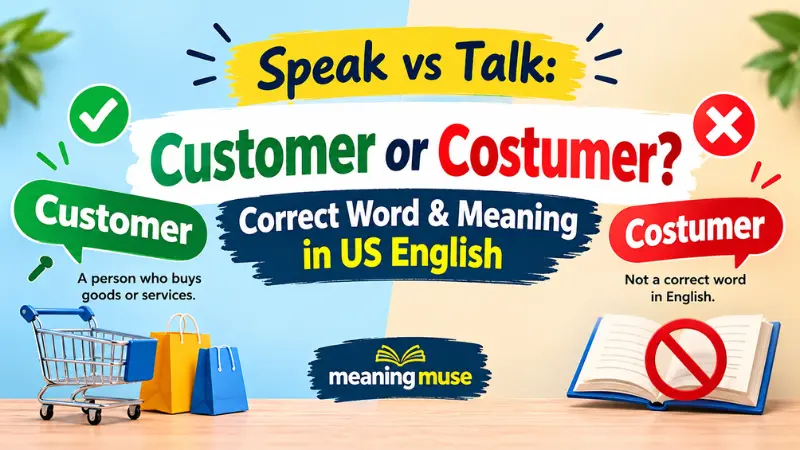
Customer or costumer? These words look and sound similar, but they do not mean the same thing.
If you are talking about a person who buys something from a store or business, the correct word is customer. Cambridge defines a customer as a person who buys goods or services.
Costumer is also a real English word, but it has a different meaning. In American English, it can mean a person who makes, sells, or rents costumes.
So, the right choice depends on what you mean.
Quick Answer
Use customer when you mean a person who buys goods or services.
Use costumer when you mean a person or company that makes, supplies, sells, or rents costumes.
Simple rule
Customer = buyer
Costumer = costume professional or supplier
These are different words, not two spellings of the same word.
Why People Confuse Them
The confusion is easy to understand because the two words look very similar.
Both contain the letters cust and end with -er. They also sound somewhat alike when spoken quickly.
There is one important clue, though: costumer contains the word costume.
Think:
- costume → costumer
- customer → person who buys something
For everyday American English, most people who are shopping, buying products, or using a service should use customer.
For example:
The customer asked for a refund.
This means the person who bought something asked for their money back.
By contrast:
The theater hired a costumer.
Here, costumer refers to someone who works with costumes.
Key Differences At A Glance
| Context | Best Choice | Why |
|---|---|---|
| Person who buys a product | customer | A customer buys goods or services. |
| Person who buys from a store | customer | This is the normal US English word. |
| Person receiving business service | customer | The word applies to buyers and service users. |
| Person who makes costumes | costumer | A costumer can make costumes. |
| Person who rents costumes | costumer | A costumer can rent or supply costumes. |
| Costume business or professional | costumer | The word is connected to costumes. |
Are They the Same Word?
No.
Customer and costumer are separate words with different meanings.
Customer
A customer is someone who buys goods or services. It can also refer to a person or organization that buys something from a business.
Examples include:
- a grocery store customer
- a bank customer
- a restaurant customer
- an online customer
- a regular customer
Costumer
A costumer is someone who makes, supplies, sells, or rents costumes. Collins also lists a second American English sense for a clothes rack or hat tree.
The word is therefore connected to costumes, not ordinary shopping.
US vs UK Preference
For the meaning “a person who buys goods or services,” customer is the normal word in both American and British English. Cambridge gives customer this meaning in both varieties.
Costumer has a different use. Cambridge lists costumer as an American English term for a person who makes and rents out costumes, especially for theater.
Collins also notes costumer as the American term in this sense, while costumier is used mainly in British English.
This does not make customer and costumer regional spellings of one word. They have different meanings.
Which Spelling Should You Use?
If you mean someone who buys something, use customer.
If you mean someone who works with costumes, use costumer.
For most everyday business, shopping, retail, banking, restaurant, and service situations in the United States, customer is the word you need.
Quick memory trick
Remember:
Customer → customer service → person buying or using a service
Costumer → costume → person working with costumes
This simple connection can help prevent the spelling mistake.
When One Spelling Looks Wrong
Costumer may look wrong when you are talking about someone who buys something.
For example:
❌ The costumer bought a new laptop.
If you mean the person who bought the laptop, write:
✅ The customer bought a new laptop.
However, costumer is not a misspelling in every situation.
For example:
✅ The costumer prepared the costumes for the play.
Here, costumer is correct because the sentence is about someone who works with costumes.
So the key is not simply the spelling. The meaning of the sentence tells you which word belongs there.
Common Mistakes (and Quick Fixes)
Mistake 1: Using “costumer” for a buyer
❌ The store welcomed every costumer.
✅ The store welcomed every customer.
Why? The people visiting and buying from the store are customers.
Mistake 2: Treating “costumer” as a misspelling every time
❌ “Costumer” is always wrong.
✅ “Costumer” is a real word with a different meaning.
A costumer can be a person who makes, supplies, sells, or rents costumes.
Mistake 3: Connecting customer with costume
The words look similar, but customer does not mean a person who works with costumes.
Remember:
customer = buyer
costumer = costume professional
Mistake 4: Using the wrong word in business writing
If you are writing about customers, use common phrases such as:
- customer service
- customer support
- customer satisfaction
- customer feedback
- customer experience
- customer needs
These are standard business expressions.
Everyday Examples
Here are natural examples for American English.
Examples with Customer
- The customer asked for help finding the right size.
- We always try to give each customer good service.
- The store sent an email to every customer.
- A new customer signed up for the service.
- The restaurant has many regular customers.
- The company wants to improve customer service.
- The customer received a replacement product.
- She has been a loyal customer for years.
Examples with Costumer
- The costumer designed costumes for the school play.
- The theater hired a professional costumer.
- The costumer prepared the outfits before opening night.
- The film company worked with a skilled costumer.
- The costumer supplied costumes for the production.
The first group is about buyers or service users. The second group is about costumes and costume work.
Dictionary-Style Word Details
Verb
Customer: Not normally used as a standard verb in everyday US English. The common word is the noun customer.
Costumer: Used primarily as a noun in the relevant American English sense. Do not invent a verb use simply because the word ends in -er.
Noun
Customer: A person or organization that buys goods or services.
Costumer: A person or company that makes or supplies costumes; in American English, dictionaries also record a person who makes, sells, or rents costumes.
Synonyms
Customer: Useful alternatives include buyer, shopper, consumer, purchaser, client, and patron, depending on the context. Cambridge lists several of these as related words for a person who buys something.
Costumer: There is no need to force a list of exact synonyms. In costume-related contexts, a phrase such as costume professional may be a useful plain alternative, depending on the job.
Example Sentences
Customer:
- The customer paid for the order online.
- Our customers can contact support by phone.
- The store offered a discount to regular customers.
Costumer:
- The costumer created outfits for the theater production.
- The studio hired a costumer for the film.
- The costumer supplied costumes for the performers.
Word History
Customer: Collins traces the word to Middle English and connects it with custom and older forms related to collecting customs.
Costumer: Collins gives costume + -er as the origin of the American English noun and dates the word to the 1860s.
The two words therefore have separate histories as well as separate meanings.
Phrases Containing
Common phrases with customer include:
- customer service
- customer support
- customer satisfaction
- customer experience
- customer feedback
- regular customer
- repeat customer
- potential customer
- loyal customer
- customer needs
Cambridge and Collins both record many common combinations with customer.
With costumer, common usage is mainly connected to costumes, theater, film, fashion, and costume supply.
FAQs
Is customer or costumer correct?
Both customer and costumer are correct words, but they have different meanings. Customer means a person who buys goods or services. Costumer refers to a person or company involved in making, supplying, selling, or renting costumes.
Is costumer a misspelling of customer?
No. Costumer is a real English word. It is not simply an incorrect spelling of customer. The two words have different meanings.
What is the difference between customer and costumer?
A customer buys goods or services. A costumer works with costumes, such as by making, supplying, selling, or renting them.
Which word should I use for someone who buys something?
Use customer.
Example: “The customer bought a new phone.”
What does costumer mean?
A costumer can mean a person who makes, supplies, sells, or rents costumes.
Is customer the correct word in American English?
Yes. Customer is the standard American English word for someone who buys goods or services.
How can I remember customer vs costumer?
Think of the first word as customer = buyer. Think of the second as costumer = costume professional.
Do customer and costumer sound the same?
No. Their pronunciations are different. Cambridge gives the US pronunciation of customer as /ˈkʌs.tə.mɚ/ and costumer as /kɑːˈstuː.mɚ/.
Is costumer used in American English?
Yes. Costumer is documented in American English, including the meaning of a person who makes, sells, or rents costumes.
What is the easiest rule for customer and costumer?
Use customer for a buyer. Use costumer for someone who works with costumes.
Conclusion
Customer and costumer are both real English words, but they do not have the same meaning.
Use customer for a person or organization that buys goods or services.
Use costumer for someone who makes, supplies, sells, or rents costumes.
The easiest way to remember the difference is:
Customer = buyer
Costumer = costume professional
So if you are writing about shoppers, clients, buyers, or people using a business service, customer is the correct word. If your sentence is about someone who works with costumes, costumer may be the correct choice.