Should you write indecisive or undecisive?
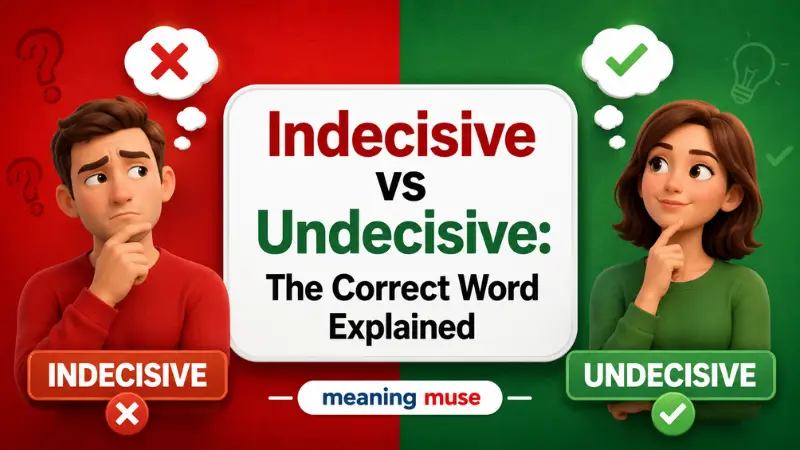
The correct word in standard English is indecisive. It describes a person who has trouble making a choice. It can also describe an action, plan, result, or situation that is not clear or final.
Undecisive may seem logical because many English opposites begin with un-. However, it is not the normal word used in modern American English. Use indecisive in school assignments, emails, articles, conversations, and professional writing.
This guide explains the difference between indecisive and undecisive. It also shows the meaning, pronunciation, word forms, common mistakes, and correct examples.
Quick Answer
Indecisive is the correct and standard word. Undecisive should normally be avoided.
Use indecisive when a person cannot make a choice easily:
Mia felt indecisive about which college to attend.
You can also use it when something does not produce a clear result:
The first round of talks was indecisive.
A simple memory rule is:
Decisive becomes indecisive.
Why People Confuse Them
People often confuse these forms because English uses both in- and un- to create negative words.
For example:
- active becomes inactive
- complete becomes incomplete
- certain becomes uncertain
- decided becomes undecided
A learner may look at the word decisive and guess that its opposite should be undecisive. That guess follows a familiar pattern, but English does not build every opposite in the same way.
The established opposite of decisive is indecisive.
Another source of confusion is the word undecided. Undecided is a correct word, but it is not the same form as undecisive.
Compare these sentences:
I am undecided about the trip.
I am an indecisive person.
The first sentence describes your current choice. The second describes a habit or personal quality.
Key Differences at a Glance
| Context | Best Choice | Why |
|---|---|---|
| A person struggles to choose | indecisive | It is the standard adjective |
| A leader avoids firm choices | indecisive | It describes a pattern of behavior |
| A result is not clear | indecisive | It can mean inconclusive |
| A choice has not been made yet | undecided | This is a separate standard word |
| School or business writing | indecisive | Undecisive looks incorrect |
| Casual conversation | indecisive | It is the natural modern form |
The main distinction is simple:
- Indecisive: standard English word
- Undecisive: nonstandard form that should usually be replaced
Are They the Same Word?
Indecisive and undecisive are not two accepted regional spellings like color and colour. They do not represent an American-versus-British spelling difference.
Indecisive is an established adjective. It has two common uses.
First, it can describe someone who finds it hard to make decisions:
Ben is indecisive when he shops for clothes.
Second, it can describe something that does not settle an issue or produce a clear result:
The meeting ended with an indecisive vote.
Undecisive is usually created by mistake. A writer may add un- to decisive because the pattern sounds reasonable. In careful modern writing, replace it with indecisive.
Pronunciation
Indecisive is pronounced:
in-di-SY-siv
The strongest sound falls on SY.
Its spelling begins with in-, not un-.
US vs UK Preference
American and British English both use indecisive.
This comparison does not follow a regional pattern. You do not need one spelling for a US audience and another for a UK audience.
Use indecisive in:
- American English
- British English
- Canadian English
- Australian English
- formal and informal writing
The spelling stays the same across these major varieties of English.
Which Word Should You Use?
Use indecisive when you mean that someone has trouble choosing or does not act with confidence.
The customer was indecisive about the paint color.
Our indecisive manager delayed the final choice.
I become indecisive when a menu has too many options.
You can also use indecisive for an unclear outcome:
The debate had an indecisive ending.
Do not use undecisive as a regular replacement.
Incorrect:
She was undecisive about the job offer.
Correct:
She was indecisive about the job offer.
You may sometimes need undecided instead. Use undecided when a choice has not yet been made.
She is still undecided about the job offer.
This sentence focuses on her present decision. It does not necessarily mean that she is usually bad at deciding.
When Undecisive Looks Wrong
Undecisive looks wrong in most edited English because readers expect indecisive.
It can be especially noticeable in:
- job applications
- school essays
- business emails
- reports
- news articles
- website content
- professional social posts
For example:
The committee was undecisive.
This sentence may distract the reader because the expected word is indecisive.
A better sentence is:
The committee was indecisive.
You could also write:
The committee was unable to reach a decision.
The second version may be clearer when you want to describe one event rather than the committee’s usual behavior.
Common Mistakes and Quick Fixes
Mistake 1: Using undecisive as the opposite of decisive
Incorrect:
The coach seemed undecisive.
Correct:
The coach seemed indecisive.
Quick fix: Use the pair decisive and indecisive.
Mistake 2: Confusing indecisive with undecided
Indecisive often describes difficulty making decisions.
Undecided means that a final choice has not been made.
I am undecided about lunch.
This means you have not chosen yet.
I am indecisive about food.
This suggests that choosing food is often hard for you.
Mistake 3: Using indecisive as a noun
Incorrect:
Her indecisive caused a delay.
Correct:
Her indecision caused a delay.
Indecisive is an adjective. Indecision is a noun.
Mistake 4: Misspelling indecisive
Incorrect:
indecisiv
indecissive
undecisive
Correct:
indecisive
Break it into parts to remember it:
in + decisive = indecisive
Mistake 5: Calling every careful person indecisive
A person who takes time to think is not always indecisive. The word often suggests difficulty choosing, repeated hesitation, or a lack of firm action.
Instead of saying:
Ava was indecisive because she read the contract carefully.
You could say:
Ava was careful and thoughtful before signing the contract.
Everyday Examples
Here are natural examples for modern American English:
Jordan felt indecisive while choosing a new laptop.
Our group became indecisive when three good ideas were suggested.
The manager’s indecisive response confused the staff.
I am too indecisive to pick a movie for everyone.
Her indecisive leadership slowed the project.
The jury returned after an indecisive first discussion.
An indecisive shopper may compare the same products many times.
He sounded indecisive during the phone call.
The game ended after an indecisive final round.
Do not let one indecisive moment ruin your confidence.
Incorrect and Correct Examples
Incorrect:
Nina is very undecisive.
Correct:
Nina is very indecisive.
Incorrect:
His undecisive answer did not help us.
Correct:
His indecisive answer did not help us.
Incorrect:
I have a lot of indecisive.
Correct:
I have a lot of indecision.
Incorrect:
The voters remain indecisive about which candidate they support.
Possible correction:
The voters remain undecided about which candidate they support.
Use undecided here when you simply mean they have not chosen yet.
Dictionary-Style Word Details
Verb
Indecisive: Indecisive is not a verb. It is an adjective.
Undecisive: Undecisive is not used as a standard verb.
Use decide when you need a verb:
We need to decide today.
You can also use hesitate when someone delays because they are unsure:
She hesitated before answering.
Noun
Indecisive: Indecisive is not a noun. The related noun is indecision or indecisiveness.
His indecision delayed the order.
Her indecisiveness made planning difficult.
Undecisive: It does not have a recommended standard noun form. Use indecision or indecisiveness instead.
Synonyms
Useful synonyms for indecisive include:
- hesitant
- unsure
- uncertain
- wavering
- irresolute
- conflicted
- vacillating
These words do not fit every sentence in exactly the same way.
Hesitant means slow or unsure about acting.
She was hesitant to speak.
Undecided means that no final choice has been made.
We are undecided about the date.
Uncertain can mean unsure about facts, choices, or future events.
He was uncertain about the plan.
Useful opposites include:
- decisive
- certain
- firm
- resolved
- determined
- confident
Example:
The indecisive leader became more decisive after reviewing the facts.
Example Sentences
Indecisive:
Leah was indecisive about which dress to buy.
The team gave an indecisive answer.
His indecisive manner made the meeting longer.
The first test produced an indecisive result.
Undecisive:
Avoid this form in standard writing.
Instead of:
I feel undecisive today.
Write:
I feel indecisive today.
Or, when no choice has been made:
I am still undecided.
Word History
The standard word indecisive is built from the negative prefix in- and the word decisive.
The prefix in- can mean “not.” It appears in words such as:
- inactive
- incomplete
- incorrect
- informal
- indecisive
The word belongs to the same family as:
- decide
- decision
- decisive
- decisively
- decisiveness
- indecision
- indecisive
- indecisively
- indecisiveness
Undecisive does not have the same accepted place in standard modern usage. Its appearance often comes from applying the un- prefix pattern to decisive.
Phrases Containing
Common phrases and word combinations include:
- indecisive person
- indecisive leader
- indecisive answer
- indecisive behavior
- indecisive response
- indecisive voter
- indecisive mood
- indecisive result
- indecisive action
- become indecisive
- feel indecisive
- seem indecisive
Examples:
An indecisive leader may delay an important choice.
I feel indecisive when I have too many options.
The test produced an indecisive result.
Do not change these phrases to undecisive leader, undecisive mood, or undecisive answer.
FAQs
Is it indecisive or undecisive?
Indecisive is the correct word in standard English. Use it for someone who struggles to make decisions or for something that does not produce a clear result.
Is undecisive a real word?
Undecisive may appear in unedited or informal writing, but it is not the normal standard form. Use indecisive in modern American English.
What does indecisive mean?
Indecisive means having trouble making a decision. It can also mean not producing a clear or final result.
What is the difference between indecisive and undecided?
Indecisive often describes a person’s difficulty or habit of making choices. Undecided means that a particular choice has not been made yet.
He is an indecisive person.
He is undecided about the offer.
Is indecisive a negative word?
It can sound negative because it may suggest weak, slow, or uncertain decision-making. However, the exact tone depends on the sentence and situation.
Is indecisive used in American English?
Yes. Indecisive is the standard form in American English. It is also used in British English and other major varieties of English.
What is the noun form of indecisive?
The noun forms are indecision and indecisiveness.
Her indecision caused a delay.
What is the opposite of indecisive?
The clearest opposite is decisive. Other possible opposites include firm, determined, certain, and resolved.
How do you pronounce indecisive?
Say it as in-di-SY-siv. The strongest part is “SY.”
How can I remember the correct word?
Remember this word pair:
decisive → indecisive
Both words contain the complete spelling decisive.
Conclusion
The correct choice is indecisive, not undecisive.
Use indecisive when someone has trouble choosing or when an action or result is not clear. Use undecided when a person has not made a specific choice yet.
Keep this simple pattern in mind:
A decisive person makes firm choices. An indecisive person struggles to choose.
Using the standard word will make your writing clearer, more natural, and more professional.