SEO Title
Tried or Tryed: Which Spelling Is Correct?
H1
Tried or Tryed: The Correct Spelling and How to Use It
URL Slug
tried-or-tryed
Meta Description
Tried or tryed: Learn which spelling is correct, why the spelling changes, and how to use tried properly in sentences with clear examples.
Featured Image Prompt
Create a clean, professional educational spelling infographic in 800 × 450 landscape format. Show the words “TRIED” and “TRYED” side by side, with TRIED clearly highlighted as correct and TRYED marked incorrect. Include a subtle dictionary, notebook, and pencil background, modern typography, excellent readability, and a polished American English learning aesthetic.
Image Alt Text
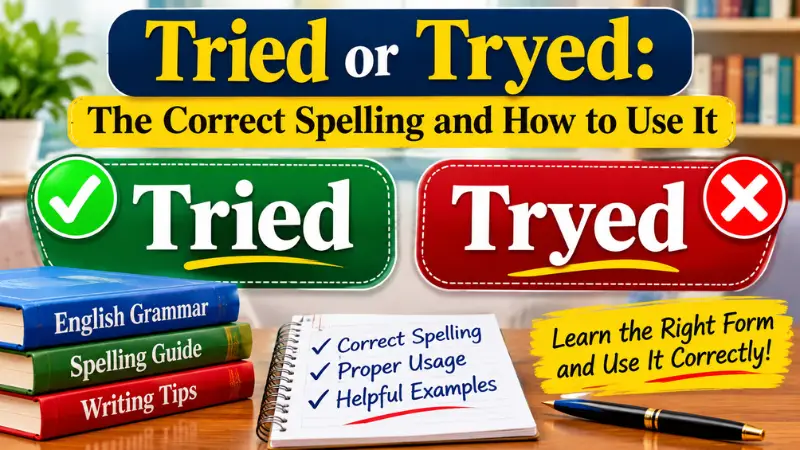
Educational graphic showing tried as the correct spelling and tryed as the incorrect modern spelling.
Tried or Tryed: The Correct Spelling and How to Use It
If you are wondering whether to write tried or tryed, the correct spelling in modern standard English is tried. It is the simple past tense and past participle of the verb try, meaning to make an attempt, test something, or make an effort.
Although tryed might look like a reasonable spelling, it does not follow the standard spelling rule for verbs ending in a consonant followed by y. Instead, the final y changes to i before adding -ed. Understanding this small rule will also help you spell words such as cried, dried, and studied correctly.
Quick Answer
Tried is the correct spelling, while tryed is incorrect in modern standard English when referring to the past tense or past participle of try.
The correct spelling follows this pattern:
- Try → Tried
- Tryed → Incorrect
Example: I tried to finish my homework before dinner.
Why Is Tried the Correct Spelling?
The reason comes down to a common English spelling rule.
When a verb ends in a consonant followed by y, change the final y to i before adding -ed to form the past tense.
The process looks like this:
- Start with the base verb: try.
- Remove the final y.
- Replace it with i.
- Add -ed.
- The result is tried.
\[ \text{try} \rightarrow \text{tried} \]
Here are some other verbs that follow the same pattern:
| Base verb | Correct past tense |
|---|---|
| Cry | Cried |
| Study | Studied |
| Carry | Carried |
| Worry | Worried |
| Reply | Replied |
| Apply | Applied |
| Dry | Dried |
| Fry | Fried |
The spelling changes do not alter the basic meaning of these verbs. They simply follow the standard way of adding the past-tense ending.
An Important Exception: Vowels Before Y
Not every verb ending in y changes to i.
When a vowel comes immediately before the final y, the y usually stays in place when adding -ed.
For example:
| Base verb | Correct past tense |
|---|---|
| Play | Played |
| Stay | Stayed |
| Enjoy | Enjoyed |
| Employ | Employed |
| Delay | Delayed |
Compare:
- Try → Tried (consonant + y)
- Play → Played (vowel + y)
This distinction explains why tried is correct but played does not become plaied.
What Does Tried Mean?
Tried is the past tense and past participle of the verb try. It generally describes making an effort, attempting something, or testing something to see whether it works.
It can be used in several everyday situations.
1. Making an effort
When someone attempts to do something, tried describes that past effort.
Example: She tried to solve the problem without asking for help.
2. Testing something
It can describe using or experiencing something to see whether you like it or whether it works.
Example: I tried the new coffee shop downtown.
3. Attempting something without success
The word does not necessarily mean that the attempt succeeded.
Example: He tried to repair the computer, but it still would not turn on.
4. Making an effort to help
Example: My friends tried to support me during a difficult week.
Cambridge also recognizes tried as an adjective in expressions such as “tried and tested,” describing something that has been used before and shown to work. English meaning – Cambridge Dictionary+1
Tried vs. Tryed in Sentences
Seeing both spellings in context makes the difference easier to remember.
| Incorrect: Tryed | Correct: Tried |
|---|---|
| I tryed to call you. | I tried to call you. |
| She tryed her best. | She tried her best. |
| He tryed a new recipe. | He tried a new recipe. |
| We tryed to finish early. | We tried to finish early. |
| They tryed again yesterday. | They tried again yesterday. |
| My brother tryed to help me. | My brother tried to help me. |
In every example, the final y changes to i before adding -ed.
More Examples of Tried in Everyday English
Here are additional examples showing how to use the correct spelling naturally:
- I tried calling you last night, but you did not answer.
- She tried a different approach to complete the assignment.
- We tried several restaurants before finding our favorite.
- They tried to fix the issue before contacting customer support.
- Have you tried this new application?
- He had tried everything he could think of.
- I tried my hardest to make the event successful.
- The teacher tried to explain the lesson in a simpler way.
These sentences show that tried works with different subjects and sentence structures.
Tried vs. Try: Understanding the Difference
Although tried and try come from the same verb, they serve different grammatical purposes.
| Word | Grammatical use | Example |
|---|---|---|
| Try | Base form | I try to exercise daily. |
| Tries | Present tense with he, she, or it | She tries to stay positive. |
| Tried | Simple past tense | He tried yesterday. |
| Tried | Past participle | I have tried that before. |
| Trying | Present participle | They are trying again. |
The important point is that try is not always interchangeable with tried.
Use try for the base form and appropriate present-tense constructions. Use tried when describing a completed past attempt or when a perfect-tense construction requires the past participle.
When Should You Use Try Instead of Tried?
Use try after the auxiliary verb did because did already indicates past tense.
Correct:
- Did you try the new restaurant?
- I did try to contact him.
- She didn’t try to explain.
Incorrect:
- Did you tried the new restaurant?
- I did tried to contact him.
- She didn’t tried to explain.
This is a separate grammar rule worth remembering: after did, use the base form of the main verb.
Is Tryed Ever a Correct Word?
Tryed is not the correct spelling in modern standard English when you mean the past tense or past participle of try.
However, there is a small historical detail: tryed appears as an obsolete spelling in historical English records. Older English texts sometimes used spellings that differ from modern conventions. Wiktionary, the free dictionary+1
You might therefore encounter tryed in an old document, historical text, or an intentionally old-fashioned piece of writing.
That does not make it appropriate for modern everyday writing. In contemporary American English, use tried.
Common Mistakes to Avoid
A few spelling and grammar mistakes often occur when people use this verb.
Mistake 1: Adding -ed without changing y
Incorrect: I tryed to complete the assignment.
Correct: I tried to complete the assignment.
Why: The final y follows a consonant, so it changes to i before -ed.
Mistake 2: Using tried after did
Incorrect: Did you tried to reach her?
Correct: Did you try to reach her?
Why: The auxiliary verb did already marks the past tense.
Mistake 3: Changing y before adding -ing
Incorrect: I am triing to learn English.
Correct: I am trying to learn English.
Why: When adding -ing, the final y stays unchanged.
Mistake 4: Confusing present and past tense
Incorrect: Yesterday, I try to finish my work.
Correct: Yesterday, I tried to finish my work.
Why: A completed action in the past generally requires the past-tense form.
FAQs
1. Is it tried or tryed?
Tried is the correct spelling in modern standard English. Tryed is a misspelling when used as the past tense or past participle of try.
2. Why is tried spelled with an i instead of y?
Because try ends in a consonant followed by y. English spelling rules generally change the final y to i before adding -ed, producing tried.
3. Is tryed ever acceptable in English?
It appears as an obsolete spelling in historical English, but it is not acceptable in modern standard writing. Use tried in emails, school assignments, business documents, and everyday communication.
4. What is the past tense of try?
Example: I tried to learn a new language last year.
5. What is the past participle of try?
The past participle is also tried. It is used with helping verbs such as have, has, and had.
The past participle is also tried. It is used with helping verbs such as have, has, and had.
I have tried that method.
She has tried several solutions.
They had tried everything.
6. Is it tried my best or tryed my best?
The correct expression is tried my best when describing a past effort.
Example: I tried my best to complete the project on time.
7. Is it trying or triing?
The correct spelling is trying. When adding -ing to try, the final y stays unchanged.
Example: She is trying to improve her writing skills.
Conclusion
When choosing between tried or tryed, always use tried in modern standard English. It is the correct past tense and past participle of try, meaning to make an attempt, test something, or make an effort.
Remember the simple spelling pattern: change the final y to i before adding -ed when a consonant comes before the y.
Try → Tried
Once you understand this rule, you can also spell words such as cried, studied, carried, and replied correctly.