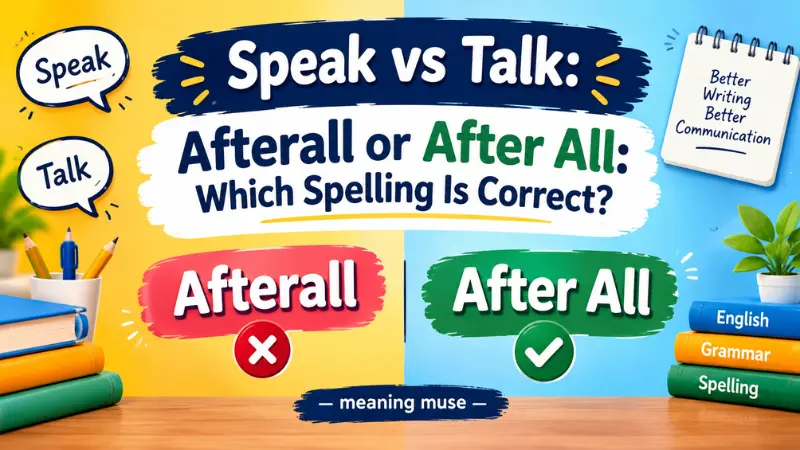
Afterall or after all is a common spelling question because the two words can sound closely connected in everyday speech. However, the written form is simple: after all has a space between the two words.
The correct form works in both American and British English. There is no standard US spelling that combines after and all into afterall.
Quick Answer
After all is correct.
Afterall is incorrect when you mean the common English expression.
| Form | Correct? | Use |
|---|---|---|
| after all | Yes | Standard English |
| afterall | No | Common spelling mistake |
Examples:
- Correct: She decided to stay after all.
- Incorrect: She decided to stay afterall.
The correct form works in both American and British English. There is no standard US spelling that joins the words together.
Why People Confuse Them
The main reason is simple: after all sounds like one connected phrase when spoken naturally.
For example, when someone says:
“I was right after all.”
The words may run together in normal conversation. A writer may then remember the sound rather than the written form and type afterall.
English also has many words that contain after, including compounds and related forms. This can make it tempting to join after and all together.
But after all has an established two-word spelling.
A useful memory trick is:
After + all = after all
Keep the two words separate.
What Does “After All” Mean?
After all is a common English expression. Its meaning depends slightly on the sentence.
It can show that something happened despite earlier doubts or expectations.
For example:
- We thought the store was closed, but it was open after all.
- She wasn’t going to come, but she came after all.
It can also introduce a reason or remind someone of an important fact.
For example:
- After all, everyone deserves a second chance.
- We should help him. After all, he helped us last week.
Cambridge lists these uses for after all, including showing that something happened despite earlier problems or doubts and adding information that supports what was just said.
Key Differences At A Glance
There is no true spelling variation here. The important difference is between the standard form and a misspelling.
| Feature | after all | afterall |
|---|---|---|
| Standard English | Correct | Incorrect |
| Number of words | Two | One |
| US English | Correct | Not standard |
| British English | Correct | Not standard |
| Formal writing | Use it | Avoid it |
| Everyday writing | Use it | Avoid it |
The safest choice is always after all when you mean the common English expression.
Is “Afterall” Ever Correct?
In ordinary English writing, afterall is not the standard form of the expression after all.
You may occasionally see Afterall used as part of a name, title, brand, organization, or other proper name. That is a separate situation and does not make afterall a standard spelling of the English phrase.
For normal sentences, write after all.
For example:
- Correct: I knew you would understand after all.
- Correct: After all, we had already agreed.
- Incorrect: I knew you would understand afterall.
US vs UK Preference
There is no important American-versus-British spelling difference for this expression.
American English uses after all.
British English also uses after all.
So you do not need to choose between a US spelling and a UK spelling here. The same two-word form is standard in both varieties. Cambridge includes after all in its American Dictionary entry as well.
Which Spelling Should You Use?
Use after all.
This is the best choice for:
- School assignments
- College writing
- Business emails
- Websites
- Articles
- Reports
- Professional documents
- Everyday messages
If you find afterall in your draft, change it to after all.
Easy Rule
Remember:
after all = correct
afterall = spelling mistake
You do not need a complicated grammar rule to remember it.
When One Spelling Looks Wrong
The one-word form can look natural because English often combines words into compounds.
However, afterall should look like a warning sign when you are proofreading standard English.
Compare these sentences:
Correct:
She was nervous, but she gave the presentation after all.
Incorrect:
She was nervous, but she gave the presentation afterall.
The meaning does not change. The problem is simply the spelling.
Another common position is at the beginning of a sentence:
Correct:
After all, we have plenty of time.
Not:
Incorrect:
Afterall, we have plenty of time.
Common Mistakes (and Quick Fixes)
Mistake 1: Joining the words
❌ We decided to leave afterall.
✅ We decided to leave after all.
Mistake 2: Joining the words at the beginning
❌ Afterall, nobody complained.
✅ After all, nobody complained.
Mistake 3: Using a hyphen
❌ We decided to go after-all.
✅ We decided to go after all.
The standard expression is written as two separate words.
Mistake 4: Forgetting the comma at the beginning
When after all begins a sentence as an introductory expression, a comma commonly follows it.
✅ After all, we already paid.
At the end of a sentence, no comma is normally needed:
✅ We already paid after all.
Everyday Examples
Here are natural examples of after all in American English:
- I wasn’t going to buy it, but I changed my mind after all.
- She decided to join us after all.
- Maybe he was right after all.
- We thought the game was canceled, but it happened after all.
- After all, everyone makes mistakes.
- You should give her a chance. After all, she worked hard.
- The plan worked after all.
- We don’t need to worry after all.
- After all, this is our home.
- He came back after all.
These examples show why after all is useful in everyday conversation and writing.
Dictionary-Style Word Details
Verb
After all is not a verb.
Afterall is not a standard verb either. It is simply an incorrect one-word spelling when someone intends to write the expression after all.
Noun
After all is not normally used as a noun.
The expression functions as an adverbial expression in standard usage. Merriam-Webster lists after all as an adverb and gives meanings related to acting despite expectations and considering all circumstances.
Synonyms
Exact replacements depend on the sentence.
Closest plain alternatives can include:
- in the end
- nevertheless
- ultimately
- despite that
- when everything is considered
These are not perfect replacements in every sentence.
For example:
Maybe she was right after all.
can sometimes become:
Maybe she was right in the end.
But the best replacement depends on the intended meaning.
Example Sentences
After all can appear in several positions:
- Beginning: After all, we promised to help.
- Middle: She is, after all, a close friend.
- End: They were correct after all.
The spelling remains the same in each position.
Word History
The expression after all has a long history in English. Merriam-Webster records its first known use as 1590 and lists it as an adverb.
For modern writers, the important point is much simpler: its established form is after all, with a space between the two words.
Phrases Containing
Common sentences and phrases containing after all include:
- After all, we tried.
- It worked after all.
- She was right after all.
- Why worry after all?
- After all this time
- After all these years
- After all that happened
The expression remains two words when used in these contexts.
FAQs
Is “afterall” or “after all” correct?
After all is correct. Afterall is not the standard spelling of the expression.
Is “afterall” one word?
No. When you mean the common English expression, write after all as two words.
Is “after all” correct in American English?
Yes. After all is standard in American English. It is also used in British English, so this is not a US-versus-UK spelling difference.
What does “after all” mean?
It can mean something happened despite earlier doubts or expectations. It can also introduce a reason or remind someone of an important fact.
Should “after all” be hyphenated?
No. The normal spelling is after all, with two separate words. Do not write after-all in ordinary prose.
Is “after all” formal or informal?
It works in both formal and informal English. You can use it in everyday conversation, emails, school writing, and professional writing when it fits the sentence.
How can I remember the correct spelling?
Think of it as two simple words: after + all. If you mean the common expression, keep the space: after all.
Conclusion
The correct form is after all, not afterall.
Write after all as two separate words in American English and in standard English generally. The phrase can express a result despite earlier doubts, or it can introduce a reason or reminder.
The easiest rule is also the best one:
After all = correct.
Afterall = incorrect in standard English.
Once you remember that the expression stays as two words, this spelling question becomes easy to solve.