Pastor and preacher are often used as if they mean the same thing. Sometimes they can describe the same person, but the words focus on different roles.
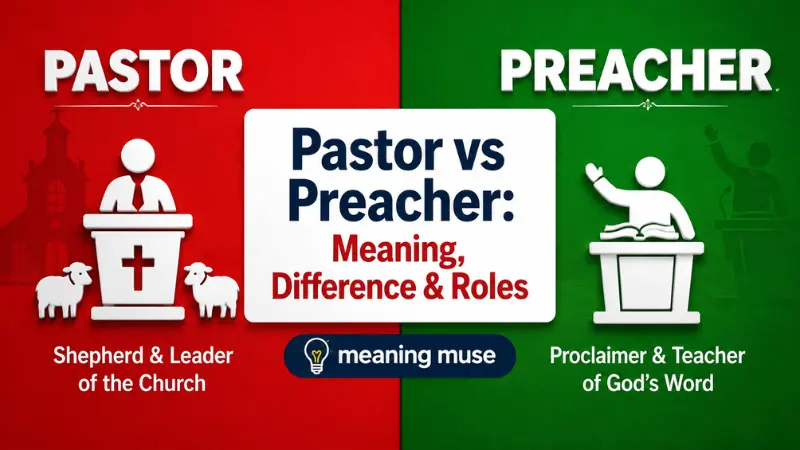
A pastor usually leads or cares for a church congregation. A preacher is someone who preaches, especially by giving sermons or sharing a religious message.
This means a pastor may also be a preacher. However, a person can preach without being the pastor of a church.
Understanding pastor vs preacher becomes much easier when you remember one simple idea: pastor describes a wider church leadership and care role, while preacher focuses mainly on preaching.
Quick Answer
A pastor usually has ongoing responsibility for a church or congregation, while a preacher is anyone whose role is to preach or deliver sermons.
A pastor may:
- preach sermons
- teach
- guide church members
- provide spiritual care
- lead worship
- help oversee church life
A preacher mainly focuses on:
- preaching
- delivering sermons
- sharing a religious message
Easy rule: Pastor = cares for a congregation. Preacher = preaches a message.
One person can be both.
Pastor vs Preacher at a Glance
| Feature | Pastor | Preacher |
|---|---|---|
| Main meaning | Person who leads or provides spiritual care for a congregation | Person who preaches |
| Main focus | Church leadership and care | Delivering sermons or messages |
| Usually connected to one church? | Often | Not always |
| May preach? | Yes, often | Yes |
| May provide pastoral care? | Usually part of the role | Not necessarily |
| Can the same person be both? | Yes | Yes |
| Common phrase | church pastor | guest preacher |
The biggest difference is not which person is more important. The difference is what each word describes.
Pastor points to a broader role.
Preacher points to the act or work of preaching.
What Is a Pastor?
A pastor is a person who provides spiritual leadership or care for a church congregation.
In many Christian churches, a pastor serves a particular local church. The exact responsibilities depend on the denomination, church, and position.
A pastor may help with:
- sermons
- worship services
- Bible teaching
- counseling
- prayer
- church leadership
- visits to church members
- weddings and funerals where permitted
- planning church activities
- supporting people during difficult times
The word therefore describes more than public speaking.
A pastor may spend part of Sunday preaching but much of the rest of the week working with people and helping the congregation.
Pastor Example
Our pastor visited the family after they returned from the hospital.
The word pastor makes sense because the sentence focuses on care for members of a congregation.
Another example:
The pastor gave the Sunday sermon.
Here, the pastor is also acting as a preacher because the pastor is preaching.
What Is a Preacher?
A preacher is a person who preaches.
Preaching usually involves publicly sharing a religious message, often through a sermon.
A preacher might speak:
- during a church service
- at a religious meeting
- at a revival
- at a conference
- outdoors
- as a guest at another church
- through other public ministry settings
The word preacher focuses on what the person is doing rather than whether that person leads a congregation.
Preacher Example
A guest preacher spoke at the church on Sunday.
The speaker may not be the church’s regular pastor. The person is called a preacher because he or she is delivering the sermon.
Another example:
The preacher spoke to the crowd for thirty minutes.
Again, the focus is on preaching.
What Is the Main Difference Between a Pastor and a Preacher?
The main difference is responsibility versus activity.
A pastor normally has a continuing relationship with a congregation.
A preacher is identified mainly by preaching.
Think about it this way:
Pastor = a church role
Preacher = a preaching role or function
A pastor may preach every Sunday and therefore be both a pastor and a preacher.
A guest speaker may preach one Sunday but have no responsibility for leading or caring for that church. That person is a preacher in that setting but not the congregation’s pastor.
Simple Example
Imagine Grace Church has Pastor James.
James:
- teaches members
- gives sermons
- visits families
- helps lead the church
- counsels members
James is a pastor and a preacher.
One Sunday, Grace Church invites Maria to deliver the sermon.
Maria preaches that day, but she does not lead Grace Church or care for its congregation as its regular spiritual leader.
In that setting, Maria is a guest preacher, not the church’s pastor.
Can a Pastor Also Be a Preacher?
Yes.
In fact, many pastors preach regularly.
When a pastor stands before the congregation and delivers a sermon, that person is performing the work of a preacher.
The two labels describe different parts of the person’s work.
Consider:
David is the pastor of the church.
This tells us about David’s position.
Now:
David is preaching this morning.
This tells us what David is doing.
Because preaching is often one part of pastoral ministry, the same person can easily fit both descriptions.
Can a Preacher Be a Pastor?
Yes, but not every preacher is a pastor.
A preacher may become or serve as a pastor if that person has responsibility for a congregation under the rules and traditions of that church.
However, some preachers do not lead local churches.
They may be:
- traveling speakers
- evangelists
- guest preachers
- conference speakers
- lay preachers
- ministry leaders
Their main work may involve preaching rather than overseeing one congregation.
That is why saying every pastor may preach is reasonable in many church settings, but saying every preacher is a pastor would be inaccurate.
Does a Pastor Do More Than Preach?
Usually, yes.
Preaching is only one part of pastoral work in many churches.
A pastor’s responsibilities may include caring for people throughout the week.
For example, a pastor might:
Teach
Pastors often teach Scripture, lead studies, or help church members understand their faith.
Counsel
Church members may speak with a pastor when they face family problems, grief, major decisions, or spiritual questions.
Lead Worship
Pastors commonly take part in planning or leading worship services.
Care for Members
They may visit people who are sick, grieving, elderly, or experiencing difficult situations.
Lead the Congregation
Depending on the church, pastors may work with other leaders on ministry plans, staff, programs, and the direction of the congregation.
Preach
Many pastors regularly prepare and deliver sermons.
So preaching is important, but it does not completely define the pastoral role.
Does a Preacher Have to Lead a Church?
No.
A person can preach without being the regular leader of a congregation.
For example:
The church invited a preacher from another state.
That preacher does not automatically become the church’s pastor simply by delivering a sermon.
A preacher’s connection to a congregation may be temporary.
A pastor’s connection is usually more ongoing.
This is one of the easiest ways to understand the difference.
Pastor vs Preacher in a Church
Consider a normal Sunday service.
The church’s pastor may welcome everyone, lead prayer, give announcements, teach, preach the sermon, and speak with members after the service.
In this case, the pastor performs several roles.
During the sermon, the pastor is also functioning as a preacher.
Now imagine another church invites someone to speak for a special event.
The visitor gives the sermon and then returns home.
That person served as a preacher but did not become the pastor of the congregation.
The difference comes from the person’s relationship with the church.
Pastor vs Preacher vs Minister
Another word that often appears in this discussion is minister.
A minister is a broader religious term that can refer to someone serving in Christian ministry.
Depending on the denomination, a minister may:
- preach
- teach
- lead worship
- provide spiritual care
- serve a church
- work in a specialized ministry
A pastor is often considered a type of minister.
A preacher may also be a minister.
However, churches use these titles differently.
A simple way to understand them is:
- Pastor: focuses on care and leadership of a congregation.
- Preacher: focuses on preaching.
- Minister: broad term for someone serving in religious ministry.
These meanings can overlap.
Pastor vs Preacher vs Priest
Priest is another church title, but it belongs to particular religious traditions and systems.
Priests are especially associated with churches such as:
- Roman Catholic churches
- Eastern Orthodox churches
- Anglican or Episcopal traditions
Their duties may include worship, sacraments, teaching, preaching, pastoral care, and other responsibilities defined by their church.
A priest may therefore preach and provide pastoral care, but pastor, preacher, and priest are not simply interchangeable titles in every Christian tradition.
The safest choice is to use the title that the person’s own church or denomination uses.
Is Pastor a Title?
Yes. Pastor is commonly used as a church title.
Examples:
- Pastor Williams
- Pastor Sarah Johnson
- Senior Pastor
- Lead Pastor
- Associate Pastor
- Youth Pastor
The exact titles differ among churches.
In a sentence, you might write:
Pastor Williams will lead the service.
You can also use pastor as a common noun:
The pastor greeted visitors after church.
Is Preacher a Title?
Preacher can describe a person’s role, occupation, or function, but it is less often used as a formal personal title in everyday American English.
For example:
He is a preacher.
The guest preacher spoke Sunday morning.
Calling someone “Preacher Smith” may occur in certain communities or traditions, but Pastor Smith is more clearly a title when the person serves as a pastor.
Usage depends on the person’s church tradition and personal preference.
Pastor and Preacher Examples
Here are simple sentences showing the difference.
Pastor Examples
Our pastor leads the Sunday service.
The sentence describes the person’s church role.
The pastor visited several church members this week.
The focus is pastoral care.
She became the pastor of a local church.
The word describes her position.
I asked my pastor for guidance.
The person provides spiritual support.
The pastor delivered today’s sermon.
Here, the pastor is also preaching.
Preacher Examples
The preacher gave a short sermon.
The focus is preaching.
A visiting preacher spoke at the evening service.
The speaker does not have to be the church’s pastor.
The preacher addressed a large crowd.
Again, the person’s public message is the focus.
They invited a well-known preacher to the conference.
The role centers on speaking and preaching.
Common Mistakes
Mistake 1: Assuming Pastor and Preacher Always Mean the Same Thing
They can refer to the same person, but the meanings are not identical.
A pastor may preach, but pastoral work normally includes more than preaching.
Mistake 2: Assuming Every Preacher Has a Church
A preacher does not need to be the regular leader of a local congregation.
Guest and traveling preachers are common examples.
Mistake 3: Thinking a Pastor Only Gives Sermons
Pastors may have many responsibilities beyond Sunday preaching.
Their work can include teaching, counseling, care, leadership, and worship.
Mistake 4: Treating Church Titles as Universal
Christian denominations organize leadership differently.
A title used in one church may not have exactly the same meaning or authority in another.
When talking about a specific person, use the title that person’s church actually uses.
How to Remember Pastor vs Preacher
Use this simple memory trick:
Pastor = People
Both begin with P.
Think:
A pastor cares for people.
That reminds you of the pastor’s broader responsibility toward a congregation.
Preacher = Preaches
This one is even easier:
A preacher preaches.
So remember:
Pastor → people and congregation
Preacher → preaching and sermons
If one person does both jobs, that person can be both a pastor and a preacher.
FAQs
What is the difference between a pastor and a preacher?
A pastor usually leads or provides spiritual care for a church congregation. A preacher is someone who preaches or delivers sermons. A pastor can also be a preacher, but not every preacher is a pastor.
Is a pastor higher than a preacher?
Not necessarily. The words describe different functions, not a universal rank. Church leadership structures vary. Pastor usually describes responsibility for a congregation, while preacher describes someone who preaches.
Can anyone be called a preacher?
In general English, a preacher is someone who preaches. However, churches may have their own rules about who is allowed or authorized to preach in worship services.
Does every pastor preach?
Preaching is a common pastoral duty in many Christian churches, but exact duties vary by denomination, church, and position. Some pastors may preach more often than others.
Can a woman be a pastor or preacher?
Christian denominations differ on who may serve in pastoral or preaching roles. Some ordain and appoint women as pastors and preachers, while others restrict certain roles. The title therefore depends on the rules and beliefs of the specific church tradition.
Is a preacher the same as a minister?
Not always. Preacher focuses on preaching, while minister is a broader term for someone who serves in religious ministry. One person may be both.
Is a pastor the same as a priest?
Not exactly. The titles come from different church traditions and structures. Some priests perform pastoral duties, while many Protestant churches use titles such as pastor or minister instead.
Can a guest preacher be called a pastor?
Only if that person actually serves as a pastor somewhere or holds that title. Giving one sermon at a church does not by itself make someone the pastor of that congregation.
Conclusion
The pastor vs preacher difference is simple once you focus on the person’s role.
A pastor usually has an ongoing responsibility to lead, guide, and care for a church congregation.
A preacher is a person who preaches or delivers religious sermons.
The roles often overlap. A pastor can preach and therefore be both a pastor and a preacher. But a guest or traveling preacher may deliver sermons without being the pastor of that church.
Remember the easiest rule:
Pastor = congregation and care.
Preacher = preaching and sermons.
That distinction will help you use both words clearly and correctly in American English.