Metonymy and synecdoche are two figures of speech that replace one word with another. That similarity makes them easy to confuse. However, the connection between the two words is different.
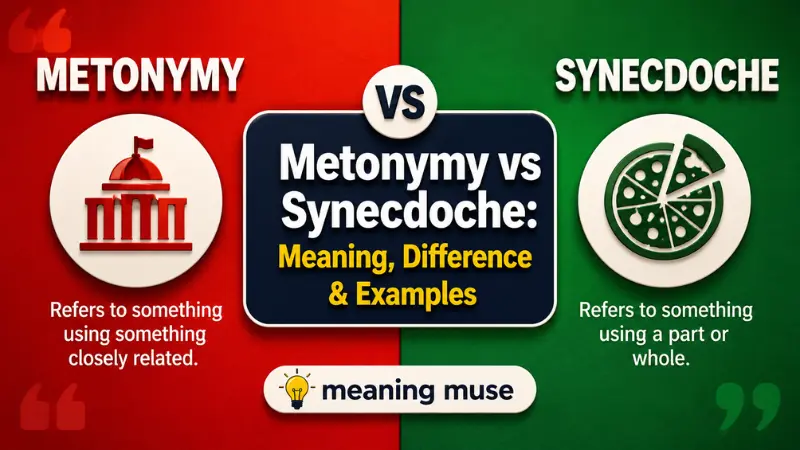
In metonymy vs synecdoche, metonymy uses something closely associated with an idea, person, or object. Synecdoche uses an actual part to represent a whole, or sometimes a whole to represent a part.
For example, “the White House” can stand for the U.S. president or administration. That is metonymy because the building is associated with the people who work there. By contrast, “wheels” can mean a car. That is synecdoche because wheels are a real part of a car.
Quick Answer
Metonymy uses association, while synecdoche uses a part-whole relationship. “The White House announced a new policy” uses metonymy because the White House is associated with the U.S. administration. “I bought new wheels” uses synecdoche because wheels are part of a car.
Easy rule:
Related to it = metonymy.
Part of it = synecdoche.
Metonymy vs Synecdoche at a Glance
| Feature | Metonymy | Synecdoche |
|---|---|---|
| Basic idea | One related thing represents another | A part represents a whole, or a whole represents a part |
| Connection | Association | Part-whole relationship |
| Example | “The White House” for the administration | “Wheels” for a car |
| Another example | “Hollywood” for the movie industry | “Hands” for workers |
| Main question | Is it closely connected? | Is it actually part of the thing? |
| Type | Figure of speech | Figure of speech, often treated as a type of metonymy |
The easiest way to remember the difference is to look at the relationship between the words.
What Is Metonymy?
Metonymy is a figure of speech in which the name of one thing is replaced by the name of something closely connected with it.
The replacement does not need to be a physical part of the original thing. It only needs a strong connection that readers or listeners can understand.
For example:
“The White House issued a statement.”
A building cannot speak or issue a statement. Here, “the White House” means the president, administration, or people working there.
The White House is not a body part or physical piece of those people. It is simply closely associated with them. That makes the expression metonymy. Merriam-Webster uses this same association-based distinction when separating metonymy from synecdoche.
Other common examples include:
- “Hollywood” for the American movie industry
- “The crown” for a king, queen, or monarchy
- “The press” for journalists and news organizations
- “Wall Street” for the U.S. financial industry
- “The bench” for judges or the judiciary
Metonymy makes language shorter and more vivid. Instead of naming a large group every time, a speaker can use one familiar thing connected with that group.
What Is Synecdoche?
Synecdoche is a figure of speech in which a part represents the whole, or the whole represents a part.
For example:
“She bought a new set of wheels.”
The word “wheels” means a car. Wheels are an actual part of a car, so this is synecdoche.
Another common example is:
“All hands on deck.”
The word “hands” refers to the people or crew members who are needed. A hand is an actual part of a person, so a part is being used to represent the whole person.
Merriam-Webster identifies this part-for-whole relationship as the main feature of synecdoche.
Synecdoche can also move in the other direction. A whole can sometimes stand for only part of that whole.
The key idea stays the same: there must be a real part-to-whole or whole-to-part relationship.
What Is the Main Difference Between Metonymy and Synecdoche?
The main difference is the type of connection.
Metonymy = association.
Synecdoche = part and whole.
Compare these two examples:
“The White House responded.”
The White House is connected with the U.S. administration, but it is not a physical part of the president or staff. This is metonymy.
“Nice wheels!”
Wheels are part of a vehicle. Here, the part represents the entire car. This is synecdoche.
Scribbr uses a similar car example to explain the distinction: a related idea such as “ride” works through association, while “wheels” works through a literal part-whole relationship.
The One-Question Test
Ask:
“Is this word actually part of the thing it represents?”
If yes, it is probably synecdoche.
If no, ask:
“Is it strongly associated with the thing?”
If yes, it is probably metonymy.
That simple test works for many everyday examples.
Metonymy Examples With Simple Explanations
Here are common examples of metonymy and why they fit.
“The White House released a statement.”
Meaning: The U.S. president or administration released a statement.
Why: The White House is associated with the administration. It is not a part of the people themselves.
“Hollywood loves sequels.”
Meaning: The American movie industry often produces sequels.
Why: Hollywood is a place strongly associated with movies and entertainment.
“Wall Street reacted to the news.”
Meaning: Investors or the financial industry reacted.
Why: Wall Street is closely linked with U.S. finance.
“The crown made a decision.”
Meaning: A monarch or monarchy made a decision.
Why: A crown is strongly associated with royal power.
“The press asked more questions.”
Meaning: Journalists asked more questions.
Why: “The press” is a traditional name associated with journalism and news reporting.
“The bench rejected the argument.”
Meaning: The judge or judges rejected the argument.
Why: Judges sit on a bench, so the bench becomes associated with the judiciary.
These examples show why metonymy is common in news, politics, business, literature, and daily speech.
Synecdoche Examples With Simple Explanations
Synecdoche becomes easier when you look for an actual part-whole connection.
“All hands on deck.”
Meaning: Everyone is needed.
Why: Hands are parts of people. The body part represents the whole person.
“She bought some new wheels.”
Meaning: She bought a vehicle.
Why: Wheels are part of a car.
“We have several mouths to feed.”
Meaning: Several people depend on us for food.
Why: A mouth is part of a person.
“The ranch has 200 head of cattle.”
Meaning: The ranch has 200 cattle.
Why: A head is one part of an animal but represents the whole animal.
“They hired more hands for the busy season.”
Meaning: They hired more workers.
Why: “Hands” represents complete workers.
“Several sails appeared on the horizon.”
Meaning: Several sailing ships appeared.
Why: A sail is part of a sailing vessel but can represent the whole vessel.
In each case, the replacement word is not simply associated with the thing. It is a real component of it.
Is Synecdoche a Type of Metonymy?
Often, yes.
Many dictionaries and language references treat synecdoche as a special or narrower form of metonymy. Both devices replace one expression with another connected expression. Synecdoche is more specific because its connection involves parts and wholes. Dictionary.com describes synecdoche as a type of metonymy, while Merriam-Webster explains the two by separating part-whole substitution from broader association.
A simple way to think about the relationship is:
Metonymy is the larger idea.
Synecdoche is the special part-whole case.
However, in school assignments and literary analysis, teachers often discuss the two as separate terms because the distinction helps students identify how each expression works.
So if you need to label an example, use the most specific term available.
If a part stands for a whole, calling it synecdoche is usually the clearer answer.
Why Are Metonymy and Synecdoche So Easy to Confuse?
They are easy to confuse because both involve substitution.
A speaker says one thing but expects the listener to understand another.
For example:
“The White House” does not literally mean a building in every sentence.
“Wheels” does not always mean only round objects attached to a car.
Context tells us what the speaker really means.
The difference lies in why the substitute works.
With metonymy, the connection comes from association.
With synecdoche, the connection comes from a part-whole relationship.
Another reason for confusion is that some references place synecdoche under the larger category of metonymy. This means the two ideas are related rather than completely separate.
A Simple Trick to Remember the Difference
Use this memory trick:
Synecdoche = Section
Think of the S in synecdoche as section.
A section is a part of something larger.
So:
Synecdoche → section → part and whole
Examples:
- wheels → car
- hands → workers
- mouths → people
Metonymy = Meaning Through a Match
Think of metonymy as using a matching association.
The two things belong together in our minds.
Examples:
- White House → U.S. administration
- Hollywood → movie industry
- crown → monarchy
- Wall Street → financial industry
The memory trick is not a formal definition, but it can help students remember which label to choose.
Metonymy vs Synecdoche vs Metaphor
Metonymy and synecdoche can also be confused with metaphor, but metaphor works differently.
A metaphor compares or identifies one thing with another because they share a quality.
Example:
“Time is a thief.”
Time is not literally a thief. The sentence compares time with a thief because both can take things away from us.
Metonymy does not depend on that kind of comparison.
Example:
“The White House responded.”
The White House is not being compared with the administration. It stands for the administration because the two are closely associated.
Synecdoche also does not depend on comparison.
Example:
“We need more hands.”
Hands represent workers because hands are parts of people.
The quick difference is:
- Metaphor: one thing is described as another because of a shared quality.
- Metonymy: one thing stands for another because they are associated.
- Synecdoche: a part stands for a whole, or a whole stands for a part.
Common Mistakes When Identifying Them
Mistake 1: Calling every substitution synecdoche
Not every replacement word is a synecdoche.
Ask whether a real part-whole relationship exists.
“The White House” is connected with the president, but the building is not part of the president. Therefore, metonymy is the better label.
Mistake 2: Calling every body-part example synecdoche
A body part does not automatically make an expression synecdoche.
Consider the famous expression “lend me your ears.”
It may look like synecdoche because ears are parts of people. However, Merriam-Webster classifies the expression as metonymy when “ears” stands for attention, because ears are associated with listening and attention rather than being a literal part of attention.
This shows why you should examine the intended meaning, not only the word itself.
Mistake 3: Looking only at the replacement word
The same word can work differently in different sentences.
Always ask what the word represents in that specific context.
Mistake 4: Treating metonymy as metaphor
Metonymy uses a real-world association.
Metaphor uses an implied comparison.
Those are different relationships.
How Metonymy and Synecdoche Work in Everyday English
These figures of speech are not limited to poetry or old books. Americans use them in ordinary speech, news reports, sports, politics, and business.
A headline might say:
“Wall Street falls after weak earnings.”
Readers understand that a street did not physically fall. “Wall Street” represents financial markets or investors.
Someone talking about a car may say:
“Check out my new wheels.”
The speaker means the whole vehicle, not only its tires and rims.
A manager might say:
“We need more hands today.”
The manager means more workers.
These expressions make communication shorter. They can also make sentences more lively and memorable.
Writers use them because readers can often understand a large idea through one familiar word.
How to Identify Metonymy or Synecdoche in a Sentence
Follow these four steps.
1. Find the unusual replacement word.
Ask what the word literally means.
2. Find what it represents.
What does the speaker really mean?
3. Check for a part-whole relationship.
Is the replacement word a real part of the thing it represents, or is the whole being used for a part?
If yes, choose synecdoche.
4. Check for association.
If the two things are connected but do not have a true part-whole relationship, choose metonymy.
For example:
“The Oval Office is considering the proposal.”
Literal word: Oval Office
Intended meaning: the president or administration
Relationship: association
Answer: Metonymy
Now compare:
“We need every pair of hands available.”
Literal word: hands
Intended meaning: people or workers
Relationship: part to whole
Answer: Synecdoche
FAQs
What is the difference between metonymy and synecdoche?
Metonymy uses the name of something closely associated with another thing. Synecdoche uses a part to represent a whole or a whole to represent a part. “The White House” for the U.S. administration is metonymy, while “wheels” for a car is synecdoche.
Is synecdoche a form of metonymy?
Yes, synecdoche is often treated as a specific form of metonymy. Metonymy covers broader associations, while synecdoche focuses on part-whole relationships.
Is “the White House” metonymy or synecdoche?
It is generally classified as metonymy when it means the president or administration. The building is closely associated with those people, but it is not a literal part of them.
Is “all hands on deck” metonymy or synecdoche?
It is a classic example of synecdoche. “Hands” are parts of people, and the word is used to represent the whole crew or group of workers.
Is “wheels” for a car metonymy or synecdoche?
“Wheels” for a car is synecdoche because wheels are actual parts of a vehicle. The part represents the whole.
Can synecdoche use the whole for a part?
Yes. Although part-for-whole examples are very common, synecdoche can also use a whole to refer to only part of that whole.
How can I remember metonymy vs synecdoche?
Remember: association means metonymy; part-whole means synecdoche. Ask whether the replacement is literally part of what it represents. If it is, synecdoche is usually the better answer.
Conclusion
The difference between metonymy vs synecdoche becomes simple once you focus on the relationship between the words.
Metonymy uses association. “The White House” can represent the U.S. administration because the two are closely connected.
Synecdoche uses a part-whole connection. “Wheels” can represent a car because wheels are actual parts of a vehicle.
When you are unsure, use one quick test: Is it part of the thing, or only related to the thing?
Part or whole means synecdoche. A close association means metonymy.
That rule will help you identify both figures of speech in literature, school assignments, news writing, and everyday English.