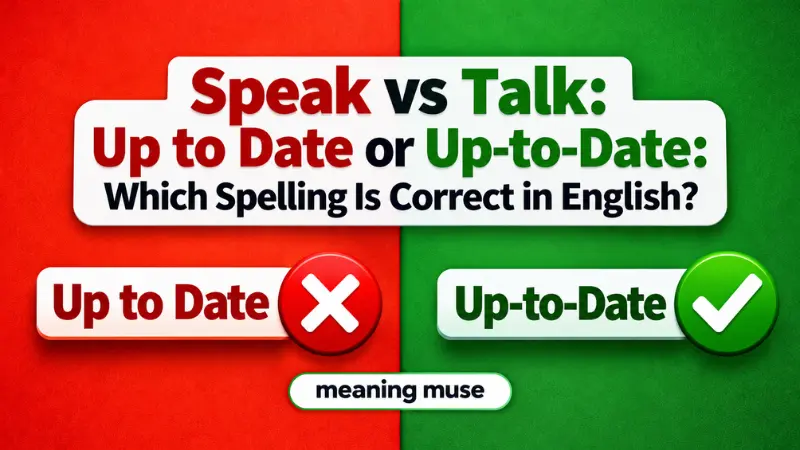
up to date or up-to-date is a common English spelling question. Both forms are correct, but they are normally used in different positions in a sentence.
- We need an up-to-date report.
- She found an up-to-date textbook.
- The company needs up-to-date information.
Use up to date when the phrase comes after a verb or works as a phrase rather than a compound modifier:
- The report is up to date.
- Please keep the records up to date.
- I want to stay up to date on the latest news.
The meaning stays essentially the same: current, modern, or containing the latest information.
Quick Answer
Both “up to date” and “up-to-date” are correct.
The easiest rule is:
Before a noun → up-to-date
We need an up-to-date schedule.
After a linking verb or in an open phrase → up to date
The schedule is up to date.
This is a practical US-English writing rule. Some dictionaries list the expression under the hyphenated form, while style guidance explains when the hyphens should be used.
Why People Confuse Them
The confusion happens because the two forms have the same basic meaning.
A reader may see:
an up-to-date website
and:
The website is up to date.
Both sentences describe a website that has current information. The only visible difference is the hyphen.
The hyphens help show that up-to-date works together as one compound modifier before the noun website.
When the phrase follows a verb, the words normally remain open:
The website is up to date.
That small difference causes many spelling questions.
Key Differences At A Glance
| Context | Best Choice | Why |
|---|---|---|
| Before a noun | up-to-date | It works as a compound modifier |
| After a linking verb | up to date | The phrase is not directly modifying a following noun |
| With “keep” | up to date | Example: “Keep the records up to date.” |
| With “stay” | up to date | Example: “Stay up to date on the news.” |
| Describing current information before a noun | up-to-date | Example: “up-to-date information” |
Quick memory rule:
- up-to-date report
- the report is up to date
Are They the Same Word?
Yes. They express the same basic idea of being current, modern, or informed about the latest information.
The difference is mainly the way the expression is used in a sentence.
When it directly modifies a noun, the hyphenated form is commonly used:
an up-to-date computer
When it follows a linking verb, the open form is normally used:
The computer is up to date.
The pronunciation is essentially the same, so this is not a pronunciation-based spelling choice.
US vs UK Preference
There is no simple US-versus-UK split in which one country uses only one spelling.
Major dictionaries used for both American and British English recognize the expression in both forms.
The more useful distinction is sentence position and style.
In US writing, up-to-date is especially common before a noun:
an up-to-date policy
After a linking verb, up to date is a strong standard choice:
The policy is up to date.
Individual publishers may have their own hyphenation preferences, so house style can affect some borderline examples.
Which Spelling Should You Use?
Use up-to-date when it comes directly before the noun it describes.
We need an up-to-date list of members.
She read an up-to-date article about the subject.
Use up to date when the expression follows a verb or appears in a phrase such as keep up to date or stay up to date.
Our records are up to date.
Please keep your information up to date.
I try to stay up to date with current events.
If you follow this pattern, you will get most everyday uses right.
When One Spelling Looks Wrong
Sometimes the wrong-looking form is actually caused by its position.
For example:
an up to date report
In this sentence, the phrase comes directly before report, so up-to-date report is the clearer standard form.
Now consider:
The report is up to date.
Here, the open form is appropriate.
Another common mistake is removing the spaces completely:
uptodate
This is not the normal standard spelling of the expression.
Also avoid random hyphen placement such as:
up-to date
or:
up to-date
The normal forms are up to date and up-to-date.
Common Mistakes (and Quick Fixes)
Mistake: The information is up-to-date.
Better in standard style: The information is up to date.
Mistake: We need up to date information.
Better: We need up-to-date information.
Mistake: Please keep the website up-to-date.
Better in a conservative style: Please keep the website up to date.
Mistake: We need an uptodate report.
Better: We need an up-to-date report.
The key is to look at what comes after the expression.
Everyday Examples
Here are natural examples for US English:
- We need an up-to-date contact list.
- The contact list is up to date.
- Please send me an up-to-date copy of the schedule.
- I try to stay up to date on local news.
- Make sure your records are up to date.
- The company published an up-to-date safety guide.
- Her information is up to date.
- We need up-to-date pricing information.
- The software is up to date.
- He wants an up-to-date version of the report.
Notice the pattern: the hyphenated form commonly appears before the noun, while the open form commonly appears after a verb or in an open phrase.
Dictionary-Style Word Details
Verb
- up to date: Not normally used as a standalone verb. It appears in phrases such as “bring something up to date” and “keep something up to date.”
- up-to-date: Not a verb. It functions primarily as a compound adjective.
Do not use up-to-date as a replacement for the verb update.
Noun
- up to date: Not normally used as a noun in ordinary US English.
- up-to-date: Not normally used as a noun either.
For the noun referring to new information, use update:
I received an update this morning.
That is a different word from the spelling pair discussed here.
Synonyms
Because both forms share the same basic meaning, their closest plain alternatives are also shared.
Depending on context, useful alternatives include:
- current
- modern
- recent
- updated
- latest
- informed
For example:
We need current information.
This can often replace:
We need up-to-date information.
The best synonym depends on the sentence.
Example Sentences
- up-to-date: We need an up-to-date map.
- up to date: Our map is up to date.
- up-to-date: She gave us an up-to-date report.
- up to date: She kept us up to date on the project.
- up-to-date: The website contains up-to-date information.
- up to date: The website is up to date.
Word History
The expression has been used in English for a long time to describe something current or modern.
The important point for today’s spelling is not a change in meaning. The hyphenation reflects how the phrase functions in a sentence. Modern dictionaries and style references continue to show both up to date and up-to-date in appropriate contexts.
Phrases Containing
Common phrases include:
- up-to-date information
- up-to-date records
- up-to-date equipment
- up-to-date report
- keep up to date
- stay up to date
- bring someone up to date
- bring something up to date
- be up to date
- get up to date
These phrases all relate to the idea of being current or having the latest information.
FAQs
Is “up to date” correct?
Yes. Up to date is correct and is commonly used after a verb or in phrases such as “keep up to date.”
Is “up-to-date” also correct?
Yes. Up-to-date is correct, especially when it directly modifies a noun, as in “up-to-date information.”
Should I write “up to date information” or “up-to-date information”?
Use up-to-date information when the phrase directly comes before the noun information.
Is “the report is up to date” correct?
Yes. The report is up to date is a standard construction. Because the phrase follows the linking verb is, it is normally written without hyphens.
Is “up-to-date” one word?
No. It is written with three parts joined by hyphens: up-to-date. The open form is written as three separate words: up to date.
Do Americans use “up to date” or “up-to-date”?
Americans use both forms. The choice usually depends on how the expression functions in the sentence rather than on a strict US-versus-UK spelling difference.
Is “uptodate” correct?
No. Uptodate is not the standard spelling for this expression. Use either up to date or up-to-date, depending on the sentence.
Conclusion
Up to date and up-to-date are both correct forms of the same expression.
Use up-to-date when it directly modifies a noun:
an up-to-date report
Use up to date when it follows a linking verb or appears in an open phrase:
The report is up to date.
For everyday US English, remember this simple pattern: before a noun, use up-to-date; in an open phrase, use up