Should you write infeasible or unfeasible?
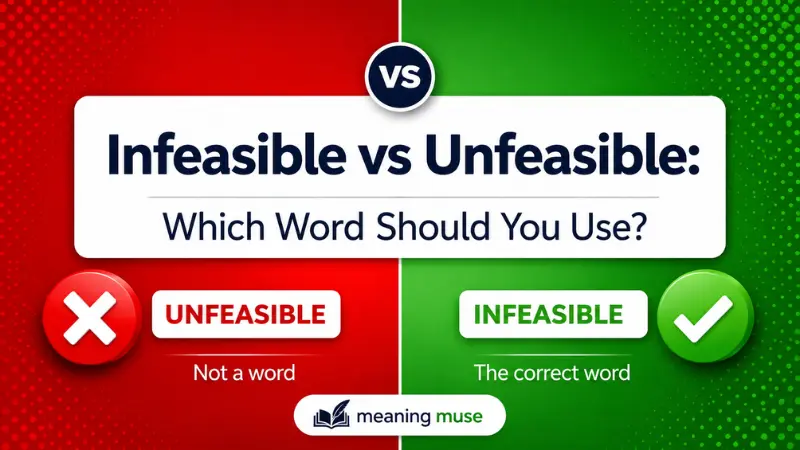
Both words are correct. They also have nearly the same meaning. Each describes something that cannot be done, achieved, or carried out in a practical way.
However, the two words are not always used with the same frequency. Infeasible is often the more natural choice in American English, especially in business, engineering, planning, law, and technical writing. Unfeasible is also accepted, but many American readers see it less often.
The safest choice for a US audience is usually infeasible.
This guide explains how the two words compare, when each one works, and how to avoid common mistakes.
Quick Answer
Infeasible and unfeasible are both correct. They mean that something cannot be done or achieved in a practical way.
For most American writing, infeasible is the better default choice.
The construction plan was financially infeasible.
You may also write:
The construction plan was financially unfeasible.
Both sentences are correct. The first one may sound more familiar in formal American writing.
Here is the simplest rule:
Use infeasible for most US writing. Use unfeasible only when it matches your natural style or an established publication style.
Why People Confuse Them
The words are easy to confuse because they use two different negative prefixes.
- in- can mean “not”
- un- can also mean “not”
Both prefixes attach to feasible, which means possible and practical to do.
This gives us:
- feasible → infeasible
- feasible → unfeasible
English often allows only one common negative form. For example, we say incorrect, not usually uncorrect. Because of that pattern, some people assume that either infeasible or unfeasible must be wrong.
In this case, both forms exist.
The confusion grows because infeasible appears more often in many American professional settings. A reader may know that form well but rarely see unfeasible. That does not make unfeasible incorrect.
Key Differences At A Glance
| Context | Best Choice | Why |
|---|---|---|
| General American English | infeasible | More familiar and widely used |
| Business report | infeasible | Sounds natural and professional |
| Engineering or technical writing | infeasible | Common in discussions of limits and requirements |
| Formal project planning | infeasible | Clear and established |
| Everyday explanation | either word | Both carry the same basic meaning |
| Existing house style uses unfeasible | unfeasible | Consistency may matter more than preference |
| Quoted material | original spelling | Keep the writer’s exact wording |
A compact comparison:
- Infeasible: correct, common, and often preferred in American professional writing
- Unfeasible: correct and understandable, but less familiar to some American readers
- Meaning: nearly the same
- Part of speech: adjective
- Regional rule: no strict American-versus-British split
- Best US default: infeasible
Are They the Same Word?
Infeasible and unfeasible are separate word forms built from the same base word. They perform the same job and usually express the same idea.
Both mean:
- not practical
- not workable
- not possible under the given conditions
- unable to be carried out successfully
For example:
The deadline is infeasible with our current staff.
The deadline is unfeasible with our current staff.
Both versions say that the deadline cannot be met under the present conditions.
There is no reliable difference in strength between the two words. One does not always mean “completely impossible” while the other means “merely difficult.”
Context gives the word its strength.
A plan may be infeasible because it costs too much. Another plan may be infeasible because it breaks a law, needs unavailable equipment, or cannot be completed in time.
Pronunciation
The prefixes sound different:
- infeasible: in-FEE-zuh-bul
- unfeasible: un-FEE-zuh-bul
The main stress falls on FEE in both words.
The difference in pronunciation does not change the meaning.
US vs UK Preference
Both words appear in American and British English. There is no strict rule that says one belongs only to the United States and the other belongs only to the United Kingdom.
Still, infeasible is a strong choice for American readers. It is common in writing about:
- budgets
- contracts
- engineering
- construction
- software
- public policy
- business plans
- transportation
- medical care
- project limits
You may see sentences such as:
The proposed schedule is technically infeasible.
Expanding the building would be economically infeasible.
The request became infeasible after the budget was cut.
Unfeasible also appears in modern writing:
The project was unfeasible without more land.
Daily delivery would be unfeasible during winter.
These examples are correct. However, when you need one consistent form for a US website, report, or school paper, infeasible is usually the safer choice.
Which Spelling Should You Use?
Choose infeasible in most American English writing.
It is clear, standard, and familiar in both general and professional contexts.
Use it when discussing a plan that cannot work:
The plan is infeasible because it requires more money than we have.
Use it when a goal cannot be reached under present conditions:
Finishing the bridge in two weeks is infeasible.
Use it when technical limits block an action:
The update is infeasible on older devices.
Use it when rules or costs prevent a choice:
Moving the office this year would be legally and financially infeasible.
You may use unfeasible when:
- it sounds more natural in your sentence
- your employer or publication already uses it
- you are keeping the wording of a quotation
- you want to match nearby text for consistency
Do not switch between the two forms without a reason. Pick one and use it consistently throughout the same document.
For a USA-focused article, infeasible should normally be your main form.
When One Spelling Looks Wrong
Neither spelling is wrong by itself. Still, one may look out of place in certain situations.
When unfeasible may look unusual
Some American readers are more familiar with infeasible. In a technical report, contract, or formal proposal, unfeasible may catch their attention even though it is correct.
For example:
The system is unfeasible under the current design.
This sentence is valid. However, this version may sound smoother in American technical writing:
The system is infeasible under the current design.
When infeasible may clash with house style
A company may use unfeasible in its older reports, templates, and policy documents. Changing only one sentence to infeasible may create inconsistency.
In that case, matching the established style can be reasonable.
When both words are too formal
In simple conversation, not possible, not practical, or will not work may sound clearer.
Formal:
The travel schedule is infeasible.
Simple:
The travel schedule will not work.
The simpler form may be better when writing for young readers or a general audience.
Common Mistakes (and Quick Fixes)
Mistake 1: Calling unfeasible incorrect
Incorrect claim:
Unfeasible is not a real word.
Better explanation:
Unfeasible is correct, but infeasible is often more common in American writing.
Quick fix: Treat both as accepted words, then explain the preference.
Mistake 2: Giving the words different meanings
Incorrect claim:
Infeasible means impossible, while unfeasible means difficult.
There is no dependable rule like this. Both words can describe something that cannot be done under the stated conditions.
Quick fix: Let the sentence explain why the idea will not work.
The plan is infeasible because it exceeds the budget.
Mistake 3: Confusing infeasible with inefficient
Infeasible means that something cannot be done successfully.
Inefficient means that something works but wastes time, money, energy, or materials.
Compare:
Building there is infeasible because the ground is unsafe.
The old heating system is inefficient because it wastes energy.
Mistake 4: Confusing infeasible with impossible
Impossible is often stronger and broader.
Infeasible commonly means that something cannot be done in a practical way under current limits.
A same-day redesign is infeasible with our small team.
The redesign may become possible with more time or more workers. It is not impossible forever.
Mistake 5: Using a noun where an adjective is needed
Incorrect:
The plan has become infeasibility.
Correct:
The plan has become infeasible.
The noun form is infeasibility:
The report explains the project’s infeasibility.
Mistake 6: Switching forms within one document
Weak style:
The first option is infeasible, and the second option is unfeasible.
Unless you intend a special contrast, choose one form:
The first and second options are infeasible.
Consistency makes the writing easier to read.
Everyday Examples
Here are natural examples for American English:
The family decided that buying a second car was financially infeasible.
The teacher said the original deadline was infeasible for such a large project.
Building a road through that area may be environmentally infeasible.
The company rejected the idea because it was too costly and unfeasible.
Daily meetings became infeasible once the team began working in different time zones.
The small kitchen made the original restaurant plan unfeasible.
Repairing the old machine was technically infeasible.
The trip became infeasible after several flights were canceled.
It would be infeasible to finish all the repairs before Monday.
The city found the proposal unfeasible because there was not enough space.
Running the program on that device is infeasible.
The plan looked simple at first, but the final cost made it unfeasible.
Correct comparison examples
The design is infeasible with the current materials.
The design is unfeasible with the current materials.
Both are correct.
For most US professional writing, the first version is the stronger default.
Infeasible vs impossible
Completing the work today is infeasible because only two workers are available.
This does not mean the work can never be completed. It means today’s plan will not work.
It is impossible for a person to be in two places at the same time.
Impossible states a basic limit, not just a practical problem.
Infeasible vs impractical
The plan is infeasible because the law does not allow it.
The plan is impractical because it would cost more than it would save.
In daily writing, these meanings may overlap. However, impractical can suggest that an idea is unwise or not useful, even when it could technically be done.
Dictionary-Style Word Details
Verb
Infeasible: Not used as a verb. It is an adjective.
Unfeasible: Not used as a verb. It is also an adjective.
Use a verb phrase such as:
- cannot be done
- will not work
- cannot be completed
- cannot succeed
Example:
The team cannot complete the project within that budget.
Noun
Infeasible: The related noun is infeasibility.
The study confirmed the plan’s financial infeasibility.
Unfeasible: The related noun unfeasibility exists, but infeasibility is often the more natural choice in American formal writing.
The report described the unfeasibility of the original schedule.
Both noun forms refer to the state of not being feasible.
Synonyms
Useful synonyms and close alternatives include:
- impracticable
- unworkable
- impractical
- impossible
- unattainable
- unachievable
- not viable
- not workable
- not possible
These words are not always exact replacements.
Unworkable often describes a plan or system that cannot operate well.
The payment system was unworkable.
Impractical may describe something that can be done but is not sensible or useful.
Driving six hours for a short meeting would be impractical.
Impossible can express a stronger or more complete limit.
It is impossible to finish before the work begins.
Clear opposites include:
- feasible
- workable
- practical
- possible
- achievable
- viable
Example Sentences
Infeasible:
The budget makes the project infeasible.
The requested delivery date is infeasible.
Engineers found the design technically infeasible.
Hiring ten new workers is financially infeasible this month.
Unfeasible:
The narrow lot made the building plan unfeasible.
The team called the schedule unfeasible.
Long daily trips would be unfeasible for most workers.
The proposal became unfeasible after the rules changed.
Both sets of sentences are grammatically correct.
Word History
Both forms have been part of English for centuries. They combine the word feasible with a negative prefix.
- in- + feasible = infeasible
- un- + feasible = unfeasible
In both cases, the prefix means “not.”
Their long history explains why both forms remain accepted. English did not remove one form simply because another form expressed the same idea.
Modern writers should not invent a historical or regional difference that the words do not reliably have.
The practical distinction today is based more on preference and familiarity than on meaning.
Phrases Containing
Common combinations with infeasible include:
- technically infeasible
- financially infeasible
- economically infeasible
- legally infeasible
- practically infeasible
- commercially infeasible
- operationally infeasible
- infeasible plan
- infeasible proposal
- infeasible schedule
- infeasible design
- infeasible solution
Common combinations with unfeasible include:
- financially unfeasible
- economically unfeasible
- technically unfeasible
- unfeasible plan
- unfeasible project
- unfeasible proposal
- unfeasible schedule
- unfeasible option
Examples:
The team rejected the technically infeasible design.
The high cost made the plan economically unfeasible.
The original deadline was infeasible for a team of three.
The lack of space made the project unfeasible.
Conclusion
Both infeasible and unfeasible are correct adjectives. They share the same basic meaning: not possible or practical to do under the given conditions.
For most American writing, choose infeasible. It is familiar, clear, and common in professional contexts. Unfeasible remains a valid alternative, but it may sound less familiar to some US readers.
Remember this rule:
Both are correct, but infeasible is the safer default for American English.
FAQs
Is it infeasible or unfeasible?
Both words are correct. They mean that something cannot be done or achieved in a practical way. Infeasible is often the better default for American English.
Is unfeasible a real word?
Yes. Unfeasible is a recognized English adjective. It is not a spelling mistake, though many American writers use infeasible more often.
Do infeasible and unfeasible mean the same thing?
Yes, in most contexts. Both can describe a plan, idea, goal, or action that cannot work under the present conditions.
Which word is more common in American English?
Infeasible is generally the more familiar choice in American professional and technical writing. Unfeasible is still correct and understandable.
Is infeasible stronger than unfeasible?
No consistent rule makes one stronger than the other. The sentence and context show how serious the problem is.
What is the opposite of infeasible?
The clearest opposite is feasible. Other possible opposites include workable, practical, possible, achievable, and viable.
Is infeasible the same as impossible?
Not always. Infeasible often means that something cannot be done under current practical limits. Impossible may mean it cannot happen under any conditions.
What is the noun form of infeasible?
The noun form is infeasibility.
The study proved the project’s infeasibility.
Can I use unfeasible in formal writing?
Yes. It is a valid word. However, infeasible may sound more familiar and natural to many American readers.
Which form should I use throughout one article?
Choose one form and remain consistent. For a US audience, infeasible is usually the best main form.