
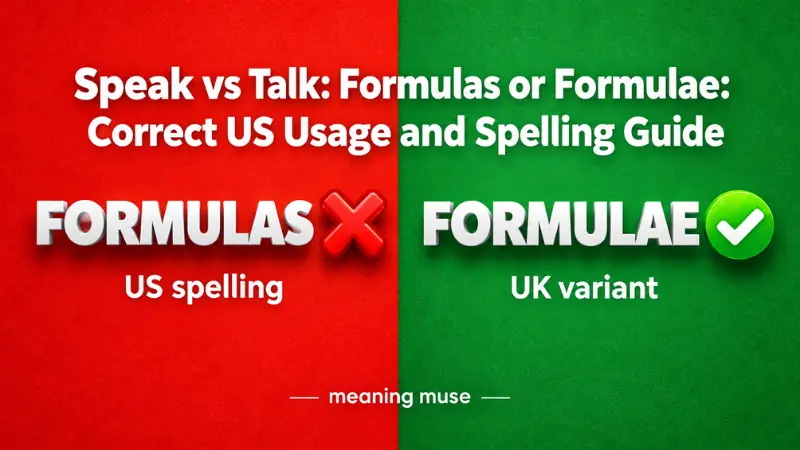
If you are unsure whether to write formulas or formulae, the good news is that both are correct plural forms of formula.
For a general US audience, formulas is usually the clearest and most natural choice. Formulae is also an accepted form and is especially associated with scientific language.
The two forms have the same basic meaning. The main difference is usage and style, not meaning.
Quick Answer
Formulas and formulae are both correct plurals of formula.
For general American English, formulas is the best default. Formulae is also standard and can be appropriate, particularly in scientific or traditional technical writing.
| Context | Best Choice | Why |
|---|---|---|
| General US English | formulas | Natural and widely familiar |
| US school writing | formulas | Clear and conventional |
| General professional writing | formulas | Straightforward modern plural |
| Scientific writing | formulas or formulae | Both are accepted; field style may guide the choice |
| Traditional scientific style | formulae | This form has a strong scientific association |
| Publication with a house style | Follow the style | Consistency matters most |
So, if you are writing ordinary American English and have no special style requirement, choose formulas.
Why People Confuse Them
The confusion comes from the fact that formulae looks different from the regular English plural formulas.
The singular is:
one formula
The two standard plurals are:
two formulas
two formulae
Both refer to more than one formula.
The ending -ae is associated with the traditional Latin plural, while -s follows a regular English plural pattern. Modern English accepts both forms.
This means you do not need to treat formulae as a different word. It is another plural form of the same noun.
Key Differences At A Glance
The clearest distinction is not correctness. Both forms are correct. The more useful distinction is general usage versus traditional or scientific preference.
| Feature | formulas | formulae |
|---|---|---|
| Singular | formula | formula |
| Number | Plural | Plural |
| Meaning | Same | Same |
| General US writing | Strong default | Accepted |
| Scientific writing | Accepted | Especially associated with scientific language |
| Pronunciation | Same plural word | Same plural word |
| Grammar | Correct | Correct |
Neither spelling creates a different mathematical, scientific, or general meaning.
Are They the Same Word?
Yes. Formulas and formulae are two plural forms of the same noun, formula.
A formula can be a mathematical expression, a scientific representation, a method, a recipe, or another established set form. The plural simply refers to more than one such formula.
For example:
The students learned three formulas for calculating interest.
The same sentence can be written:
The students learned three formulae for calculating interest.
The spelling changes, but the basic meaning does not.
Pronunciation is also not a major source of confusion. Both plural forms are commonly pronounced with a final sound similar to “lee,” although actual pronunciation can vary by accent.
US vs UK Preference
American and British English both recognize formulas and formulae.
For US readers, formulas is generally the easier general-purpose choice. Formulae remains acceptable, especially in scientific or academic contexts.
British English also uses both forms. Therefore, it is too simple to say that formulas is exclusively American and formulae is exclusively British.
A more accurate guide is:
- US general writing: formulas is usually the natural default.
- US scientific writing: formulas and formulae can both be used.
- UK general writing: both forms occur.
- Scientific language: formulae has a particularly established presence.
If your publication has a house style, follow it consistently.
Which Spelling Should You Use?
For most general US writing, use formulas.
It works naturally in sentences about mathematics, business, science, cooking, methods, and other topics.
Examples include:
- mathematical formulas
- chemical formulas
- pricing formulas
- formulas for success
- spreadsheet formulas
- formulas for calculating interest
Use formulae when that form fits the established style of your field, publication, or audience.
The important point is that choosing formulas does not make scientific writing less correct. Likewise, choosing formulae does not make your writing wrong in American English.
When One Spelling Looks Wrong
Some readers may think formulae looks overly formal or unfamiliar. That does not make it incorrect.
Other readers may expect formulae in scientific writing and consider formulas less traditional. That is a matter of style and familiarity, not a basic grammar error.
For example:
The students compared several formulas.
This is correct.
The researchers compared several formulae.
This is also correct.
The best choice depends on the writing context and the style you are following.
Common Mistakes (and Quick Fixes)
1. Treating formulae as incorrect
Mistake: “Formulae is wrong.”
Fix: Formulae is an accepted plural of formula.
2. Treating formulas as incorrect in science
Mistake: “Scientists must always write formulae.”
Fix: Formulas is also an accepted plural. A scientific publication may prefer one form, but that is a style choice.
3. Assuming they have different meanings
Mistake: Thinking formulas and formulae describe different things.
Fix: They are two plural forms of the same noun and have the same basic meaning.
4. Mixing forms without a reason
Using formulas in one section and formulae in another can make a document look inconsistent.
Fix: Pick the form that fits your audience or house style and use it consistently.
Everyday Examples
Mathematics
The students used several formulas to solve the equations.
Science
The textbook includes chemical formulas for common compounds.
Business
The company tested several pricing formulas.
Spreadsheets
The worksheet contains formulas that calculate each total.
Methods
The researchers compared several formulas for estimating the result.
General writing
There are no simple formulas for solving every problem.
In each example, formulae could also be used as the plural where appropriate:
The students used several formulae to solve the equations.
The core meaning remains unchanged.
Dictionary-Style Word Details
Verb
- formulas: Not a verb. It is the plural noun form of formula.
- formulae: Not a verb. It is another plural noun form of formula.
Neither term should be treated as a verb.
Noun
- formulas: Plural noun meaning more than one formula.
- formulae: Plural noun meaning more than one formula.
A formula can refer to a mathematical or scientific expression, a method, a recipe, or another established form. Both plural spellings can cover these uses.
Synonyms
Because formulas and formulae have the same basic meaning, their closest plain alternatives are also the same.
Depending on the context, useful alternatives may include:
- equations for some mathematical contexts
- methods for a process or approach
- recipes for a preparation
- rules for an established mathematical or practical principle
- expressions for some mathematical contexts
These are not exact replacements in every sentence. The best alternative depends on what formula means in that sentence.
Example Sentences
- formulas: The students memorized several formulas.
- formulae: The students memorized several formulae.
- formulas: The spreadsheet contains formulas for each total.
- formulae: The researchers compared several formulae.
- formulas: The book explains common formulas for calculating interest.
- formulae: The book explains common formulae for calculating interest.
The plural form changes, but the underlying idea remains the same.
Word History
Formulae preserves the traditional Latin plural pattern of formula, while formulas uses the regular English plural ending.
Modern English accepts both forms. The practical difference today is mainly one of usage, context, and style rather than correctness.
Phrases Containing
Common expressions include:
- mathematical formulas
- chemical formulas
- scientific formulas
- pricing formulas
- spreadsheet formulas
- formulas for success
- mathematical formulae
- chemical formulae
- scientific formulae
Both plural forms can occur in these expressions. The choice should follow the style and audience of the writing.
FAQs
Is formulas or formulae correct?
Both formulas and formulae are correct plural forms of formula. Neither is automatically wrong.
Is formulas better for American English?
For general American English, formulas is usually the clearest default. It is familiar and works naturally in everyday, educational, and professional writing.
Is formulae only British English?
No. Formulae is also used in American English. It has a particularly strong association with scientific language, but it is not restricted to British English.
Is formulae more correct in scientific writing?
No. Formulae has a strong traditional scientific association, but formulas is also correct. A publication or field may have its own preferred style.
Do formulas and formulae have different meanings?
No. They are two plural forms of the same noun and have the same basic meanings.
Can I use formulas in a formal paper?
Yes. Formulas is acceptable in formal writing, including academic and scientific contexts. If your institution or publication has a specific style preference, follow that preference.
Which should I use for a US website?
Use formulas as the default for a broad US audience. Choose formulae when a specific publication style or technical convention makes it preferable.
Conclusion
Formulas and formulae are both correct plural forms of formula.
For general American English, formulas is the best default. Formulae is also accepted and has a particularly strong presence in scientific language.
The two forms do not have different basic meanings. The main difference is usage and style.
If you are writing for a broad US audience, choose formulas and use it consistently.